Chapter 6
The Secret of White Rice
Enshrined by a Bowl of Rice
Chapter 6: The Secret of White Rice
The Elder Council Tower had no guards in the dead of night.
The tower itself was the guard. Every third step in the stone staircase held an embedded detection crystal — an unauthorized footfall would trigger the entire tower’s lockdown array. Chen Xifan counted as he followed the expressionless attendant upward. Seventeen floors. Two hundred and thirty-six steps.
He had not come willingly. Half an hour ago he’d been lying on the stone bed in Fire Hall, staring at the ceiling. Three knocks on the door. He opened it to find a gray-robed attendant handing him a slip of paper, four characters on it:
Top floor. Now.
He recognized the handwriting. The old man who’d produced a notebook from his sleeve in that underground chamber — Can Sui.
His first instinct was to pretend he hadn’t seen it. But on the back of the slip, a second line, smaller: I saw what you did behind the mountain.
So he came.
The chamber at the top was more crowded than the room he’d woken up in before. The circular stone room could hold thirty people standing; the bookshelves were the problem. Ancient texts and scrolls packed every surface so dense that the room felt airless. The yellowed page edges looked liable to crumble like dried moth wings; the wormholes along the wooden axles outnumbered any intentional carving. Warm yellow energy crystals stained the whole space the color of amber, and the air carried the layered smell of old paper and old ink. The walls were thick enough to block out the wind entirely. It was so quiet he could hear his own breathing. He was beginning to suspect Can Sui actually lived here.
Can Sui sat across the hexagonal stone table, notebook open on the surface, three stacks of handwritten manuscripts arranged beside it.
No pleasantries.
“Your energy signature,” Can Sui began, his tone suggesting he was reading from an abstract, “is an exact match for what the ancient records call the saturated state of White Jade Soul Essence. Saturated meaning — every meridian in your body, every magical node, is filled. All of it. White Jade Soul Essence.”
His eyes were fixed on Chen Xifan with an expression that had nothing threatening in it — instead, the brightness of a pet-shop owner who has just spotted an albino Bengal tiger cub.
“Where did you get that much White Jade Soul Essence?”
Chen Xifan stayed at the doorway. He spent two seconds calculating — what information could be released, and what had to stay locked. The white light in the assessment arena had been witnessed by hundreds of people. Can Sui had also seen the incident behind the mountain. The cost of continuing to play dumb had overtaken the risk of partial disclosure.
But full disclosure was a different matter. Announcing he’d crossed worlds was a death sentence.
He chose a middle path.
“I come from somewhere very far away.” He walked to the stone table and sat down, his voice as flat as a weather report. “Far enough that you’ve never heard of it. Where I come from, people eat White Jade Soul Essence every day.”
Can Sui’s pen stopped.
“Every day?”
“Every day.”
Can Sui’s gaze swept him from head to toe, swift and practiced — the look of someone flipping through a medical chart they’ve already memorized. His lips moved without sound. Chen Xifan could read the motion: he was mentally cross-referencing the saturated state markers against the meridian distribution pattern produced by long-term consumption.
Verification complete. Can Sui set down his pen and leaned forward slightly. “How many times a day?”
“Three meals. Sometimes a late-night snack.”
“Three meals.” The way Can Sui repeated the words, his pitch climbed half a step. His fingers began tapping the table, rapid and rhythmic. “For how long?”
“From birth to now. Twenty-five years.”
The tapping stopped. Can Sui’s mouth opened. Closed. Opened again. His expression underwent a small private earthquake — a scholar who had spent forty years cataloging a rare resource had just been told that resource was tap water somewhere else.
“Twenty-five years — three meals a day —” He stood up; the chair legs dragged across the stone floor with a sharp, grating shriek. “You feed White Jade Soul Essence to infants?”
“To the elderly as well. To the sick. To the perfectly healthy. To anyone who’s hungry.” Chen Xifan paused. “Also to cats.”
Can Sui gripped the table’s edge. His breathing went ragged for a few seconds — but he was a seventy-year-old scholar, and even his unraveling had structure. He drew a long breath, lowered himself back into his chair, and turned to the first page of the manuscript stack.
“Look at this.”
The manuscript was a hand-copied reproduction of ancient murals from a ruin site. Chen Xifan leaned in. The image showed a vast golden field — dense spike-shaped plants covering the ground from edge to edge, their heads heavy with full-swollen grain, all swept to the same curve by an invisible wind.
A rice paddy.
His stomach clenched.
Can Sui turned the page. This one showed a catastrophe. The sky fracturing. The golden field withering under some unseen force — crumbling, scattering, disappearing. In the final frame, only scattered golden fragments remained on scorched earth.
“The ruins of the ancient civilization — every record of White Jade Soul Essence hints that it once existed everywhere.” Can Sui’s voice dropped low, as though afraid the walls might hear. “After a great catastrophe it nearly vanished. The survivors preserved only fragments, and no one has ever been able to make it grow again.”
He turned to the third page. Four symbols on it — a flame, a dewdrop, a grain ear, a granary.
“Fire-kindler. Dew-gatherer. Grain-bearer. Granary-keeper.” Can Sui tapped each symbol with his fingertip. “The naming of this rank system was not arbitrary. Fire-kindler — burning the fields before planting season. Dew-gatherer — the morning dew during the seedling stage. Grain-bearer — the plant producing its ears, filling its grain. Granary-keeper — the harvest returned to store.”
He looked up at Chen Xifan. “This is a complete agricultural cycle. The people of the ancient civilization used it to name magical ranks because they understood what White Jade Soul Essence actually was. It was never a gift from heaven. It was a crop.”
Chen Xifan stared at the four symbols. Something in his head — a line stretching from the night he crossed worlds three months ago all the way to this moment — went suddenly taut.
“So your entire magical civilization,” he said, his voice carrying a strange calm, “was built on top of an agricultural catastrophe.”
Can Sui did not answer. His silence was the answer.
He turned back to the notebook and flipped to the final pages. “This document has one problem. The last page — I’ve been copying it for forty years and I cannot parse it. Every individual character I recognize. Together they form no grammatical structure found in any known text.” He pushed the notebook across the table. The last page was covered in dense ancient script, margins crowded with Can Sui’s annotations and question marks. “Each word is legible. The combination is not.”
Chen Xifan scanned it briefly. He didn’t recognize the ancient characters, but he noticed a small hand-drawn grain stalk on the margin, with the annotation: key? — followed by three question marks.
He didn’t press further. Some things weren’t the right time yet.
Can Sui closed the notebook and stood. The chair legs produced a brief, sharp screech against the stone floor.
“Take me there.”
He had walked the path behind the mountain once before. This time he had company.
The old man set a solid pace. A Granary-keeper of seventy had physical reserves far beyond ordinary people; his footsteps were steady in a way that had no business belonging to his age. Moonlight filtered through the branches and scattered broken silver across both of them, and the insects around them rose and fell in waves, the forest’s slow breathing.
About fifteen minutes later, they reached the hollow. The smooth depression left behind where the boulder had been was still there, and beside it the natural wetland caught the moonlight, glinting in dark silver. The spring ran thin and quiet; the air smelled of wet mud and rotting leaves.
Chen Xifan crouched down and fished the small plastic bag from the hidden fold in his waistband.
Thirty grams. Poolshang brown rice. Trial sample packet.
He tore the seal and tipped a small portion into his palm — maybe five grams, the rest resealed and tucked back into the fold. The pale yellow grains lay in his hand, surface rough, the bran layer still intact, each grain ending in a tiny raised point at its base.
The germ.
Can Sui’s gaze fell to his open palm.
The old man went rigid — the rigidity traveling upward from the soles of his feet, climbing each vertebra in turn. His hand extended halfway and stopped, fingertips hovering just short of the grains.
“Is that —” His voice caught in his throat; when it came out it rasped like sandpaper pulled across wood. “Complete White Jade Soul Essence seeds? With living cores?”
“Brown rice,” Chen Xifan said. “Unhusked grain with the germ retained. This variety can germinate. It can be planted.”
Can Sui’s knees hit the soft mud at the wetland’s edge — his legs had given out. Seventy years of academic career concentrated into one gesture: an old man kneeling in mud, staring at a few grains in another person’s palm, the way you stare at a relic that was supposed to be lost forever.
“The kind you eat every day,” Can Sui said, his voice shaking, each word forced through clenched teeth, “what state is it in?”
“White rice. The bran and germ removed. Only the starch core left.” Chen Xifan tapped one of the brown rice grains with a fingernail. “Once the germ is gone, it can’t germinate. So —”
“So all your fragments are dead.” Can Sui finished the thought, eyes blazing. “A thousand years of it — every piece of White Jade Soul Essence anyone has ever obtained has been dead. Dead seeds stripped of their living cores. Nobody knew to preserve this —” His finger nearly touched the germ. ”— to bring it back to life.”
Chen Xifan watched Can Sui kneeling in the mud, and a realization settled over him.
That thirty-gram sample pack in his pocket just became the blueprints for a nuclear power plant.
“I’m not an agricultural expert,” he said, looking at the grains in his palm once more, his tone practical. “I spent a few growing seasons with my grandfather when I was a kid. I know the basics — soaking seeds to sprout them, raising seedlings, transplanting, how to manage the water. Precision work is beyond my range.”
Can Sui climbed out of the mud, his knees dark with wet soil. He didn’t notice. His brain had already switched back to scholar mode — the collapse was the collapse, the problem was still a problem that needed solving.
“Magical enhancement,” he said, speaking faster than usual, his sentences shorter, all social courtesy stripped away. “Accelerated growth — a low-intensity version of the time-compression technique would work. Water temperature control — thermostat inscription arrays, third-level sufficient. Pests —”
“You have magic for pest control?”
“Yes.”
“That’s better conditions than my grandfather ever had.”
Can Sui’s eyes flickered. He studied Chen Xifan for two seconds, then asked a question with no connection to agriculture at all: “Do you understand what this means?”
The tone was academic euphoria — the expression of a collector watching a priceless artifact arrive at his doorstep, already mentally rearranging the display case.
Chen Xifan understood the look. He let it pass without comment.
“It means we have one more problem.” He crouched back at the edge of the wetland and pressed his finger into the soft mud, making small holes. “Getting from unhusked grain to edible white rice requires milling and dehusking. Back home, machines handle that. Here —”
Can Sui thought for a moment, the excitement between his wrinkles briefly suppressed by practical consideration: “Precision Essence Grinding technique. It can pulverize any mineral to the molecular level. Applied to grain in theory —”
“You want to use mineral-grinding technology to mill rice?” Chen Xifan glanced at him. “Killing a fly with a cannon. But it works.” He paused, and his expression shifted into something unexpectedly serious. “More importantly — do you have soy sauce?”
Can Sui blinked. “What?”
“Soy sauce. Condiment. Dark liquid, salty. I can’t eat plain white rice without soy sauce.”
“You’re —” Can Sui’s brow knotted hard. “You’re worried about condiments?”
“Food is the foundation of everything.” Chen Xifan kept a straight face. “Civilizations can collapse, but a person still has to eat first.”
Can Sui stared at him for three full seconds, then let out a sound — quiet, through the nose — the particular sound of someone ambushed by absurdity. The person holding the power to remake the world was currently preoccupied with dipping sauce.
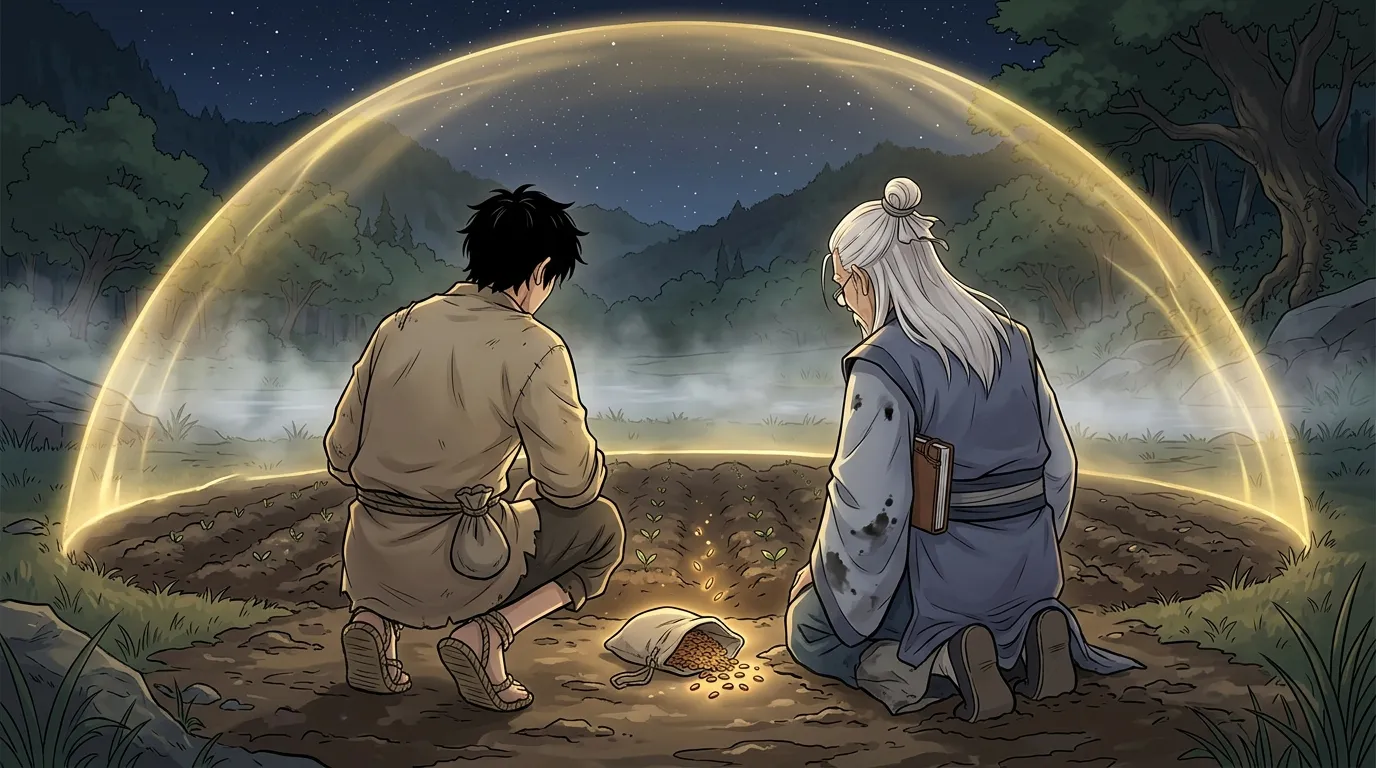
Chen Xifan scattered the grains from his palm into the small holes he’d made, then pressed the wet mud back over each one with his fingertips. Unhurried, steady, the practiced ease of someone who’d learned this from soil rather than from books, and who found nothing magical about it.
His fingers felt it through the mud — a faint warmth. The ambient trace of gentle power in the earth.
“The fields in Miaoli didn’t have this,” he said to no one in particular. “More nutrients can’t hurt.”
Can Sui stood to one side, hands clasped behind his back, watching Chen Xifan place the seeds one by one. In the moonlight his expression was layered — the scholar’s elation, the old man’s trembling, and beneath both, something harder to name. It belonged to the act of discovery, not to a person. Forty years of searching had been confirmed in this moment, and the confirmation was crouched in the mud in front of him, planting with its hands.
When the last seed was in, Can Sui raised both palms toward each other. Golden light spread from his fingertips. A boundary array expanded outward from his hands — thin as a soap bubble, settling over the entire wetland. The light pulsed once, then faded, leaving behind a barely perceptible resistance in the air.
“Concealment array.” Can Sui lowered his hands, his voice recovering some scholarly restraint. “Granary-keeper level. Everything that happens within this area will appear, from the outside, as an ordinary thicket.”
Chen Xifan stood and brushed the mud from his knees.
He looked once at the small depressions where he’d pressed the seeds in. The mud had settled flat, indistinguishable from the rest of the ground. Nothing to see.
But he knew what was buried there.
The abacus was pushed to the side.
The calculation was too large for it.
In the narrow underground room beneath the administration building, pale green magical lamps turned everything the color of deep water. Three walls lined with filing cabinets, each drawer sealed shut. On the long table, three abacuses arranged in ascending size — a small boxwood one, a medium ebony one, and a large rosewood one. The Ledger normally used only the smallest.
Today he had gone through all three. Then pushed the largest one aside as well.
He remembered the energy readings from assessment day with perfect clarity. The value recorded by the monitoring inscription array at the moment the Guidance Stone shattered — he had recalculated it seven times, and the conclusion was the same each time. The quantity of White Jade Soul Essence within that young man’s body was approximately equal to the entire kingdom’s five-hundred-year accumulated reserves.
Five hundred years.
He sat in the pale green light, expression unchanged — but his abacus beads betrayed him. Four beads per second, normally, steady as a metronome. Now: seven per second. And an occasional miss.
He pushed all three abacuses to the table’s edge and pulled a palm-sized black stone tablet from the lowest drawer. Its surface was smooth as a mirror, edges carved with encryption runes — the Covert Bureau’s proprietary communication stone.
The Ledger traced a symbol across the tablet’s surface. The stone lit briefly, and a voice came through, blurred by distance.
“Report complete.” The Ledger’s voice was dry and brief, indistinguishable in register from the voice he used to present the academy’s administrative budget. “The target’s energy readings have exceeded all projected upper limits.”
A beat of silence. Then he added:
“Found. Much larger than anticipated.”
The stone’s light went out. The Ledger returned it to the drawer, locked it, tucked the key into his sleeve. Then he pulled the smallest abacus back in front of him and began calculating next month’s academy food budget.
Four beads per second. Steady.
Li Feng knelt on the stone floor of the practice chamber.
The posture was for communication, not cultivation.
The private practice chamber in Grain Hall had a full-height black mirror embedded in one wall, its surface so smooth it held no reflection. This was no ordinary mirror — the Li family’s exclusive communication medium, activated only by bloodline. Li Feng bit his thumb; a drop fell to the surface and was absorbed, and from the center the black mirror rippled outward in silver-grey waves.
A projection formed in the ripples. Semi-transparent, silver-grey, torso only — commanding features, a jaw line cut as though with a blade, eyes colder than the stone floor.
The Li family patriarch. His father.
“I’ve read the report from the assessment.” The patriarch’s voice carried the distortion of long-distance transmission, each word rising from a deep well. “The white light — confirmed White Jade Soul Essence saturated state?”
“Highly probable.” Li Feng’s phrasing was precise and clean, no spare words. “Cast without hand seals or incantation. Power output far beyond the Grain-bearer ceiling. Specific rank indeterminate.”
“Origin unknown.”
“Yes.”
The patriarch was quiet for several seconds. His expression in the silver-grey light revealed nothing, but the angle of his mouth had shifted fractionally downward.
“The unknown-origin boy — find out what he is.”
“Yes.”
“If his power is truly uncontrollable —” The patriarch’s tone held no inflection whatsoever, as if discussing tomorrow’s weather. “Remove him.”
The temperature in the practice chamber seemed to drop a degree.
Li Feng knelt on the cold stone floor, the sharpness of it biting through his knees. His back was straight, his posture perfect — the standard a Li family heir had been trained into since the age of three.
“Remove?” he asked. Not questioning the order — his tone was entirely level. But he asked.
“Power unconstrained by order is a threat to all.” The patriarch’s voice grew more distant in the distortion. “You understand this.”
Li Feng was silent for three seconds.
“Understood.”
The projection dissolved. The black mirror returned to its absolute smooth stillness.
Li Feng did not stand immediately. He remained where he was, hands still folded over his knees. The only sound in the practice chamber was the low-frequency hum from the inscription arrays in the stone walls — a sound he normally never noticed, now pressing like a needle at his temple.
Ability determines rank. Rank may not be transgressed.
This was the order he had believed in for as long as he could remember. His faith held that the strongest stand at the summit — rank as the skeleton of order, the world without it mere chaos. The nobles were incidental. The hierarchy was the point.
But his father had said remove him, not put him in his correct position.
If that person was truly the strongest — removing the strongest to maintain order: was that protecting order, or breaking it?
He stood. The motion was slow; as his knees left the stone floor, a quiet sound. His expression, in the empty chamber where no one could see it, belonged to a man taking the first careful measurement of where he stood.
The practice chamber door closed. The inscription arrays continued their low hum. On the black mirror’s surface, the trace of Li Feng’s blood faded slowly away, as though nothing had happened here at all.
Behind the mountain, the spring still ran.
Chen Xifan lay on the stone bed in Fire Hall, staring at the ceiling. Zao Xin had already fallen asleep in the next room, his breathing even as a countdown timer.
His mind would not stop.
Before today, his plan had been stay low, stay hidden, don’t be noticed. After today, that plan was officially dead. The white light had been seen by the whole field. Can Sui knew. The seeds were in the ground.
He had shifted from someone with unusual power to someone who controls the seeds.
The gap between those two things was significant. Someone with unusual power was, at worst, a bomb. One explosion, then done. Someone with seeds was a factory that never stopped running.
He turned over. Moonlight squeezed through the fist-sized window and lay across the back of his hand. On the inside of his wrist, something was faintly visible — a pattern rising beneath the skin — but his sleeve covered most of it, and he hadn’t noticed.
He’d read Can Sui’s expression clearly enough. But there was something else — a feeling he couldn’t name, like someone watching his back. He pressed his face into the pillow and held the unease down.
He couldn’t manage all of it.
When would the first batch of seedlings be ready to harvest?