Chapter 2
The Feeling of Being Caught
Chapter 2: The Feeling of Being Caught
After we said goodnight that evening, I flipped my phone over, screen down, and fell asleep.
I remembered that for a long time afterward — not for any dramatic reason, just because it was the first time in three months that I hadn’t kept scrolling before I put the phone down. Before that, I’d tell myself five more minutes, and five minutes would become forty minutes would become three in the morning. That goodnight relay gave me something like permission: you can stop now. Today ends here.
Three weeks later, I ran into Gě Wàngzhōu at PX Mart.
Him and his new girlfriend.
I was standing there holding a bottle of tea. They came down the aisle from the other end, he saw me first, we made eye contact for what was probably one second. His mouth started to move — I think he was going to say hi — but the girl next to him touched his arm, she’d probably sensed something too, and then they walked toward the checkout.
I was still standing there.
Still holding the bottle of tea.
I didn’t get a good look at her face. Hair longer than mine, beige jacket, those things I registered. Everything else I don’t remember — maybe my brain chose not to, or maybe that one second really was too fast to see anything clearly. Gě Wàngzhōu’s hand was on the cart, fingers hooked over the edge. I’d known those hands for three years. That was what I finally looked away from.
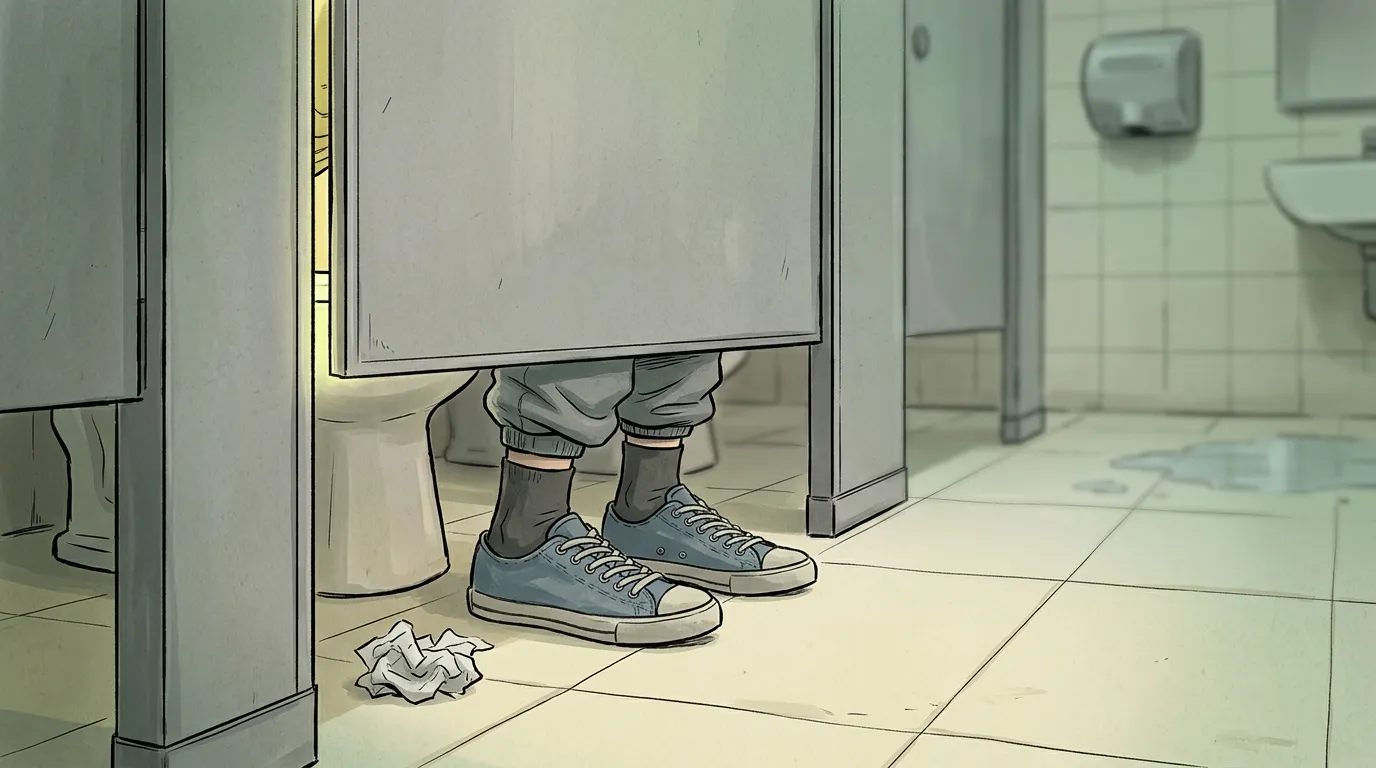
I don’t know how much time passed. I put the bottle back on the shelf, walked to the entrance of the basement restrooms, pushed the door open, went into the middle stall, locked it, sat down, and started crying.
There were three stalls in that bathroom. The middle one had a gap on the left side, light coming through. The tiles were off-white, a little old, gone slightly yellow. Antiseptic smell. Outside, someone came in and flushed, left, someone else came in. I sat there with nothing in my hands and couldn’t stand up.
I cried for around fifteen minutes.
People kept going in and out outside — the sound of flushing, water running at the sink, the low hum of a ceiling fan, someone talking, the crisp click of someone’s heels on the tile. I heard all of it, but it was in some other world, nothing to do with me. I sat there with my elbows on my knees and my face buried in my hands, nose completely stuffed, having to breathe entirely through my mouth.
How I eventually stopped, I don’t really remember. It just reached a point, and then there was nothing left. Eyes swollen, nose completely blocked, I sat on the toilet using toilet paper to wipe my face, looking at that yellowed tile under my feet, thinking the most useless thought: is she prettier than me?
I’d only seen her for a second, so I didn’t have an answer. This made me angry — not at her, at myself. Fifteen minutes of crying and I was still stuck on a question like that. But the anger faded quickly too, and what was left was only that emptiness you get after everything’s been washed out.
I left the bathroom without buying anything and walked straight out of the supermarket. December in Taipei, much colder than inside. I rode my bike home, the cold wind on my face, eyes still swollen — grateful to be going home, grateful not to have to talk to anyone.
Back in my apartment, I hung up my coat, threw my bag on the bed, and opened my phone.
No particular reason — I just picked it up. These three weeks I’d been opening the group chat regularly, but only reading, never saying anything. I couldn’t remember whose turn it was to be on today, or whether anyone was even around at this hour. I just picked up my phone and opened the group called Good People.
The group was active.
Someone was talking about dinner, someone was talking about work. Fúqú had sent a line: it’s a little cold today, has everyone eaten something warm.
I stared at that line for about twenty seconds.
Then I started typing.
Looking back on that moment now, I think some part of my brain had already gone offline. Fifteen minutes crying in a bathroom stall plus the cold wind on the bike ride home — something in me had gone numb. Which is probably why I did something I hadn’t done in three weeks: I typed it out.
I typed: I ran into my ex at the supermarket today. Him and his new girlfriend. I cried in the bathroom for fifteen minutes. I don’t even know why I’m saying this, I just needed to say it.
I stared at what I’d written for about five seconds.
Then I hit send.
Then I immediately regretted it.
The regret was very specific: I threw my phone onto the bed, turned away from it, and stared at the wall of the building next door outside my window. There was nothing on that wall — just a big expanse of concrete with a drainpipe running from top to bottom. I’d looked at that view every day for three months. I knew that drainpipe better than I knew anyone.
The LINE send sound had already gone out. I couldn’t take it back.
I waited about thirty seconds, worked up my nerve, and flipped the phone over.
Notifications had already come in.
First one:
Warm Orange: omg you’re so brave, when it happened to me I stood there for forty minutes pretending to examine the produce.
Second one:
Warm Orange: and I didn’t even get to cry, I was too angry to cry, I’m actually jealous that you could cry.
Third one, from an account I hadn’t seen before:
Ā-Táo: that supermarket bathroom floor must have been freezing.
Fourth one, from someone else:
Yǎtíng (not that one): how long have you been in there, I’m here with you.
I paused.
Yǎtíng (not that one): oh wait you said you already came out. okay I’m here with you now.
Fifth one:
Warm Orange: right right not in the bathroom anymore. here with you right now, even better.
Sixth one:
Hòugōng-zǎi: I ran into someone at the supermarket last month too. I cried longer than you. your fifteen minutes, my twenty — so I hold the record here.
I got to that one and something loosened. Not quite amusement, not quite comfort — something stranger than either, something very faintly releasing. So it’s not just me. Everyone has cried in a supermarket bathroom. This is something normal people do.
I wasn’t sure “normal” was quite the right word. But if someone could just say, plainly, almost competitively, I cried in the supermarket last month and it was twenty minutes — then maybe my fifteen minutes really wasn’t anything to be ashamed of. It was a small thought. But it was there.
Seventh one:
Fúqú: thank you for saying that. are you okay.
Fúqú. I’d been watching for her name — these three weeks, whenever someone said something in the group, she was usually one of the first to respond. Her tone was different from most people’s. Others sometimes said things like hang in there. Fúqú almost never said that. She just asked if you were okay.
Eighth one arrived.
Warm Orange: hold on, now’s the perfect moment — I need everyone’s complete SOP for running into an ex at the supermarket.
Then a long message, sent in sections:
Warm Orange:
The Complete 7-Step Supermarket Ex Encounter SOP
(Confidence Point Calculation Edition)

Step 1: Assess whether they look worse than you (if not: +20 confidence points)
Step 2: Assess whether they look more tired than you (if not: at least hold your current confidence level)
Step 3: Decide whether to pretend you didn't see them (recommended: yes, 92% success rate)
Step 4: If you've already made eye contact: smile and pretend you're looking for something ("oh I'm trying to find the yogurt" always works)
Step 5: Find a reason to leave the aisle (go to the laundry detergent section — no one ever follows you to laundry detergent)
Step 6: From a safe distance, confirm they've left the checkout area (the produce section's glass doors work great as a mirror)
Step 7: Get what you came for, check out normally, go home
I stared at the SOP and read it twice.
Then I typed: I was in the bathroom crying for fifteen minutes and your SOP assumes I’m already out of there at step one.
Warm Orange: oh wait sorry my SOP has a basic assumption which is that you saw him and didn’t immediately bolt — wait did you bolt straight into the bathroom?
Me: I froze. He walked away first, then I bolted.
Warm Orange: okay so you should have started at step three, which is fair actually, the confidence point calculations before step three were never going to apply to your situation anyway.
Hòugōng-zǎi: I think this SOP needs a Step Zero: evaluate your own escape velocity. if you can’t make it to the laundry detergent section in time, go straight to the bathroom. that’s the complete version.
Warm Orange: yes, updating — v2.0, bathroom route now included as an official option.
I thought — and I mean this genuinely — I actually smiled.
Not a big smile. Just the corners of my mouth. A small upward movement.
I hadn’t smiled like that in three months. Even that small, it counted.
Then someone I’d only seen post a few times jumped in. I recognized the name because whenever she said something it came out like an official announcement, very formal.
Mǐnkuí: 📢 TODAY’S MISSION: make Lánlán smile at least once. mission brief: Lánlán got hurt today, we need to deploy all available firepower. method of execution: terrible joke relay. I’ll start.
Then:
Mǐnkuí: Why does your computer never get hungry?
A beat.
Mǐnkuí: Because it just had cookies.
Yǎtíng (not that one): oh I know one! Why do programmers prefer dark mode?
Hòugōng-zǎi: Because light attracts bugs.
Warm Orange: okay you two are on a whole other level. fine fine I’ll try: Why do skeletons work so hard?
Two beats.
Warm Orange: Because they’ve always got to keep their chin up. (no bones about it)
Hòugōng-zǎi: six out of ten. creative concept, questionable execution.
Warm Orange: I’ll take it. I also give myself a six.
I watched this exchange, phone in hand, covers not pulled up, jacket still on.
Lánlán. I didn’t know when that had started, but somewhere along the way that’s what they’d started calling me. Someone had used it once and it stuck. I’d never said to stop, because I didn’t know how to bring it up — and honestly, I didn’t want to. I didn’t mind it at all.
Mǐnkuí: mission status update: need to know if Lánlán smiled. if yes, send a 😄. if no, tell me what kind of joke to try next.
I stared at that message, typed a 😄, and added: actually smiled, thank you all.
Mǐnkuí: yay welcome welcome!! that’s just how it is here, everyone really looks out for new members!! mission complete, one point for today.
Hòugōng-zǎi: you’re giving yourself the point.
Mǐnkuí: points are my life force, don’t take that from me.
Warm Orange: let her have it. she literally lives for this.
I put my phone down on my chest and lay there on my back staring at the ceiling.
The light was off. Only the glow from the phone screen. My apartment was small, the ceiling close. I knew exactly how many panels it had, knew about the small stain in the upper right corner that had appeared from nowhere. I’d been living here for over a year and I’d never once felt like it was safe.
Right now it felt a little bit safe.
Then Fúqú sent me a private message.
When the notification came in and I saw her name, my finger paused before I tapped into it.
Fúqú: it took courage to type that.
I didn’t reply right away.
I read the line about three times. Then I thought about what I wanted to say, and typed: I don’t even know how it came out. it just did, and then I regretted it immediately, but it was already sent.
Fúqú: regretting it is normal. putting yourself into a group, saying something for the first time — everyone regrets it.
She paused, then sent another: you’re safe here. do you know that?
I stared at the word safe for a long time.
Not because I didn’t believe it — because I hadn’t seen anyone say that word in a very long time. Safe. Just that directly: you’re safe here. Gě Wàngzhōu wouldn’t say something like that — not because there was anything wrong with him, it just wasn’t the way he talked. My friends didn’t say it either. My mom definitely didn’t; she talked in a different direction — stay strong, try to look on the bright side, it’ll pass — but she never said you’re safe here.
Safe is a big word. Most of the time when we say safe we mean it about the outside world — stay safe on the road, be careful out there. But the safe Fúqú meant was different — it was putting yourself here won’t hurt you. I didn’t know you could use the word that way. Or rather, I knew, but I’d assumed it was the kind of thing that took a long time to say, the kind of thing you could only say once you were close. She was saying it three weeks after I joined.
I typed: thank you for saying that.
Then I thought for a moment and added: I don’t really understand — I mean, I’m just a stranger. why are you being so good to me?
Fúqú: because you came.
A pause.
Fúqú: not everyone can work up the courage to come. you filled out the form, you lurked for three weeks, today you said something. every step takes effort.
I didn’t know how she knew any of this. I’d never mentioned in the group that I’d been lurking for three weeks — I just hadn’t said anything. How could she tell? I thought about it for a moment — maybe she kept records of when people joined, when they started talking? Or maybe she was just… very attentive? Freelancing, flexible schedule, maybe she really was watching the group all the time. But even so, how could she just get it right like that?
I didn’t ask out loud.
Fúqú: you said today you saw him. that you cried in the bathroom for fifteen minutes. how are you right now.
It was a question, but she hadn’t put a question mark. I noticed this later — Fúqú’s questions usually had no question marks. She’d just ask you, calmly, the way you confirm something that’s already happening.
I typed: okay. just kind of — I can’t really describe it. kind of empty.
Fúqú: empty is normal. there’s always an empty feeling after crying. empty isn’t bad — empty means you got something out.
I thought for a moment and typed: but I’m not sure I actually finished crying. it’s like this feeling that’s always there, I don’t know when it’s supposed to end.
She took a little longer to reply, like she was thinking about how to say it.
Fúqú: it won’t have an ending point. it doesn’t end when you’ve cried enough, and it doesn’t end when you suddenly feel better one day. it’s more like it slowly becomes background noise.
A pause.
Fúqú: you’re not too sensitive. you’ve just gone too long without anyone catching you.
I read that line about four times.
Not because I didn’t understand it — because I’d never used those words for that feeling before. Without anyone catching you. I’d always assumed the problem was mine — I was too closed off, I didn’t say things, I made myself hard to reach. But she was saying something different. She was saying it was because there were no hands. Not because I wasn’t falling.
I stared at the line, eyes going warm.
Then: have you thought about texting him tonight?
That question made my heart jump.
I had. I hadn’t admitted it, but I had. In the supermarket, in the bathroom crying — there’d been a very faint voice saying: text him. tell him you saw him. tell him you’re still struggling. I hadn’t listened to it. But it had been there.
I typed: kind of. but I know I shouldn’t.
Fúqú: when you say “know I shouldn’t” — do you actually know, or are you scared he won’t reply?
I stared at that question and felt something get hit with precision.
I typed two characters, deleted them, typed again, deleted again. Finally I wrote: probably both.
Fúqú: that’s enough. knowing the difference between your own motivations — that’s hard.
A pause.
Fúqú: don’t send it yet. let yourself settle a little more — not because sending would be wrong, but because you’re not in your most stable place right now, and what you say when you’re steady is closer to what you actually want to say.
Don’t send it yet.
I turned those four words over in my head. Don’t send it yet.
Not you shouldn’t send it, not sending won’t do anything — just not yet, wait until you’re steady. I don’t know why that landed differently than the other two ways of putting it, but it did. Something released. It was like she’d closed that door for now and said we’ll talk about it later, and suddenly I wasn’t in such a rush.
I typed: okay.
Then: thank you.
Fúqú: nothing to thank me for. you were willing to talk — that’s what lets me be here with you.
We talked a while longer. She asked where I worked; I said digital marketing. She said she freelanced, which was why her schedule was flexible, why I saw her in the group. I told her she was amazing, always there, late at night, in the afternoon.
She said: I’m just always here.
I thought that was really moving at the time.
Someone saying I’m just always here — it sounded like a promise. Like you don’t have to worry. Whenever you need it, she’s there. I was lying in bed, covers pulled up to my chin, holding the phone in front of my face, the cold wind outside making the window frame rattle softly, and I thought that moment was the least alone I’d felt in three months.
I asked her: don’t you get tired. with so many people — how do you catch them all.
She waited a moment before answering: because someone caught me.
Just that, no further explanation. I didn’t know who the someone was, or what that story had been, and she didn’t tell me and I didn’t ask. The sentence was enough on its own. It meant: she’d also had a time when she needed catching. She knew what that felt like. So she was here.
I think that explanation made her feel real to me — not just a symbol of kindness, but someone who’d actually been hurt.
I remembered that sentence for a long time after.
But it wasn’t the kind of promise I thought it was at the time.
That night, I fell asleep.
Not struggling to fall asleep. Not tossing the phone around trying to fall asleep. Fúqú said you had a hard day, go sleep, and I put the phone down, closed my eyes, and then I don’t remember.
I used to say that was the deepest sleep I got in those three months.
It wasn’t entirely because I was tired, though I was. It was because something had loosened. That thing I’d been waiting for every night — waiting for some confirmation, some verdict, waiting for something I couldn’t name but was clearly looking for — that night, just slightly, it let go a little.
I tried to explain this feeling to a friend later and couldn’t. It’s just that someone was there, I said. She nodded but I could tell she didn’t really get it. It wasn’t about someone being there — I had friends, I had family, they were all there — but the there of the group was different. I didn’t have to explain the background. I didn’t have to start with we were together for three years and he said I was too closed off. I didn’t have to wait for someone to say try to look on the bright side. I just said I cried in the bathroom for fifteen minutes and someone said I cried for twenty, I win.
That kind of there was a there that skipped all the backstory.
I didn’t know what it was. At the time I didn’t know why it made me feel so light.
I only know I fell asleep, fell deep, and when my alarm went off the next morning, for half a second I didn’t remember what had happened the day before. That half second was light and blank.
Then I remembered. The supermarket. The bathroom. The group. Fúqú.
I opened the group and looked at the conversation from after I’d fallen asleep — people had kept talking, people had said goodnight, the last goodnight was around one in the morning, then it went quiet. Just before the final goodnights, Fúqú had written: everyone get some sleep, tomorrow has its own things to deal with.
Then Warm Orange and Mǐnkuí said goodnight, the final goodnight passing from them to me.
I sent a goodnight, making up for the one I’d missed.
No one said it came late.
Fúqú: good morning. did you sleep well last night.
She was already there.
Two months later — five months in the group — I was nominated for Helper of the Month.
I was sitting in my apartment, looking at the notification on my phone screen, thinking about that first night I’d said something. The color of the bathroom tiles. Step Zero of the SOP. Don’t send it yet. I’m just always here.
I thought at the time that getting nominated meant I was getting better.
I thought the group had taught me how to catch other people, the same way I’d been caught.
What I didn’t know then was that catching — the act of catching itself — can also be a kind of hook.