Chapter 9
return home;
The latch clicking into the frame.
The last time he’d heard this sound, he’d been on the other side of the door. Five-thirty a.m., sky not yet light, backpack on his shoulder, he’d looked back at the living room, then pulled the door shut. The sound was small — like a sentence left unfinished.
Now he stood on this side. Three p.m., early summer, Taipei muggy as a laptop with a failing heat sink. He held a duffel bag with so little inside it could have fit in a carry-on — the sum total of two years in a fishing village, minus the salt and fish smell, amounted to roughly three changes of clothes and a phone with a cracked screen.
The door opened.
The entryway light was on. Not the kind of on that means “left burning all night in case he comes home to a dark house” — just normal, afternoon, someone-is-home-and-flipped-the-switch on. He stared at the light for two seconds. Two years ago she’d left the living room light on all night. She didn’t need to anymore.
He looked down.
Four pairs of slippers. Lined up in a row, toes aligned, not a centimeter off. On the left, one adult pair; in the middle, two small pairs; on the right —
The pair on the right was new. Dark gray, men’s, correct size. The soles were impossibly clean. Never worn.
He learned the story of these slippers later. Shen Jingxi had bought them three times. The first time, six months after he disappeared — she set them out for a week, then put them away. The second time was the night Yanhe asked “Where are Dad’s shoes?” She took them out again, left them for two days, put them away again. The third time was after the phone call from Hualien. This time she didn’t put them away.
He took off his shoes. His feet stepped into the new slippers. Perfect fit.
Three steps inside and he was already lost.
The mugs weren’t where they used to be. He reached for the cabinet — inside were storage containers and sealed jars, arranged by a logic he didn’t recognize. He closed it, opened the next one. Spices. The next. A box of plastic bags and rubber bands, labeled in Jingxi’s handwriting.
“The mugs are in the dishwasher.”
He turned. Yanqiu stood in the kitchen doorway, half an apple in his hand, the other half presumably in some place apples had no business being.
“When did we get a dishwasher?”
“Ages ago.” Yanqiu bit into the apple, assessed the question’s value, and decided it wasn’t worth pursuing. “Mom said there were too many dishes to wash by hand.”
He bent down and opened the dishwasher. His mug was in there, crowded in among dishes and bowls he didn’t recognize. Printed on the side in faded letters: Hello World. He’d bought it ten years ago. It was still here. It had just moved.
He stood in the kitchen holding the mug, looking around. The sticky notes on the fridge had been replaced — “Remember to buy milk,” “Yanqiu PEANUT ALLERGY!!!” — three exclamation marks, Jingxi’s style. The kitchen knife had changed positions, the cutting board had gone from wood to plastic, and the range hood looked different too.
He was standing in the kitchen he’d lived in for eight years, feeling like a first-time guest.
The days stitched themselves back together more clumsily than he’d expected.
The first week, he knocked over a new shelf unit in the bathroom — nothing had been there before. Jingxi surveyed the bottles and jars scattered across the floor and said one thing: “Your spatial awareness is still terrible.” Same tone she used when scolding Yanqiu for spilling milk. He wasn’t sure if that was a good sign or a bad one.
The second week, she taught him to use the new washing machine. The buttons had gone from three to twelve; the interface was more complex than some software he’d written. She stood beside him, using a tone he knew intimately: “This one, press here, then select this — are you even listening?”
He was listening. While listening, he remembered the look on her face two years ago when he’d used the same tone to say “the underlying architecture is RAG” — eyes gone vacant, soul departed. Now the roles were reversed. Karma.
“Your face looks exactly like mine did when you were explaining APIs.” She’d caught it. The corner of her mouth curved up.
“It does not.”
“It does. Glazed over, can’t keep up, but too embarrassed to say so.”
He shut his mouth. She pressed the start button. The machine began to spin. She patted his shoulder the way you’d pat an old printer that finally connected to the Wi-Fi: “Take your time. You’ll get the hang of it.”
He stood in front of the washing machine, listening to the clothes tumble inside, and decided the universe’s law of karma operated with remarkable precision.
One evening she sat him down at the dining table and walked him through the insurance. Over two years she’d mastered every policy — rider and base plan sorted clean, claims process memorized cold. When she got to “principle of indemnity” and “unjust enrichment,” his brain did something he had absolutely no right to let it do: it shut down. The same way hers had when she’d heard “Retrieval-Augmented Generation” — his soul floated right out through his ears.
She stopped. Looked at him for three seconds.
“You just zoned out.”
“I did not.”
“You did. Your eyes drift to the upper right when you zone out. Ten years of marriage — you think I don’t know?”
He surrendered. She laughed. The lines at the corners of her eyes were deeper than two years ago, but the arc of the laugh was the same.
The supermarket. He pushed the cart, stopped at the refrigerated section. His hand pulled open the door automatically. Grabbed the milk.
Four cartons.
Two years ago at the general store in the village, he’d grabbed two, and didn’t know why. The owner had asked, “Two cartons for just yourself?” He’d frozen, put one back. Now he knew why. One for him, one for Jingxi, and two for the twins — Yanqiu drank whole, Yanhe wanted low-fat, because he said whole was “too greasy,” a seven-year-old already particular about mouthfeel.
He put all four in the cart. His hand didn’t hesitate.
School. Four p.m. He stood at the gate waiting for dismissal. Parents all around, mostly mothers, a handful of fathers scrolling their phones. He stood with his hands in his pockets, feeling like a man who’d joined the wrong line.
The bell rang.
Clang — clang — clang —
An old metal bell. The same frequency as the one he’d heard that afternoon outside the elementary school wall near the village — bright, piercing. That time he’d stood outside the wall watching other people’s children run out, tears streaming down his face, not knowing why.
Now he knew.
Children poured out. Yanqiu led the charge, backpack swinging behind him like a helicopter rotor, shouting “Daaad —” loud enough to turn heads across the pickup line. Yanhe walked behind, pace unhurried, but his direction was certain. He walked up to Anyuan, said nothing, and simply stood beside him. Close.
Anyuan’s right hand came out of his pocket. Hung at his side. Fingers open, reaching down.
Found.
Yanhe’s hand. Cool, small. Not gripping — just resting there. Like a return value that had finally been caught.
Yanqiu grabbed his other hand: “Dad, you’re coming to the park to play ball with me today. You promised.”
“When did I —”
“Yesterday.”
“What I said yesterday was ‘we’ll see.’”
“‘We’ll see’ means yes.”
He glanced at Yanhe. Yanhe shrugged, expressionless, meaning: You lose. Accept your fate.
He accepted his fate.
The park. Yanqiu hurled the ball in his general direction with force and accuracy that were both cause for concern. Anyuan caught a few, and when he threw back he dialed down the power — his arm still remembered the calibration for playing catch with a five-year-old, and now it needed recalibrating, because seven meant longer arms, a lower center of gravity, the ability to handle faster throws.
Yanhe sat on the bench nearby, reading. Every so often he looked up to check on them, like a foreman inspecting the progress of a construction site.
On the walk home, Yanqiu hung from his arm, turning the walk into a swing set. Yanhe walked on the other side, quiet, but half a step closer than last week.
Dinner. Jingxi had made braised pork. It tasted the same as two years ago — on the sweet side, heavy on the soy sauce, a hint of star anise. He picked up a piece, and his chopsticks reached sideways on their own —
An extra piece of braised pork appeared in Jingxi’s bowl.
She looked up. He pretended to be reaching for the vegetables. Same script as two years ago, not a single line changed.
She looked down and ate it. Didn’t smile. But the corner of her mouth bent once, quickly pressed flat.
Yanhe’s hand slipped while passing his soup bowl. The rim caught the table edge, soup spilled across half the surface, a few drops splashing onto the back of his own hand. He froze — shoulders locked, chopsticks suspended in midair, his face wearing an expression that didn’t belong on a seven-year-old.
“It’s fine.” Anyuan stood, grabbed a rag, wiped the table. Slow movements, level voice, like handling an exception well within expected parameters. “There’s more soup in the pot.”
Yanhe’s shoulders loosened. Not all at once. Slowly — like a rubber band that had been stretched taut for two years finally being allowed to snap back. He lowered his head and quietly finished the soup left in his bowl.
Yanqiu offered commentary from the side: “Bro, your soup-spilling technique is worse than mine. Last time I dropped the whole bowl on the floor.”
Yanhe kicked him. Under the table. Lightly. But he kicked him.
Jingxi watched her two sons kicking back and forth beneath the table and sighed. Inside the sigh lived something deep and quiet — a loosening.
One twenty-seven a.m. The apartment was as quiet as a machine gone to sleep.
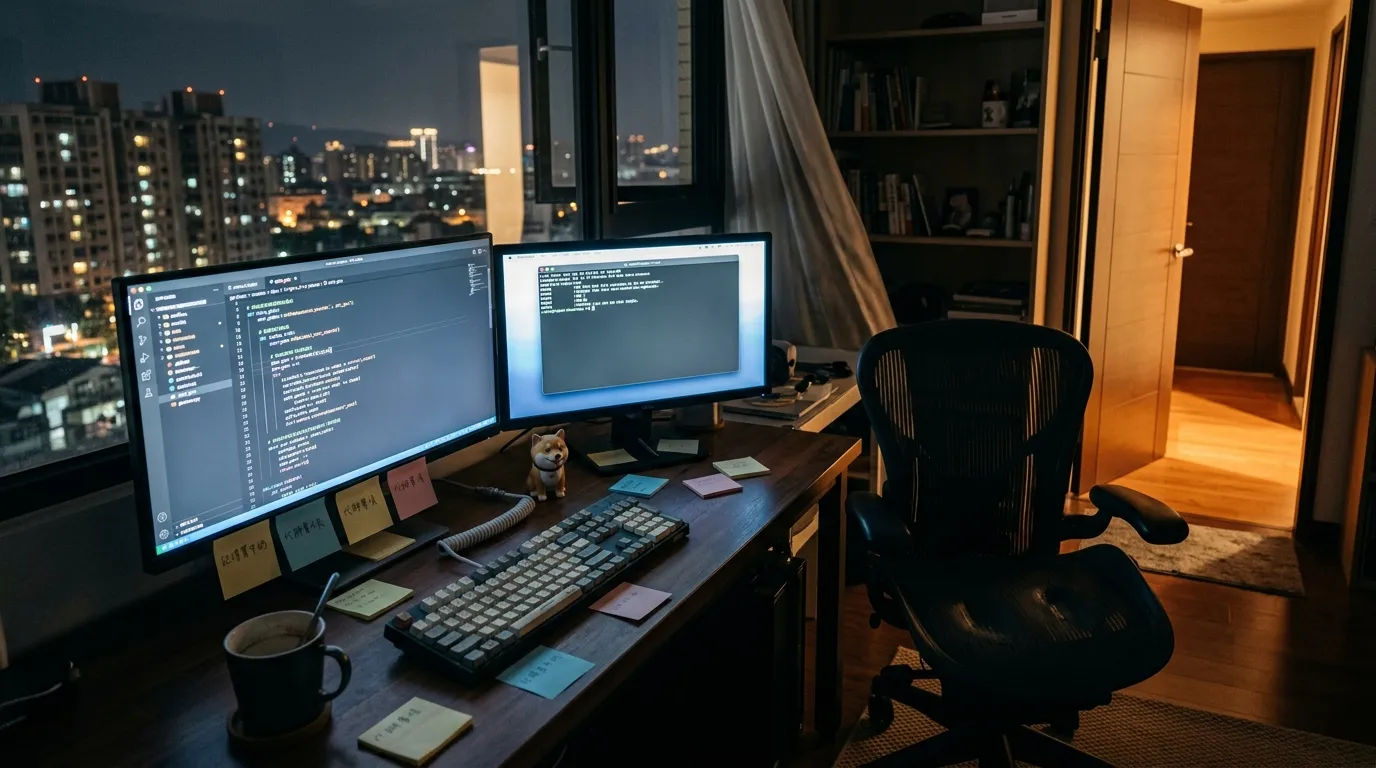
The study. He pulled the chair back — the same ergonomic chair, the seat worn into two depressions, one his, one from Jingxi’s two years of sitting in it. Her dent was shallower than his. But it was there.
Everything on the desk had changed. The sticky notes had gone from his technical scrawl to her life management — “Wed Yanqiu dentist,” “Credit card bill due 15th,” “Plumber Mr. Wang 0912-XXX-XXX.” The lopsided Shiba Inu capsule figurine still sat beside the keyboard, head tilted, plastic eyes catching the blue glow of the screen. Unmoved for two years. Jingxi hadn’t put it away; she probably hadn’t deliberately left it either. It was simply there. As if it had always been there.
He opened the Agent’s back end.
Code spread across the screen. He saw the things he’d written two years ago — the Prompts, the rules, the little asides that started with #. He scrolled down.
# She'll hesitate. That's not a flaw. Give her spaceHe shook his head.
Not because it was poorly written. Because this line had been written by a man who had no idea what she would become. Two years ago, he’d thought of her as someone who needed protecting — afraid she’d get swindled, afraid she couldn’t pay the bills, afraid she wouldn’t understand the statements. He’d written all his worry into code, every line saying: “If she runs into a problem, solve it for her.”
But she had run into problems. She’d solved them herself.
She’d learned to read insurance policies, learned to fix pipes, learned to pick up the phone and ask for help, learned to navigate a cloud service console and find the “Billing” button. She’d pulled his Agent back from the brink of shutdown. She’d rebuilt a life for three people from the wreckage.
She didn’t need protecting anymore.
But she’d let him come back.
He began to edit. Not deleting — updating.
# Insurance Knowledge Base — Response Style Config (v2.0)
# User now has a working knowledge of insurance — no need to oversimplify
# But if she asks a basic question, don't be patronizing (she probably knows more than you now)
# She makes her own decisions. You provide information, not verdicts
He kept editing. Cleaned up the old time-delayed trigger rules — some had expired, some she’d handled with her own hands, some had never fired. He marked them deprecated but didn’t delete them. Those little asides were artifacts of the version of himself that had existed two years ago. Deleting them would feel like deleting a chapter of history he’d already apologized for but had no right to pretend had never happened.
He added a new section.
# Yanhe's school notice handling
# He organizes his own contact book now — no daily reminders needed
# But he sometimes forgets his supplies on Wednesdays (club day)
# — She knows all this. She knows it better than I do. But I'm writing it down, just in case.
He paused. The cursor blinked for a few seconds.
He added one last comment at the end:
// She's stronger than I ever imagined. But I'll still write a few extra lines, just in case. An engineer-husband's last stubbornness.He looked at the line. The corner of his mouth pulled to one side. Two years ago he’d sat here at three a.m. writing Prompts, believing he was building a defensive wall. Now he sat here at one a.m. editing Prompts, knowing that wall had long since been rebuilt by her own hands, and he was just adding a few comments in the margins, pretending he was still useful.
He hit save.
The study door opened.
“There you go again with that stuff of yours?”
Shen Jingxi leaned against the doorframe. Hair down, wearing a sleep shirt washed until it had pilled. The tone, the posture, the exact spot where she stood — identical to two years ago, the night she’d walked past the study carrying two glasses of water, seen him hammering away at the keyboard in front of both monitors, leaned against the doorframe, and said those very same words.
He turned around.
Two years ago, when he’d heard that line, his eyes had lit up in a way that wasn’t normal, and he’d pulled her over to look at the RAG architecture, and launched into a barrage of things she couldn’t understand.
Now he heard it again. On the screen was the code he’d just finished editing, and after every # was Chinese she could read. He looked at her. She looked at him.
He smiled.
She smiled back.
Not a big smile. The kind where the corners of the mouth lift just a little. Two people reshaped by two separate years, standing in the same study, a chair between them, a lopsided Shiba Inu, and a whole screen full of little asides.
Outside the window, Taipei sat muggily awake in the early summer night. The air conditioner hummed. Somewhere in another room, two children were sleeping — one had definitely kicked off the covers, the other had definitely draped a hand across his brother’s back. Awake, they never touched; asleep, their bodies were more honest.
The Agent’s back end was still lit. The cursor blinked on and off. The code had been saved.
But it would keep being updated.