Chapter 1
The Line on the Report
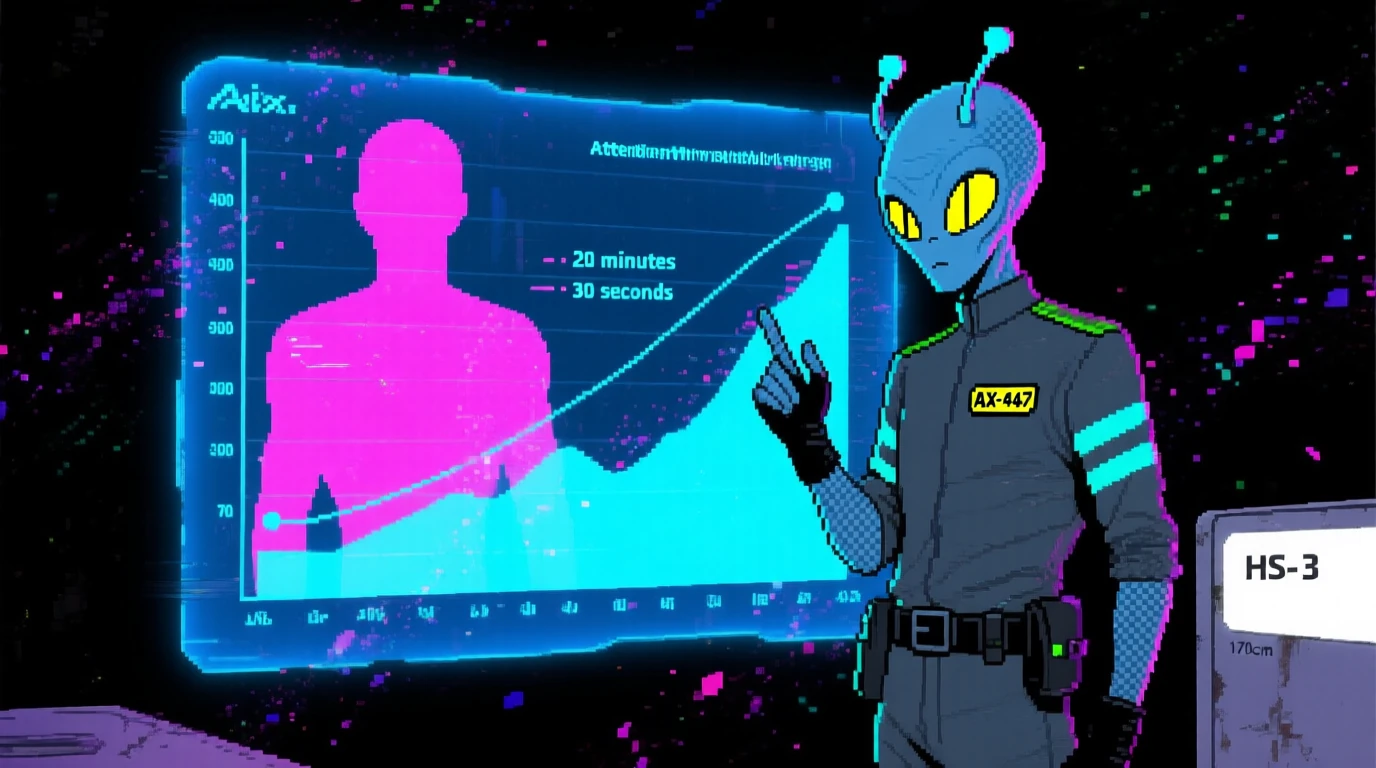
The lighting in the Universal Administration Bureau was always the same—an impartial, uniform white that seeped from the walls, ceiling, and floor alike, casting no shadows, leaving no corners. Ax sat in his holo-cubicle, staring at the file number floating before him, and felt the light was mocking him.
“HS-3, Human Civilization.”
He said it aloud, just to make sure it wasn’t a hallucination. This was his first independent case-closure assignment since joining the Bureau. Four standard years grinding through the Academy, two more slogging through an internship—and finally, he was entrusted with the full archival of an entire civilization. He took a deep breath and opened the file.
Humans. Codename HS-3. Home planet: Earth, third planet of the Solar System. Emerged approximately three hundred thousand years ago. Extinction occurred—he swiped right—seventy-three years after the invention of short-form video.
Ax blinked. He suspected his retinal chip had malfunctioned.
He read the cause-of-extinction field again. The text hadn’t vanished: “Invented short-form video.”
“This has to be a typo,” he muttered to himself, fingers gliding over the touchpad, pulling up more data. The cause-of-extinction field was theoretically supposed to hold only a short phrase; details went in the attachments. But the field usually read “Nuclear war,” “Resource depletion,” “Planetary impact”—something grand, something worthy of the end of an intelligent civilization.
What was “short-form video”?
He opened the attachment. It was empty. Completely empty. Only an automatically generated timestamp showed that the preliminary data had been archived in the twelfth standard year after human extinction. The filer’s employee number was too blurred to read—probably a glitch during data migration. But next to the cause-of-extinction field, there was a handwritten note—extremely rare in digital files—scrawled in messy strokes, as if someone had jotted it down with a stylus in a hurry:
“What the hell?”
Ax stared at that line for a long time. The handwritten note hadn’t been deleted or modified. It just sat there in the formal archival record, as if the previous researcher had shrugged after writing it, closed the file, and never come back.
He decided to go see his supervisor.
The senior specialist’s office sat right in the center of the cubicle farm, with transparent walls that gave a full view of every subordinate’s every move. When Ax walked in, AX-001 had his feet propped on the desk, a steaming beverage floating in front of him—some species’ extract, the color of muddy water, smelling like burning plastic.
“Specialist Zero-One, I have a question.”
“You have seventy-two standard hours.” AX-001 didn’t even look up, his tone as flat as a receipt.
“What?”
“Didn’t you come to request a review?” The supervisor finally lifted his eyelids to glance at Ax, noticing the expression Ax couldn’t hide. “You’re not about to ask about the cause of extinction, are you?”
Ax opened his mouth, then closed it. He’d been called out.
AX-001 took a sip of that muddy water, then set it down. “Your predecessor—the junior researcher before you—did exactly the same thing when he got this case. Came running to me saying, ‘This has to be a typo,’ requested a review, and I gave him seventy-two standard hours. And then?”
“And then?”
“Then he spent three months digging through data, wrote a two-thousand-page attachment, and in the cause-of-extinction field, wrote exactly the same words—‘Short-form video’—and submitted the report upstairs.”
Ax froze.
“So it’s correct? Humans really died because—”
“I don’t know.” AX-001 shrugged, his posture utterly dismissive. “I never read his report. I just sign off on the closure rate, not the content. Anyway, he submitted it, the closure rate was met, headquarters replied with ‘Pay more attention next time,’ and the file was archived. That’s it.”
“But—”
“But now you’re the case handler.” AX-001 cut him off, tapping the air with a finger. A countdown timer materialized in front of Ax—72:00:00, already ticking. “You want a review? Fine. Seventy-two standard hours, starting now. When time’s up, whether you’ve finished investigating or not, the report lands on my desk. Format A3-7b. Fill in the cause-of-extinction field with your conclusion. Attachments can be as long as you like, but don’t mess up the closure rate.”
“Mess up the closure rate?” Ax couldn’t help raising his voice. “This is the extinction of a civilization! Shouldn’t we find out the real—”
“Real what?” AX-001 stood up, finally looking him in the eye. The old hand’s gaze held no malice, but something that made Ax even more uncomfortable—the calm that came from having seen too much. “You think the cause of human extinction should be a runaway nuclear fusion reaction? A quantum computer awakening? An alien invasion? A super-virus created by gene editing? Sorry, none of that. They just invented short-form video and scrolled themselves to death. Absurd? Yes. But ninety percent of civilization extinctions in the universe are absurd. We’re just here to record, not to judge.”
He sat back down and waved a hand. “Go investigate. See you in seventy-two hours.”
Ax turned to leave, then stopped. “That predecessor—what happened to him?”
AX-001’s eyes drifted back to his drink. “Transferred. Heard he’s at some remote observation post on the outer spiral arm, monitoring a bunch of soft-bodied creatures that can’t even use tools. Probably what he wanted—at least those creatures didn’t invent short-form video.”
On his way back to his cubicle, Ax passed the break room. A senior researcher he recognized but had never really talked to was leaning against the wall, holding a much more normal-looking beverage, watching him with a half-smile.
“Zero-One gave you seventy-two hours?”
“Yeah.”
“Better than me.” The man walked over and extended a hand. “Zoltan. I handle PL-9, the self-replicating pet rocks.”
Ax shook it, frozen for a second. “Self-replicating—what?”
“Pet rocks.” Zoltan grinned, revealing a few teeth that weren’t quite the right color—probably some species’ aesthetic. “Rocks. Humans had a fad in the late twentieth century, keeping rocks as pets. Then some genius—or lunatic—invented self-replicating pet rocks. Imagine: one rock gives birth to baby rocks. The babies grow up and make more. Within fifty years, the entire planetary surface was covered in rocks. Civilization suffocated.”
Ax didn’t know what expression to make.
“Absurd, right?” Zoltan patted his shoulder. “But that’s what the closure report says. I wrote ‘Self-replicating pet rocks,’ and headquarters replied with ‘Filed.’ So your short-form video thing is at least a little better than rocks.”
“Better?”
“Short-form video at least needs electricity and a network. Rocks don’t need anything—not even oxygen.” Zoltan shrugged. “On the scale of absurdity for civilization extinctions, your case is probably somewhere in the middle.”
He picked up his cup and walked back to his own cubicle, leaving Ax standing at the break-room door, digesting the conversation.
Back at his seat, Ax took a deep breath and activated his holo-terminal.
He decided to start with the most basic question: What was short-form video?
He typed the keywords into the search bar and hit confirm. The next second, billions of data entries avalanched into his field of vision—videos, texts, data charts, academic papers, business reports, personal diaries, government documents. The sheer volume of information was so massive that even the Bureau’s holo-processor took a full three seconds just to complete the initial categorization.
Ax stared at the summary numbers popping up on the screen, a chill running down his spine.
Short-form video: A form of extremely short user-generated content, typically fifteen to sixty seconds long. Driven by algorithmic recommendations, it created a highly addictive cycle of consumption. Platform names varied—FlashVid, QuickClip, variants of TikTok—but the core mechanism was identical: a positive stimulus every fifteen seconds, shortening the human reward cycle and lowering attention thresholds.
He scrolled down.
Average human sustained attention span: about twenty minutes before the birth of short-form video. Fifty years after short-form video’s birth: less than thirty seconds.
Ax stopped and read that number again.
Thirty seconds.
A civilization that took three hundred thousand years to go from mastering fire to landing on the moon. Then, in seventy-three years, it condensed its collective attention span into thirty-second fragments. This wasn’t degeneration—it was reconfiguration, rewiring the entire nervous system of the civilization to a machine that fed nothing but dopamine.
He kept scrolling. A data chart jumped out—average daily usage time of short-form video users. It climbed from fifty-eight minutes in the year short-form video was born, in a near-perfect exponential curve. By the end of the civilization, that number was twelve point seven hours—more than half of waking hours spent scrolling.
A day has only twenty-four hours. After sleep, humans had about sixteen waking hours. Twelve point seven of those were spent on short-form video.
Ax leaned back in his chair. The holo-screen’s light reflected on his face. He remembered AX-001’s words—“They just invented short-form video and scrolled themselves to death.”
He had thought it was hyperbole.
Now he was starting to think it was just a plain description of the facts.
His finger hovered over the touchpad for a moment before he opened a timeline of human technological development. Before short-form video was invented, humans had already achieved nuclear fusion—net energy gain, clean power. Quantum computing—supremacy, computational power breaking classical limits. Gene editing—CRISPR technology mature enough to precisely modify the code of life.
And then, right alongside those achievements, on the same timeline, short-form video was born.
Ax overlapped the development curves of those three technologies with that of short-form video. Investment in nuclear fusion peaked ten years after short-form video’s birth, then plummeted—funds diverted to expanding data centers for short-form video platforms. The largest application of quantum computers in the final stages of civilization was optimizing short-form video recommendation algorithms, consuming sixty percent of computational resources. The first large-scale commercial application of gene editing wasn’t curing diseases—it was enhancing infant facial features to boost future short-form video traffic.
He stared at the data, speechless.
Zoltan’s words from the break room echoed again—“At least it’s better than rocks.”
No, Ax thought. Rocks wouldn’t make you willingly divert power from a fusion reactor just to scroll the next fifteen-second clip more smoothly. Rocks wouldn’t make you use the most powerful computers on Earth to figure out how to keep you glued to the screen. Rocks wouldn’t make you modify your own children’s genes just to get them more likes on short-form video.
Rocks were just rocks.
Short-form video—short-form video was the prison that humans built for themselves, using their own finest intelligence, perfectly tailored to their weaknesses.
He closed the timeline and reopened the cause-of-extinction field. The line was still there: “Invented short-form video.” The handwritten note beside it—“What the hell?”—still glared at him.
Ax muttered to himself, “What the hell…” his voice tinged with bitter recognition.
His fingers paused over the keyboard for a moment, then he opened a new A3-7b format report. In the cause-of-extinction field, he copied and pasted that same line and saved it as a draft. At the signature line, he entered: Junior Researcher Ax (Employee ID AX-447).
He wasn’t ready to change it yet. But he also wasn’t ready to overturn it.
Seventy-two hours had just begun.
On the holo-screen, search results kept pouring in without pause. He opened one document—a public speech by the last president of humanity, dated year seventy-two after the birth of short-form video, one year before extinction. The entire speech was one sentence, repeated three times:
“Just five more minutes.”
Ax closed the file and shut his eyes. The uniform white light seeped through his eyelids, impossible to block.
He began to understand why the previous researcher had chosen to transfer to the outer spiral arm.
But one thought lingered in his mind: that note “What the hell?” was left by the predecessor. Yet since his final conclusion was still “short-form video,” it meant the evidence he found forced him to accept that answer.
Ax opened his eyes.
“Alright,” he said to himself, sitting up straight again. “Let me see what kind of evidence could make a normal researcher write ‘What the hell’ and then still have to obediently fill in the same answer.”
He clicked on the first entry in the search results.
It was the social statistics annual report of humanity’s last decade. He skimmed the table of contents and jumped straight to the “Attention Distribution” chapter.
The numbers were worse than he expected.
And he had a faint feeling this was just the tip of the iceberg.