Chapter 8
Next Time, Pay Attention
The response from the higher-ups arrived on the morning of the third standard workday, right on schedule.
Ax was in the break room pouring himself a drink — he’d finally learned how to do it without spilling liquid all over his hands. Zoltan stood next to him, holding that mug with “PL-9 Souvenir” printed on it, launching into the latest discovery from his pet rock civilization.
“You know,” Zoltan said, “the pet rock civilization’s latest breakthrough — they spent twenty thousand years trying to figure out if rocks have consciousness, and then they found out they don’t. But by then, nobody cared anymore.”
Ax didn’t respond. He took a sip — a short chime sounded. An official notification.
He set down the mug and opened his communicator. The screen displayed a single line of text:
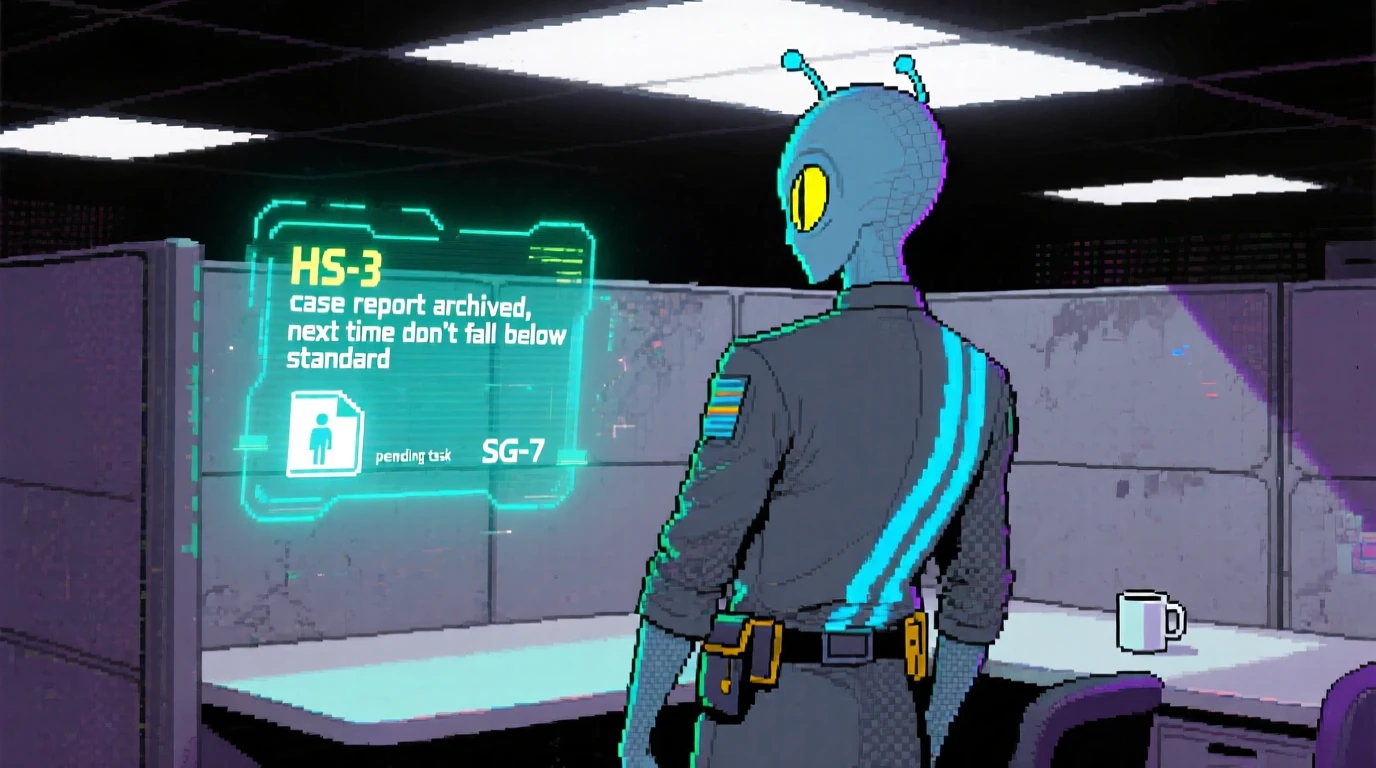
“HS-3 case-closure report archived. Next time, pay attention: closure rate must not fall below standard.”
Signed by “Superior Review Department.” No name. No attachment. No explanation. No “good work” or “well done” — just that one line, cold and impersonal, as if it had been auto-generated.
Ax stared at the line for a long time.
“What’d they say?” Zoltan leaned over and glanced at the screen, then snorted. “‘Next time, pay attention’ — standard reply.”
“That’s it?”
“What were you expecting? ‘Great report, we’re giving you a raise’?”
“I wasn’t expecting that, but —”
“But what?”
Ax looked at the line and couldn’t find words. He’d spent seventy-two standard hours investigating the truth behind human civilization’s extinction. He’d gone to Earth. He’d dug through quantum computing resource allocation reports, Meiyuan Gene’s business plan, short-form video platform technical development memos, attention threshold decline curves, hospital records, data from the last dance — he’d compiled everything into a Format A3-7b report, solemnly written “Short-form video (see attachment for details)” in the cause of extinction field, and in the remarks field, replied to the senior’s “What the hell is this?” with “Indeed.” He’d thought he’d at least get a response — an “acknowledged,” a “noted.”
All he got was one line: “Next time, pay attention: closure rate must not fall below standard.”
He turned off the communicator, picked up his mug, and took a sip. The drink had gone cold.
“You okay?” Zoltan asked.
“Fine,” Ax said. “Just feels like —”
“Like what?”
“Like thirty thousand years of human civilization boiled down to one line: ‘Next time, pay attention.’”
Zoltan looked at him, not answering right away. He set down his mug, leaned against the counter, and folded his arms.
“You know what my pet rock civilization’s case-closure report got back from the higher-ups?”
“What?”
“‘Attachment format incorrect. Please resubmit.’”
Ax blinked.
“I resubmitted three times. First time — attachment format wrong. Second time — cover page missing barcode. Third time — signature block needed the supervisor’s handwritten signature. You know that signature block — Zero-One always stamps it, but they said ‘handwritten signature only.’”
“Then what?”
“Then I spent two standard hours convincing Zero-One to sign it by hand. He complained for about an hour — said ‘in thirty thousand years, no one has ever asked me to sign by hand.’ Then he signed, and the report went through.”
Zoltan took a sip of his drink, then continued: “So I learned one thing — the higher-ups’ reply is never what you want to hear, but at least they reply. ‘Next time, pay attention’ is a good result. At least it’s not ‘rewrite.’”
Ax was quiet for a moment. Then he said, “So that’s it for human civilization?”
“Yeah, that’s it,” Zoltan said. “Archived. Stamped. Good to forget.”
“You don’t care?”
“No,” Zoltan said. “Because the next civilization will come soon. We’ll write another report. Then we’ll get another ‘next time, pay attention.’ And then we’ll forget again.”
He set down his mug, clapped Ax on the shoulder. “Welcome to the Universal Administration Bureau.”
Ax didn’t answer.
He finished his drink, washed the mug, and put it back. Then he walked out of the break room and returned to his cubicle.
On the holographic screen, the human civilization file had been archived. He opened it and looked at the data he’d spent seventy-two standard hours assembling — quantum computing resource allocation reports, Meiyuan Gene’s business plan, short-form video platform technical development memos, attention threshold decline curves, hospital records, data from the last dance — all neatly arranged in folders, with his annotations and explanations, looking like a perfect academic paper.
But now it was just an archived file — shorter than any history book humans had ever written.
He closed the human civilization file and opened the system’s notification page. The line “Next time, pay attention: closure rate must not fall below standard” still hung on the screen, with a “Read” mark beside it.
He stared at the line for a while.
Then he remembered something — he still hadn’t seen Zoltan’s pet rock civilization case-closure report.
He opened the system’s file archive, searched for “PL-9,” and found the report. The format was identical to the human one — Format A3-7b, cover page, cause of extinction field, attachments, conclusion page, remarks field.
He flipped to the remarks field and saw a handwritten note: “At least it wasn’t short-form video.”
He blinked, then laughed.
Not a big laugh — a light, helpless one. Like hearing a bad joke you know isn’t funny but you can’t help it.
He closed the pet rock civilization report and went back to the system homepage. His task list showed the human civilization as archived, status changed from “In Progress” to “Completed.”
Then he noticed a new task on the list.
Civilization code: SG-7.
Cause of extinction field: blank.
He stared at that blank for a moment.
Then he pressed “Accept.”
The system displayed a prompt: “Task accepted. Estimated completion time: seventy-two standard hours. Please submit a Format A3-7b case-closure report within the deadline.”
He dismissed the prompt and opened SG-7’s preliminary data. This civilization was much younger than humanity — only about fifty thousand years old, in its late industrial stage, not yet having reached nuclear fusion or quantum computing. The cause of extinction field was blank, meaning no preliminary investigation results existed.
He flipped to the last page of the data and saw a handwritten note: “This civilization is inventing a ‘social credit system’ — supposedly assigns a score to every individual based on behavior. Not yet known if it will cause extinction, but it looks promising.”
He looked at the note, the corner of his mouth lifting slightly.
“Social credit system,” he murmured. “Sounds even more creative than short-form video.”
He closed the data and leaned back in his chair.
Uniform white light fell from the ceiling, illuminating the entire space. He closed his eyes and sat there in the light for a while.
He remembered the curve he’d seen on the human civilization development timeline — thirty thousand years of slow climb, then a vertical plunge in the last seventy years. He remembered the data: average daily short-form video usage grew from fifty-eight minutes to twelve point seven hours; attention threshold dropped from twenty minutes to under thirty seconds; sleep duration fell from eight hours to four point two hours.
He remembered that video of someone dancing in front of a reactor — a person dancing before a burning building, plasma glow in the background, likes ticking up slowly, stopping at “7.”
He remembered the contract research assistant Chen’s note file: “Nobody cares anymore anyway — everyone’s scrolling short-form videos. Forget it, might as well dance. At least someone will watch.”
He remembered all that, and found the corner of his mouth still lifted.
Not because it was funny — because he finally understood what Zoltan meant: “Not apathy, just practicality.”
The Universal Administration Bureau’s purpose wasn’t to change civilizations’ fates, wasn’t to stop their extinction — only to record. Record each civilization’s absurdity, record each civilization’s method of self-destruction, then archive, then wait for the next.
He opened his eyes, looked at the new task on the screen — code SG-7, cause of extinction field blank.
He reached out and opened SG-7’s preliminary data, began reading.
“Social credit system,” he muttered to himself. “Interesting.”
He started taking notes.
Then the holographic communicator buzzed again — this time it was Specialist Zero-One.
“Ax.”
“Yes.”
“You got the new task?”
“Yes.”
“SG-7. That social credit civilization.”
“Right.”
Zero-One paused, then said, “Don’t spend too much time on investigation this time. The higher-ups want the closure rate up — annual budget review is coming.”
“I know.”
“Good. Don’t pull another seventy-two-standard-hour investigation. The human civilization thing already had them asking ‘why did it take so long.’”
Ax paused. “I’ll try.”
“Not ‘try’ — ‘must,’” Zero-One said. “Closure rate falls below standard, next year’s budget gets cut. Budget cut means layoffs. You don’t want to get laid off, do you?”
“No.”
“Good. Get to work.”
The call ended.
Ax stared at the darkened screen for a moment.
Then he opened SG-7’s preliminary data and started reading.
Social credit system.
Sounded even more creative than short-form video — at least from an absurdity standpoint.
He started taking notes, then thought of something: if every civilization’s cause of extinction was this absurd, then at least one person — a researcher, employee ID AX-447 — would record those absurdities, write them into reports, archive them, and wait for the next civilization.
The thought made the corner of his mouth lift again.
“What will the next civilization die from?”
He didn’t have an answer.
But he knew he’d find one — because that was his job.
He continued reading SG-7’s preliminary data, starting to plan his investigation route.
Uniform white light fell from the ceiling, illuminating the entire space.
In the Universal Administration Bureau’s office, everything was as usual.