Chapter 9
A Worthless Life (II)
On moving day, Chen Guohao hailed a taxi.
He didn’t call a truck or a moving company—because he didn’t have much to move. All the fancy furniture in the luxury apartment was rented: the sofa, the bed, the coffee table, the crystal chandelier—everything came with the landlord’s setup. His own stuff was just one suitcase, exactly the same as when he’d moved in from the rooftop extension three months ago. Same suitcase, same brand (cheap nylon fabric, zipper that stuck), same person.
The driver helped him put the suitcase in the trunk and asked, “Where to, sir?”
“Wanhua.”
“Where in Wanhua?”
Chen Guohao gave the address—the tin-roofed rooftop extension where he’d lived for three years. The driver didn’t ask more, just followed the GPS. The car left Xinyi District, passed through the Eastern District, past Taipei Main Station, past Ximending. The scenery outside the window slowly changed from glass-curtain-wall skyscrapers to old apartment buildings. Chen Guohao leaned against the window, looking at streets he knew well but hadn’t seen in three months.
He remembered the first time he walked into that luxury apartment—back then, he thought he’d finally escaped the “worthless life” class. He stood in front of the floor-to-ceiling windows, looking at the Xinyi skyline, thinking: This is where people should live. Now he knew: not a single thing in that apartment was his. Not even the dust on the sofa.
The car stopped in front of a five-story apartment building.
Chen Guohao got out, paid, took his suitcase from the trunk. He looked up at the building’s exterior—gray tiles, some chipped off, a motorcycle repair shop on the first floor, iron grilles on windows from the second floor up. He used to pass here every day and never thought it was anything special. Now looking at it, still nothing special. But standing here, he felt grounded.
He dragged the suitcase into the stairwell. Same old stairwell—walls peeling, handrails rusted, the light on the second floor still burned out. He climbed to the fifth floor, then pushed open the iron door to the rooftop.
The rooftop extension was still the same rooftop extension.
Tin roof, peeling walls, air conditioner dripping—drip, drip, drip. A puddle on the floor from a leak. The mold stains were worse now, a patch of gray-white mildew spreading in the corner. He stepped inside. The air smelled damp, mixed with dust and old newspaper.
He set the suitcase in a corner, stood in the center of the room, and looked around.
Seven ping total—one bedroom, one bathroom, no kitchen. He used to think it was small, cramped, crappy. Now it still looked small, cramped, crappy. But weirdly, he didn’t have that old feeling of “I have to get out of here.” He just stood there, feeling like he’d come back.
Saying “come back” wasn’t just a snap of the fingers. Three days earlier, he’d called Lin Shufen. The call connected, and both sides were silent for a few seconds—the last time they’d seen each other, she’d brought her son, who was drowning in gambling debt, to borrow a million NT. He’d called her out on the spot and kicked them both out, lies and all. Making this call meant he was the first to lower his head. But he figured he didn’t have much of a head to lower anyway, so he just got straight to business: he wanted to rent the rooftop extension back, same rent as before, not a cent increase; he’d pay for repairs himself—insulation, soundproofing, and that broken air conditioner that had been dripping for three years, all replaced.
Lin Shufen was stunned on the other end for a long time. She probably couldn’t figure out why someone she’d driven away would come back to rent her illegal rooftop unit, let alone spend his own money fixing it. “You… you’re going to pay for the repairs yourself?” Her voice instantly softened, that greedy streak bubbling up. “Hey, um, Guohao, forget about what happened before, it was all a misunderstanding—” “Just don’t raise the rent, that’s all I care about.” He cut her off. She quickly agreed, “Okay, okay, no raise, no raise, don’t worry.” Hanging up, Chen Guohao knew perfectly well: he hated this woman—hated her mercenary attitude, hated that she tried to dump her son’s mess on him. But this seven-ping tin shed was the only place he’d ever lived that felt like home. Hate all you want, but life still had to be lived here.
Afu padded over from beside the suitcase, sniffed the floor, sniffed the corner, then walked to his usual spot—next to the bed, near the window. He circled twice, lay down, and yawned.
Chen Guohao watched him. “You still remember this place?”
Afu ignored him, closed his eyes.
Chen Guohao smiled. He walked to the bed, opened the suitcase, and started unpacking. Not much to unpack—a few clothes, a towel, a toothbrush. From the bottom of the suitcase he pulled out a dog leash, bought at a convenience store for 150 NT. The leash was still new because Afu refused to be leashed. He hung it on the hook by the door, just like before.
He walked to the kitchen—really just a countertop and a small fridge—and opened the fridge. Empty inside except for half a bottle of expired soy sauce and a moldy steamed bun. He remembered that on the day he moved out, there were half a carton of eggs in the fridge that he’d forgotten to throw away. By now those eggs had turned to trash and been taken away by the cleaning crew. He tossed the soy sauce and bun into a garbage bag.
He closed the fridge, stood up, and saw a yellowed sticky note on the fridge door. He’d written it before winning the lottery, in blue ballpoint pen, messy handwriting: “Stored credits: 14 left, 7-Eleven, Americano.”
He stared at the note for a moment.
Fourteen cups. Three months ago he’d been too cheap to drink them, wanted to save them, and then he moved to the luxury apartment and completely forgot. Now those fourteen cups should still be there—7-Eleven’s stored credits don’t expire.
He peeled off the note, folded it in half, and put it in his pocket.
In the afternoon, he walked down to the noodle stand. The owner was Mr. Zhou, over sixty, bald, his apron perpetually stained with oil. Chen Guohao used to eat here every day: a bowl of dry noodles with a braised egg, thirty-five NT. Mr. Zhou saw him and froze.
“Mr. Chen? You’re back?”
“Yeah, moved back.”
“Moved back? Didn’t you say you were going to live in Xinyi District?” Mr. Zhou sounded confused.
Chen Guohao smiled. “Couldn’t get used to it.”
“You must be out of your mind.” Mr. Zhou shook his head, but without malice. “Same as usual?”
“Same. Dry noodles with a braised egg.”
Mr. Zhou turned to cook. Chen Guohao stood in front of the stand, watching the white noodles boil in the water. He remembered his first breakfast in the luxury apartment—eggs Benedict made by the landlord’s personal chef, 450 NT a plate. He’d taken two bites and couldn’t finish, because he was thinking: Am I eating breakfast, or am I eating money?
“Your noodles.” Mr. Zhou placed a bowl of dry noodles on the counter, with a braised egg on the side.
Chen Guohao took it, lifted a strand of noodles, blew on them, and put them in his mouth.
Tasted exactly the same as before. Chewy noodles, fragrant minced pork, flavorful egg. He used to eat this every day and thought it was ordinary—just something to fill his stomach. Now it tasted better than anything from those high-end restaurants—at least he knew this bowl of noodles was real.
“Your noodles are still the best,” Chen Guohao said.
Mr. Zhou laughed. “No shit. I’ve been cooking them for thirty years.”
After finishing, Chen Guohao paid and walked to the MRT station exit. That was where he used to hand out flyers. Three in the afternoon, not many people around, but a few were still handing out flyers—a middle-aged woman, a young guy with glasses, a man in a suit. He stood under the arcade across the street, watching them.
He remembered standing here himself, holding a stack of flyers, saying “Hello, please take a look” to everyone who passed. Most people ignored him; a few would take one, but drop it two steps later. He used to hate this job, thought he was wasting his time. Now, watching those flyer-handlers, he felt they were serious—at least they were doing something, meaningful or not.
He walked over and approached the middle-aged woman. “Excuse me, are you hiring?”
She looked him up and down. “You want to hand out flyers?”
“Yeah. For free. I just want something to do.”
The woman froze, then laughed. “You must be out of your mind?”
“You’re the second person to tell me that today.” Chen Guohao gave a wry smile. “I’m serious. I’ll hand them out for you, you take a break. I promise I won’t steal your business.”
The woman studied him, then pulled a stack of flyers from her bag. “Here. Don’t throw them away.”
Chen Guohao took them. “Don’t worry.”
He stood at the MRT exit, flyers in hand. Same spot as three months ago. He took a deep breath, then said to the first person walking toward him: “Hello, please take a look.”
That person didn’t even look, just walked past.
Chen Guohao didn’t feel embarrassed or angry. He just kept holding up the flyer and said to the next person: “Hello, please take a look.”
Some took one. Some didn’t. Some took one, walked two steps, and dropped it in the trash can. Chen Guohao watched those discarded flyers, bent down, picked them up, and put them in the recycling bin next to him.
He handed out flyers for an hour. Half the stack was left. He leaned against the wall, pulled out the sticky note: “Stored credits: 14 left, 7-Eleven, Americano.”
He walked into the 7-Eleven next to the MRT station, opened the app on his phone, and tapped “Action-anytime.” Sure enough, there were still fourteen Americanos, valid until next March. He redeemed one and walked to the counter.
“One Americano, with my own cup.”
The clerk glanced at him. “Got a cup?”
Chen Guohao pulled a reusable cup from his backpack—a plain plastic cup with a 7-Eleven sticker, a freebie from a previous coffee purchase. He handed it over.
The clerk took it, filled it, and handed it back. “That’ll be thirty dollars, five-dollar discount, so twenty-five.”
Chen Guohao took the cup and paused—he’d forgotten about the five-dollar discount for bringing your own cup. He used to bring his cup every day just to save that five bucks. Three months later, he’d almost forgotten.
He stepped out of the convenience store, coffee in hand, and stood under the arcade. He didn’t gulp it down like before. Instead, he took a slow sip. Americano was still Americano—bitter, a little sour. He used to drink coffee like water, feeling he didn’t deserve to enjoy it, just wanting to finish fast and get back to handing out flyers. Now he stood under the arcade, watching people come and go, sipping little by little.
The coffee was hot, but he wasn’t in a hurry.
He finished the coffee, walked back to the MRT exit, and kept handing out flyers. By evening, his stack was empty. He handed the last flyer to a high school student, who said “Thanks” and took it.
Chen Guohao froze. No one had ever said thank you to him before. He used to think society was cold. Now he realized he’d been too busy complaining to notice the occasional kindness.
He went back to the middle-aged woman. “All done.”
She looked surprised. “Really? You’re fast.”
“Not really. I’ve done it before.”
“Want to come again tomorrow? I have a morning shift.”
“Sure.”
Chen Guohao walked back to the apartment. Passing the lottery shop at the alley entrance, he stopped. He used to pass by here and fantasize about how he’d spend the money if he won. Now he looked at the shop, thought about it, and walked in.
“One Powerball, quick pick.”
The clerk printed a ticket. “One hundred dollars.”
Chen Guohao pulled a hundred-dollar bill from his pocket and handed it over. He looked at the ticket—same as the one from three months ago: quick pick, seven numbers. He didn’t grip it tightly like before, didn’t fantasize about revenge if he won. He just folded the ticket, put it in his pocket, and walked home.
He climbed to the fifth floor and opened the door to the rooftop extension.
Afu was waiting at the door, tail wagging a few times.
Chen Guohao crouched down and reached out to pet his head. Afu didn’t dodge; instead, he leaned in and pressed his head into Chen Guohao’s palm. His fur was still coarse, his body odor still strong, but Chen Guohao didn’t find it disgusting. Instead, it felt real—not perfume, not deodorizer, not some fancy dog shampoo. Just dog smell.
“You know,” Chen Guohao said softly, “I handed out flyers today.”
Afu looked at him.
“I also picked up that coffee. Fourteen cups, now thirteen left. One cup a day, I can drink for thirteen days. When it’s done, I’ll buy more.”
Afu yawned.
“I also bought a Powerball ticket just now. A hundred bucks. Quick pick. Same as last time.”
Afu sat down, head tilted.
“But this time,” Chen Guohao said, “I didn’t think about what to do if I win. Because I know, even if I win, nothing will change.”
He stood up and walked inside. Afu followed, lay down in his corner. Chen Guohao sat on the edge of the bed, looking at the mangy, ugly, smelly dog.
“You know, Afu,” he said. “When I won the lottery three months ago, I thought my life was going to change. I thought money could solve everything. And what happened? I ended up worse than before. Before, I was just poor. Now I’m poor and lonely.”
Afu licked his front paw.
“But weirdly,” Chen Guohao said, “now that I’m back here, I feel grounded. Because everything here is real. The leak is real, the mold is real, and you are real.”
He reached out. Afu walked over and rested his head on Chen Guohao’s knee.
“You know, Afu. I used to think ‘loneliness’ was terrifying. I was lonely when I handed out flyers, lonely in the rooftop extension, even lonelier in the luxury apartment. I kept trying to get rid of it—buying things, treating people, getting revenge, finding someone to keep me company. And what happened? The more I tried, the worse it got.”
Afu didn’t say anything, but his tail moved.
“Now I realize,” Chen Guohao said, his voice calm, “loneliness isn’t the problem. Pretending you’re not lonely is.”
Afu leaned against him and closed his eyes.
Chen Guohao stroked Afu’s head and smiled. Not a bitter smile, not a forced smile—a real smile. He looked at the mangy, ugly, smelly dog and thought: He probably will never know I have 1.2 billion. He just knows I smell like sweat, that I feed him, that I yell at him, that I crouch down to pet him. That’s all he knows. But he still chooses to lean against me.
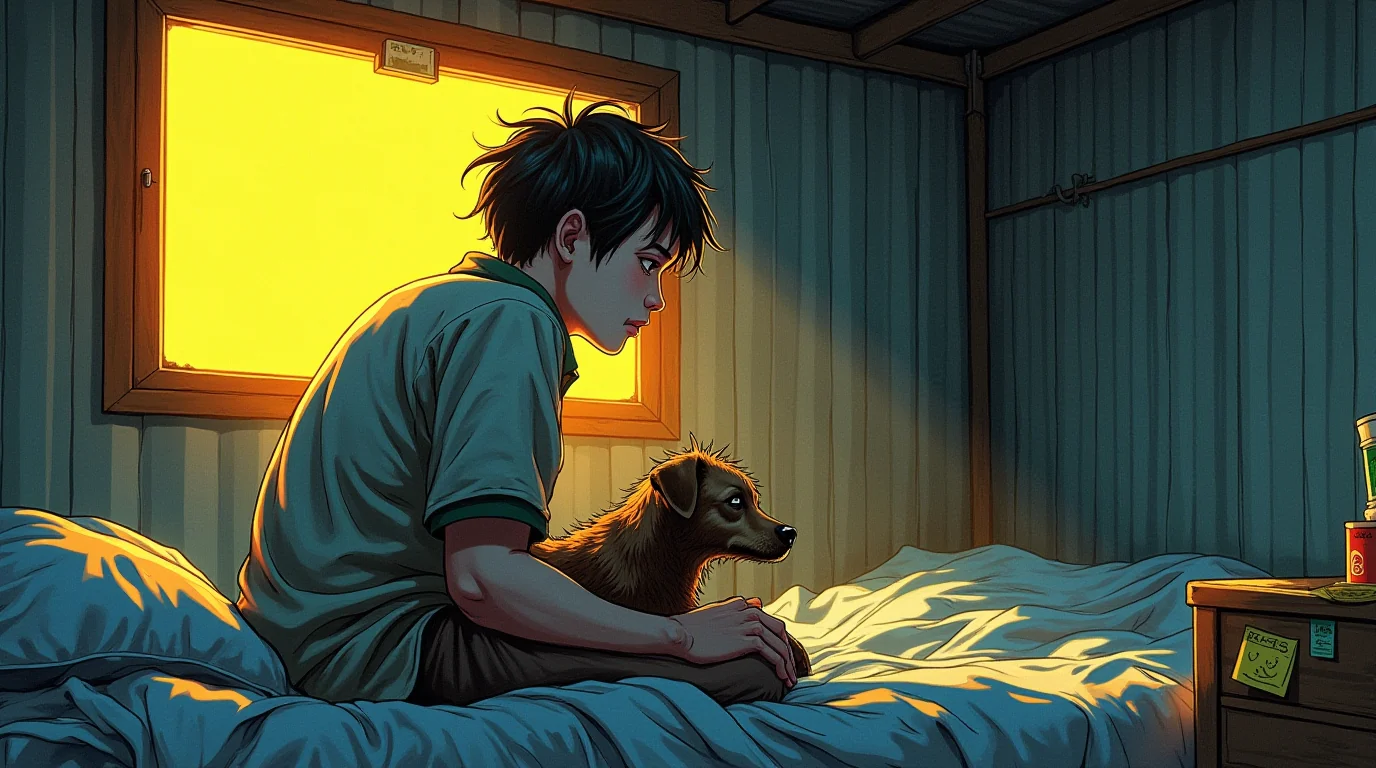
He picked Afu up and set him on his lap. Afu was a little heavy, but he didn’t care.
Outside, the sky had darkened. No lights were on in the rooftop extension. Only the streetlight cast a yellow rectangle on the floor through the window. Chen Guohao sat on the bed, holding the dog, looking at that patch of light.
Suddenly he remembered the lottery ticket. He pulled it from his pocket and glanced at it—seven numbers, quick pick. He thought for a moment, then didn’t put it away. Instead, he placed it on the bedside table, next to the sticky note.
The sticky note read: “Stored credits: 14 left, 7-Eleven, Americano.”
Now it was thirteen.
Tomorrow morning, he’d go hand out flyers again. The day after, too. And the day after that. He’d drink one cup of coffee a day, and when it ran out, he’d buy more. He’d keep taking care of this dog, until it got old, died, or left. He’d keep living here, fix the leak, replace the air conditioner, treat the mold. He’d keep on living.
A worthless life. But lived with dignity.
He looked down at Afu. Afu was already asleep, belly rising and falling with each breath, occasionally twitching, like he was dreaming.
“Good night, Afu.”
Chen Guohao said it. Then he smiled.
He turned off the light and lay down. Afu shifted, pressing against his back.
In the dark, Chen Guohao closed his eyes.
He didn’t dream.
But he slept well.