Chapter 1
Name on the Dispatch Slip
The office air conditioner was ancient, its vents wheezing like an old man catching his breath. Chen Mo sat at the folding table, scrolling through the gig-worker matching platform on his phone. Job listings flashed across the screen one after another: factory operator, packer, cleaner, administrative assistant.
The door swung open. Old Zhou walked in holding two cups of convenience-store coffee. He set one in front of Chen Mo, pulled out the folding chair opposite, and sat down.
“Got a case—Mingyang Technology.” Old Zhou peeled the lid off his coffee and blew on it. “Production department admin specialist. Temp position.”
Chen Mo’s finger froze on the screen. Mingyang Technology—a name he hadn’t heard in three years. But the moment it hit his ears, his stomach tightened.
“Production department?” he asked.
“Yeah.” Old Zhou took a sip. “They’re rolling out something called the ‘Temp Workforce Optimization Project.’ Starting with the support unit. They need a temp to handle paperwork and data entry.”
“Target?”
“Deputy manager of production. Li Zonghan.”
Chen Mo didn’t answer right away. He lifted his coffee, took a sip, let the bitterness dissolve on his tongue. Three years. That face—sharp suit, ever-present smile—he thought he’d forgotten it. But the second Old Zhou said the name, the image came back as vivid as yesterday: the man standing in the conference room, wearing an expression so sincere it made you sick, saying, “Chen Mo forged documents. The company has decided to terminate him.”
“You can turn it down,” Old Zhou said, his tone calm. But he knew—this case only Chen Mo could handle. “Company policy. Cleaners have the right to refuse cases that conflict with their own interests. You two have history. I can pass this to someone else.”
“You’ve already taken it, haven’t you?” Chen Mo asked.
Old Zhou didn’t deny it. He just drank more coffee.
“I know you’ve been waiting for this chance a long time,” Old Zhou said. “But I’m telling you—this is work, not revenge. The mission is to make him resign voluntarily. Everything has to be legal. If you let your personal feelings cloud your judgment and something goes wrong, the company won’t cover you.”
“I know the rules.”
“Are you sure?”
Chen Mo set down the coffee cup and looked at Old Zhou. The retired HR expert’s eyes were like a scale, weighing him.
“I’m sure,” Chen Mo said. “Three years ago, he made me take the fall. Used forged documents to kick me out of the company. Now I’m going to use legal means to make him leave the same way.”
Old Zhou was silent for a few seconds. Then he pulled a brown paper envelope from his briefcase and placed it on the table.
“Inside is Mingyang Technology’s internal data—org chart, department KPI system, employee handbook, and Li Zonghan’s performance reviews from the last three years,” Old Zhou said. “The temp assignment has been approved. Report day after tomorrow. Your cover is an ordinary temp worker—average education, average experience, keep your head down.”
Chen Mo took the envelope but didn’t open it.
“One more thing.” Old Zhou stood up, walked to the door, and turned back. “Mingyang recently started working with a temp agency called Supai Human Resources. Li Zonghan brought them in. That agency has a bad reputation—several records of wage theft.”
“What are you saying?”
“Just reminding you—you might have to deal with more than just Li Zonghan himself.” Old Zhou pushed the door open. “Day after tomorrow, eight-thirty, Mingyang Technology lobby. Good luck.”
The door closed. The air conditioner’s hum grew louder again. Chen Mo opened the envelope and pulled out the first document: the org chart for Mingyang’s production department. Li Zonghan’s name was printed under the deputy manager slot. Below him, a dense list of section chiefs and team leaders.
He flipped to the second document—Li Zonghan’s performance reviews. The numbers were impressive, the comments glowing: “Strong leadership,” “Improved departmental efficiency,” “Effective cost control.” Standard corporate flattery. But Chen Mo noticed something: in the last quarter’s review, one indicator had a particularly low score: “Department Employee Morale Survey.”
He smiled. Same old story—great at packaging, but the cracks always showed.
Chen Mo picked up his phone and dialed.
“Hey, it’s me,” he said. “I need you to look into someone—Li Zonghan, production deputy manager at Mingyang Technology. And the temp agency they’re working with, Supai Human Resources. As fast as possible.”
A young voice came through the line: “The case involving your old supervisor?”
“Yeah.”
“Got it. I’ll have it for you tomorrow.”
Chen Mo hung up, put the documents back in the envelope, and leaned back in his chair. He stared at the air vent on the ceiling. The air conditioner sounded like someone sighing.
Three years ago, Li Zonghan had called him into the conference room. The HR director and the general manager were already there. Li Zonghan spread a stack of purchase orders on the table, his face full of pain: “Chen Mo, I always trusted you. But you’ve let me down.” The orders bore Chen Mo’s seal and signature. The amounts didn’t add up. The dates were wrong. He tried to explain, but no one listened. Because Li Zonghan had already talked to everyone: “Chen Mo’s been having financial trouble lately. He might have gotten some bad ideas.”
He didn’t even get a chance to appeal. He was fired. The involuntary termination notice said “business restructuring,” but word travels fast in the industry. No one wanted to hire someone suspected of forgery. He searched for three months before Jingjie Human Resources took him in.
Old Zhou had said: “I’ve seen your resume. Big problem. But I have another kind of work that suits you.”
That was how he became a Cleaner.
Chen Mo stood up, tucked the envelope under his arm, and walked out of the office. Outside, the sky had darkened. Streetlights flickered on. Crowds streamed past. He took two buses back to his rental apartment.
He spread the documents across the bed and began studying Mingyang’s employee handbook. KPI evaluation system, disciplinary rules, transfer regulations, grievance channels—he read every clause carefully, marking key points, scribbling notes in the margins. Those seemingly boring rules were ammunition in his arsenal.
He paid special attention to Article 37: “The company may, based on operational needs, transfer employees to other departments or positions, provided there is no improper purpose or infringement of employee rights.” A small note beside it read: “The new position shall have comparable salary, benefits, and working conditions to the original.”
This clause could be twisted in all sorts of ways.
He flipped to Article 42: “Supervisors shall evaluate subordinate performance based on objective standards, free from discrimination, bias, or retaliation.” The note added: “If an employee objects to an evaluation result, they may file a grievance with the HR department.”
Chen Mo smiled. Li Zonghan had probably never bothered to read these clauses. He thought he was at the top of the food chain, never realizing the ice beneath his feet was cracking.
The next morning, Chen Mo reported to Mingyang Technology’s lobby. The receptionist handed him a visitor badge and told him to wait. He sat on a plastic chair, watching the electronic board cycle through the company’s promotional video. The background music was the kind of elevator Muzak that put you to sleep.
He noticed a photo wall in the corner, displaying the company’s outstanding employees over the years. One photo was of Li Zonghan—navy suit, beaming smile, caption reading “Best Supervisor of the Year.”
Chen Mo stared at it. “Best Supervisor of the Year? More like Best Speechwriter of the Year,” he thought. But his face showed nothing.
“Mr. Chen?”
A voice came from behind. He turned. A woman in a business suit, early thirties, thin-rimmed glasses, a professional expression.
“I’m Specialist Zhang from HR. Welcome to Mingyang Technology.” She handed him a temporary ID badge. “Please follow me—I’ll show you around.”
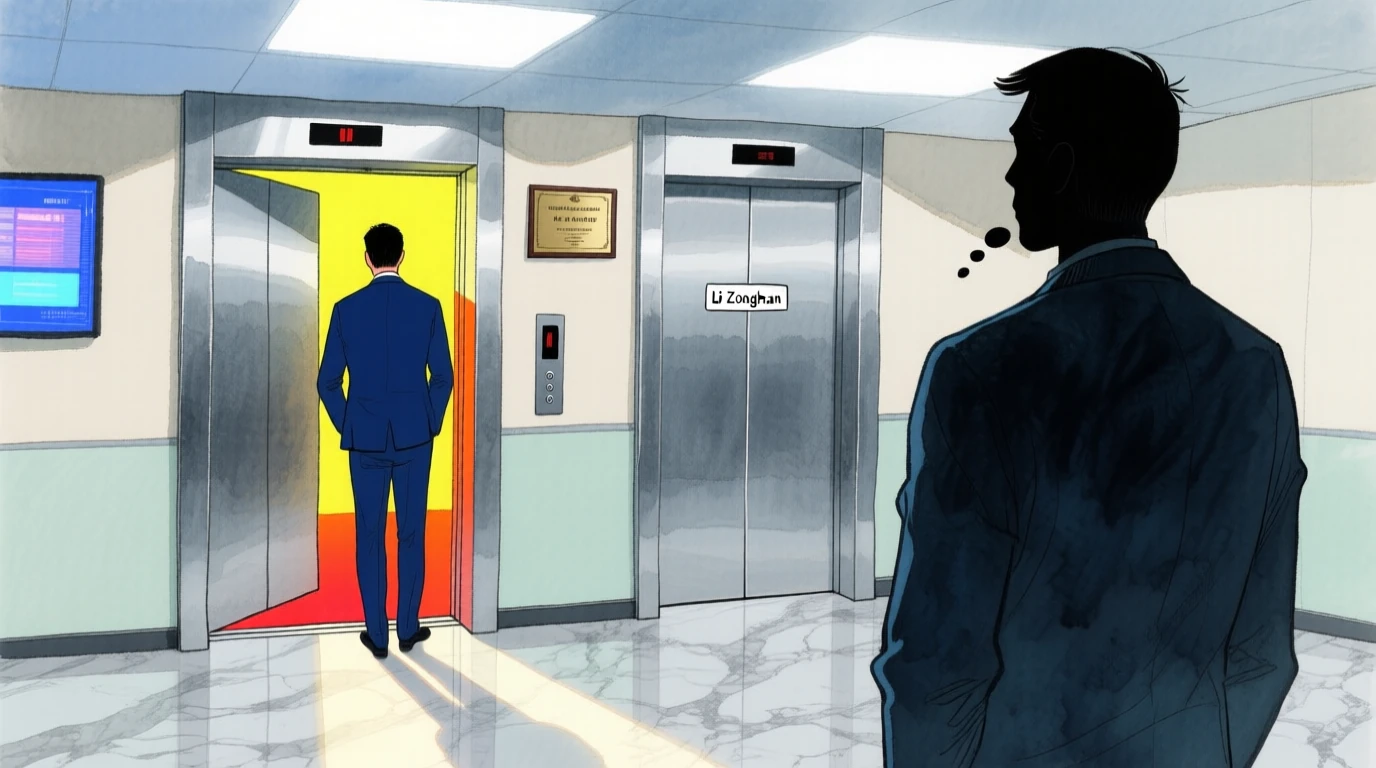
Chen Mo took the badge and stood up. At that moment, the automatic doors slid open. A man walked in.
Sharp suit, steady gait, professional smile plastered on his face.
Li Zonghan.
Chen Mo’s heartbeat didn’t accelerate. His breathing didn’t change. He just lowered his head slightly, letting his eyes fall on the name tag pinned to the man’s chest: “Production Deputy Manager Li Zonghan.”
Li Zonghan didn’t look at him. He walked across the lobby, nodded to the receptionist, then turned into an elevator. The doors closed. The floor numbers climbed.
“This way, please,” Specialist Zhang said.
Chen Mo followed her into another elevator. As the doors slid shut, he glanced through the gap toward where Li Zonghan had disappeared.
He said one sentence to himself, silently.
“This time, I’ll be the one asking you to leave.”
The elevator doors sealed completely. The car began to rise.