Chapter 7
Cat and Mouse
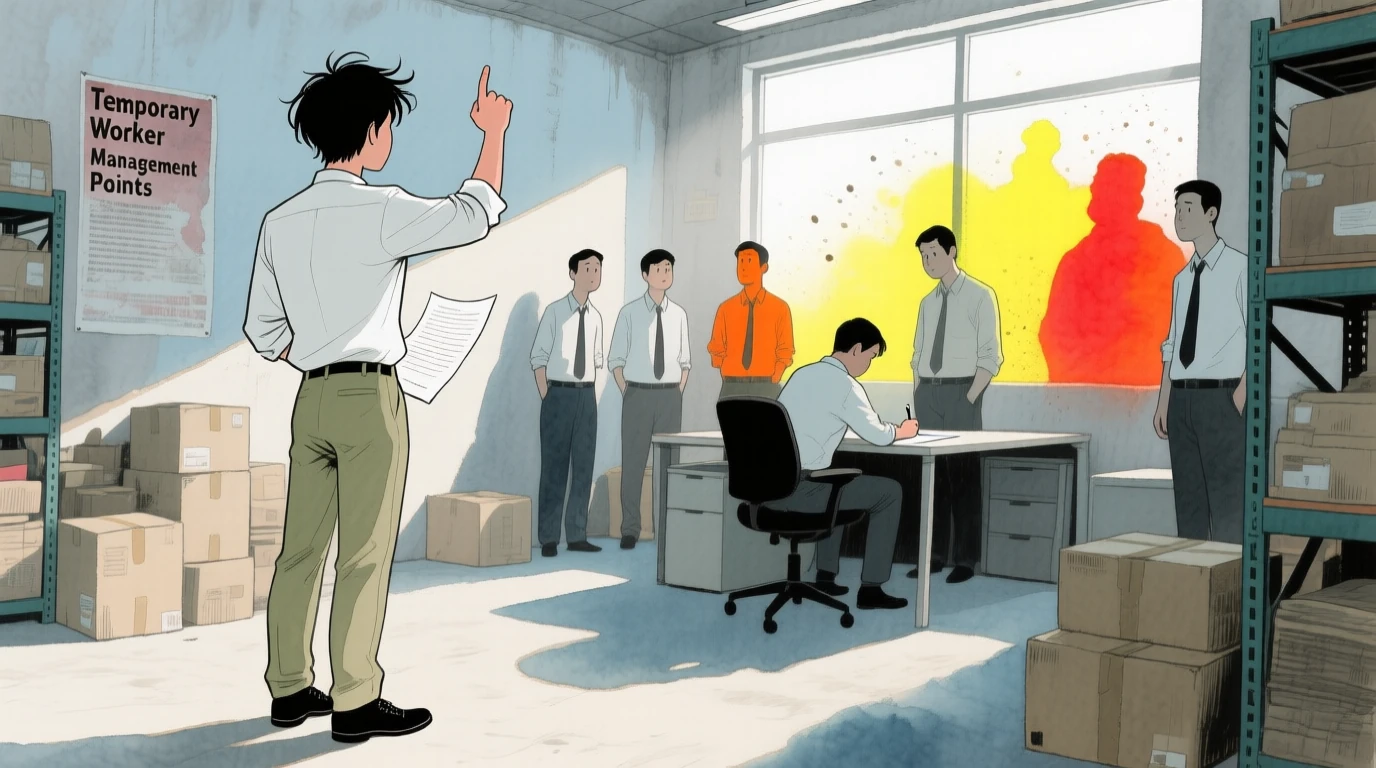
Li Zonghan stood before the whiteboard in Production Unit 1’s morning meeting room, tapping his finger on the words “Temp Worker Management Guidelines” written there. His tone was as calm as if he were explaining the lunch menu.
“Starting today, all temp workers in the Support Team must submit a weekly work log, detailing each day’s tasks, hours, and assignments from supervisors. Failure to submit on time will be treated as an unexcused absence.”
The section chiefs in the room exchanged glances. Zhang Wenxiang frowned and was about to speak, but Li Zonghan cut him off: “This was approved by the GM, to improve temp workforce management efficiency. Anyone with objections can take it up with the GM directly.”
Zhang Wenxiang shut his mouth.
When Chen Mo heard the news in Warehouse C, he was sorting through a pile of expired quotation sheets. He stopped and looked at Xiao Lin, who had come over to tell him.
“He also announced something else,” Xiao Lin said, lowering her voice. “He filed a Work Deficiency Notice with Jingjie Human Resources, claiming you have a negative work attitude. Jingjie has already logged a minor demerit.”
Chen Mo set down the quotation sheets and leaned against a shelf. “What’s the reason?”
“He said you weren’t at your workstation yesterday afternoon,” Xiao Lin said. “But he has no evidence—you were having lunch in the employee cafeteria. Lots of people saw you.”
“Did he check the surveillance footage?”
“He didn’t request it,” Xiao Lin said. “But Jingjie still logged it.”
Chen Mo was silent for a few seconds. Then he said, “Did he specify the time?”
“Two to two-thirty in the afternoon,” Xiao Lin said. “But you should have been in the warehouse then—you picked up the warehouse keys from me.”
Chen Mo nodded. He remembered—around two, he went to the cafeteria because they were serving his favorite braised beef brisket that day. He queued, paid, found a seat, ate, cleared his tray, and returned to the warehouse. The whole thing took less than twenty-five minutes.
“He knows I was in the cafeteria,” Chen Mo said. “But he deliberately marked me as absent because he couldn’t find another reason.”
Xiao Lin looked nervous. “What are you going to do?”
Chen Mo didn’t answer right away. He bent down, pulled a stack of documents from the cardboard box, and continued sorting. He marks me absent, I save the company three days’ salary—win-win, he thought to himself. Then he looked up, his tone flat: “Let him enjoy it for now.”
Li Zonghan’s written Work Deficiency Notice was sent to Jingjie Human Resources Consulting at 3:00 p.m. The duty supervisor at Jingjie glanced at it, logged a minor demerit in the system as per procedure.
But Chen Mo’s counterstrike began at 3:15 p.m.
He pulled out his phone, opened the online complaint portal of the Labor Bureau, and filled in a report: “Mingyang Technology Employee Handbook Article 28 stipulates that an unexcused absence results in a three-day salary deduction, which allegedly violates Article 22 of the Labor Standards Act on full wage payment.” He attached a scanned copy of the relevant handbook page.
After submitting the complaint, he turned off his phone and went back to the warehouse as if nothing had happened, continuing to sort quotation sheets. Xiao Lin was waiting for him, her face slightly pale. “Where did you go just now?”
“Made a call,” Chen Mo said.
The next morning, Mingyang Technology received an official letter from the Labor Bureau. The content was concise: A complaint has been received. Your company’s Employee Handbook Article 28, “three-day salary deduction for absence,” appears to violate Labor Standards Act Article 22. Please provide an explanation and corrective action within one week, or a fine will be imposed according to law.
When the GM saw the letter, his expression was grim. He called the HR director, his voice carrying suppressed anger: “Who filed the complaint?”
“I don’t know,” the HR director said. “But yesterday afternoon, a temp worker from the Production Department came to talk to me about this.”
The GM was silent for a few seconds. “A temp worker?”
“Yes. His name is Chen Mo.”
The GM hung up, sat back in his chair, and stared at the official letter on his desk. He was silent for a long time.
Li Zonghan learned about it that afternoon. When his assistant placed a copy of the letter on his desk, his expression looked as if someone had punched him.
“Who filed the complaint?” he asked.
“I don’t know,” the assistant said. “But HR said a temp worker reported the internal rule yesterday afternoon.”
Li Zonghan’s fist clenched. He didn’t need to ask which temp worker—the answer was obvious.
But he couldn’t do anything. The Labor Bureau letter was real, and that internal rule was indeed illegal. If he targeted Chen Mo now, he’d only look guilty.
He went back to his office, closed the door, picked up the fountain pen on his desk, and threw it hard onto the floor. The nib snapped, ink splattering across the tiles.
He could only wait.
Chen Mo’s counterstrike didn’t stop. The next morning, HR issued an announcement: Effective immediately, Employee Handbook Article 28 is suspended pending revision. All deducted amounts will be reimbursed in next month’s payroll.
That same day, HR gave Li Zonghan a written warning for improper management. When the news spread, Li Zonghan’s face turned ashen, but he didn’t respond publicly.
When the announcement was posted on the bulletin board in the break room, many employees gathered around to read it. Some whispered, others wore subtle expressions—but nobody said anything out loud.
Only Zhang Wenxiang, when he met Chen Mo in the hallway, gave him a slight nod.
Chen Mo didn’t respond. He walked into the warehouse and continued sorting quotation sheets.
At 2:00 p.m., Xiao Lin came to find him. Her expression was tense, but she clenched her fists, a new resolve in her eyes.
“Chen Mo, I have something for you.”
She took a USB drive out of her pocket and placed it in his hand.
“What is this?”
“Photos of Li Zonghan meeting a supplier privately three years ago,” Xiao Lin said. “I took them with my phone. That night, I was working late and passed the parking lot. I saw his car parked there next to an unfamiliar car. I hid behind a pillar and took pictures of them shaking hands.”
Chen Mo looked at the USB drive without speaking.
“I remember the date,” Xiao Lin said. “June 15, 2018. Three days before that procurement contract was signed.”
Chen Mo put the drive in his pocket. “Would you be willing to testify to HR?”
Xiao Lin hesitated a few seconds, then nodded. “Yes.”
“Good,” Chen Mo said. “But you don’t need to show up. I have other arrangements.”
Xiao Lin looked at him, her eyes complicated. “What are you going to do?”
Chen Mo didn’t answer. He turned and continued sorting quotation sheets.
That evening, Chen Mo went home, turned on his computer, and inserted the USB drive. It contained only three photos—a bit blurry, but clearly showing Li Zonghan shaking hands with a middle-aged man in the parking lot. Chen Mo recognized the man: the sales manager of Hongyun Machinery.
Three years ago, that same person had signed Hongyun Machinery’s quotation.
Chen Mo copied the photos to his computer, then opened an encrypted folder. Inside was a scanned copy of the forged documents he had photographed from Li Zonghan’s safe.
He placed the photos and the scanned documents in the same folder, stared at the two file icons on the screen for a long time.
Then he shut down the computer, lay down on his bed, and closed his eyes.
The next morning, when Chen Mo walked through the gates of Mingyang Technology, he noticed the atmosphere was different. A few employees stood near the reception desk, whispering. He saw Xiao Lin at her workstation, her face pale.
“What happened?” he asked.
Xiao Lin glanced at him, her voice very low: “Li Zonghan announced this morning that he’s accelerating the Temp Workforce Optimization Project.”
“What does that mean?”
“He’s going to replace all the Support Team temp workers within a week,” Xiao Lin said. “All of them will be swapped out with Supai Human Resources workers. He guaranteed the GM that Supai’s wage arrears are settled, and Qian Dafu signed an agreement—said he’ll take responsibility if there are any more problems.”
Chen Mo frowned. “How can he do that?”
“He has the authority,” Xiao Lin said. “The GM agreed. Li Zonghan reported that accelerating the swap would lower temp costs in the short term and also calm the Labor Bureau’s attention to the wage arrears issue. The GM weighed it and nodded.”
Chen Mo’s mind raced. He understood Li Zonghan’s move—if all existing temp workers were replaced, Chen Mo would lose his sources of information and allies within the department, becoming isolated.
And Li Zonghan could also use the opportunity to replace him.
“How many temp workers are in the Support Team?” he asked.
“Eight, including you,” Xiao Lin said.
“Do they know yet?”
“Not yet,” Xiao Lin said. “But Li Zonghan said he’ll announce it in a meeting this afternoon.”
Chen Mo checked his watch: 9:20 a.m. He had a few hours.
He walked into the warehouse, closed the door, pulled out his phone, and dialed.
“Old Zhou, it’s me.”
Old Zhou’s voice came through the line. “What’s up?”
“Li Zonghan wants to replace all the temp workers,” Chen Mo said. “I need something.”
“What?”
“A petition,” Chen Mo said. “In the name of all eight current temp workers, reporting Mingyang Technology for violating Labor Standards Act Article 17-1—Li Zonghan privately interviewed temp workers one by one.”
Old Zhou was silent for a few seconds. “Do you have evidence?”
“Xiao Lin does,” Chen Mo said. “She says she saw Li Zonghan interviewing those temp workers, calling them into his office one by one.”
“Okay,” Old Zhou said. “I’ll prepare it. But are you sure those temp workers will sign?”
Chen Mo paused for a second. “I’ll convince them.”
After hanging up, Chen Mo left the warehouse and walked to the Support Team’s seating area. The seven other temp workers were at their stations, some looking tired, some sneaking a glance at their phones.
He stood in front of them and spoke: “Everyone, I have something to tell you.”
Seven faces looked up at him.
“Deputy Manager Li plans to replace all of you,” Chen Mo said. “With Supai Human Resources people.”
The air froze for a few seconds. Then a young temp worker spoke: “Why?”
“Because he wants to control the whole department,” Chen Mo said. “You’re not his people, so he wants to clear you out.”
Another temp worker stood up, looking panicked. “What do we do? Will we lose our jobs?”
“No,” Chen Mo said, his voice calm. “If you’re willing, I can help you fight back.”
He pulled a piece of paper from his pocket—a few lines he had quickly scribbled in the warehouse.
“This is a draft of a petition,” he said. “It reports Li Zonghan for privately interviewing temp workers, violating Labor Standards Act Article 17-1. If you’re willing to sign, this petition will be sent to the Labor Bureau today.”
The seven temp workers exchanged glances. Some hesitated, others looked scared.
“If we sign, will Deputy Manager Li retaliate against us?” one asked.
“He will,” Chen Mo said. “But he’s already going to replace you. You have nothing to lose.”
Silence.
Then an older temp worker stood up, walked over to Chen Mo, and said, “I’ll sign.”
He took the pen and signed his name on the paper. The others hesitated for a moment, then came forward one by one and signed. The seven of them looked at each other, then signed. No one asked another question.
At 1:00 p.m., Chen Mo scanned the petition and emailed it to Old Zhou. Old Zhou replied: “Received. I’ll deliver it to the Labor Bureau before 3:00 p.m.”
At 3:00 p.m., Li Zonghan gathered all temp workers in the meeting room and announced the accelerated implementation details of the “Temp Workforce Optimization Project.” His tone was light, his smile pleasant, as if he were announcing good news.
“Everyone, starting tomorrow, new temp workers will begin reporting. Your tasks will be gradually handed over. We expect to complete the transition within a week.”
No one spoke. The atmosphere in the meeting room was like stagnant water.
Li Zonghan’s gaze swept across the room and finally landed on Chen Mo. The corner of his mouth lifted slightly, his eyes carrying a hint of triumph. “Chen Mo, any questions?”
Chen Mo looked up at him. “No.”
“Good,” Li Zonghan said. “This meeting is adjourned.”
He turned and walked out. As the door closed behind him, he heard low murmurs.
But Li Zonghan didn’t look back. He had won—at least, that’s what he thought.
At 6:00 p.m., as Chen Mo was packing up to leave, his phone vibrated. The caller ID showed Old Zhou.
“The Labor Bureau has received the petition,” Old Zhou said. “They said they’ll send an investigator to Mingyang Technology within a week.”
“Good,” Chen Mo said.
“Also, that thing you asked me to handle—I’ve taken care of it,” Old Zhou said. “The scanned forged documents have been encrypted and uploaded to a secure cloud. You can download them whenever you need.”
“Thanks.”
“Be careful,” Old Zhou said. “Li Zonghan has started to fight back.”
Chen Mo hung up and walked out of the Mingyang Technology gate. He stood under the canopy, watching the darkening sky, silent for a long time.
He opened his phone and tapped on the encrypted folder. The scanned forged documents lay quietly inside.
He opened his laptop and logged into Mingyang Technology’s internal announcement system. The cursor hovered over the “Upload” button, blinking. His finger paused above the mouse. Wait for one more signal, he thought to himself.
Then he closed the laptop and walked into the MRT station.
The sun would still rise tomorrow.