Chapter 9
The Cleaner's Next Mission
Chen Mo walked into the Jingjie Human Resources office. Old Zhou was sitting in his swivel chair, feet propped on the desk, a cup of tea in his hand.
“Here?” Old Zhou put his feet down, pointed to the chair across from him, and slid a manila envelope across the desk. “Your next assignment.”
Chen Mo sat down. The office smelled of tea leaves. The envelope was thin—just a few sheets of paper.
“Mingyang Technology is all wrapped up,” Old Zhou said, his tone flat, like he was commenting on the weather. “Li Zonghan submitted his resignation this morning. HR has signed off. Your temp-worker status can officially end.”
Chen Mo didn’t pick up the thread. He picked up the envelope, feeling its thickness—thin, which meant the case was either very simple or very tricky.
“Target is a financial manager at a listed company,” Old Zhou said. “We got a tip. He’s been running a slush fund inside the company for ten years. Fake invoices, funneling money to shell companies under his name.”
“Evidence?”
“The client provided some,” Old Zhou said. “But the chain of evidence is incomplete. You’ll need to fill in the gaps yourself.”
“Difficulty?”
“One notch above Li Zonghan,” Old Zhou said. “This guy is careful. No obvious holes. And he’s got someone above him—the general manager was his college buddy.”
Chen Mo nodded. This was the kind of case he was best at—not head-on confrontation, but finding a wedge in the system.
“Who’s the client?” he asked.
“Internal rival,” Old Zhou said. “From the finance department. I didn’t ask for a name—standard procedure.”
Chen Mo opened the envelope and pulled out the file. The photo showed a middle-aged man in a suit, about fifty, with gold-rimmed glasses and a gentle smile. Below it was his name and title: “Lin Mingda, Financial Manager.”
He flipped a few pages and saw photocopies of financial reports and fake invoices. The clues were scattered, but enough to start laying the groundwork.
“How long do I have?”
“A month,” Old Zhou said. “The client wants him gone before the quarterly financial report comes out.”
Chen Mo nodded, put the file back in the envelope.
“Anything else?” he asked.
“No,” Old Zhou said. “Take a few days off, then report in.”
Chen Mo stood up and turned toward the door.
His hand was on the handle when Old Zhou’s voice came from behind: “Chen Mo.”
He turned back.
“That thing with Li Zonghan—have you let it go?” Old Zhou asked, his tone uncharacteristically serious.
Chen Mo was silent for a few seconds, then said, “I’ve let it go.”
“Good,” Old Zhou said. “Don’t let the past cloud your judgment.”
Chen Mo didn’t answer. He pushed the door open and walked out.
The hallway was empty. He went into his small office—a desk, a chair, a computer. The window looked out onto an alley, sunlight slanting in.
He sat down, turned on the computer, scanned the file from the envelope into a folder, then closed it. He opened an encrypted folder—inside, the scanned forged documents for Li Zonghan had already been deleted. Only an empty folder remained.
He confirmed it was empty, then closed it.
The desktop was clean.
He leaned back in his chair and closed his eyes. Li Zonghan’s last words surfaced in his mind: “You win. But you’ll never know why I did it back then.”
He didn’t need to know. A bastard is a bastard. The reason doesn’t matter.
His phone vibrated.
He opened his eyes and saw a new email. Sender: Old Zhou. Subject: “New Assignment Details.”
He opened it and read a few lines: “Mingyang Technology is all wrapped up. You can officially exit your temp-worker status. Report for the new assignment next Monday at 9:00 AM. Location: company headquarters.”
He replied: “Received.”
Then he turned off his phone, put the envelope in his drawer.
He stood up and walked out of the office.
Passing the break room, he stopped to get a glass of water. The sunlight outside was nice, hitting the countertop and reflecting a soft glow.
He took a sip, set the cup down, and walked out of the Jingjie Human Resources building.
The alley was quiet. Only a cat crouched in a corner, soaking up the sun. As he walked past, the cat didn’t move—just squinted at him. He crouched down, reached out, and scratched the cat’s head. The cat purred and rubbed against his fingers. He stood up, walked to the alley entrance, turned, and entered the MRT station.
3:30 PM. The train car wasn’t crowded. He found a window seat and sat down, looking outside.
The train started moving. The cityscape began to slide backward.
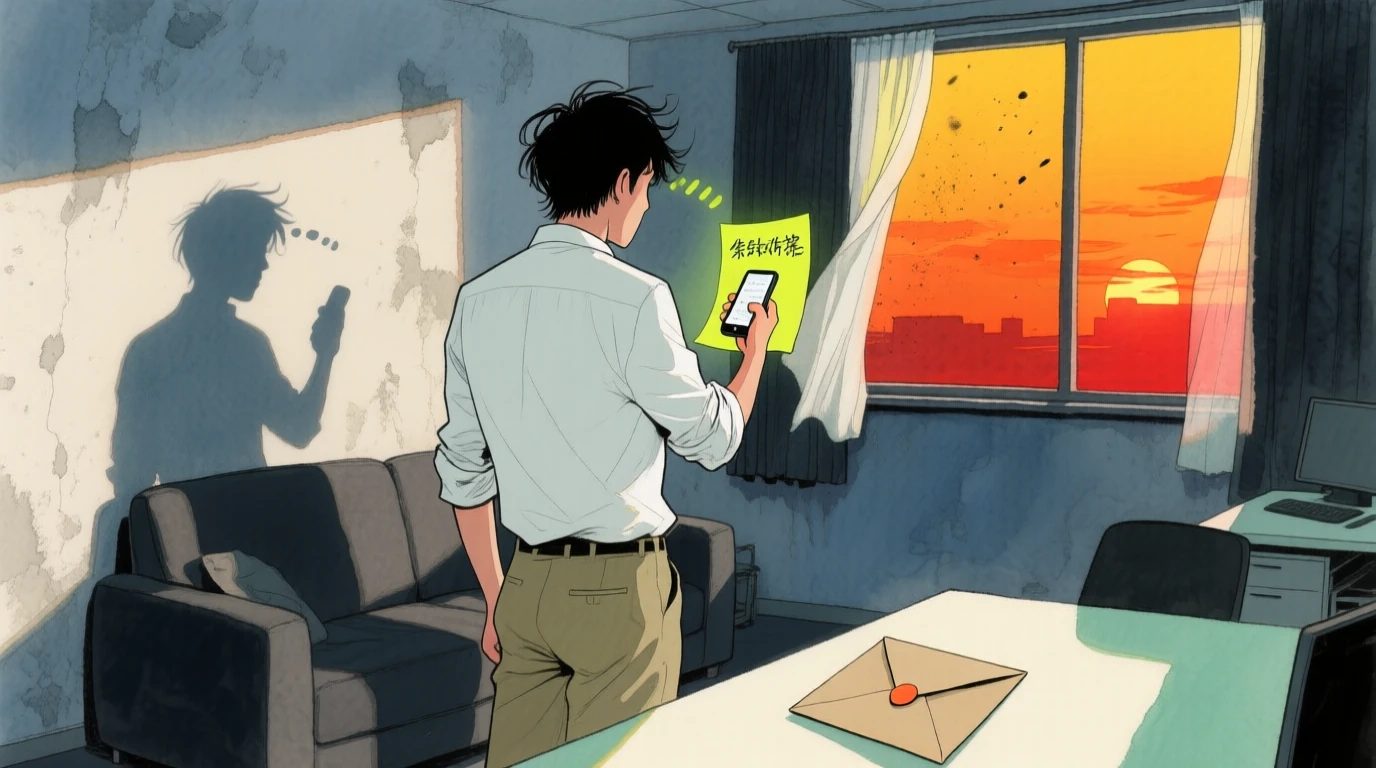
He opened his phone and tapped into the new assignment file. When he reached the last page, he found a slip of paper tucked inside—not part of the file, just an ordinary sticky note. On it were a few lines:
“You know too much, Cleaner.”
Chen Mo froze.
He stared at the words. His heart rate didn’t spike. His expression didn’t change. But his fingers tightened slightly.
He didn’t look up immediately. He kept his posture as if still reading his phone, his peripheral vision scanning the car—an elderly man reading a newspaper to the left-front, a young man scrolling his phone to the right-rear, a mother soothing a child diagonally across. No one was staring at him. But he didn’t relax.
He flipped the note over. The back was blank. No signature, no date, no other message.
He put the note back in the file, turned off his phone, and swept his gaze across the car again. In the reflection of the young man’s phone screen, he seemed to catch a side profile—just as the doors were about to close, a man in a black jacket stepped quickly into the adjacent car. Chen Mo logged his build.
The train pulled into a station. He stood up and got off. He deliberately took a detour—stepped into a convenience store, bought a bottle of water, exited through the back door, and confirmed no one was following him—before heading to his apartment.
It was an old walk-up, fifth floor, no elevator. He climbed the stairs, unlocked the door, and walked in.
He put the manila envelope on the table, went into the kitchen, and poured a glass of water.
He leaned against the counter, looking out the window. The sunset was slowly falling, the sky turning orange.
He picked up his phone and dialed.
“Hello?” Old Zhou’s voice came through.
“I found a note in the assignment file,” Chen Mo said, his voice calm.
A few seconds of silence on the other end. Then Old Zhou said, “What note?”
“‘You know too much, Cleaner.’”
Longer silence. Chen Mo could hear Old Zhou take a breath.
“Are you sure it was in the assignment file?”
“Positive.”
“Where are you now?”
“Home.”
“Don’t go out,” Old Zhou said, his tone unusually serious. “I’ll send someone over.”
“No need,” Chen Mo said. “I just want to know who put it there.”
“I don’t know,” Old Zhou said. “But it means someone knows who you are.”
Chen Mo said nothing.
“Chen Mo,” Old Zhou said, pausing for a long time before continuing, “you can turn down this assignment.”
“Why?”
“Because it means your identity might be compromised,” Old Zhou said. “If they know about you, your safety is at risk.”
Chen Mo was silent for a few seconds.
Then he said, “I’ll take the assignment.”
“Chen Mo—”
“I’ll take the assignment,” Chen Mo repeated. “The other side went to all this trouble to plant a note. They want to see me back down. If they want to play, let’s play bigger.”
On the other end of the line, Old Zhou’s silence stretched longer this time. Long enough that Chen Mo thought he’d hung up.
“Do you know what you’re doing?” Old Zhou finally said, his voice half a notch lower than usual.
“I do.”
“Then fine,” Old Zhou said, a hint of street-wisdom creeping into his tone. “Looks like someone wants to see you fall. But you were trained by me. If anyone’s going down, it’ll be them first. Report to the office on Monday. We’ll go over the details then.”
“Good.”
Chen Mo hung up.
He walked back to the living room, picked up the envelope, and pulled out the note.
He stared at the words. No sneer. No inner monologue. He just folded the note in half and slipped it into his shirt pocket.
He didn’t turn on the lights. In the dark, the glow of his phone screen reflected off his face. The words on the note were burned into his mind like a brand.
He turned off his phone. In the darkness, only his breathing remained.