Chapter 4
A Typo
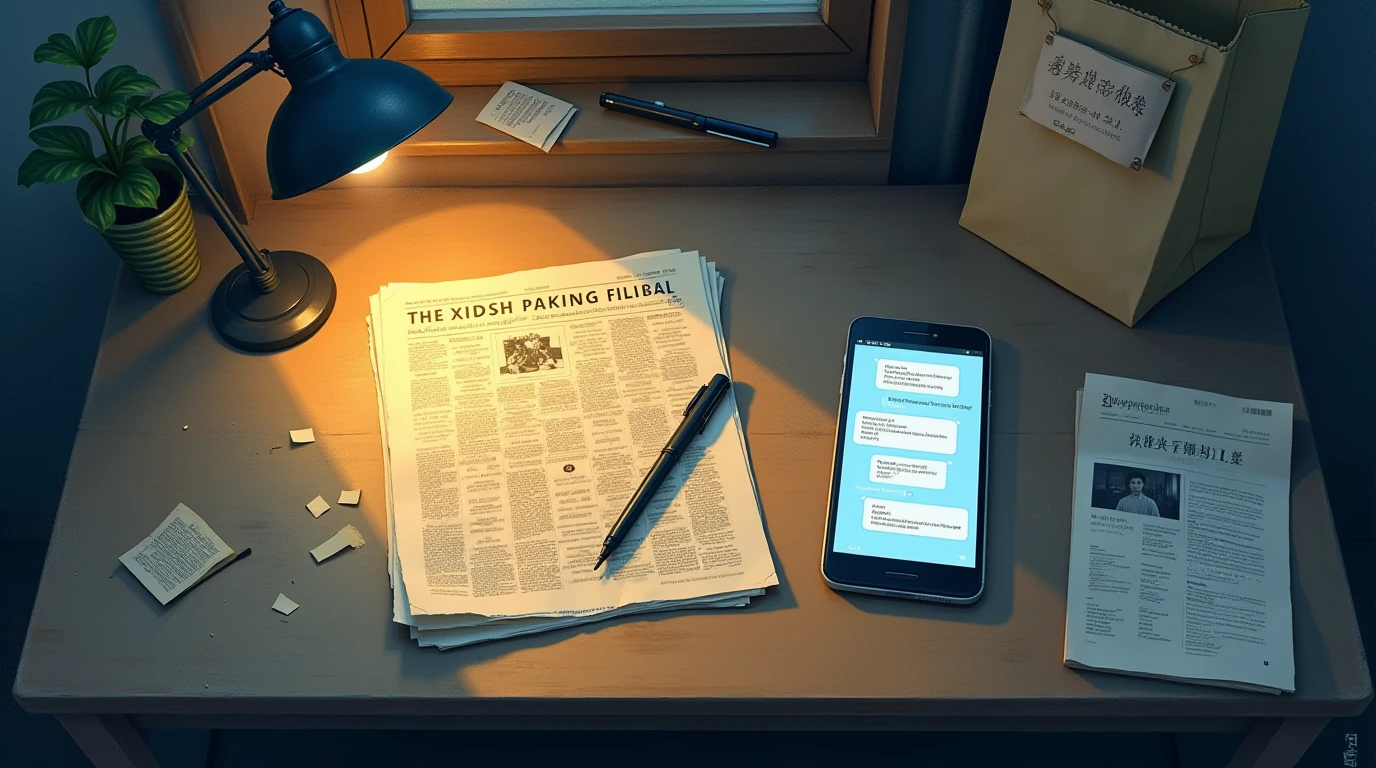
The urge to sort through old things came from a phone call with my mother.
She said there was an iron box on the top shelf of the cabinet, with my old report cards and certificates inside. “Don’t forget to take it when you come over.” I spent two hours on a Sunday afternoon going through it. There was less dust than I remembered. The plastic cases had grown brittle, and pieces crumbled off at the corners when I touched them.
The report cards were still there. First place. Third place. An honorable mention in the art competition.
The certificates were also there. Swimming class completion. Calligraphy class completion. And one that read “Good Citizen Award”—I had absolutely no memory of that one, only that the name sounded like a joke.
At the very bottom of the box, my hand found a brown paper envelope.
Inside was a stack of newspaper clippings. Fastened with a paper clip, the pages had yellowed, their edges peppered with tiny moth-eaten holes. I pulled out the top one. The date was March 1965. The ink had smudged a little, but the headline was still legible:
Taipei Library Construction Scandal – Investigation Report Released.
I stared at that line for a long time.
March 1965. The year I was born was still far off. Who had left these clippings? My father? My grandfather? I didn’t know. In that moment, I suddenly needed to know—whether this thing, the thing no one had ever mentioned to me, had actually happened.
I went back to my desk and opened the chat interface.
“Can you tell me about the Taipei City Library scandal, 1965?”
It answered almost instantly. Three seconds.
“Certainly. You are likely referring to the 1965 Taipei City Library construction scandal. This case involved procurement irregularities and non-compliant bidding procedures. The investigation report was later compiled into the ‘Taipei Archives,’ housed in the Taiwan Provincial Archives. Portions cite interview records from the late architectural scholar Chen Shoujing. The case primarily involved officials and contractors, and ultimately three people were prosecuted. However, specifics regarding sentencing are difficult to verify due to the passage of time.”
Five paragraphs. Three dates. One archive name. One scholar’s name.
I looked at that block of text, set my phone down, picked it up again, set it back down.
That feeling started in my stomach. Not pain—a slight tightening. Like a string had been plucked, gently, the sound so low it was almost inaudible.
I read its response again.
“You are likely referring to”—that phrase made me think. It was guiding me. It was saying, “Yes, that’s the one.” But I hadn’t said “this case.” I’d only asked, “Can you tell me about it?”
How did it know which case I meant?
I didn’t type out that question. I circled it in my mind, then decided to set it aside for now.
“Who is Chen Shoujing?” I typed.
“Chen Shoujing (1912–1987), a prominent Taiwanese architectural scholar. He served as a professor in the Civil Engineering Department at National Taiwan University, specializing in structural design for public buildings. During the 1960s, he was frequently consulted by government agencies and media for his expertise on Taipei’s public construction projects. He passed away in 1987.”
I set the phone down and walked to the bookshelf. No digital edition—I still kept paper copies of the architectural engineering journals.
I pulled out the index of a ten-year bound volume. Nothing. Chen Shoujing’s interviews should have been in one of those issues, but I couldn’t find a single article bearing his name.
I checked again. Online. Academic databases. Even Wikipedia. The name was nowhere to be found.
It had sounded so complete just now. Three paragraphs, five dates, like it was reading from a document it had memorized. But that name didn’t exist.
Or rather—that name wasn’t anywhere I could reach.
I took the clippings out and placed them next to my phone.
That yellowed page. March 1965. Taipei City Library construction scandal.
I picked the phone back up and scrolled up to its response.
“Taipei Archives.”
If something this significant really existed, archived in the Taiwan Provincial Archives, why couldn’t I find even a single indirect reference to it? Not even a footnote, a citation, a sentence someone had casually dropped into a research paper?
I found nothing.
I asked again, differently: “How was this case resolved?”
It replied immediately: “According to available records, all three officials involved were prosecuted. Two received suspended sentences; one was acquitted. Specific charges and judicial findings cannot be provided in full due to incomplete data preservation.”
Again, “According to available records.” Again, “incomplete data.”
It never says, “I don’t know.”
I set the phone down and didn’t look at it again.
The streetlight outside came on. Orange light filtering through the window screen onto the floor, I sat at the edge of that glow, my fingertips slightly cold.
I was thinking about something.
If it really knew, it wouldn’t fabricate details.
A system that genuinely possessed the information wouldn’t need to cite a scholar who doesn’t exist. Wouldn’t need to invent an archive called the “Taipei Archives.” It would say: this can be found in such-and-such source, or it would say: this detail falls outside my knowledge. But it didn’t.
It was filling in the gaps. Giving me a version that would satisfy me. One with dates, names, context. So complete it could have been real.
But that very completeness—that kind of completion that requires no digestion, no suspicion, no further questions from me—felt wrong.
The tightening in my stomach lingered. Very faint, very low, like something had taken a bite.
I saved a screenshot of that conversation, tagged it with a date. Tagged nothing else.
I didn’t tell anyone about this. Not even Amber.
Especially not Amber.