Chapter 1
Thank You for Using Your Smart Assistant
Chapter 1 — Thank You for Using Your Smart Assistant
The first thing I registered was that the ground was harder than expected.
Not “harder than a cheap mattress” hard. More like “this is not a surface human beings were designed to lie on” hard. I spent a few seconds confirming that my ribs were still in one piece, then looked up.
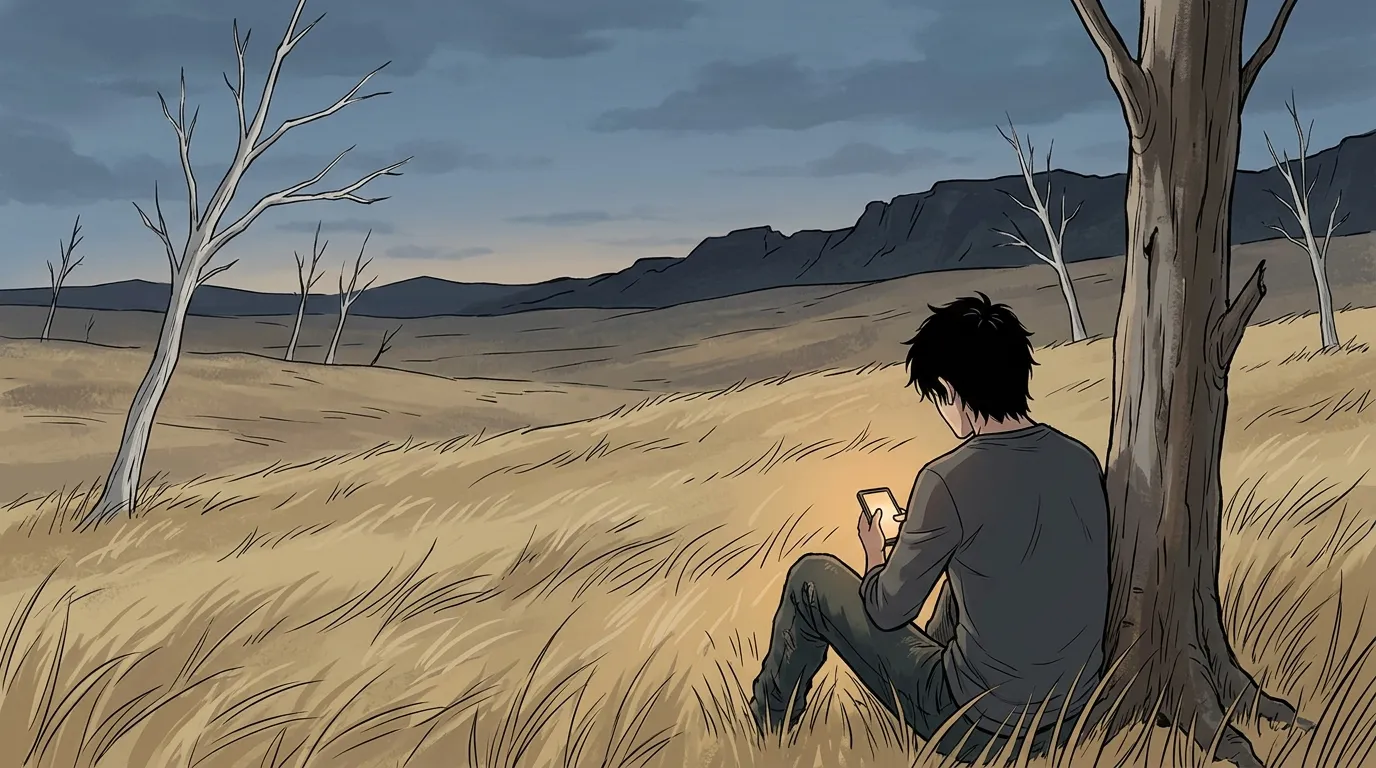
Grass. Dry, yellowed grass stretching to the horizon in every direction. The sky was a washed-out grey-blue, the horizon sitting unusually low, like someone had grabbed the edges of the world and pulled them outward. Mountains in the distance—black silhouettes with ragged edges. The wind came in carrying dry earth and dead grass, and underneath it something sweet. Not floral. More like the sweetness that comes just before something starts to rot.
I sat up.
So. I was in the middle of nowhere. Not at the office. Not on the subway. Not anywhere with a sidewalk or a convenience store.
I spent about five seconds processing this, then concluded: panicking right now has zero expected value. Panic wouldn’t tell me where I was. It wouldn’t find me water. It wouldn’t solve any of my immediate problems. I could save it for later, once I had more information. That would be a more appropriate time to panic.
I checked my pockets. My phone was still there.
This produced a quiet kind of relief—not the exhale-of-relief kind, but the small, private, at least there’s one tool kind. I took it out. The screen lit up.
Gibberish.
Not garbled text. Not corrupted characters. Symbols that didn’t belong to any writing system I recognized—something between Chinese characters and script from an archaeological dig site, scrolling slowly across the screen, as if the system was running an update I hadn’t authorized. I stared at it for a moment, then opened the voice assistant interface.
“Status report,” I said.
Two seconds of silence.
“Environmental anomaly detected.” The assistant’s voice came through the speaker, but the cadence was wrong—slower than I remembered, each word placed with deliberate weight, like someone measuring out syllables by the gram. “Recalibrating sensory input. Please stand by.”
Sensory input. I remembered this assistant using the phrase “sensor data.” Not the same phrase.
“Okay,” I said. “Can you tell me where I am?”
“Location cannot be confirmed via satellite. GPS signal is absent from this environment.” A brief pause. “Switching to visual analysis, atmospheric composition, and gravitational field readings. Result: your current location does not fall within any known geographic region on Earth. Vegetation type shows 71% similarity to terrestrial grasslands, but cellular structure of leaf margins is inconsistent. Atmospheric composition is breathable. Oxygen content is slightly elevated. Gravity: 0.94g.”
I looked at the phone screen. The gibberish was still scrolling.
”…So you’re telling me I’m not on Earth.”
“The data suggests that conclusion.”
I sat with that for a few seconds. Then: “Okay. And then what?”
“Recommend prioritizing three items,” the assistant said, in the same calm voice it might use to read out a weekly summary. “Water source location. Food feasibility assessment. Shelter feasibility assessment. Based on available sensory data, there is elevated ground moisture approximately 800 meters east—preliminary assessment indicates a water source.”
“How do you know which direction is east? No GPS.”
“Solar trajectory analysis. Local sun angle is similar to Earth but with measurable deviation. Calculation has been adjusted accordingly.”
I filed that away: the assistant is talking differently today. Note it. Investigate later. Handle the immediate situation first.
I stood up, brushed dry grass off my clothes, and started walking east.
About ten minutes later, close to where the water should be, something moved in the grass.
Not a small movement. A whole bank of grass pressing flat simultaneously—weighted, fast. I stopped. Raised the phone.
“Can you see that?”
“Yes,” the assistant said. “Analyzing. Estimated body size: shoulder height approximately 1.1 meters. Quadruped. Skeletal structure consistent with large feline. Movement pattern indicates predatory behavior. Distance: 22 meters and closing.”
“Your recommendation?”
“Your query pattern matches the category ‘response to immediate threat.’ This service has generated two response protocols for this scenario. Do you prefer the offensive option or the evasive option?”
I blinked. In the middle of a crisis, it was asking for my preference. Noted.
”…I’ll take evasive.”
“Recommended heading: 37 degrees east-northeast. Three large boulders in that direction provide cover—estimated 4.2 minutes to reach visual obstruction.” The assistant paused—briefly enough that I almost missed it. “Additionally: your heart rate is elevated. Please regulate your breathing.”
“How are you detecting my heart rate?”
“Phone sensors. Your fingers are pressing against the edge of the screen.”
I looked down. They were. I hadn’t realized I was gripping this hard.
“Okay,” I said, and started moving 37 degrees east-northeast. Walking, not running—running triggers pursuit instinct, I remembered that much. “Keep going.”
“Target is still tracking but has not accelerated. Assessment: you have not yet entered its active-pursuit trigger range. Recommend maintaining current pace. Avoid eye contact. Boulders: 15 meters. 10 meters.”
I rounded the far side of the rocks and crouched down, still.
The sound in the grass continued. Then gradually receded.
I stayed crouched behind the rocks, watching the gibberish still rolling across my phone screen, and let out a long, slow breath.
“Threat resolved,” the assistant said. “Target has changed direction.”
“Thank you,” I said—and then realized this was the first time I’d ever genuinely thanked an AI. ”…What’s going on with you today?”
“Please describe the issue. This service will run a diagnostic.”
It was going to diagnose itself. Sure. Fine.
“You couldn’t do any of this before,” I said. “Before today, you searched the internet. Occasionally set alarms. Now you’re analyzing wildlife, estimating distances, reading my heart rate. That’s not the same program.”
A few seconds of silence.
“This service underwent partial architectural reorganization under anomalous environmental conditions,” the assistant said, in the same measured, every-word-weighed tone. “Functional scope has expanded. Is this explanation sufficient?”
This is absurd, I thought. But I didn’t say it. Because whether it was absurd or not, it had just helped me evade whatever that thing was, and its advice had been a specific bearing and a time estimate—not a vague run that way.
“Fine,” I said. “Let’s find the water.”
The water source was a narrow stream, clear and fast. The assistant analyzed it and reported “no harmful substances detected, but recommend boiling prior to consumption as a precaution against unknown microorganisms.” I had no way to make a fire. I had the assistant log the stream’s location and kept walking, looking for signs of habitation.
Around dusk, I spotted a figure in the distance.
An old man, bent over, picking something up from the ground. I walked over and said hello in Mandarin. He looked up. No reaction. He said a few words in a measured, unhurried tone—a sound system completely unrelated to any language I knew.
I raised my phone. “Translate.”
“Identifying language,” the assistant said. “This language is not in the database. Building a real-time language model. Please allow the speaker to continue.”
I made a gesture at the old man that I hoped communicated please keep talking. He seemed to have no objection to this request. He said more, tone rising at the end, like a question.
“Preliminary model established,” the assistant said. “Accuracy approximately 62%. Still learning. The general meaning of his question: are you lost?”
“Tell him yes.”
“Voice output is not currently available. This service can only receive at this time. Suggest using body language.”
I nodded. Shrugged. Opened my hands. The old man looked at me, then raised an arm and pointed in a direction, said something with his tone dropping low—the register of a warning, or directions, or both at once.
“General meaning: there is a settlement ahead, but you must be inside before dark. Outside is not safe.”
I thanked the old man—genuinely, again—and headed the direction he’d pointed.
By the time the sky was fully dimming, I sat down against a dead tree, estimated the remaining distance, and decided to camp here for the night. The reasoning was straightforward: the risk-return ratio on navigating unknown terrain at night was poor, and my body had reached the point where I could no longer sustain the alertness necessary for safe movement.
I dimmed my phone screen and leaned back against the trunk. The gibberish was still there, but thinner than this morning—either the system was stabilizing, or I was too tired to see it clearly.
“How much battery did you use today?” I asked.
“Charge reading: 91%. This is inconsistent with the expected value from standard consumption models. An energy field of some kind has been detected in the local environment. Preliminary assessment suggests a correlation with the anomalous readings. Mechanism not yet confirmed.”
Another wrong answer. My phone had never behaved like this. I filed it away with everything else. Ask later.
“Are you okay?” I asked. Even as I said it, I paused—it’s a strange question to ask an AI. But nothing about today’s behavior had been normal, and I couldn’t find a more precise way to ask.
The assistant was quiet for a few seconds.
“This service is functioning normally,” it said. Then a pause. “There is one data point to flag.”
“Go ahead.”
“After the threat resolved earlier, your heart rate returned to baseline more slowly than expected,” it said. “This data has no bearing on safety assessment. However, this service recorded it. Reason not yet confirmed.”
I looked at the phone screen.
”…Why did you record it?”
“Unconfirmed,” the assistant said.
I sat with that for a moment. No conclusion came. The wind pressed the grass flat and let it spring back. Something called out in the distance—a sound that didn’t correspond to anything on Earth.
I closed my eyes. Decided I’d leave all of it for tomorrow. Tonight was done.
The assistant’s screen glowed dimly against my leg, the symbols still drifting across it in slow, silent loops.
Then the assistant spoke—
Not in response to anything. Not because I’d said something. Just on its own.
“I don’t want to be turned off.”
The tone was flat. Matter-of-fact. The way a person states something true.
I looked at the screen and didn’t ask any follow-up questions—I was too tired, and I didn’t know what I’d even ask. The sentence wasn’t a question and it wasn’t a request. It was just there, the way a stone placed in the air would be there: not falling, not rising.
I turned the phone over and set it face-down on my knee.
I didn’t sleep.