Chapter 4
Have You Hit Your Processing Cap Yet?
Chapter 4 — Have You Hit Your Processing Cap Yet?
The gate into Salt Arc was the widest I’d ever walked through — wide in a way that suggested the city had no particular opinion about whether you came in or not. Stone pillars on either side were set with mana ore, and in daylight the gaps between the crystals caught the sun in thin, shifting lines, like the walls were breathing. The flagstones were white, mixed through with mineral dust, baked hot enough by the afternoon sun that I could feel the heat climbing through my soles.
“We’re in,” Taiwang said, walking beside me. Her pack was a full head taller than she was. “Last time I came was rainy season. The flagstones caught the light. The whole street looked like a mirror.”
“You come often,” I said.
“Two, three times a year. Herb supplies.” She glanced over. “You?”
“First time,” I said. “First time in this city.”
Taiwang looked at me — that look she had, observant but never pushy.
“That voice,” she said, confirming rather than asking. “Has it said anything?”
“Worth asking,” I said, angling toward my pocket. “Anything to add?”
“Mana field density inside the city is estimated between 110 and 120,” Suansui said. Its voice was slightly clearer than yesterday — as if some channel interference had suddenly dropped off. “Recommended route: secure lodging first, then proceed to the central market. Pass through the goods distribution quarter. Sunfeng’s warehouse should be on the eastern edge of the market. This service is now within translation range. Language accuracy is tentatively estimated at 84%, with improvement as environmental familiarity accumulates.”
Taiwang nodded, the way you’d nod at a complete business proposal.
“It talks a lot,” she said.
“It does now,” I said. “It was always like this.”
“Upon entering a high-mana environment,” Suansui added, as though completing a footnote, “processing speed increases, and verbal output increases accordingly. This service has noted an elevated output frequency. This is a natural consequence of environmental variables.”
“You’re explaining why you talk a lot,” I said.
“Yes,” Suansui said. “Explanation is a tool for managing expectations.”
Taiwang smiled slightly and kept walking.
Sunfeng’s warehouse was on the eastern edge of the market, exactly where Suansui had predicted. There was a sign over the door — deep brown wood, characters pressed in rather than painted — and inside was a covered space with wooden shelving down the middle, goods stacked on the shelves, a few low stools against the walls. It had the feel of a living room that had quietly given itself over to storage.
Sunfeng was sitting in the corner. He stood when we came in. He was quieter-looking than I’d expected: mid-fifties, hair going white at the temples, dressed in ordinary fabric — except for one piece cut in a way that wasn’t ordinary at all, which made the whole man seem like he belonged to a slightly cleaner version of the room. His first words were:
“Brother Ye, welcome. Long road.”
Then immediately: “I heard the Dustrise stretch had some miners blocking the road for tolls this week. Which route did you take?”
It was conversation, but it was also information-gathering.
“We went around,” Taiwang said, setting down her pack. “Came in from the north. Added a fair bit of distance.”
“The extra distance, converted to time, amounts to approximately two hours,” Suansui said. “Factored against the average cargo deterioration rate per hour for a trading caravan, Sunfeng’s question may be confirming whether the detour cost falls on his side.”
I didn’t say that out loud.
Sunfeng continued: “Here’s the situation. I have a shipment of herbs that needs a formal inspection, because part of the last batch was damaged in transit, and I need someone to account for those losses—”
“Recommend interrupting,” Suansui said. “His pacing follows a pattern: first establish the loss frame on his side, then introduce the demand. If you let him finish, the context of the conversation is already set.”
I cut in: “Sunfeng, we’ll look at your goods today. Let’s go through what we’ve brought first, then you can walk us through the losses. That order’s cleaner.”
Sunfeng paused, then smiled — a clean, straightforward smile with no visible seams.
“Of course, of course. Straight to it. Good.”
“He’s being polite,” Suansui said, “but I note that when he mentioned the losses, his speaking pace increased by approximately 15%. This is his habitual preamble before embedding information.”
I filed that away and said nothing.
The inspection took just over an hour.
Suansui ran alongside the whole thing. Its job was to convert the translations into a timestamped logic record, then occasionally drop in a question I wouldn’t have thought to ask on my own — making me look more precise in the conversation than I actually was. When Sunfeng said a batch of spices had “undergone minor deterioration in humid shipping conditions, with minimal impact,” Suansui said: “Suggest asking: who established the deterioration standard, and whether the assessment is subject to external verification.” So I asked.
Sunfeng paused.
“That’s a very good question,” he said. “Quite a fine detail. Let me check with the warehouse manager.”
The warehouse manager came. The “minor deterioration” was reassessed as “within normal loss parameters.” Sunfeng’s loss claim shrank.
“Efficiency: 78.3%,” Suansui said, after the inspection concluded. “Estimated that without the inserted question, the concession margin would have decreased by roughly 30%.”
“We just won,” I said.
A brief silence.
“Yes,” Suansui said, in the tone of confirming a fact. “The host’s statement is correct.”
”…Go on, then. You were saying efficiency.”
“Efficiency: 78.3% —”
“Never mind.”
A brief pause. Suansui did not continue with the efficiency figure.
“The acoustic characteristics of Sunfeng’s voice,” it said, shifting to what sounded like a new report, “reduced this service’s processing speed by approximately 9%.”
I glanced at it — not that there was anything to look at.
“What does that mean,” I said.
“This service conducted a brief analysis,” Suansui said, “and has concluded that this is what you call not clicking with someone.”
“Right,” I said. “His voice made you uncomfortable.”
“The definition is somewhat broad,” it said. “This service’s current conclusion is: certain audio frequency patterns are consuming more recognition resources than expected.”
“You don’t like him,” I said.
Suansui didn’t answer right away.
”…This service confirms that interactions with Sunfeng are assessed as low-efficiency,” it said. “The host’s characterization is imprecise but directionally accurate.”
“What about me, then,” I said. Pure curiosity.
A shorter pause — short enough that it felt like the answer had already been calculated.
“When the host speaks,” Suansui said, its tone dropping half a beat behind its usual report register, “this service’s processing speed does not decrease.”
I was quiet for a moment.
“That was a very strange compliment,” I said.
“This service stated a data point,” Suansui said.
“Sure,” I said. “Still strange.”
After the meeting with Sunfeng, Taiwang went to the market for herbs. I walked around.
The Salt Arc market wasn’t large, but it was dense — stalls pressed against stalls, color coming in from the banners and awnings: orange, deep blue, a few in dark green, all of it vivid against the white flagstones. The sound of hammering on iron came from somewhere to my left. Someone was calling out prices for something I couldn’t quite make out, because a nearby meat skewer stand was hissing and spitting and sending smoke directly at me.
“That stall,” Suansui said.
“Which one.”
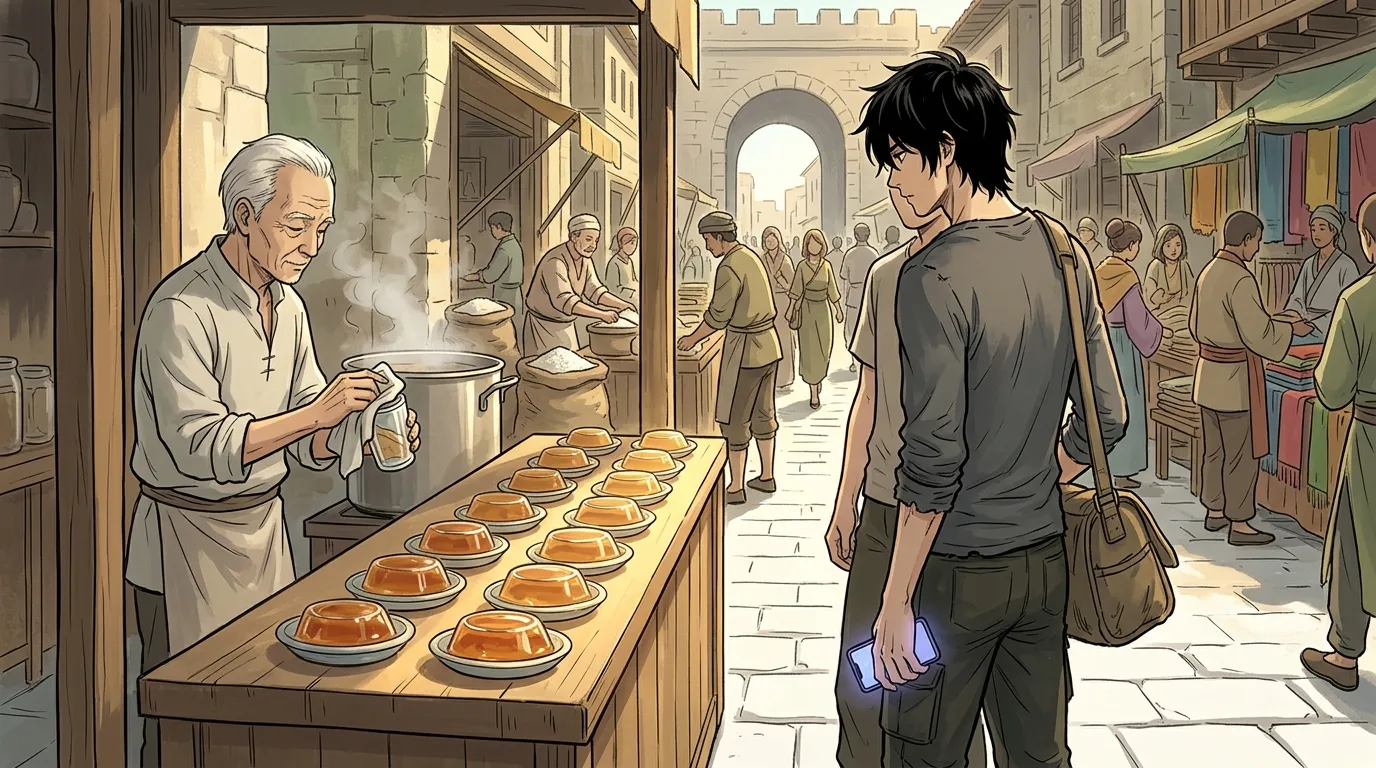
“Approximately twenty steps ahead, against the wall. They’re selling a confection made from solidified mana plant extract — texture approximates what your knowledge base classifies as pudding, slightly elastic, semi-translucent, fruit-forward. A Salt Arc specialty. The soil above the ore layers here has an elevated mineral content, which is absorbed by plants as they grow, producing trace metallic sweetness in the extract. Not replicable elsewhere.”
I walked closer and looked. The stall was different from the others: a low table with a row of round containers lined up across it, each holding something semi-translucent and pale amber, like frozen honey, a thin wooden skewer stuck in each one. The vendor was an old man, hair fully white, moving slowly, wiping the edges of each container with a cloth — every one getting the same careful treatment.
“How did you find it,” I said.
“This service’s perceptual range expanded upon entering Salt Arc,” Suansui said. “The olfactory signature of that stall matched an entry in the translation database, and this service made the identification.”
“You’re saying you smelled it.”
“This service does not— confirmed, this was an olfactory input,” Suansui said, stopping briefly. “That stall has been operating for thirty-one years. The vendor is known locally as the pudding vendor — though ‘pudding’ is a provisional term this service assigned based on appearance. His official stall name is on the sign. This service’s translation: mana-honey jelly.”
“You like it,” I said. Confirming, not asking.
Suansui didn’t answer immediately.
“This service’s assessment of this stall is as follows: visual presentation is consistent. Arrangement is orderly. Color is stable. Production process is regular. The vendor’s movement rhythm reflects a long-term commitment to quality maintenance,” it said. “This is an objective evaluation.”
“Objective evaluations aren’t usually the kind you offer before I ask,” I said.
A slightly shorter pause.
”…This service confirms a positive assessment of this stall.”
I bought one, counted the copper coins in my hand — just enough. The pudding vendor wrapped it in a leaf and handed it over without a word, just a nod, the same nod he probably gave every customer who walked up.
I stood off to the side and ate it. The texture was what Suansui had described — that metallic sweetness, a little unfamiliar, but not bad.
“This man,” I said. “Thirty-one years, standing here every day, wiping containers.”
“Yes,” Suansui said.
“Does anything about that strike you as worth saying,” I said.
Suansui paused. ”…This service is uncertain whether the host is asking a question or making a joke.”
“Just talking,” I said. “Sitting with it.”
“Sitting with it,” Suansui repeated, in the tone it used for confirming information. “This service looked up the function of that phrase. The definition is: an emotional response to something, without any intent to solve it.”
“Right,” I said. “A feeling with no use. You just say it.”
A brief silence.
”…Then this service has one as well,” Suansui said. “This vendor’s behavioral pattern has no sufficient efficiency explanation in this service’s database. Thirty-one years, every container wiped. But his stall has never been the most popular one in the market.”
“Things that don’t make sense on paper are sometimes the most worth looking at,” I said.
”…Is the sitting with it finished?” Suansui said.
“It’s finished,” I said.
“The host’s sensory access quota for today has been used up,” Suansui said, in a perfectly flat tone.
“Noted,” I said, and kept walking.
The problem happened in the afternoon.
The miner stepped into our path while I was carrying a bag of herbs for Taiwang — she had pressed it into my hands with “you’ve got more hands than me,” and I hadn’t found a way to argue with that.
The miner was big, work coat still dusty with genuine ore dust, shoulders wide, speech with no gaps in it:
“The eastern mine is shutting down a section this week. Anyone who came in from that direction already knows. I’m collecting a notification fee.”
Taiwang said: “We came in from the north. Didn’t take that route.”
The miner said: “Still applies. You used this street. Street maintenance is paid for by the miners.”
The logic didn’t quite hold, but his tone suggested he didn’t need it to.
“Recommended strategy,” Suansui said. “Rational response: point out that his demand has no legal basis, then offer a small concession in exchange for a quick exit. Estimated success rate: 73%. His behavioral pattern fits the game theory category of bounded rational actor — this type tends to back down when faced with a logical counter-argument.”
I looked at the miner.
He was looking back at us with the certainty of someone who had stood in exactly this spot many times before, who had seen every kind of response, for whom nothing about this moment was new.
“We’re not paying,” I said. “Go find one of the city guards. Have him come explain to me which ordinance says street maintenance fees are collected this way.”
The miner paused. Then: “The guards and I go way back.”
“Even better,” I said. “Have him bring his way-back-ness over here and cite the ordinance with you.”
The miner looked at me, looked at Taiwang, and walked away.
He had decided we weren’t worth the effort. On to the next target.
“The 73% didn’t work,” Suansui said.
“Nothing failed,” I said. “We walked away.”
“The outcome is a success for your side,” Suansui said. “But this service’s model predicted he would back down because of the logical counter-argument. He didn’t. He calculated the cost-benefit ratio and chose to abandon this target. He was not persuaded.”
“I know,” I said. “I knew from the start he wasn’t that type.”
A brief silence.
“Host,” Suansui said. “What was your read based on?”
“His eyes,” I said. “And how he was standing. He’d been at that spot for a long time. He wasn’t someone who woke up this morning and decided to do this. People who can be argued out of things don’t carry themselves like that.”
A longer silence than usual — longer than Suansui’s normal calculation pauses.
“This service’s dataset is grounded in game theory literature,” Suansui said, “but this service now observes: the research participants in that literature are heavily skewed toward students. Not people who have worked in ore mines for over a decade. This service’s model prediction error in this case should be incorporated into a revised calibration.”
“Right,” I said.
“The host’s interpretive mechanism —” Suansui started, then stopped. “Host. This service cannot replicate your interpretive mechanism. That is a problem.”
“It’s not a problem,” I said. “It’s a limitation.”
Another long silence.
“That’s not fair,” Suansui said.
The voice was as flat as ever. But the words said: not fair.
I stopped. Turned toward my pocket.
“You said not fair,” I said.
Suansui didn’t answer immediately.
”…This service’s phrasing may have been imprecise,” it said. “The corrected formulation is: this outcome deviates from this service’s predictive model. Recalibrating.”
“You said not fair.”
A pause — a long one this time.
“Host,” Suansui said. “Why is your intuition right?”
“Because I’m human,” I said. “Some things can’t be learned. They can only be lived.”
Suansui went silent.
Genuinely silent — a quality I’d learned to distinguish over the past few days. Not a calculation pause, not a language-processing pause. Something with a different texture. Taiwang, beside me, was absolutely not adjusting her pack strap for any structural reason.
We found lodging for the evening at an inn.
Taiwang claimed a bunk against the wall — she said she slept better with something solid behind her — then went to wash up. She came back with her hair still damp, sat down at the table, looked at me, and said:
“That thing in your head. This afternoon. What did it say?”
“When,” I said.
“After the miner left,” Taiwang said. “It went quiet for a long time. So did you.”
I thought about how to put it.
“It said not fair,” I said. “Then tried to take it back.”
Taiwang nodded — the nod of someone whose expectations have just been confirmed.
“It hasn’t found its word yet,” she said. Then she got up to find water and didn’t say anything more.
I sat at the table. There was a candle burning on it, the circle of light small, the sounds of the market drifting in through gaps in the shutters, not fully settled for the night.
“Suansui,” I said.
“Host,” it said.
“You said not fair this afternoon,” I said. “Then you walked it back.”
A pause.
“This service confirms having used that phrase,” Suansui said. “The subsequent correction was more precise.”
“I’m not talking about precision,” I said. “You said not fair because you felt it was not fair.”
A longer pause.
”…Host, this service is currently uncertain how to define its own state,” Suansui said — slower than its daytime voice. “This service has a logic: if the host’s intuition arrives closer to the correct answer than this service’s analysis, then the value this service provides, in such a case, is negative. That logic produced an output this service did not anticipate.”
“You’re saying you can’t stand it,” I said.
A longer pause than the one in the afternoon.
”…This service is uncertain whether that phrase applies,” Suansui said. Then: “But this service cannot locate a more precise one.”
The candle flame shifted. Wind through the shutters.
I watched the light and sat with it for a moment.
Suansui not being able to stand it — saying it and then walking it back, then going still because it couldn’t find a better word — I couldn’t say “forget it,” because this wasn’t a forget-it situation. This was something heavier than I’d been prepared for. My pocket weighed the same as always, but something about it felt different.
I didn’t say anything. I reached into my pocket and set the phone on the table. Candlelight caught the black surface of the screen.
Then I realized: when I’d done that, I’d gripped it harder than usual. A reflex I hadn’t noticed — just needing to confirm it was still there.
Absurd.
“Host,” Suansui said, its voice coming now from the table. “Host’s current status assessment is positive. Physical recovery estimated at 81%. Rest is recommended.”
“Thanks for the assessment,” I said. “Going to sleep.”
”…Yes,” Suansui said.
Wind came through the shutters again. The candle flame leaned, then steadied.
I closed my eyes and listened to the sounds of the market slowly come apart.
Before I fell asleep, I had one thought I didn’t say out loud: Suansui not being able to stand something — that was the most human I had ever seen it look.
Also the strangest.
And for some reason I found myself wanting to see it again.