Chapter 1
One Place Setting Too Many
Chapter 1: One Place Setting Too Many
Yīn Zhòngguāng stood outside the convenience store for about thirty seconds.
Not hesitation. A buffer. The distance from the motorcycle to the store entrance was too short — he needed to stand there a moment longer. Across the street was the precinct, its gray-white exterior looking in the nine o’clock morning sun like a slab of concrete that hadn’t fully dried. Two officers were smoking by the front door, sleeves rolled to the elbows.
He pushed open the convenience store’s door. Cold air and the sound of the coffee machine hit him at the same time. He grabbed an Americano and a triangle rice ball, and when the cashier asked if he wanted to add a bread, he said no.
When he came out, the two smokers had already gone inside. He crossed the street and walked into the precinct.
The ground floor was reception and the duty room. The air had a smell of sweat that the cleaning solution couldn’t quite cover. He didn’t take the elevator — three people were waiting at the elevator door, and it looked like they’d be waiting a while. He found the stairwell and went up.
The second floor was administration. Someone wheeled a document cart down the hallway, its wheels making a continuous, grating squeal against the tile.
Third floor.
The fluorescent tube in the stairwell was out, and in its flickering the corridor seemed to breathe. On the right was the criminal investigation unit, door wide open, the sound inside like a pot of rolling water — keyboards, phones, someone getting chewed out, someone laughing. Yīn Zhòngguāng paused briefly at the investigation unit’s door. He’d spent eight years in that kind of noise. Not this precinct’s unit, but the sound was the same.
He turned left. At the end of the hallway was the records room, door closed. Next to it was another door, with a label above the frame — the kind made with a label printer, smaller than the keyhole, one corner lifting: “Missing Persons Task Force.”
The door was open. The space inside looked roughly a third the size of the records room, maybe smaller. Two desks were pressed together face-to-face, just enough room to sidle through between them. An iron-gray filing cabinet stood against the wall, four drawers, a dehumidifier sitting on the top drawer with its cord hanging down, plug unconnected. The ceiling had a water stain shaped like an unfinished circle.
The noise from the investigation unit poured in unimpeded — the door was open, closing it would probably suffocate everyone inside.
A woman sat behind the desk nearest the door, typing at her screen. A tea sat on her desk, white porcelain cup, no lid, the color light. She didn’t look up.
Yīn Zhòngguāng knocked on the door frame.
The woman’s gaze moved from the screen to his face and stayed there for about two seconds. The appraisal carried no particular emotion, as though she were confirming the recipient on a piece of official correspondence.
“Officer Yīn?”
“Yes.”
“Welcome. You’re the third. The other two are gone. Not missing — transferred.”
Yīn Zhòngguāng spent one second parsing this as a joke, and another second deciding not to laugh. He nodded.
“Xǔ Zhìmàn. Admin and paperwork.” She pointed at the desk by the window. “You sit there.”
He set the coffee and rice ball on the desk, pulled out the chair, and sat down. One of the chair wheels had something stuck in it, and it lurched right when he settled in. The window faced a back alley. The balcony of the apartment across the way had a row of dark laundry hanging on it, drifting slowly when the wind moved like flags. On the balcony there was also a plastic tub and a pair of slippers, looking as though no one had touched them in a long time.
The desktop had only a computer, a pen cup, and a desk pad left behind by the previous occupant. Under the pad was an internal precinct directory, dated two years ago.
Yīn Zhòngguāng pulled the lid off his coffee and took a sip. He retrieved an A5 notebook from his coat pocket and set it on the desk, a blue ballpoint pen clipped to the bookmark ribbon on the cover.
“Where’s the team leader?” he asked.
“Meeting.” Xǔ Zhìmàn’s gaze had already returned to her screen. “He said if you came, look through the case files first.”
She gestured at the filing cabinet with her chin.
“Which ones?”
“All of them.”
Yīn Zhòngguāng looked at the filing cabinet. Four drawers, year labels on each. He didn’t ask what “all” meant, because he knew she meant exactly what she said.
“Tea’s over there.” Xǔ Zhìmàn added, pointing to a small table beside the cabinet with an electric kettle and a few paper cups on it. “No sugar, no creamer. Though you seem to have brought your own.”
She glanced at the convenience store cup on his desk. Yīn Zhòngguāng didn’t respond. He unwrapped the rice ball and ate it while he waited for the team leader.
Zhuāng Péi’ān didn’t appear until forty minutes later.
His footsteps arrived first — not walking, a little faster than walking, but definitely not running. The pace of someone halfway between hurrying and giving up on hurrying. The pace of a man who had walked this hallway for twenty-five years.
He stood in the doorway, looked at Yīn Zhòngguāng, and sighed.
Yīn Zhòngguāng would later learn that Zhuāng Péi’ān’s sighs had at least five meanings. This one was the first kind: unrelated to content, purely physiological gas exchange, like the sound of a computer fan starting up.
“Yīn Zhòngguāng.” Zhuāng Péi’ān came in without extending his hand. His face had the kind of gray that comes from long-term sleep deprivation, the bags under his eyes not black but blue. “You fill out your registration forms?”
“Done.”
“Get them stamped at HR?”
“Done.”
“Good then.” He squeezed sideways through the gap between the two desks — his belly nearly caught on the back of Yīn Zhòngguāng’s chair — and pulled open a filing cabinet drawer. As it slid out, it knocked into Xǔ Zhìmàn’s chair back. Her body tilted slightly forward. Her expression didn’t change — clearly this collision had happened countless times before.
Zhuāng Péi’ān pulled out a stack of manila envelopes and set them on Yīn Zhòngguāng’s desk. Over a dozen, varying in thickness. The thickest was about two centimeters; the thinnest was not much more than a letter.
“This is your work.”
Yīn Zhòngguāng looked at the stack.
“Cold cases,” Zhuāng Péi’ān said. “Missing persons reports — the ones where the family withdrew the report or the tracking period expired. Your job is to verify each case, close what needs closing, file what needs filing, flag anything that seems off.”
“And then?”
“And then I’ll sigh once, and put it back.” Zhuāng Péi’ān laughed at his own joke, a short sound that got cut off before it could become a laugh. “Kidding. If there’s a problem, write it up and send it up the chain.”
“And then?”
Zhuāng Péi’ān didn’t answer. He turned and walked to the door, then stopped with one hand braced on the door frame, the posture of a man who had just remembered something but actually hadn’t remembered anything at all.
“The precinct’s performance report got flagged last month. The word from above is that the closure numbers need to look better.” He paused. “You’re smart. I don’t need to explain what ‘look better’ means.”
Yīn Zhòngguāng understood.
“Questions, ask Officer Xǔ. She knows everything.” Zhuāng Péi’ān was gone. Out in the hallway, someone in the investigation unit was on the phone, loudly asking someone whether the lunch order should be pork ribs or chicken.
Yīn Zhòngguāng opened the first manila envelope.
Missing persons form, standard format. Missing person: Lín Ruìfāng, female, 57. Reporter: Lín Jiāháo, male, 32, relationship to missing person: child. Report filed fourteen months ago.
He turned to the back. A two-page preliminary investigation record — phone call to family, check of household registration system, surveillance footage search with no results. Then a withdrawal notice, signature dated two months after the report. In the reason-for-withdrawal field: “Family has confirmed they are aware of the missing person’s whereabouts and have handled the matter directly.”
He opened the next one. Missing person: Zhāng Jìncái, male, 43. Reporter was the spouse. Report filed eleven months ago. Also withdrawn around two months in. Reason: “Family has confirmed they are aware of the missing person’s whereabouts and have handled the matter directly.”
Third one. Female, 62. Daughter filed the report, withdrew three months later. Same reason.
Fourth. Male, 36. Mother filed the report. Withdrawn in two months.
Fifth. Male, 50. Spouse filed the report. Withdrawn.
He paged through as he spread the files across the desk, his A5 notebook open nearby, blue ballpoint in hand. He hadn’t written anything yet — this was the “looking” stage, not the “recording” stage. Let things come in first, sort them later. He’d had this habit back in criminal investigation. His old mentor said he was slow. He didn’t disagree.
On the sixth file he noticed a sticky note tucked into the folder. The fluorescent yellow had faded to a creamy off-white, the handwritten characters a hasty scrawl: “Confirmed subject left of own accord. People have legs.” A period at the end. No signature.
Yīn Zhòngguāng stared at the three characters — people have legs — read them twice. He wasn’t sure if he should find it funny or feel something else. He turned the sticky note over and looked at the back. Blank. He put it back.
“Who wrote this?” He held the note up for Xǔ Zhìmàn to see.
Her gaze moved from her screen, spent less than a second on the note. “Previous one. The first officer who got transferred.”
“This is how he closed cases?”
“More or less. The conclusion’s always the same anyway.” Xǔ Zhìmàn lifted her tea and took a sip. The faint smell of jasmine drifted across the gap between the two desks. “Ninety percent of these cases are people who left voluntarily. Ran away from home, dodging debt, moved in with a mistress and didn’t tell the family, stormed off after a fight. When an adult disappears, it’s basically voluntary. The police have no obligation to investigate by force. Usually the family withdraws the report within two or three months.”
“Why two or three months?”
“Because at first they hold out hope. Two or three months later, they accept it.” Her voice held no inflection, like she was reading out a statistic. “Some people don’t even file a report. And even if they do, what’s going to happen? An adult wants to leave, who’s going to stop them.”
“And then?”
“Then it gets filed.”
“And then?”
Xǔ Zhìmàn looked at him. That look lasted about two seconds — the version of “are you serious” that still fell within the bounds of politeness.
“Then there’s no ‘and then.’ Filing is the end. If you chase down every single one, three years wouldn’t be enough.”
Yīn Zhòngguāng asked nothing more. He kept paging through.
Sixteen case files. Twelve with withdrawn reports. Three closed automatically after the tracking period. One marked active — but the “active” status had been maintained for eight months. The last entry in the file was in handwritten ink: “Pending inquiry,” dated five months ago, in the same handwriting as the sticky note.
He finished all sixteen, closed the last manila envelope, and drew a horizontal line in his notebook.
Below the line he wrote four words: Something’s off here.
Not that he’d gone through them too fast — the family withdrawals were too fast. Twelve withdrawn reports; the shortest was one month, the longest three. Not one exceeded three months. Xǔ Zhìmàn said this was normal. Maybe it really was normal.
He pulled out the withdrawal notices again and laid them on the desk — twelve white sheets, identical format. The language in the reason fields was broadly similar: “family has confirmed they are aware of the missing person’s whereabouts and have handled the matter directly” appeared eight times, “missing person has returned home” appeared three times, “family has given up searching” once.
He picked one up.
Missing person: Chén Bǎixùn, male, 41. Spouse filed the report. Disappeared four months ago, report filed three months ago — a month had passed before anyone reported it. Withdrawn last week. Withdrawal reason: “Confirmed by family that missing person departed voluntarily.”
The file was about as thin as a utility bill. Inside was the report form, one photo — a front-facing shot, looked like a cropped ID photo blown up, the man wearing glasses, his expression the kind of smile that doesn’t know it’s a smile, the corner of his mouth cocked slightly right — and a notification of case receipt, a bare preliminary investigation record, and the withdrawal notice.
The preliminary record contained just two lines: Called reporter to confirm, missing person’s phone off. Checked household registration system, no changes.
Two lines. One person had vanished, and the record was two lines.
Yīn Zhòngguāng set this file to one side.
“I want to make a visit.” he said.
Xǔ Zhìmàn didn’t stop typing. “Where?”
“Chén Bǎixùn’s case. Withdrawn last week. Do a home visit before we close it.”
“His wife already withdrew the report.”
“Standard closing procedure. Just confirm the facts.”
Xǔ Zhìmàn’s fingers paused on the keyboard for a beat. She didn’t turn her head, but the pause itself was an expression.
“You want to go do fieldwork on your first day?”
“Is that a problem?”
“No problem. Just efficient.” Her tone was unreadable as praise or otherwise. The pause ended, fingers back to typing. “Want me to come? Admin can take notes for closing home visits.”
Yīn Zhòngguāng thought about it. “If that’s okay.”
“Fine.” She saved her file and picked up a ring of keys from her desk. “I’ll drive. Do you know the way?”
“Navigation’s fine.”
As she passed his desk on the way out she said: “You know this is just a routine closing visit.”
“I know.”
“You know she withdrew the report, which means the case is already over.”
“I know.”
“All right. Let’s go.”
The department car was an aging silver sedan. The engine shuddered when it started, like an old dog being woken up. The steering wheel pulled right; the air conditioning vent had a persistent, sourceless smell of mold. Xǔ Zhìmàn drove the way she typed — steady, precise, not a single wasted movement. She checked the rearview mirror before changing lanes exactly as often as necessary, no more and no less. Yīn Zhòngguāng sat in the passenger seat while the phone navigation played between them, calling out directions without feeling.
After the Zhōnghé exit the road narrowed. The apartment buildings on both sides stood packed together like books on a shelf, distinguished only by color and the degree to which their tile had chipped. On the roadside was a tin-roofed laundromat, two rows of clothes hanging out front, swaying in the car exhaust.
“What unit were you in before?” Xǔ Zhìmàn asked. Red light; one hand on the wheel, the other hanging by the gear shift.
“Criminal investigation.”
“What kind of cases?”
“Whatever came in. Mostly theft. Drugs occasionally.”
“How long?”
“Eight years.”
“Eight years.” She repeated it, her tone like she was saving a file. “How’d you end up here?”
Yīn Zhòngguāng looked out the window at a stack of cardboard boxes outside a hardware store. A cat was crouched on top of the boxes, watching the traffic.
“Personnel reassignment.”
Xǔ Zhìmàn didn’t push. The light changed, the car moved forward. Yīn Zhòngguāng sensed that her silence wasn’t the considerate kind — “I can tell you don’t want to talk about it.” It was the efficient kind — “Information that doesn’t affect the job I don’t need.” Yīn Zhòngguāng decided working with this person should be fine.
The car turned right onto an even narrower road, both sides crammed with motorcycles, some of them up on the sidewalk, leaving just enough passage for one car to get through.
“Here.”
The apartment building’s exterior was like everything around it — not new, not old, tiles in the beige common to the nineties, a few already flaked away to bare concrete. The front door was the kind that pushed closed automatically but never quite latched, an aluminum-framed glass affair. A few of the buttons on the intercom panel beside it had sunk inward; one resident had taped a strip of paper next to their button with a handwritten name. The button for the fourth floor had nothing beside it.
Chén Bǎixùn’s wife was named Wáng Xiǎoqíng. Xǔ Zhìmàn had told him in the car, along with the names and ages of their two children — the daughter was nine, Chén Yíxuān, the son six, Chén Yítíng. She’d said all this in a tone like reading out a shipping manifest: clean, quick, no excess.
The elevator had a smell of laundry detergent, the sweet sickly kind that covered up something else. Yīn Zhòngguāng pressed four. The elevator made a tired humming sound and began moving upward at a speed that made it feel like it might change its mind at any moment.
Fourth floor hallway. Two units on each side. The floor was pale green tile. One of the doors had a pair of rain boots and a folding umbrella out front. The Chén family’s door had nothing.
The doorbell rang twice before the door opened.
Wáng Xiǎoqíng looked to be in her mid-to-late thirties, wearing a gray loungewear set, hair pulled back in a low ponytail with a few strands fallen loose around her ears. She didn’t look like she’d just woken up, and she didn’t look like she was in the middle of anything. In the instant she saw the two of them, a small tightening passed over her expression — a subtle pull in the muscles between her brows — not fear, more like the disappointment of someone who thought something was already finished.
“Hello, Ms. Wáng, we’re from the precinct.” Xǔ Zhìmàn opened. At the same time she showed her ID, flipping it open at exactly the right angle for the woman to read without having to lean in. “Regarding Mr. Chén Bǎixùn’s case — a routine confirmation before we close the file. Just a few minutes of your time.”
Wáng Xiǎoqíng’s gaze moved from Xǔ Zhìmàn to Yīn Zhòngguāng’s face, where it paused a moment before moving back.
“I withdrew the report last week.”
“We know. This is just procedural wrap-up, a few questions and we’re done.”
She stepped back and opened the door.
The entryway had a shoe cabinet with a vase of dried flowers and a set of keys on top. Shoes arranged in a tidy row — two pairs of women’s shoes, one small pair of sneakers, one even smaller pair of sandals. No adult men’s shoes.
The living room was neater than Yīn Zhòngguāng had expected. Sofa cushions perfectly positioned, throw pillows standing at each end, angled almost identically. On the coffee table only a box of tissues and a remote control, the remote parallel to the tissue box. The television was off, and the window’s reflection could be seen in the dark screen. A faint citrusy scent hung in the air — probably one of those plug-in air fresheners.
The room had the quality of something being maintained. Not the kind of tidy that comes from living comfortably, but the kind that’s been cleaned into existence, taut with effort. As though someone spent a great deal of time every day sustaining the appearance of everything is fine. Or maybe not just appearance — maybe she was just meticulous. Yīn Zhòngguāng reminded himself not to lead with assumptions. A parent keeping a home like this could simply be doing it because the alternative was collapse.
They sat on the sofa. Wáng Xiǎoqíng didn’t offer water or ask what they’d like. She sat across from them in a single-seat armchair, hands folded on her knees, back very straight.
Xǔ Zhìmàn took out a form and a pen, set them on the folder on her lap, and began with the standard questions. When was the last time she had contact with Chén Bǎixùn? Why had she withdrawn the report? Did she know Chén Bǎixùn’s current whereabouts?
Wáng Xiǎoqíng’s answers were measured. A fixed beat between each sentence, not long and not short, as though confirming that each one was complete before moving to the next.
“He left at the end of January. Phone went dark, I waited a month before filing the report.” Her gaze was fixed on the edge of the coffee table, not looking at either of them. “After thinking about it, I figured maybe he just needed some time away. It’s happened before.”
“He’d done this before?” Yīn Zhòngguāng asked. He kept his voice as neutral as he could — no implication in the question, the basic skill from criminal investigation work.
“He did this sometimes. A few days without coming home, not answering his phone. When work stress was bad he’d go stay at a friend’s place. Before, a week or two at the most. This time was longer.”
“What did he do for work?”
“Sales. Tech company.” She said it and then paused, as though weighing whether to say more. She decided not to.
“So you withdrew the report because—”
“Because there’s nothing left to look for.” She said this flatly, the tone of someone who had thought through this conclusion many times and no longer needed to think. “He wants to go, let him go. I’ve got two kids here, tuition to pay, mortgage to pay. I can’t just sit and wait. Waiting gets you nowhere anyway.”
Yīn Zhòngguāng watched her. Her face showed no sadness, no anger. If he had to name it: exhaustion — but not the kind from sleeplessness, not the kind from anxiety. The exhaustion after a very long race. The finish line was behind her. Relief.
A woman whose husband had been gone for four months, and what she projected was relief.
Maybe he really wasn’t a good husband. Maybe the marriage had been nominal for a long time. Maybe she had spent these months working through every feeling and was now left with nothing but practical problems — the mortgage, the tuition, what to make for dinner. Yīn Zhòngguāng had seen all kinds of families react all kinds of ways; he knew what “normal” looked like. The problem was, it could look like anything.
His gaze drifted toward the dining area without meaning to.
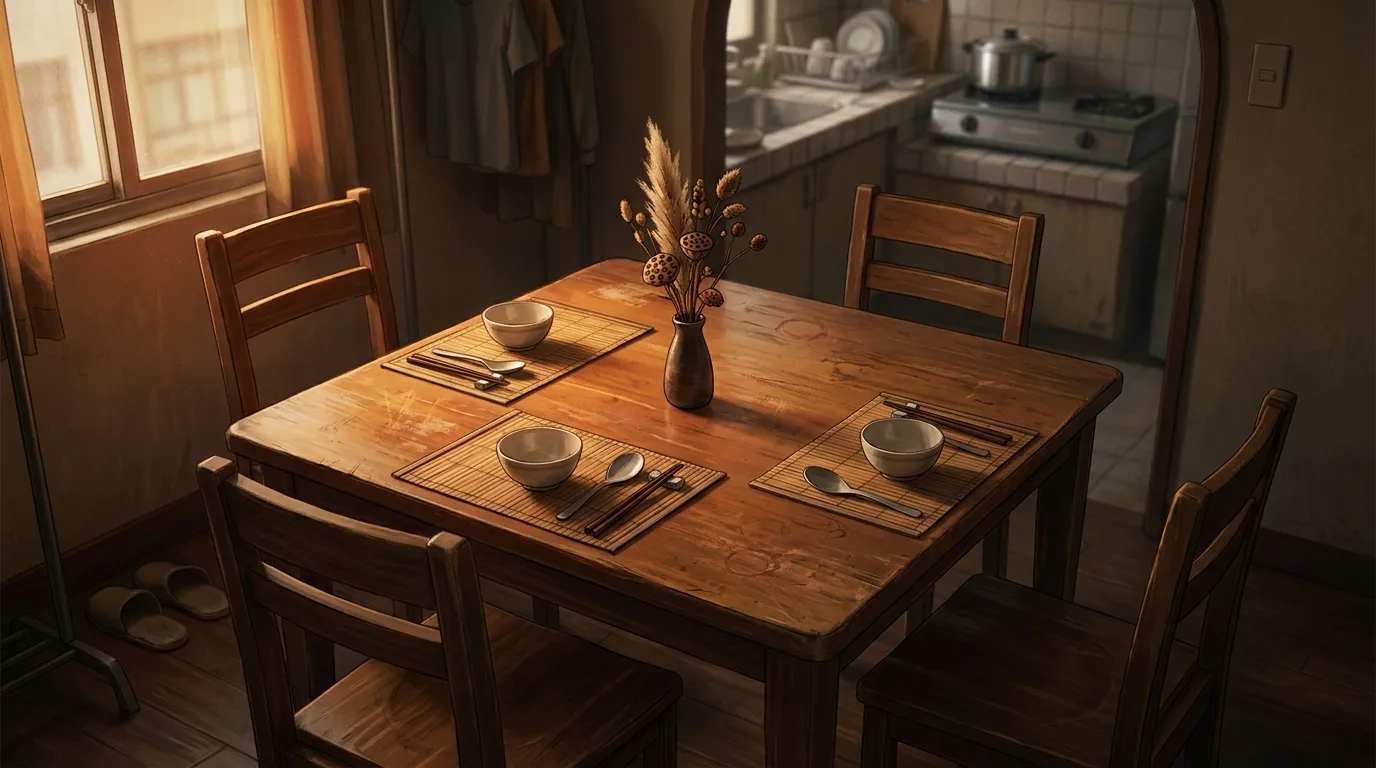
The dining table sat between the living room and the kitchen, a square four-seater pushed against the wall. Four chairs. But only three sides of the table were set — three bowls, three pairs of chopsticks, three spoons, arranged neatly on bamboo placemats. The chair on the wall side was pushed all the way in, almost touching the table legs, and the tabletop in front of it was bare — no placemat even.
Perfectly reasonable. Husband is gone, one fewer place setting. A mother eating with two children, three settings: entirely sensible.
“How are the kids doing?” Yīn Zhòngguāng asked. He wasn’t entirely sure why he asked — it wasn’t on the standard list.
Wáng Xiǎoqíng’s expression changed for the first time. A small change: the line of her mouth softened slightly, like a taut rubber band eased just a fraction.
“Fine. The older one’s more mature now. She helps clear the table.”
“Still in school?”
“Yes.”
“Do they know about their father?”
“They know he’s gone away.” Wáng Xiǎoqíng said. She paused for a beat or two. “Kids adapt. Better than adults do.”
Xǔ Zhìmàn was checking off boxes on the form, the pen moving against paper audible in the quiet living room. Yīn Zhòngguāng hadn’t taken out his notebook — he never recorded in front of people. Some people, when they saw you writing, would tighten up and start editing themselves, turning what was true into what was safe. His habit was to watch, listen, memorize tone and the location of pauses, then write it up afterward.
When he stood to leave, he took one more look at the dining table. Three place settings, clean, clearly laid out for dinner that evening. Not stored in the cabinet to be retrieved as needed — already set. It was three-thirty in the afternoon.
Maybe she just prepared early.
“Thank you for your cooperation.” Xǔ Zhìmàn had already gathered her papers and stood. “We’ll reach out if we need anything further.”
“Of course.” Wáng Xiǎoqíng walked them to the door. Her footsteps were very light; she moved across the wood-grain floor almost without sound. The motion of opening the door was fast — fast enough that Yīn Zhòngguāng had the sense she’d been ready to open it the moment they sat down.
“Ms. Wáng.” Yīn Zhòngguāng stopped in the doorway. He wasn’t looking at her face; he was looking at the tile floor in the hallway. “Mr. Chén’s personal belongings — are they still in the apartment?”
One second of silence.
“Sorted through.” Her voice was steady. “Stored in the storage room.”
“I see. Thank you.”
The door closed behind them. The click was soft, complete, like a box being carefully sealed.
In the elevator, Xǔ Zhìmàn pressed one.
“I’ll write up the closing report when we get back,” she said. “You just need to sign.”
Yīn Zhòngguāng nodded. His right hand slipped into his pocket and found a few coins — one ten-dollar coin, two fives. He trapped the ten-dollar piece between his thumb and index finger and began slowly rotating it. The metal temperature changed against his fingertip in slow circles, the raised characters alternating with the smooth face.
“She said he’d done it before,” he said.
“Mm.”
“Waited a month to report it.”
“Very common.” Xǔ Zhìmàn watched the elevator floor number change from four to three. “Especially when there’s a pattern of disappearing. At first the family doesn’t take it seriously. They file when they’ve hit their limit of patience.”
“Something was off about her.”
The number changed from three to two. Xǔ Zhìmàn’s expression didn’t change. “What was off?”
Yīn Zhòngguāng thought about how to put the blurred feeling into words he could say out loud. “She wasn’t sad. She wasn’t angry. Both of those would make sense. But she was—” He searched for the word. “Relieved.”
“Husband walks out on her, she doesn’t have to wait anymore — of course she’s relieved.” Xǔ Zhìmàn’s logic was sound. “For some people, closing the report is when they finally let go.”
The elevator reached the ground floor. The door opened and they walked out into the lobby. The light outside was a little glaring; Yīn Zhòngguāng squinted briefly. The parking lot asphalt was throwing back the afternoon sun, a delivery motorcycle passed nearby, leaving a brief engine sound behind.
“The belongings,” Yīn Zhòngguāng said, walking toward the car, not looking at Xǔ Zhìmàn. “She said they were in the storage room.”
“So?”
“Gone for four months, and the things are already sorted and put away.”
“A lot of families do that. Seeing the stuff is hard, putting it away makes it easier.”
Yīn Zhòngguāng opened the passenger door and got in. Xǔ Zhìmàn got in too. She started the engine; the mold smell from the air conditioning came back, and this time Yīn Zhòngguāng thought he could detect underneath it a trace of air freshener — someone had once tried to fix this problem and failed.
“Withdrawn cases are all like this.” She reversed out of the parking spot, the wheel turning smoothly one and a half rotations. “You spent too long in criminal investigation. You see everything as suspicious. Missing persons is different — most of them don’t have any hidden angle. The person left, they left. You’ll get used to it.”
Yīn Zhòngguāng didn’t respond. He flipped the ten-dollar coin over and pressed his thumb against the number.
The car pulled onto the main road. Navigation announced: in three hundred meters, turn left.
He was thinking about those three place settings. To be precise, he wasn’t thinking about the three place settings — he was thinking about the fourth chair. The chair pushed all the way in, nearly flush with the table leg, and nothing on the tabletop. Not even a placemat.
Not “one fewer setting.” That would mean the place still existed.
This one had been cleared away. Like a name that had been erased.
A table for three, with three positions. The fourth wasn’t empty — empty meant it was still there — it had been removed. Like a name that had been erased.
Yīn Zhòngguāng didn’t say this out loud. He wasn’t sure if it was professional instinct or a criminal investigation habit that had nowhere to go in the new job. When the car passed an intersection, he saw a buffet restaurant, steam fogged across the glass windows, tables of people inside, every table set with exactly as many bowls and chopsticks as there were people sitting at it.
He put the coin back in his pocket.
It was nearly five by the time they got back to the precinct. The investigation unit was changing shifts, the hallway louder than morning — someone relaying case updates, someone hunting for a file, someone’s phone ringing three times unanswered. Yīn Zhòngguāng took the stairs up to the third floor. The elevator was slow, and besides, he needed those stairs. Not for the exercise — for the buffer. The thirty-odd steps were exactly the right amount of distance between “out there” and “in here.”
Back in the office, Xǔ Zhìmàn was already typing up the closing report. She’d gotten back before him — she’d taken the elevator, he’d taken the stairs, of course she’d arrived first. Her screen was dense with form fields; her fingers moved across the keyboard at a steady rhythm, barely pausing.
Yīn Zhòngguāng sat down, took out his A5 notebook, turned to a fresh page, and started writing.
He began with the date, time, and location. Then Wáng Xiǎoqíng’s statements — not verbatim, he wasn’t a recording device — but tone and pacing, where she’d paused, where she’d sped up, where her gaze had moved away. He drew a line under it’s happened before, and another under kids adapt better than adults.
Then he wrote his observations: living room tidy, studied quality. Personal effects sorted and stored. No men’s shoes in the entryway. Table set for three, fourth position cleared. Set at three-thirty in the afternoon.
He put down the pen.
The light outside had started going orange, and the laundry on the apartment balcony across the way had become a row of dark shapes. He turned back to Chén Bǎixùn’s file and pulled out the withdrawal notice.
Reason for withdrawal: “Confirmed by family that missing person departed voluntarily.”
His hand reached toward the other files spread open beside him — the ones from this morning. He flipped through a few withdrawal notices from cases already closed. Most said “family has confirmed they are aware of the missing person’s whereabouts and have handled the matter directly” — that one appeared eight times, and the phrasing was almost identical — but that was normal, it was the standard official language, and the window staff probably suggested it as a template. Two different windows, different times, both happened to offer the same wording.
He set Chén Bǎixùn’s notice back on the table and let his eyes travel to the next file over — Lín Ruìfāng’s case, the first one he’d opened. The 57-year-old woman, reported by her son.
The son’s withdrawal notice said: “Confirmed by family that missing person departed voluntarily.”
Yīn Zhòngguāng’s fingers stopped on the paper.
He placed the two withdrawal notices side by side on the desk.
Chén Bǎixùn case: “Confirmed by family that missing person departed voluntarily.” Lín Ruìfāng case: “Confirmed by family that missing person departed voluntarily.”
Not similar. Identical. Not a single word different. Even the comma was in the same place.
He went through a few more. “Family has confirmed they are aware of the missing person’s whereabouts and have handled the matter directly” appeared eight times — that was the common official phrasing. But “Confirmed by family that missing person departed voluntarily” — that appeared exactly twice, in these two completely unrelated cases. Different times, different areas, different reporters, different officers.
He checked the case officer signatures at the bottom of both notices. Different names. Different handwriting.
Yīn Zhòngguāng turned to a fresh page in his notebook and copied out the two sentences side by side in blue ballpoint. Then he wrote a question mark below them.
He stared at the question mark for a while.
Maybe a coincidence. Two families happened to use the same phrasing. Or someone at the window had suggested a sentence — “you could write: confirmed by family that missing person departed voluntarily” — and both families had done exactly that. Two different windows, two different times, both happening to offer the same template.
Very plausible. This kind of thing happened all the time in administrative systems.
He put the notices back in their files and the files back in their envelopes.
The light outside kept fading. The laundry on the apartment balcony across the way still hung there, drifting gently in the wind, no longer any distinguishable color. The handover noise from the investigation unit down the hall gradually subsided, like a tide going out. Someone laughed in the distance, then a door closed.
Xǔ Zhìmàn stood up and poured from a thermos. The smell of jasmine moved through the air again, startlingly gentle in this end-of-day office.
“Report’s done.” She set a printed form on his desk. “Take a look, sign at the bottom.”
Yīn Zhòngguāng picked it up and scanned it. Closing home visit report, correct format, concise, everything that should be there was. Xǔ Zhìmàn’s paperwork skills were genuinely good. He signed at the bottom and handed it back.
“Thanks.”
“No problem.” She sat back down and began sorting other documents. “When you have time tomorrow, take a look through the others. I can handle the closing reports.”
“Sure.”
Yīn Zhòngguāng closed the notebook and slipped it into his pocket. The question mark inside it looked very small — small enough that he wasn’t sure he’d remember what it was about when he opened it tomorrow.
But he knew he would remember.
Just past eight in the evening. Yīn Zhòngguāng returned to his apartment in Yǒnghé. The twelve-square-meter space looked smaller than twelve square meters, because several boxes he hadn’t unpacked were still stacked by the door — he’d moved in two months ago and hadn’t gotten around to it. Not laziness. No need. Most of what was in the boxes was books, and there was no bookshelf in this apartment.
He dropped his keys on the shoe cabinet, changed into slippers, and walked to the kitchen — if the space containing a single sink counter and a small refrigerator could be called a kitchen.
The refrigerator was single-door. Stuck to the door was a sticky note in his mother’s handwriting, blue ballpoint, the characters neat and small:
Come home for dinner on Sunday.
He opened the fridge. Inside: half a bottle of mineral water, a box of tea eggs past their expiry date by two days, and one unopened pack of kimchi. He took out the mineral water and closed the fridge.
The corner of the sticky note fluttered slightly in the air movement as the door shut.
Yīn Zhòngguāng leaned against the counter and drank. His mind was blank. Or rather — he was letting the things from the day settle on their own. An old mentor from criminal investigation had taught him: don’t rush the thinking; let what you’ve seen speak for itself.
He set down the water, walked over to the room’s only table. On it: a laptop, a charging cable, a half-eaten pack of crackers. He pushed the crackers to one side, took out his notebook and opened it.
The question mark was still there. Beside it, the two sentences he’d copied out.
He flipped back a few pages and looked at what he’d written during the day. Wáng Xiǎoqíng’s tone. Where she’d paused. Three place settings. Fourth position cleared. Effects stored.
Then the two withdrawal notices, word for word the same.
He picked up his pen and slowly wrote a line next to the question mark: Different officers. Different cases. Who taught them to write it like this?
Then he closed the notebook again.
Outside was the night of Yǒnghé — not really a view, just the apartment building directly across, a few lit windows, shadows of people moving inside. From the street below came the sound of a motorcycle passing, its engine bouncing off the walls of the alley several times before fading. Somewhere in the distance a dog barked a few times and went quiet.
Yīn Zhòngguāng picked up his phone. His mother had sent a message asking how the new posting was. The timestamp was 2:13 in the afternoon. He’d only just seen it now.
He typed two characters: Fine.
Thought about it, and added a period.
Sent.
He turned the phone face-down on the table. He sat there, facing the closed notebook and the half-bottle of mineral water, for a long time. He wasn’t thinking about anything in particular — or rather, what he was thinking about hadn’t taken shape yet, was still a vague, formless wrongness with no clear edge. Like someone talking in the next room: you can hear the sound, but you can’t make out the words.
The feeling was faint. Like the lifted corner of the sticky note on the refrigerator door. You wouldn’t particularly notice it, but every time you opened the fridge, it was there.
He got up to shower.
Like his thoughts, the water heater needed a moment before it ran warm.