Chapter 2
The Same Story
Chapter 2: The Same Story
It took Yīn Zhòngguāng two days.
Not intentionally. The first day he simply pulled every withdrawal record from the past three years out of the system, printed them on paper, and spread them across his desk. Xǔ Zhìmàn passed by and glanced over without a word, then moved a stack of scrap paper away from the copier to clear him a little room.
The second day, he started drawing lines.
Blue ballpoint, one after another. On each withdrawal notice, he underlined the key sentence in the “reason for withdrawal” field with a ruler, then copied it into his notebook. When he reached the seventh notice, his pen stopped.
Not just two.
He flipped back to the beginning and matched from the first. The phrasing fell into three categories. Not random categories — they were like fill-in-the-blank templates, the sentence structure identical, only the names, dates, and a handful of words swapped out.
First: “Confirmed by family that missing person departed voluntarily; family no longer requests search assistance.”
Second: “Missing person has made contact with family; personal safety confirmed; family requests withdrawal of search.”
Third: “Family, upon reflection, concludes that missing person left of their own volition; requests termination of search procedure.”
Three. Twelve withdrawal notices distributed across three templates. Different officers, different precincts, different families. But the wording looked like it had been copied from the same instruction sheet.
Yīn Zhòngguāng turned to a fresh page in his notebook and drew a table. Columns for the three templates, rows for case numbers. When he finished and stared at the table, he stared for a long time.
Of the twelve, five fit the first template, four the second, three the third.
Evenly distributed. As if taking turns.
He closed the notebook and went to find Zhuāng Péi’ān.
Zhuāng Péi’ān’s desk sat in the corner, separated from the rest of the team by a filing cabinet. On top of the cabinet stood an electric fan, unnecessary in April, but Zhuāng Péi’ān liked having it there. Like an unplugged border marker.
“Boss, I put something together I want to report.”
Zhuāng Péi’ān was typing at his computer, screen showing a monthly report spreadsheet. He didn’t look up. “Mm.”
Yīn Zhòngguāng opened the notebook and set it on Zhuāng Péi’ān’s desk. “The withdrawal notices from the past three years — the phrasing divides into three fixed templates. Twelve notices, no exceptions.”
Zhuāng Péi’ān’s fingers stopped on the keyboard. He glanced at the notebook, then at Yīn Zhòngguāng.
“Templates?”
“Yes. Sentence structure completely identical, only the names and dates swapped. Different officers, different precincts — same wording.”
Zhuāng Péi’ān pushed his chair back slightly and leaned against the backrest. He sighed — not the startup-fan kind from the first day, something different: thin-layered weariness underneath, like a man saying I already know where this is going.
His gaze went back to the screen, then back to the notebook, then settled on Yīn Zhòngguāng’s face.
“How many of these cases have you closed?”
Yīn Zhòngguāng didn’t answer immediately. “I’ve been in analysis mode—”
“Zhòngguāng.” Zhuāng Péi’ān’s tone wasn’t heavy, but it had the quality of patience that had been used too many times. “Very good analysis. But the report the higher-ups look at doesn’t have a column for ‘pattern analysis.’ It has a column for cases closed.”
He pushed the notebook back. Not a shove — a push. Two fingers, very level.
“That Bǎnqiáo case — the family came in last week asking for an update. Handle that one first.”
Yīn Zhòngguāng took the notebook back. “Boss, if there’s something behind these withdrawals—”
“Something like what?” Zhuāng Péi’ān raised his head, and this time he held the look longer. Not impatience — more like he was measuring how much to say. “Families withdraw reports, their reasons sound similar, so? This isn’t a writing contest, nobody requires each person to write something different. Go look at the household registration office — eight out of ten divorce petitions say ‘irreconcilable differences.’ You want to investigate that too?”
He turned back to his screen. “Bǎnqiáo first.”
Yīn Zhòngguāng stood there two seconds, then turned and walked back to his desk.
The ten-dollar coin in his pocket went one slow revolution under his thumb. Cold, then warm.
He didn’t handle the Bǎnqiáo case first.
Not insubordination — he told himself he just needed to do one small thing. Pull out the closest matches from the three templates, look at the basic details, ten minutes, that was all. Then go handle Bǎnqiáo.
Ten minutes became an afternoon.
He selected three cases. Simple criteria: within each template, whichever cases had the highest phrasing similarity. The kind where even the punctuation was in the same place.
First: the Chén Bǎixùn case. He’d already seen this one. Forty-one years old, disappeared from his home in Xīnzhuāng. Family reporter was his wife, Wáng Xiǎoqíng. Report withdrawn nineteen days after filing. During the interview Wáng Xiǎoqíng had only mentioned sales work and stress, but tucked into the case file appendix was a police station interview record — far more detailed than the report form — stating that Chén Bǎixùn had “chronic gambling behavior leading to household debt.” Wáng Xiǎoqíng hadn’t mentioned this when she filed the report.
Second: the Cài Cháoyáng case. Thirty-six years old, long-term psychiatric history, had not returned after leaving the family home in Zhōnghé. Family reporters were his parents, Cài Jīnlóng and Lín Xiùměi. Report withdrawn twenty-three days after filing.
Third: the Yóu Yǎhán case. Twenty-eight years old, long-term conflict with her family of origin, cut contact after moving out. Family reporter was her mother, Yóu Zhāng Shūhuá. Report withdrawn sixteen days after filing.
Yīn Zhòngguāng spread the three files side by side on his desk.
Then he opened his notebook and started listing shared characteristics.
The missing persons were all, in their households— He thought about how to write it, and couldn’t find the right words. Troubled members? He crossed it out. Burdens? Too heavy. What he finally wrote was: the person who made everyone else in the house very tired.
Time to withdrawal: two to four weeks after filing.
Reason for withdrawal phrasing: templated.
He drew a line under the three names, connecting them.
Then wrote beside it: 2–4 weeks. What happened in between?
On the third day, Yīn Zhòngguāng decided to visit the Cài family.
He had his reasons for choosing this case. Of the three, he’d already been to see Chén Bǎixùn — Wáng Xiǎoqíng’s reaction had left him uncertain what he’d gain from another visit. Yóu Yǎhán’s family was up in Jīlóng, too far. The Cài family lived in Zhōnghé, twenty minutes by motorbike.
There was also a detail in the Cài case that nagged at him. The incident report noted Cài Cháoyáng “had a regular medical care record,” but his medical record after the disappearance was blank. A psychiatric patient who needed regular check-ins had suddenly stopped going.
He went to ask Xǔ Zhìmàn for the family’s address and phone number.
“You’re going for a visit?” Xǔ Zhìmàn asked.
“Yes.”
“That case has been withdrawn.”
“I know.”
Xǔ Zhìmàn looked at him — that assessing look. Then she opened the filing cabinet, pulled out a thin case file, and read him the address.
“I’ll come with you.”
Yīn Zhòngguāng was caught off guard. “You don’t have to—”
“You go alone, the elderly couple will get nervous.” She was already clearing her desk. “Two of us, a man and a woman — it looks more routine.”
Yīn Zhòngguāng thought about it and decided she was right.
They took two motorbikes. An April afternoon, the sun bright but the wind still cool. The inner lining of his helmet carried a persistent smell of dried sweat he’d never managed to wash out. He followed behind Xǔ Zhìmàn; her bike was a white MANY 110 with a reflective sticker on the back — no text, just the reflection.
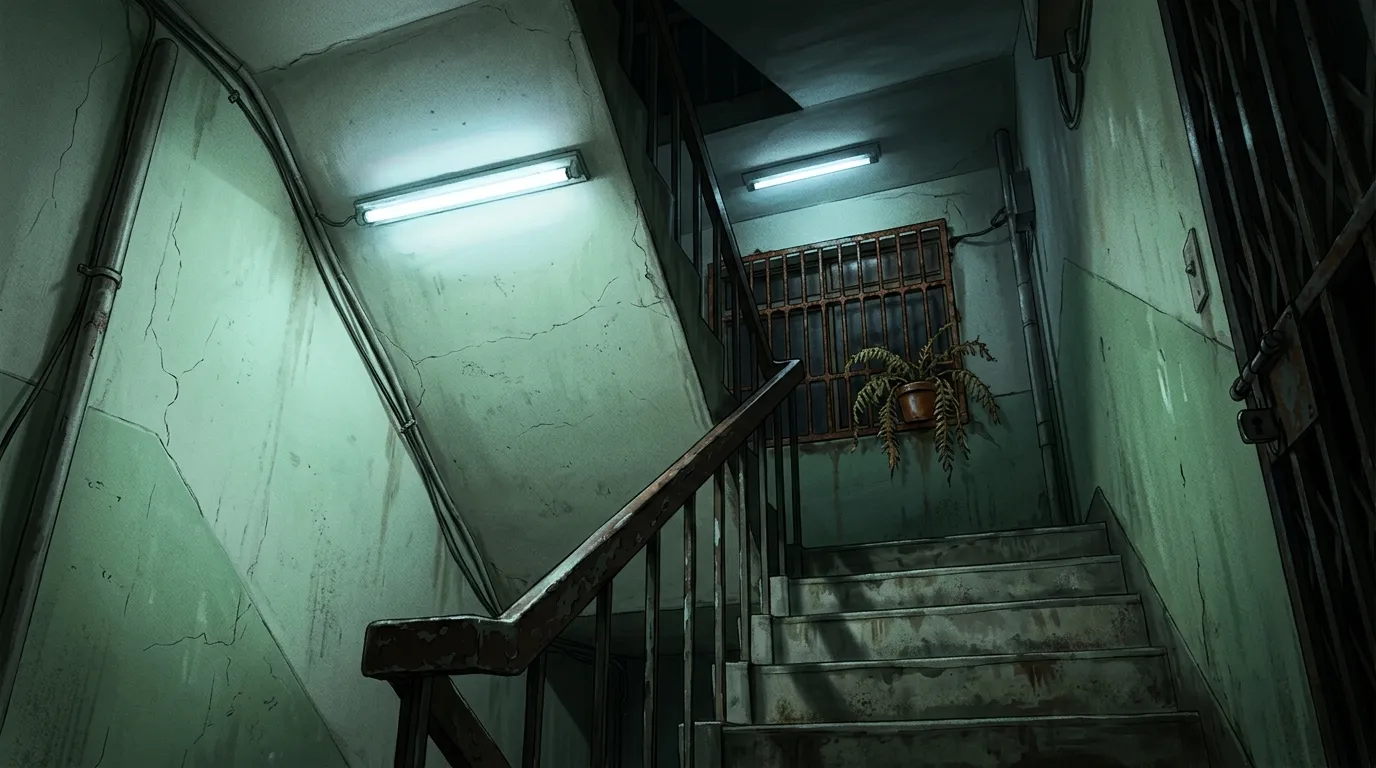
The Cài family lived on the third floor of a five-story walkup near Jǐng’ān Road. No elevator. The stairwell walls were that shade of pale green, the kind that had been fashionable a long time ago, now looking like faded mint candy. At every landing a wrought-iron flower shelf held plants of varying degrees of still alive.
The third-floor door was two layers — iron gate and wooden door. Yīn Zhòngguāng pressed the buzzer. Television from inside, loud. A Hokkien-language soap opera.
The door opened a crack.
An old woman’s face appeared in the gap. Round face, hair dyed black with two or three centimeters of gray growing back at the roots. A floral housedress, the top button at the collar undone.
“Hello, Mrs. Cài — I’m—”
“Who are you looking for?” Her voice was narrower than the gap.
Yīn Zhòngguāng held up his ID badge. “Missing Persons Task Force, surname Yīn. A colleague was in contact previously regarding Cài Cháoyáng’s case—”
The gap didn’t widen. The old woman’s lips moved slightly, like she was silently reciting something, then she turned and called back into the apartment. Yīn Zhòngguāng couldn’t make it out — the television had hit a noisy stretch.
Someone turned the television down from inside. Footsteps. The door opened wider but not all the way. The old man stood behind his wife. Thin, skin darkened the way only decades of sun produce, fingers thick with large knuckles. His arms were folded across his chest, eyes on Yīn Zhòngguāng’s ID badge, not on his face.
“The case has been withdrawn.” The old man said it in Hokkien. Southern accent, the tail sounds drawn out longer than northern speakers pull them.
“Mr. Cài, we know the case has been withdrawn.” Yīn Zhòngguāng slowed his cadence. “This is just a follow-up welfare visit—”
“No need.”
Xǔ Zhìmàn moved half a step forward, not in front of Yīn Zhòngguāng. Her voice was softer than his, but not deliberately so. “Mr. Cài, Mrs. Cài — we won’t take long. Just a few questions. May we come in for a moment?”
The old man looked at his wife. The old woman’s lips moved again.
The door opened.
The living room was dim. Curtains drawn, only the television light shifting on the walls. The smell of an old apartment — not unclean, but the kind of smell that comes from the furniture and walls themselves, time compressed and sealed inside. Camphor? Not exactly. Something more like aged wood and fabric that had never quite dried out from lack of sun.
The sofa was old leather, the corners cracked and repaired with tape. On the coffee table: a pot of tea, two cups, and a plate of mandarin oranges. The oranges had two leaves on them, already dried out.
Yīn Zhòngguāng and Xǔ Zhìmàn sat on the sofa. The old man took the rattan chair across from them; the old woman stood beside it. No one gestured for her to sit.
Xǔ Zhìmàn opened with a few loose questions — how was their health, did they need anything from the local community services. The old man’s answers were short: “fine” or “no need,” but at least answers. The old woman stood alongside, hands clasped in front of her, thumbs moving in slow circles against each other.
Yīn Zhòngguāng waited for Xǔ Zhìmàn to establish the rhythm before he stepped in.
“Mr. Cài, during the period when Cháoyáng left—”
“He went to practice.” The old man cut him off. Still Hokkien. “Cultivation. Religious practice.”
Yīn Zhòngguāng didn’t follow up immediately. He waited three seconds.
“Religious practice,” he repeated, tone flat, no question mark in it.
“Someone took him.”
Yīn Zhòngguāng gave a single nod, like he was filing the information away. Then he shifted to an unrelated question: “When Cháoyáng was still living at home, what did he usually do with his time?”
The old man seemed slightly thrown — he’d braced himself for more follow-up on the religious practice. “Stayed up top. His room was in the rooftop addition.”
“Did he take any luggage with him?”
“A little bit.” Some things.
Yīn Zhòngguāng’s gaze moved to the old woman. She’d been standing beside the rattan chair the whole time, lips moving faintly, like she had words circling at the edge of her mouth and couldn’t let them out.
“Mrs. Cài,” Yīn Zhòngguāng slowed further, “the person who took Cháoyáng away—”
“Someone—” The old woman opened her mouth. Her voice was barely there, like she was afraid something might overhear.
“Xiùměi.” The old man’s voice came down over hers — Hokkien, fast and clipped. Then he said something to her in a rush. Yīn Zhòngguāng only caught fragments: practice, bother, what for.
The old woman closed her mouth. Her lips were still moving, but silently now.
Xǔ Zhìmàn said quietly beside him: “He seems to be telling Mrs. Cài not to bother… the practice people. After that it went too fast, I couldn’t be sure.”
Yīn Zhòngguāng nodded. He didn’t press the religious practice angle — the old man had already shut that door. He pulled back to a wider position.
“Mr. Cài, Cháoyáng was seeing a doctor before. Does the place where he’s doing his practice have medical resources?”
The old man’s clasped hands loosened slightly — not from relief, but because this question was easier to answer. “Someone’s looking after him.”
“What kind of person?”
The hands crossed again. “Young man, the case has been withdrawn — what are you still coming back to ask all this for?”
Yīn Zhòngguāng didn’t take the bait. He looked at the old woman for a moment. She was looking down, right hand gripping the edge of her floral hem, knuckles white.
He asked a few more unrelated questions — was there a new community activity center nearby, were there any elder care services in the area — to let the air loosen a little. The old man’s answers were all “no” or “no need.” Xǔ Zhìmàn filled in appropriately, asking the old woman about her health, whether she was seeing a doctor; the old woman nodded and shook her head, but said nothing more.
When they left, the old woman saw them to the door. The old man did not.
Yīn Zhòngguāng was already at the top of the stairs when he heard the old woman’s voice behind him — very small, almost eaten by the echo in the stairwell:
“He hasn’t come home for dinner in a long time.”
Mandarin. The tone was completely flat, like talking to herself.
Yīn Zhòngguāng turned. The old woman stood in the shadow of the doorway, her expression unreadable. Then the iron gate swung shut. The locks, one after the other, two of them.
He stood in the stairwell. Pale green walls, a fern of uncertain vitality on the landing shelf. The fluorescent tube above him hummed, the light cool-white, cutting every shadow to a hard edge.
Xǔ Zhìmàn passed him and headed down. Three steps, then she stopped and looked back.
“Let’s go.”
Not a question. Yīn Zhòngguāng followed.
On the ride back to the precinct, Yīn Zhòngguāng stopped at a red light. The engine’s vibration came up through the handlebars into his palms. He was thinking about the old woman’s hands. The trembling was small in amplitude but it hadn’t stopped — from the moment she’d carried out the tea to the moment he’d taken his cup, it had been continuous the whole time.
He was thinking about what she’d said. He hasn’t come home for dinner in a long time.
Not he went to practice. Not the old man’s version.
The light turned green. The car behind him honked. Yīn Zhòngguāng pulled away, nearly stalled.
He was back at the office by four. Zhuāng Péi’ān was out — Xǔ Zhìmàn said he’d gone to the precinct for a meeting.
Yīn Zhòngguāng sat at his desk and opened his computer. He did something that, even to himself, seemed without much basis: he looked up the social media accounts of the three missing persons.
The incident reports included social media account information, provided by the families. Yīn Zhòngguāng went through them one by one — Cài Cháoyáng’s Facebook, Chén Bǎixùn’s Facebook, Yóu Yǎhán’s Instagram. All accounts were still up, not deleted. But all activity had stopped.
The Cài case was clearest. The incident report contained a “preferred communication methods” sheet listing a LINE account. At the time of the report, the status was “messages read, no replies” — the family had sent a flurry of messages in the three days before filing, and the account had read them without responding.
After the disappearance: messages read. Then no replies. Then the report was withdrawn.
And after the withdrawal? Yīn Zhòngguāng clicked through to Cài Cháoyáng’s Facebook page. The last post was two years ago, a shared article about a mobile game. Profile photo: a blurry shot of a reservoir railing. Since then, the account had been sitting there collecting dust.
The other two were similar. Yóu Yǎhán’s last Instagram photo was two weeks before she disappeared — a bowl of beef noodle soup, captioned another day alone. After that, nothing. Account intact, person not logged in. Chén Bǎixùn’s Facebook was even more barren; the last account that had liked any of his posts no longer existed.
Three accounts — all still up after the disappearances, but all activity stopped. Not a sudden cutoff on one specific day; rather a gradual tapering of activity until it reached zero. Like someone slowly turning a volume dial down, the sound fading until it was gone.
Yīn Zhòngguāng drew a timeline in his notebook. He marked the report dates, the withdrawal dates, and the last traceable activity on each account. All three lines took the same shape — activity trailing off around the withdrawal date, then complete silence.
He wrote:
Account activity ceased around the date of withdrawal. Consistent across all three cases. Need precise login record data.
Quarter to six. The office was starting to empty, people packing up. The keyboard sounds and phone calls from the investigation unit had thinned.
Yīn Zhòngguāng was still at his computer. He heard something placed on his desk. Light, paper.
He looked up. Xǔ Zhìmàn was standing beside his desk, already had her bag on. It was black, very small — looked like it couldn’t hold much.
On the desk, a document had appeared. Thin, one staple through the corner, the paper already gone a little yellow.
“If you really want to understand the withdrawals.” Xǔ Zhìmàn said it the same way she said everything else — level, not deliberately hushed, but not at a volume the next desk over could catch. “This might be worth a look.”
Yīn Zhòngguāng picked it up. The title on the first page:
“Proposal for Establishing a Post-Withdrawal Follow-Up Mechanism”
An internal memo. Dated five years ago.
He scanned the format quickly — submitter, rank, recipient. The submitter’s name was Xiāo Zhònghéng, rank listed as officer. The recipient was the task force supervisor at the time.
“This person now—”
“Transferred away.” Xǔ Zhìmàn was already walking. “Five years ago.”
Yīn Zhòngguāng watched her reach the door. She didn’t look back, didn’t add anything. The door closed.
He turned to the second page.
Xiāo Zhònghéng’s writing was spare. No wasted words. He opened directly: “Among the missing persons cases handled by this unit in recent years, the proportion of family-initiated withdrawals is high, and the phrasing of withdrawal reasons shows a marked degree of repetition.”
Yīn Zhòngguāng’s fingers stopped on the words marked degree of repetition.
He kept reading. Xiāo Zhònghéng had listed six cases in the memo, spanning a period from seven to five years back. The shared characteristics he had laid out point by point:
One: all missing persons were members of their households who had placed long-term caregiving burdens on the family.
Two: in all cases, the family had proactively withdrawn the report within two to four weeks of filing.
Three: the phrasing of withdrawal reasons was highly similar across cases, suggesting the existence of a template.
Four: after the withdrawal, the missing persons’ social media accounts and communication records showed a “gradual-stop” pattern — not a sudden cutoff, but activity tapering off over time to zero.
Five: in follow-up contact, withdrawing families uniformly described the missing person’s whereabouts as gone to do religious practice or gone away to rest.
Six: the families in the above cases had all, in the one to two weeks before withdrawing, called the same phone number. The call records came from phone bills the families had provided voluntarily. The number belonged to a prepaid SIM with no registered owner.
The first five points Yīn Zhòngguāng had already encountered — in his own notebook, written in different words but arriving at the same discoveries. The sixth was new. A prepaid number.
The coin’s edge caught under his thumbnail, once, again. He wasn’t aware he was doing it.
Identical.
Six cases. Someone had compiled all of this five years ago. The same template, the same time window, the same gone to do religious practice, the same gradual account silencing. And Xiāo Zhònghéng had found something he hadn’t yet found — a telephone thread connecting all the families.
He turned to the last page. Xiāo Zhònghéng’s recommendation was specific: establish a post-withdrawal follow-up mechanism, conduct at least one home visit within six months of withdrawal to confirm the missing person’s status, and establish a reporting link with the social work system.
At the bottom of the memo was a handwritten annotation in blue ink, the characters hurried and difficult to read:
Inconsistent with current operational guidelines.
No signature, but a seal had been pressed beside it. Yīn Zhòngguāng worked out the impression — it was the unit supervisor at the time.
The fluorescent lights hummed overhead. After six. The investigation unit had gone quiet, only the duty officer remaining. The paper on Yīn Zhòngguāng’s desk curled at the corners in the air conditioning.
He tucked the memo carefully inside his notebook and closed it.
Five years ago, a man named Xiāo Zhònghéng had seen the same thing. Had organized the data, written the report, submitted the proposal.
Then the memo was rejected. Xiāo Zhònghéng was transferred away.
Yīn Zhòngguāng turned off his monitor. After the screen went dark, he could see his own face in the black reflection.
He wasn’t looking at his expression. He was looking at the notebook on the desk.
The closed notebook, with the memo tucked inside, was a few centimeters thick. A few centimeters of paper, holding eighteen names. Twelve of his, six of Xiāo Zhònghéng’s. The time periods didn’t overlap — his were from the past three years, Xiāo Zhònghéng’s from five to seven years back. Eighteen people, spanning seven years.
Yīn Zhòngguāng stood up and put the notebook in his shoulder bag. The strap dug across his shoulder — not heavy, but he adjusted it twice before it felt right.
He had to find Xiāo Zhònghéng.