Chapter 3
Those Who Seek the Path Do Not Return
Chapter 3: Those Who Seek the Path Do Not Return
Xiāo Zhònghéng lived in Sānchóng, on the top floor of a four-story walk-up.
It took Yīn Zhòngguāng two days to find him. The HR records only had his registered household address, but Xiāo had moved after retirement and never updated his registration. Yīn Zhòngguāng finally got it from a senior colleague in the Criminal Investigation Unit — “Old Xiāo? He moved to Sānchóng, his wife’s family’s place. What do you want him for?” Yīn Zhòngguāng offered a vague reason. The man didn’t press.
Saturday, ten in the morning. He rode over. Yǒnghé to Sānchóng — cross Zhōngzhèng Bridge, follow the river a stretch, about twenty-five minutes. There was no wind that day. The light on the river lay flat, like a whole sheet of tin foil no one had touched.
The building was down a lane. At the mouth of the lane: a hardware store and a laundry shop with its shutter pulled down. The stairwell had four mailboxes. The top one had a character stuck to it — “Xiāo,” written directly on a strip of tape with a marker. He climbed up. No doorbell on the fourth floor. The door was ajar.
He knocked twice on the doorframe.
“It’s open.” The voice came from inside — unhurried, with a weight to it.
Yīn Zhòngguāng pushed the door open, passed through a short hallway, and walked into the living room. Small, but the sparse furniture made it feel open. A rattan chair, a folding table, an old television. The terrazzo floor had been swept clean. Looking toward the balcony — the aluminum door standing wide, a slant of sunlight cutting through — he saw a figure crouching on the balcony floor, back to him.
Heavyset, polo shirt, relaxed trousers, Birkenstock sandals. The crown of his head had thinned, a patch of sun-browned scalp visible.
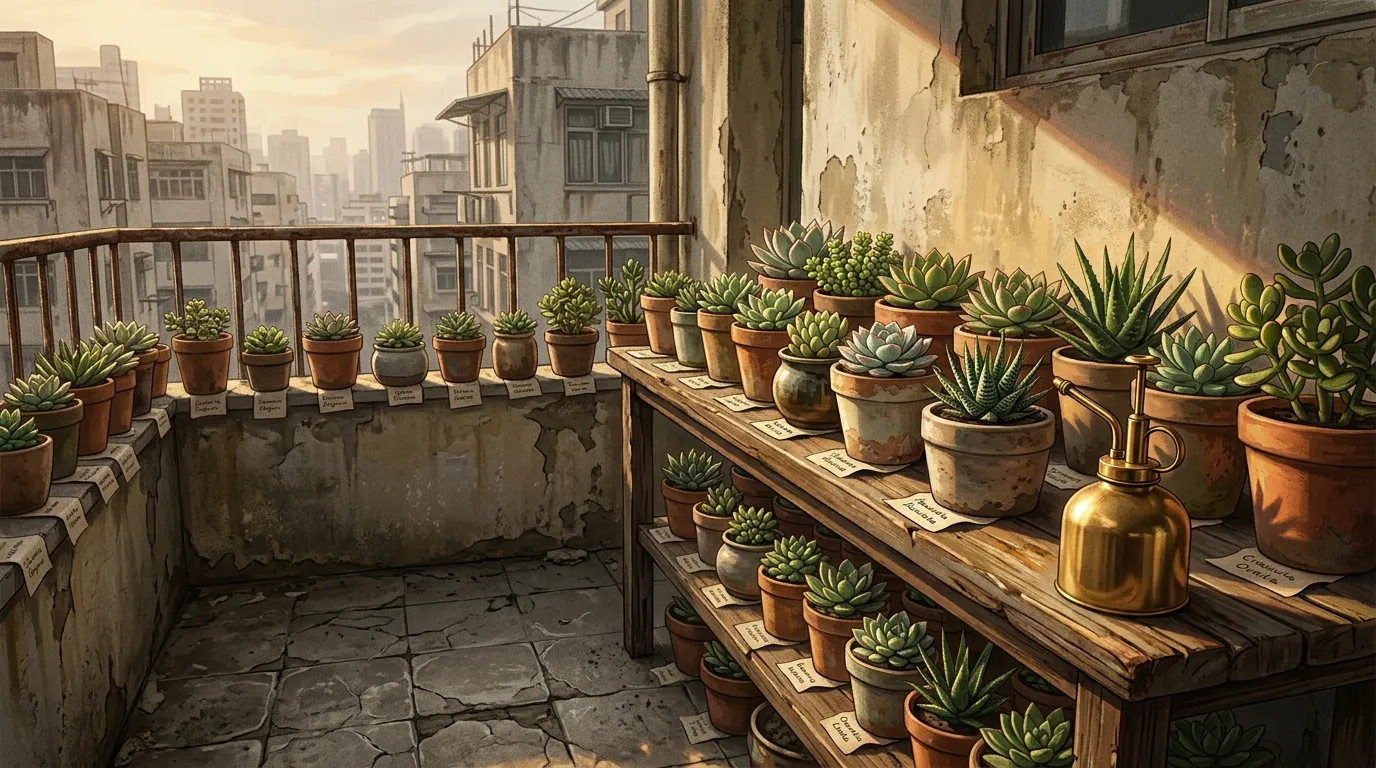
Xiāo Zhònghéng didn’t turn around. He held a small spray bottle and misted a row of succulents lined up along the balcony railing. The plants were arranged with perfect regularity — the gap between each pot looked like it had been measured. Most of the pots were white plastic; a few were ceramic, different shapes but roughly the same size.
“You’re Yīn Zhòngguāng?”
“Yes. I mentioned it on the phone.”
Xiāo Zhònghéng stood up; his knee made a crisp crack. He turned and looked at Yīn Zhòngguāng for about five seconds. Not unfriendly — more like an appraisal. The look of a man deciding which drawer to file a document in.
“Sit.” He pointed at the rattan chair. “I’ll make tea.”
“You don’t have to —”
“I’m making it for myself. Whether you drink it is your business.”
Xiāo Zhònghéng went into the kitchen. Yīn Zhòngguāng heard the kettle, then a cabinet opening. He didn’t sit in the rattan chair. He stood at the balcony doorway and looked at the succulents.
Each pot had a small slip of paper pressed under it. He leaned down and read one: Clearance rate.
The pot next to it: Annual performance review.
The one after that: Team leader’s directive.
Yīn Zhòngguāng straightened and scanned the whole row. More than twenty pots, each one labeled. He couldn’t read them all, but the ones he caught included Senior directive, HR, and one especially small pot with shriveled, curling leaves that read: Sense of justice.
Xiāo Zhònghéng came out of the kitchen carrying two cups of tea. He followed Yīn Zhòngguāng’s gaze toward the balcony.
“That one’s called ‘Clearance Rate.’” He set one cup on the folding table and pointed at the plump, bright green plant nearest the door. “No matter how you care for it, it won’t die. But it won’t grow either.”
Yīn Zhòngguāng accepted the tea. It was very hot. He didn’t drink it — just held it in both hands.
“Officer Xiāo —”
“Call me Senior. Everyone does.” Xiāo Zhònghéng settled into the rattan chair; the chair creaked under his weight. He set the spray bottle down beside his foot. “On the phone you said you wanted to ask about the memo.”
“That’s right.”
“How did you get it?”
“Xǔ Zhìmàn.”
Xiāo Zhònghéng gave a small nod, as if confirming something. “Little Xǔ.” He drank from his cup. “She’s still in that storage room?”
“Yes.”
“That office was already a storage room when I was there.” His voice was as flat as a weather report. “I was the first one shoved in.”
Yīn Zhòngguāng took his notebook from his shoulder bag and rested it on his knee. Xiāo Zhònghéng glanced at the notebook, then at him.
“Write it down if you want to.” Xiāo Zhònghéng said. “But I need to ask you something first.”
Yīn Zhòngguāng waited.
Xiāo Zhònghéng’s fingers traced a slow circle around the rim of his teacup. “You’ve read the memo. What do you have in your hands right now?”
“Eighteen cases,” Yīn Zhòngguāng said. “Six of yours, twelve of mine. Three withdrawal templates, a two-to-four-week withdrawal window, missing persons all family dependents, social media accounts gradually going dark in sequence, a unified story — ‘went to seek the path.’ You also mentioned a prepaid phone number in the memo.”
Xiāo Zhònghéng’s eyebrows lifted slightly. Confirmation, not surprise. “You pulled it together faster than I did.”
“After you traced the prepaid number — what happened?”
Xiāo Zhònghéng didn’t answer immediately. He set his teacup on the rattan armrest.
“I traced the number. Prepaid card, bought at a convenience store, registered with fake information. Call records showed it only received calls, never made them. Each call was short — a couple of minutes.” He paused. “Then I did something that looks not very smart in hindsight. I tracked the cell tower location.”
“What did you find?”
“A place.” Xiāo Zhònghéng’s gaze moved from Yīn Zhòngguāng’s face to the row of plants on the balcony. “A mountain area in New Taipei, very remote. The registered address was a —” he paused to choose the word, ”— studio. Something called… Serenity Living Studio.”
Yīn Zhòngguāng wrote the name in his notebook. The angle of his knee made his handwriting come out slightly crooked.
“I went.” Xiāo Zhònghéng continued. His tone hadn’t changed, but the pace slowed slightly. “Drove there. From Sānchóng it’s about an hour and a half. Up in the hills, the last stretch of road had no streetlights. When I got there it was — how to describe it — like one of those rural guesthouses. A courtyard, a vegetable garden, a few flat buildings made of corrugated metal. No lock on the gate, no guard.”
He drank from his cup.
“I went in and said I was a police officer investigating a missing persons case. They were very courteous. A woman came out to receive me, and we talked for about — half an hour. She said the facility was a place for mental and physical recovery, and everyone there had come voluntarily. She offered me tea, walked me around inside. I saw a few people working in the vegetable garden; they seemed mentally coherent, and no one appeared to have their movements restricted. The whole time, the woman was completely composed — not a trace of —” he made a gesture, ”— guilt.”
“Did you ask about the missing person?”
“I mentioned Cài Cháoyáng’s name. She said she couldn’t disclose personal information, but she could confirm that all residents had been referred by family members and could leave at any time.” Xiāo Zhònghéng’s mouth moved — not quite a smile. “She was legal enough that you couldn’t find a single thing to challenge. You know that feeling? Every sentence perfectly on the right side of the law. Not afraid of crossing the line — she simply didn’t need to cross it.”
Yīn Zhòngguāng said nothing. His fingers touched the coin in his pocket.
“Then she showed me out very graciously.” Xiāo Zhònghéng said. “Even poured me a cup of tea to take for the road.”
“What was this woman’s name?”
“Zhōng Zìfāng.”
Yīn Zhòngguāng wrote it down.
“When I came back I wrote the memo.” Xiāo Zhònghéng said. His voice took on a dry quality, like a newspaper that had been sitting too long. “You’ve seen what happened. Returned. The reason was —”
“‘Does not conform to current operational guidelines.’”
“Right. The following month I was transferred to the Juvenile Division.” Xiāo Zhònghéng leaned back; the rattan chair creaked again. “If you’re asking whether someone put pressure on me — the answer is no. Nobody came to talk to me, nobody threatened me, no — ” he paused, chose a word, ”— conspiracy. The people above simply thought I was wasting time. Case withdrawn, family not pursuing it, and you, an officer, want to use public resources to investigate a case with no victim?”
He shook his head.
“It wasn’t suppression. It was marginalization. They don’t need to push you down — they just need to make things inconvenient. Move you somewhere completely unrelated to what you’re doing, and you stop naturally.”
Yīn Zhòngguāng thought of the way Zhuāng Péi’ān had slid the notebook back across the desk. Two fingers, steady.
“The institution isn’t a villain,” Xiāo Zhònghéng said. “The institution is people who are not interested.”
A gust of wind moved through the balcony. The leaves of the succulents trembled slightly. Yīn Zhòngguāng’s tea had cooled enough to drink. He took a sip. Cool, with a faint bitterness.
“Senior — that prepaid number —”
“You want to know if it still works.” Xiāo Zhònghéng said. “I don’t know. That number from five years ago is probably long dead. But if the network is still running, they’ll have switched numbers by now.”
“The network.” Yīn Zhòngguāng repeated the word.
Xiāo Zhònghéng looked at him. “You don’t think one person did this.”
“No.”
“Then you’re thinking right.” Xiāo Zhònghéng leaned back against the chair. “It’s not some criminal organization. No pyramid structure, no single boss, no violence. It’s a — service. Someone needs a family member to disappear; someone else provides the means of disappearance. Family withdraws the report, missing person doesn’t come back, everyone gets what they wanted. If you try to investigate, you’ll find no victims. Everyone ‘went voluntarily.’”
He said the last two words with a particular intonation. Not mockery — something closer to exhaustion.
“And then you stopped.” Yīn Zhòngguāng said. Not a question.
Xiāo Zhònghéng’s gaze moved from his face to the balcony. “I retired,” he said. Then in a tone like he was talking to the succulents, he added: “Didn’t stop. Reached the end of the line.”
Silence for about ten seconds. Yīn Zhòngguāng heard the television next door — a murmur, stopping and starting. Someone watching a weather forecast.
Xiāo Zhònghéng stood up, unhurried. He walked to the balcony doorway and stood with his back to Yīn Zhòngguāng.
“Zhòngguāng.”
Yīn Zhòngguāng looked up.
“You have something I didn’t.”
He didn’t ask what. He waited.
Xiāo Zhònghéng turned. His expression was neither encouraging nor cautionary — it was something harder to name. Like a man standing on the far bank of a river, watching another man about to wade in. He knows what’s in the water. But he also knows that shouting won’t help.
“Someone willing to look at this with you.” Xiāo Zhònghéng said. “That matters. I was alone the whole time. Look at something alone for long enough, and you either go a little mad or stop caring.”
Yīn Zhòngguāng’s fingers rested on the cover of his notebook for a moment. He didn’t write anything. Something lodged briefly in his throat — not the dramatic surge of emotion, but more like swallowing a mouthful of tea that was still too hot. The kind that slowly settles down through the esophagus, a warmth sinking past where you can feel it.
He stood. “Thank you, Senior.”
Xiāo Zhònghéng gave a small nod. “Serenity Living Studio. Pull the business registration.” He walked back to the balcony and crouched down again with the spray bottle. “Owner: Zhōng Zìfāng. The last stretch of road has no streetlights — you’ll understand why when you get there.”
Yīn Zhòngguāng shouldered his bag and walked toward the door. As he passed the balcony, Xiāo Zhònghéng’s voice came from behind him:
“Yīn Zhòngguāng.”
He turned.
Xiāo Zhònghéng stood in the balcony doorway, spray bottle in hand, nozzle pointing down.
“Don’t go alone.”
Monday morning. Yīn Zhòngguāng sat at his desk and opened the Ministry of Economic Affairs’ Commercial Registration Public Inquiry System.
Serenity Living Studio.
The search results came up. Registered address: a road number in Xīndiàn District, New Taipei. Owner: Zhōng Zìfāng. Date of approval: eight years ago. Business category: Other personal services. Modest capital, registration status: normal. No violation records, no penalty records, no administrative sanctions of any kind.
Yīn Zhòngguāng printed out the registration data and set it beside his notebook. He searched for Zhōng Zìfāng’s name as well — no ID number, but her name plus New Taipei City as a filter returned a clean result. No criminal record. Her name didn’t appear on any flagged account watchlists.
He looked up the address in Google Maps. Satellite view showed mountain terrain, narrow roads, the nearest convenience store six kilometers away. The location pin marked a cluster of unnamed structures — several corrugated-metal buildings arranged around a courtyard, surrounded by trees.
Legal. Every piece of it, legal.
Yīn Zhòngguāng stared at the commercial registration page on his screen. Approved. Normal. No violations. These words were like the woman Xiāo Zhònghéng had described — perfectly positioned on the right side of the line.
He screenshotted the page, saved it, and closed the browser.
Xǔ Zhìmàn glanced over from the adjacent desk. She didn’t ask what he’d been searching, but her eyes paused on the printed pages for a moment.
“Found something?” she asked.
Yīn Zhòngguāng nodded. “Serenity Living Studio. Owner: Zhōng Zìfāng. Registration normal. Nothing wrong with it.”
Xǔ Zhìmàn’s expression didn’t change. “Nothing wrong with it,” she repeated, voice completely level, and Yīn Zhòngguāng heard that it wasn’t agreement — it was a different kind of understanding.
Monday afternoon, 2:17. The office phone rang.
Xǔ Zhìmàn picked it up. Yīn Zhòngguāng heard her say a few sentences — her voice carrying something extra compared to usual, not warmth, but alertness. She hung up and turned to look at him.
“Someone wants to report a missing person.”
“Family?”
“No. A friend.”
Yīn Zhòngguāng’s fingers paused on his notebook. Not family. He’d been here just over a week; everyone who had come to report was family.
“Send her in.”
The first thing Yīn Zhòngguāng noticed when Hóng Cǎiníng walked into the office was not her expression but the cup of coffee she was carrying. Takeaway cup, iced Americano, the condensation already pooled at the bottom. The coffee was about two-thirds gone.
She looked about twenty-six or twenty-seven. Short hair with a section dyed brownish. Black T-shirt, jeans, canvas bag with two or three keychains hanging from it, clinking softly as she walked. Dark circles ran deep beneath her eyes, but her gaze was alert — the kind of alert maintained on caffeine, carrying a thin layer of agitation.
“Please sit down.” Xǔ Zhìmàn gestured to the chair beside the desk.
Hóng Cǎiníng sat and placed the coffee at the corner of the desk. She glanced around the room, mouth opening slightly before closing — she’d probably stopped herself from saying something.
“My name is Hóng Cǎiníng,” she said. Her words came faster than most people’s. “My friend has disappeared. Kē Yìngcǐ. We were roommates in university, stayed in touch after graduation, saw each other at least once a week. Then the week before last she suddenly stopped replying to my messages.”
Yīn Zhòngguāng picked up his pen and wrote down a date in the notebook. “The week before last. Can you be more specific? Which date did she stop responding?”
“March… twenty-seventh. No, twenty-sixth. Wednesday the twenty-sixth. I remember because we had dinner plans that day, and she read the message and didn’t reply.” Hóng Cǎiníng’s fingers tapped twice on the coffee cup. “At first I thought she was busy, but I messaged again the next day — same thing, read but no reply. Then on Friday I called —”
“Did she pick up?”
“Out of service. Not switched off — out of service. That recording: ‘The number you have dialed is not in service.’ I tried three times.”
Yīn Zhòngguāng stopped. “Not switched off?”
“Out of service. The number had been disconnected.” She paused. “I called three times.”
Yīn Zhòngguāng underlined something in his notebook. Phone went from read-and-no-reply to out of service. Not switched off — the number had been cancelled.
“Did you contact her family?”
“I called. Her mother picked up.” Hóng Cǎiníng’s pace slowed slightly here. “Her mother said Yìngcǐ had gone to stay with relatives in the south.”
“Something felt wrong to you?”
“Yìngcǐ has a terrible relationship with her relatives in the south.” Hóng Cǎiníng’s brow furrowed, as if working to keep the story in order. “She told me — when she was little she spent a summer at her aunt’s place down there, and her aunt’s husband… wasn’t good to her. She never went back after that. She wouldn’t have gone on her own.”
Yīn Zhòngguāng kept his face neutral. He was waiting.
“Then I asked her mother when Yìngcǐ would be back, and her mother said ‘hard to say.’ Just those two words. Hard to say.” Hóng Cǎiníng turned the coffee cup half a rotation; the base scraped a short, faint sound on the desk. “You know what the strangest part is?”
“What?”
“Her family seems… relieved.”
Yīn Zhòngguāng’s hand went still.
Not the hand holding the pen — the other one, the one in his pocket. His thumb had been edging a coin along its rim, and at the five syllables of seems relieved, the whole hand stopped. About two seconds. Then his thumb started moving again, but faster than before.
He didn’t ask himself why he’d stopped. He pulled his attention back.
“How did you read that?”
“I went to see her mother. Last week.” Hóng Cǎiníng’s voice dropped half a notch, but her pace didn’t slow. “I went to her building, rang the doorbell, her mother opened the door, and the look on her face when she saw me — you know that look? When you’re telling someone something they already know the answer to, and they look at you that way. Not worry, not urgency. It was —” she paused, searching for the exact word, ”— impatience. Like I was asking a very stupid question.”
Xǔ Zhìmàn was sorting documents at her desk. Her movements were quiet, but Yīn Zhòngguāng knew she was listening.
“Does Kē Yìngcǐ have any…” Yīn Zhòngguāng chose his words, “…situations that were difficult for her family to manage?”
Hóng Cǎiníng gave him a brief look. Something guarded in it. “She has bipolar disorder,” she said. “Diagnosed. She was seeing a doctor regularly, taking medication. But her family — her father thought she was making it up. Her mother thought she wasn’t trying hard enough.”
Yīn Zhòngguāng didn’t respond. He wrote two characters in his notebook and then asked: “The last time Yìngcǐ went out — do you know when that was?”
“The twenty-fifth. The day before she stopped replying to me.” Hóng Cǎiníng thought a moment. “That day she went to a convenience store. I know because she sent me a photo — a receipt, there was a line on it about some points promotion, she thought it was funny.” She held out her phone to Yīn Zhòngguāng. “This one.”
On the screen was a blurry photo of a receipt, timestamped the afternoon of March 25.
Xǔ Zhìmàn looked up from the pile of documents. She glanced at Hóng Cǎiníng’s phone, then said in a very quiet voice, almost as if to herself: “Probably the clearest sign someone in Taiwan has disappeared is that they stop going to the convenience store.”
Hóng Cǎiníng went still for a beat, then her mouth twitched — not quite a laugh, more the expression of I wasn’t expecting anyone to say that right now.
Yīn Zhòngguāng pressed on. “Before Kē Yìngcǐ disappeared, were there any unusual behaviors?”
Hóng Cǎiníng bent her head and thought for a few seconds. Her fingers stopped tapping the coffee cup and wrapped around it instead, knuckles going slightly pale.
“There was one thing.” Her voice shifted — no longer that quick, poured-out rhythm from before, but something slow and careful. The way you move when you’re carrying something fragile and heavy.
“About a week before she disappeared, she gave me some things to keep for her.”
Yīn Zhòngguāng didn’t push.
“A small bag. Inside were copies of some of her documents and… a USB drive.” Hóng Cǎiníng looked up at Yīn Zhòngguāng. “She said: if you suddenly can’t reach me, give this to the police.”
Outside the office, the phone in the Criminal Investigation Unit rang. Someone picked up; voices, kept low. Yīn Zhòngguāng heard those sounds, but they felt like they were behind glass, very far away.
“She had a feeling.” Yīn Zhòngguāng said.
Hóng Cǎiníng nodded. “She knew. She knew what was going to happen.” Her eyes went red, but she didn’t cry. Her hands were shaking — not the rhythmic tapping from before, but the kind that isn’t controlled. She pressed them flat against her knees.
Yīn Zhòngguāng closed his notebook. “Ms. Hóng, please wait here for a moment. I’m going to brief the team leader, and then we’ll formally open a case.”
When he stood up he caught Xǔ Zhìmàn’s eye. Her gaze was already on him. Between them passed something — not the theatrical kind of signal, just a brief confirmation: this case was different from the others. Not family reporting, then withdrawing. A friend reporting, while the family wanted no search.
Yīn Zhòngguāng went to find Zhuāng Péi’ān. Zhuāng was at his desk making tea, an official document spread open in front of him. He listened to Yīn Zhòngguāng’s report, blew on the surface of his tea, and said: “A report is a report. Follow procedure.”
He didn’t ask for details. Yīn Zhòngguāng didn’t offer any.
Tuesday afternoon. Yīn Zhòngguāng and Xǔ Zhìmàn went to Kē Yìngcǐ’s home.
The Kē family lived in Bǎnqiáo, on the seventh floor of a twelve-story building. The complex looked like it had been built over a decade ago — a few tiles loose, a front desk in the lobby but no one sitting at it. They took the elevator up. One of the hallway lights was out; that stretch of corridor was dark.
Yīn Zhòngguāng rang the doorbell.
About thirty seconds. The door opened, but only a crack — chain still on.
Kē’s father’s face appeared through the gap. Somewhere in his fifties, lean, close-cropped hair, T-shirt and track pants and slippers. His eyes went first to Yīn Zhòngguāng, then to Xǔ Zhìmàn, then to the ID badge in Yīn Zhòngguāng’s hand.
“Mr. Kē, we’re —”
“I know who you are.” His voice was low, but each word was clean-cut. “Her friend went and filed a report.”
Yīn Zhòngguāng nodded. “We just want to understand Yìngcǐ’s situation —”
“She went to stay with relatives.” Kē’s father shifted slightly toward the doorframe. Not to close it — to become part of it. His right hand was in his pocket, his left hand braced on the frame. “We told her friend already. She worries too much.”
“We understand. But since a report has been formally filed, we need to do a basic inquiry.” Yīn Zhòngguāng’s voice held steady, neither deferential nor adversarial. “Would it be alright if we came in?”
“Nothing to inquire about.”
Xǔ Zhìmàn stepped forward half a pace. “Mr. Kē, we won’t take long. Five minutes.”
Kē’s father looked at her. Then he lowered his head and unhooked the chain, pulling the door open to about half a person’s width. Not a welcoming gesture — more the posture of you want in, fine, but don’t say I didn’t warn you.
The living room was bright but cold. Air conditioning on, temperature low. The floor was pale wood-grain vinyl, clean. The sofa was gray fabric; on the coffee table, a remote control and a box of tissues.
Kē’s mother was sitting on the sofa. Somewhere past fifty, hair pinned up, wearing house clothes. When she saw Yīn Zhòngguāng and Xǔ Zhìmàn come in, her body drew back slightly — not enough to stand, just a small contraction. Her hands were folded in her lap, thumbs interlaced.
“Hello, Mrs. Kē.” Yīn Zhòngguāng gave a small nod.
Kē’s mother nodded back. Didn’t speak.
Kē’s father didn’t sit. He positioned himself in the space between the living room and the hallway, like a human roadblock.
Yīn Zhòngguāng sat at the far end of the sofa. Xǔ Zhìmàn stood beside him. He scanned the room — clean, orderly, nothing excessive. On the wall: a landscape painting and a clock. No photographs.
“When did Yìngcǐ go south?”
“End of last month,” Kē’s father said.
“What did she take?”
“Train.”
“Which day?”
Kē’s father’s lips pressed together. “Can’t remember exactly. The twenty-sixth or twenty-seventh.”
Yīn Zhòngguāng noted it mentally. March 26 — the day Hóng Cǎiníng said Kē Yìngcǐ had gone silent.
“Did she take luggage?”
“Yes. A suitcase.”
“What size?”
Kē’s father’s expression shifted. Not evasiveness — more the irritation of why are you asking that. “Normal size. She was going to her relatives’, not committing a crime.”
“I understand. Just routine questions.” Yīn Zhòngguāng turned to Kē’s mother. “Mrs. Kē, did Yìngcǐ say how long she’d be staying?”
Kē’s mother’s mouth opened slightly. Her gaze drifted toward Kē’s father — briefly, but Yīn Zhòngguāng caught it.
“No.” Kē’s father answered for her.
Yīn Zhòngguāng waited two seconds. Kē’s mother didn’t add anything.
“Could we take a look at Yìngcǐ’s room?” Yīn Zhòngguāng asked. He said it naturally, like an afterthought.
“What for?” Kē’s father’s voice went up a register.
“Just to see if there’s anything she might need brought down to her.” Yīn Zhòngguāng said. It was a thin reason and he knew it.
“No need.” Kē’s father shook his head. “She took everything with her.”
Yīn Zhòngguāng didn’t push. He asked a few loose questions — how was Yìngcǐ’s job lately, was she still seeing the doctor regularly, had she mentioned anything making her unhappy. Kē’s father’s answers were all one-word or very short: “Fine,” “Yes,” “No.” Kē’s mother didn’t speak once throughout.
Xǔ Zhìmàn asked: “Mrs. Kē, has Yìngcǐ called home recently?”
Kē’s mother looked at Kē’s father again.
“She called,” Kē’s father said. “Last week. Said she was fine.”
Yīn Zhòngguāng closed his notebook. “All right, thank you for your time. We’ll be in touch if anything comes up.”
He stood. As he walked toward the door, his gaze passed down the hallway. Two doors on the left, both closed. The second one — there was a pair of indoor slippers outside it. Pink, with the fabric worn and faded.
Yīn Zhòngguāng looked at that door’s handle.
The handle was silver, round. On the top of it — the curved face where a hand would naturally grip — lay a thin layer of dust. But the dust wasn’t evenly distributed. The lower half of the handle was clean, as if wiped with a cloth. The upper half and the sides still had dust on them.
If someone opened the door normally, the palm grips from above, and the dust would be gone from the upper half while the lower half stayed. But this handle was the reverse: clean on the bottom, dusty on top.
Someone had turned the handle from underneath. That was a wiping motion, not a using motion. Someone had been in this room recently — not to use it, but to clean it.
Yīn Zhòngguāng’s footsteps didn’t falter. He didn’t reach for the handle. He walked past.
Kē’s father was waiting by the entryway. The door was open, his body angled to one side — technically making way, but the angle said you can leave now.
“Thank you for your time,” Yīn Zhòngguāng said.
Kē’s father didn’t reply. The door closed behind them. A single click of the lock. Then the chain sliding back into its latch.
The elevator doors closed.
Xǔ Zhìmàn pressed one.
Yīn Zhòngguāng leaned against the elevator wall. In his pocket, his right thumb moved across the coin — not pushing it this time, but grinding. The raised pattern on its edge scraped rough across the lines of his fingerprint.
“Someone went into her room,” he said.
Xǔ Zhìmàn glanced at him. “The handle?”
Yīn Zhòngguāng turned his head slightly.
“Dust distribution,” Xǔ Zhìmàn said. “I saw it too.”
The elevator reached the ground floor. The doors opened. The lobby guard had come back and was sitting behind the front desk, looking at his phone.
They walked out of the building. Late afternoon in Bǎnqiáo — the sun hadn’t set yet but the angle was already low, shadows stretched long. The parking area was on the side of the complex; they walked together in the same direction for a stretch.
“What do you think they’re afraid of?” Yīn Zhòngguāng asked.
Xǔ Zhìmàn thought a moment. Her pace didn’t change, hands in her jacket pockets.
“Maybe it’s not fear,” she said.
He waited.
“Maybe it’s relief.” Xǔ Zhìmàn’s voice was even. “Same as what you said about Mrs. Chén.”
Yīn Zhòngguāng didn’t answer. They reached the parking area and each went to their own bike.
When Yīn Zhòngguāng took out his keys, he stopped for a moment. What Hóng Cǎiníng had said came back to him. Her family seems relieved. Then Xǔ Zhìmàn’s words just now. Then Wáng Xiǎoqíng’s face at the Chén family door. The old man from the Cài family and his no need.
Not fear. Not grief. Something more like the hollow that comes when a weight has been set down.
He started the motorcycle. The engine’s vibration moved through the handlebars into his palms, covering over the feel of the coin.
Past nine in the evening.
Yīn Zhòngguāng sat at the table in his studio apartment, notebook open in front of him. On the table also: a microwave curry rice carton from the convenience store, already empty, the plastic lid half on.
He was organizing the day’s notes. The Kē family visit, Hóng Cǎiníng’s statement, the dust on the door handle, Kē’s mother’s silence throughout. In blue ballpoint under Kē Yìngcǐ’s name he wrote a few keywords: bipolar disorder, family uncooperative, phone out of service (not switched off), reported by friend.
Then he flipped back a few pages to the name Xiāo Zhònghéng had given him: Serenity Living Studio, Zhōng Zìfāng.
He turned another page to the business registration data from that morning. Address in a mountain area of Xīndiàn District.
He picked up his phone and opened Kē Yìngcǐ’s case file. Hóng Cǎiníng had provided Kē Yìngcǐ’s basic medical information when she filed the report — she had regular appointments at a psychiatric clinic. Name, address, health insurance records.
Yīn Zhòngguāng looked at the clinic’s address.
Then he picked up the printed business registration data and looked at the address for Serenity Living Studio.
His gaze moved back and forth between the two pages once.
The same road.
Kē Yìngcǐ’s last psychiatric clinic and Serenity Living Studio were on the same road. Mountain terrain heading from Xīndiàn toward Pínglín — up in those hills the roads were sparse, and two addresses on the same road wouldn’t be far apart.
Yīn Zhòngguāng laid the two sheets side by side on the desk. His fingers rested on the edge of the notebook. He didn’t write.
The refrigerator compressor kicked on suddenly — a low hum. He looked up.
The sticky note on the fridge door was still there. His mother’s handwriting, blue ballpoint — same brand as the pen he used.
Come home for dinner on Sunday.
Just that one sentence. He looked at it for a long time.
Not reading it — reading only takes a moment. He was looking. Looking at the brushwork, at the slight curl where the note’s corner had lifted from the fridge door, at the shadow those characters cast under the fluorescent light — a shadow almost too thin to exist.
He couldn’t say why. He’d seen this note the day he put it up, and every day since whenever he opened the fridge. But today it made him feel — off. Not the note itself. The way he was looking at it had changed. He had heard the word come home too many times now, until it had started to sound different, to give off a frequency he hadn’t noticed before.
He moved his gaze back to the two sheets on the desk.
Two addresses. The same road.
Yīn Zhòngguāng picked up his pen and wrote a line in his notebook:
Kē Yìngcǐ’s last clinic visit and Serenity Living Studio — same road.
He closed the notebook but didn’t stand. The compressor’s hum was the only sound. Outside, Yǒnghé was quiet — an occasional motorcycle in the distance, its engine sound bouncing through the alley walls a few times before fading. Somewhere, a dog barked a few times and went still.
His eyes found the sticky note on the fridge again.
Then he turned off the desk lamp.