Chapter 4
Everyone on That Road Is Quiet
Chapter 4: Everyone on That Road Is Quiet
Yīn Zhòngguāng borrowed a departmental car.
The precinct didn’t have many vehicles, and the Criminal Investigation Unit had nearly every one booked solid. He signed up with the admin clerk the day before. The clerk looked him over and asked where he was going. He said the mountain area in Xīndiàn. The clerk looked him over again, opened a drawer, and produced a set of keys with a plastic tag hanging from them — the writing half-worn away. “The white one. The air conditioning cuts out sometimes.”
Wednesday morning at eight twenty, Yīn Zhòngguāng pulled out of the precinct lot. A white Toyota, year unknown, the right side mirror refusing to hold its angle — he adjusted it twice and gave up. Inside: a smell of sun-baked plastic and faint cigarette smoke, and a gas station receipt wedged into the passenger seat cushion.
From Zhōnghé, he took Ring Road north and connected to Xīndiàn. Morning traffic was light enough; he kept around fifty. Past Bìtán, the road began climbing into the hills.
The scenery changed fast. A gas station, a metal-siding factory, a recycling depot — signs sliding back one by one. The road narrowed from two lanes to one and a half, then to single lane. The buildings on either side gradually shrank and then vanished, replaced by bamboo groves and scrub forest. Sunlight fell through the canopy and across the windshield in alternating light and shadow, like fragments of a tunnel.
He cranked the window down a few inches. The air was cold, carrying a smell of wet earth. His phone signal jumped from four bars to two, back to three, unstable.
He passed a clinic. Three stories, converted from a townhouse, sign reading “XX Psychiatry” — he had looked it up in the business registry; Kē Yìngcǐ’s health insurance records pointed to this address too. A small parking lot alongside the building, one car in it. Wednesday morning: the clinic hadn’t opened yet.
Yīn Zhòngguāng let his gaze rest on the building for two seconds, then kept driving.
Ten more minutes. The road narrowed further — two vehicles meeting would need one to pull onto the shoulder. On the roadside appeared a low concrete building, a hand-painted wooden board by its door: Vegetarian. No sign, no name, no hours posted. The roller shutter was half up; nothing visible inside.
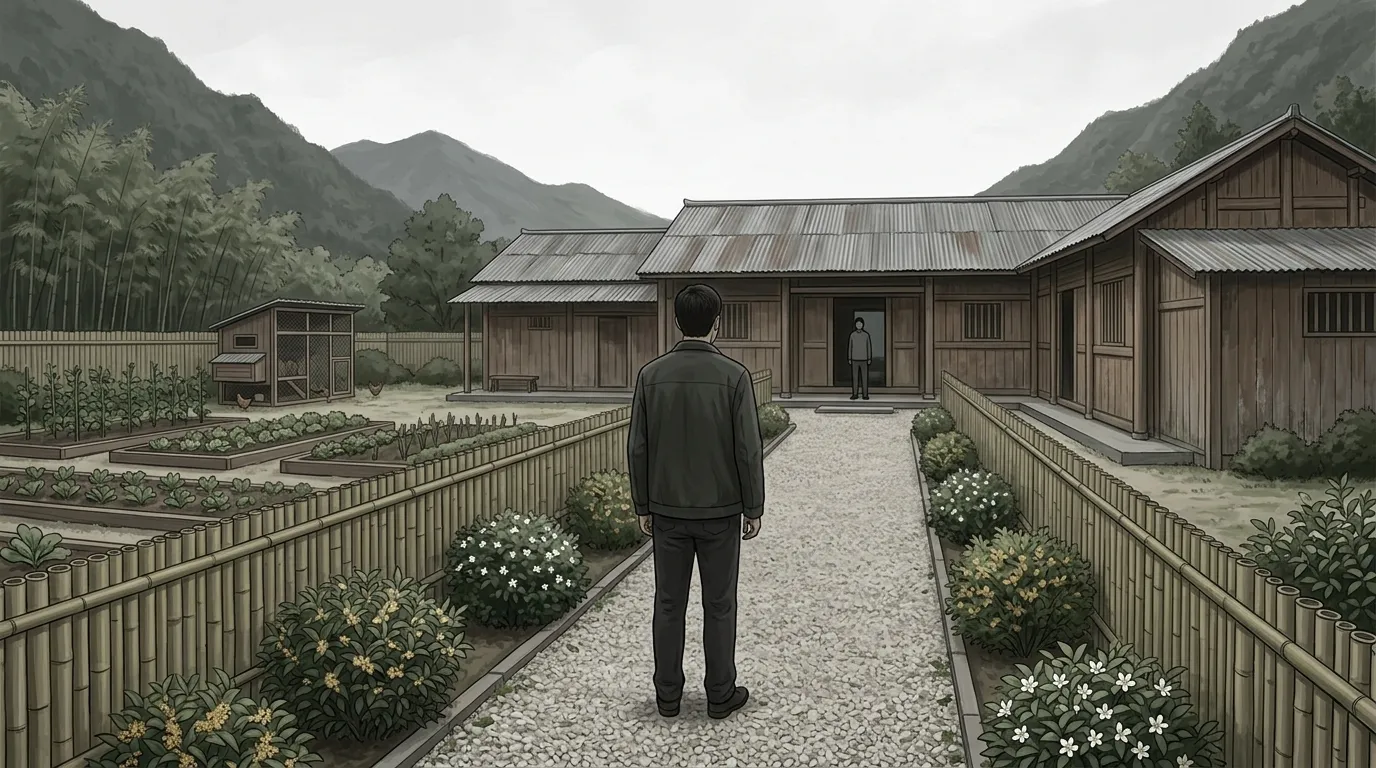
A few hundred meters on. Before the road ended, a stretch of bamboo fencing appeared on the right. About waist height, the bamboo cut clean and bound with hemp rope. Dense shrubs behind it, trimmed, nothing wild about them. At the entrance stood a wooden gate frame, the gate itself two panels of woven bamboo, ajar, unlocked. Above the frame hung a small wooden plaque, the script carved in and filled with dark brown lacquer: Serenity Living Studio. The characters carried a Zen quality — the kind made by someone drawing a blade across wood one stroke at a time, far from any computer font.
Yīn Zhòngguāng parked in a patch of open ground beside the road. When the engine died, silence fell. Not the city kind of silence, the kind filled with every sort of sound — this was mountain silence, with insects, wind through leaves, a bird somewhere in the distance. Those sounds didn’t constitute noise. They were part of the silence.
He sat in the car a moment before getting out. His right hand found the coin in his pocket; his thumb settled against the edge. He thought of Xiāo Zhònghéng’s description: no locks, no walls, a compound of corrugated-metal buildings and a vegetable garden, residents apparently there of their own accord. The operator clean enough that she didn’t need to cross any lines.
What he was looking at now: a waist-high bamboo fence, a half-open bamboo gate, a hand-carved wooden plaque. No walls, exactly as described.
He put the coin back in his pocket. Got out.
A gravel path ran through the gate, with osmanthus and orange jasmine planted on either side. April — osmanthus wasn’t in season, but the jasmine was blooming, small white flowers in dense clusters, and the air carried a faint sweetness.
When he pushed open the bamboo gate, the panels gave a soft scrape against each other. Not the sound of something old — the faint natural creak that comes from bamboo once it has fully dried.
The courtyard was larger than it had looked from outside.
The main building was a farmhouse that had been converted: two stories, the exterior plastered and painted off-white. A wooden veranda ran across the front, with a few ferns hanging from it. The first-floor windows were large, and through them he could see what looked like a common area — a long table, chairs, a bookshelf. The second-floor windows were covered by bamboo blinds.
Behind the main building stood two corrugated-metal outbuildings, arranged in parallel, a walkway between them. The metal was gray, but someone had brushed a coat of white paint over it — an improvement on bare metal, if still plain. Each outbuilding had a pair of sandals by its door.
To the left, a vegetable garden — small, the beds laid out in straight rows. Someone had built a chicken coop beside it, framed with bamboo poles and wire mesh, three or four hens moving around inside. Next to the garden, a well with a wooden cover.
The whole compound was immaculate. The gravel had been swept; no fallen leaves. Nothing cluttering the outbuilding doorways. Not a smear of dust on the windows.
Yīn Zhòngguāng stood in the middle of the courtyard and turned slowly in a circle.
A very well-maintained rural guesthouse. If this place had a star rating, it would be at least four.
He heard footsteps from inside the main building. An unhurried stride, slippers making soft sounds on wooden floor.
The door opened.
Zhōng Zìfāng looked nothing like any version of what Yīn Zhòngguāng had expected.
She was somewhere in her mid-fifties. Medium height, lean. Hair cut neither short nor long, uncolored, silver-gray, pinned behind one ear with a dark clip. No makeup; her skin had the texture of someone who spent time outdoors but took care of herself — weathered, yet very clean. A plain cotton-linen shirt, dark trousers, cloth shoes. No jewelry of any kind. Her fingers were slender, nails cut extremely short, the surface without a mark.
Her hands. Yīn Zhòngguāng noticed her hands. Exceptionally clean. A sustained cleanliness, as though maintained without interruption — something beyond the clean of having just washed. No soil in the creases, no spots on the backs of her hands. Like a tool that received careful attention every day.
“Hello.” Her voice wasn’t loud, but in that quiet space it carried clearly. She spoke slowly, each word given its full shape. “May I ask who you are?”
Yīn Zhòngguāng showed his badge. “Yīn Zhòngguāng, New Taipei City Police. Sorry to disturb you — I’d like to ask a few questions.”
Zhōng Zìfāng glanced at the badge, then at him. Her gaze was not appraisal — appraisal carries judgment. Hers was closer to receiving. Like a very still surface of water, on which nothing placed there made ripples.
“Officer Yīn.” She used his full name. “Welcome. Please come in and sit — I’ll make tea.”
She stepped to one side to let him through. Yīn Zhòngguāng followed her into the first floor of the main building.
The common room was larger inside than it looked from outside. A long wooden table, seating ten or so, the surface worn smooth, the grain running deep. Chairs placed around it. A bookshelf along one wall — quite a few books; his eye swept across them: some on Buddhism, some on psychology, some on gardening. Beside the shelf, an old radio, switched off. On the opposite wall, several framed pieces of calligraphy — the kind with Zen aphorisms — he didn’t read them closely.
Near the window was a low table set with a full tea arrangement. Not a simple set — there was a teapot, cups, a pitcher, a tea holder. Each piece placed with precision; the distance between items looked measured.
Zhōng Zìfāng walked to the low table and knelt. The motion was fluid, her knees bending at an identical angle and speed. She gestured for Yīn Zhòngguāng to sit across from her.
He sat.
She began the tea. Boiling the water, warming the pot, measuring the leaves — each step slow but not drawn out. The particular slowness of something that has been repeated so many times it has become precise. Watching her hands move between pot and cups, Yīn Zhòngguāng had a momentary thought of a surgeon in an operating room: that complete mastery of instruments, knowing without looking where everything is.
Water poured into the pot. Steam rose. Zhōng Zìfāng’s gaze didn’t follow the steam — it fell on Yīn Zhòngguāng’s hands, resting on his knees beside the open notebook.
“Is this your first time here, Officer Yīn?” she asked. Her eyes moved away just before the question, settling on the teapot — manufacturing a pause of apparent reflection. Then they returned to him.
“Yes.”
“It’s very quiet here.” She poured the first steeping. The sound of water from the spout was strangely clear in the room. “Many people coming for the first time find it takes some adjustment.”
She slid a cup toward him.
Yīn Zhòngguāng picked it up and drank.
It was very good. Genuinely good, beyond any polite acknowledgment. The temperature exactly right, the finish arriving at precisely the right moment.
He was investigating someone who might be connected to a disappearance case. Her tea was a hundred times better than the water from the dispenser at the far end of the precinct hallway. His expression didn’t change, but the thought stayed in his mind a moment.
“Ms. Zhōng —”
“Call me Zìfāng.” She smiled. The smile was slight, but not false. Or if it was false, it was very good.
“Ms. Zhōng,” Yīn Zhòngguāng said, not adjusting. “What kind of work do you do here?”
“Mental and physical recovery.” She said it without hesitation and without elaborating. She waited a moment to see if he would follow up.
“Can you be more specific?”
“We provide a quiet environment where people who need rest can come and stay for a while.” Her pace didn’t change. “Some have mental health difficulties; others are simply exhausted. We don’t treat, don’t prescribe, don’t perform any medical procedures. Only lodging, meals, and some daily activities.”
“How do people come to you?”
“Family referrals.” Zhōng Zìfāng poured a second cup. This time she didn’t push it across immediately — she lifted it herself, inhaled once, set it down. “We don’t advertise; we have no website. All word of mouth, people introduced by people they know.”
Yīn Zhòngguāng wrote a few words in his notebook. Slowly — controlling the pace of his notes so they didn’t run ahead of the conversation.
“Could you show me around?”
Zhōng Zìfāng stood. “Of course.”
She led him out of the main building and across the courtyard. As they walked, she gestured toward the vegetable garden: “This is planted by the members themselves. We don’t require it, but after most people have been here a while they want something to do. Growing vegetables, making things by hand, looking after the chickens. People need to be occupied.”
“Members?”
“That’s what we call them.” Her tone was even. “The word isn’t meant in the teacher-and-student sense. Just slightly more agreeable than ‘residents.’”
As they passed the outbuildings, Yīn Zhòngguāng heard sounds from inside. Not voices — a rhythmic, very quiet sound, like grinding or rubbing at something.
Zhōng Zìfāng pushed open the door to the first outbuilding.
Inside: a crafts room. Small — six tables; shelves along the walls with fabric, yarn, pieces of wood. Four people sat at the tables: three women, one man. A range of ages, twenties to fifties. Each was doing something different — one knitting, one sanding a piece of wood, one gluing something, one just sitting, a ball of yarn in hand, looking out the window.
When Yīn Zhòngguāng entered, all four glanced at him. Not the look of wariness — a flat, barely reactive attention. The way animals in a zoo watch visitors. Then their eyes went back to whatever was in front of them.
Their faces looked normal. Clothes clean, fitting. No one appeared thin or undernourished. Posture relaxed.
No one’s movements were restricted. No one looked frightened.
“They found here what they needed.” Zhōng Zìfāng stood beside him. She said it the way you’d say nice weather today. “Their families are more at ease too.”
Yīn Zhòngguāng looked at the man sanding wood. Early forties, gray T-shirt, movements focused. Sand, stop, look, run a finger along the surface, continue sanding.
“I’d like to ask about someone.” He turned to Zhōng Zìfāng. “Cài Cháoyáng.”
Zhōng Zìfāng’s expression didn’t shift in any direction. No surprise, no evasion, no flicker of stiffness. Her smile held exactly where it had been, the corners of her mouth neither rising nor falling.
“We protect our members’ privacy.” She said. “It wouldn’t be appropriate to confirm or deny whether any specific individual is here.”
She paused.
“However,” she continued, and something entered her tone — not defensiveness, closer to consideration, “if his family would like to visit, we welcome that at any time. They can call our number to arrange.”
Yīn Zhòngguāng said nothing. He was waiting for his own response to settle.
Zhōng Zìfāng knew the family wouldn’t come. She said welcome knowing the invitation would never be accepted. This wasn’t refusal — refusal closes a door. What she had done was open the door and let you see there was nothing behind it.
“How many members do you have?”
“Twelve at present.” She answered quickly — quickly enough for Yīn Zhòngguāng to know this was a number she carried with her at all times, no counting required.
“Turnover?”
“Quite low.” Her pace slowed. “Most people who come stay for some time. Months to a few years. Some have left and come back.”
“Do many leave?”
“Some.” She nodded. “We never press anyone. The door is always open.”
She gestured toward the bamboo gate. The gate was still open — he hadn’t closed it on his way in.
“Any members who leave on their own? Not picked up by family — just decide to go?”
Zhōng Zìfāng thought for a moment. Or gave the appearance of thinking.
“There have been.” She said. “Not many. Most who leave do so because things at home have improved.”
Yīn Zhòngguāng closed his notebook. He noticed that through the whole visit, not one of the four people in the crafts room had spoken. Not a silence that had been forbidden — a habitual quiet. Their hands moving, their mouths closed, their gazes turned inward. Like people in a library.
“Ms. Zhōng, thank you for showing me around.” He walked toward the door.
“Of course.” Zhōng Zìfāng followed him. “Officer Yīn, you’re welcome here at any time. There’s nothing here that can’t be seen.”
Her tone carried no proof in it — it was a statement of fact. And that fact was harder to answer than any defense could have been.
Walking back through the courtyard, Yīn Zhòngguāng passed the vegetable garden. A member was turning the soil there, wearing a long-sleeved work shirt and a hat. She looked up at him, gave a brief nod, and went back to her turning. The nod was natural. The way you’d greet a neighbor in an alley.
Zhōng Zìfāng walked him to the gate. He noticed that when she walked, her shoes made no sound. Inside it had been the soft pad of slippers on wooden floor; now in cloth shoes on gravel, her footsteps were so light they barely registered.
“Officer Yīn.” She stopped at the gate.
He looked back.
Her gaze was not on his face. It was on the space behind him. One second — like confirming something — then she drew it back.
“Drive carefully. There are a lot of curves on this road.”
Yīn Zhòngguāng nodded and walked to the car. The gravel crunched under his shoes. He pulled open the door and glanced back.
Zhōng Zìfāng was still standing at the gate. Her hands were folded in front of her, with the same stillness as when she had knelt to pour tea. She didn’t wave, didn’t urge him away, didn’t turn back inside. Just stood there.
Yīn Zhòngguāng started the engine. In the rearview mirror, Zhōng Zìfāng’s figure slowly shrank along the gravel path. About two hundred meters out, past the first curve, she was swallowed by the green wall of trees.
He rolled the window up.
The car was quiet. The air conditioning vent pushed out warm air — the compressor problem was real. His hands gripped the wheel, knuckles faintly pale. His right thumb moved instinctively toward the pocket, but he was driving; his hand couldn’t leave the wheel. The impulse was blocked, stalled somewhere in his wrist — the way a sentence gets stuck in the throat before it’s spoken.
He couldn’t name what was wrong.
Every word Zhōng Zìfāng had said was reasonable. Every corner of the compound was clean. Every member appeared mentally sound. The gate had no lock. The tea was excellent. She had been polite.
Xiāo Zhònghéng’s voice surfaced in his mind: “She was legal enough that you couldn’t find a single thing to challenge.”
It wasn’t that he couldn’t find anything to challenge. She had handled every possible challenge in advance.
Early afternoon, past two o’clock, Yīn Zhòngguāng walked into the office.
Xǔ Zhìmàn was there. She looked at him once, gauged his condition, and said: “The Kē Yìngcǐ case.”
Yīn Zhòngguāng stopped.
“The family came in to withdraw it.” Xǔ Zhìmàn handed him a sheet of paper.
He took it. A withdrawal notice. The reporter of record was Hóng Cǎiníng, but the person withdrawing was Kē’s father. The reason-for-withdrawal field read:
“Confirmed subject is at relatives’ home in the south, residing voluntarily, search no longer required.”
He read the line twice.
Hóng Cǎiníng had filed it; Kē’s father had withdrawn it. His gaze paused on the withdrawing party field for a beat.
Then he flipped his notebook back to the front and found the page where he had laid out three withdrawal templates.
Template Two: “Family has confirmed they are aware of the missing person’s whereabouts and have handled the matter directly.”
The wording in the Kē Yìngcǐ withdrawal wasn’t any of the three templates he had. The phrasing was different, but the structure was the same — one confirmed, one voluntarily, one conclusion. The format was identical to the earlier cases.
“When did he come in?” he asked.
“Ten this morning. Kē’s father came alone.” Xǔ Zhìmàn’s voice carried no affect. “Procedure was normal. Filled out the form, signed, clerk stamped it. The whole thing was under fifteen minutes.”
Yīn Zhòngguāng set the withdrawal notice on his desk. His eyes stayed on that line. Confirmed subject is at relatives’ home in the south, residing voluntarily.
He sat down and said nothing.
Xǔ Zhìmàn waited about ten seconds. “You went to that place this morning.”
Not a question.
Yīn Zhòngguāng nodded.
“How was it?”
He thought about how to answer. Took a long time. Then said: “Very clean.”
Xǔ Zhìmàn’s expression didn’t change. But her fingers on the keyboard paused — just once — and then kept typing.
Yīn Zhòngguāng picked up the desk phone and dialed Hóng Cǎiníng’s number.
Four rings.
“Hello?” Hóng Cǎiníng’s voice came through, slightly breathless — she was walking, or had just set something down.
“Ms. Hóng, this is Yīn Zhòngguāng. I came to the precinct last time when you filed the report —”
“I remember. Any news?” Her pace sped up immediately. This time the urgency was something held down a long time suddenly being opened.
“I need to tell you about a development.” Yīn Zhòngguāng used the word development. Not news, not outcome. A neutral word, pointing nowhere. “The family of Kē Yìngcǐ — her father came to the precinct today to withdraw the report.”
About three seconds of silence on the other end. Yīn Zhòngguāng counted.
“What does that mean?” Hóng Cǎiníng’s voice dropped. Not a lowering of volume — the pitch itself fell, the way a taut string goes slack when released.
“Mr. Kē submitted a withdrawal application. The stated reason is that Kē Yìngcǐ is at relatives’ in the south, residing voluntarily.”
“That’s impossible.”
Two words, no hesitation, no gap for thought. A refusal at the bodily level, out of her mouth before her mind had caught up.
“Ms. Hóng —”
“She could not have done this voluntarily.” Hóng Cǎiníng’s pace began to accelerate, words spilling like water through a crack. “I told you. She would never go to the south, she would never do this voluntarily. Do you know — two days ago her mother sent me a LINE message.”
Yīn Zhòngguāng shifted his grip on the receiver slightly. “What did it say?”
“Told me to stop asking. Exact words —” she paused, rustling through her phone. “‘Yìngcǐ needs rest. Let her be quiet for a while. Don’t look for her anymore.’ Verbatim.”
Yīn Zhòngguāng didn’t respond.
“Don’t you find that strange?” Hóng Cǎiníng’s voice had begun to shake. Not the controlled anxiety from their first meeting, fingers tapping on a coffee cup, still held together — this was the shake of control giving way entirely. “‘Let her be quiet for a while. Don’t look for her anymore.’ What does that mean? A daughter disappears and the mother tells people to stop looking?”
“Ms. Hóng, that message — can you screenshot it and send it to me?”
“Yes. I’ll send it right now.”
“To my work phone. I’ll text you the number.”
“Okay.” Her breathing was audible through the phone, slightly hurried. Then her voice dropped again, to a frequency Yīn Zhòngguāng didn’t quite recognize — not collapse, but the sound of someone at the edge of collapse going abruptly still. Like the eye of a storm.
“Officer Yīn.”
“Yes.”
“If the case is withdrawn — does the investigation stop?”
Yīn Zhòngguāng’s lips moved. He knew the standard answer. Family withdraws, case closes. The status in the system changes from search active to withdrawn. One fewer case on his workload.
“I’ll continue looking into the situation,” he said.
He hung up. Two days ago — Monday. When he had gone to the Kē family on Tuesday, Kē’s mother hadn’t said a word. Someone who had already told others to stop looking had nothing more to say in person.
The noise from the Criminal Investigation Unit across the way came through as usual. Someone on the phone, speaking loudly. Someone eating, plastic bag rustling.
Yīn Zhòngguāng replaced the receiver and glanced at Xǔ Zhìmàn.
Xǔ Zhìmàn held his gaze for a second, then returned to her screen. She didn’t ask anything.
Five thirty in the evening. The hallway was emptying out.
Yīn Zhòngguāng stood at Zhuāng Péi’ān’s desk, his notebook open to the pages of his compiled notes.
Zhuāng Péi’ān was leaning back in his chair with a cup of tea. Today’s tea looked stronger — a darker color. He listened to Yīn Zhòngguāng speak for about five minutes.
Yīn Zhòngguāng presented it in order. The withdrawal pattern: three templates, the Kē Yìngcǐ case as a fourth variant. Geographic connection: the psychiatric clinic and Serenity Living Studio on the same road. Serenity Living Studio: legally registered, operator Zhōng Zìfāng, visited in person this morning. Member privacy protections, family-referral model, Xiāo Zhònghéng’s findings from five years prior.
He didn’t say I think something’s wrong. He arranged the facts.
Zhuāng Péi’ān said nothing for a moment after. He set his cup down. The cup met the desk with a soft sound, amplified by the silence.
“Zhòngguāng.” His voice wasn’t sharp. It carried that particular flatness that comes with a great deal of fatigue. “How many pending cases are you carrying?”
Yīn Zhòngguāng knew the answer. “Seventeen.”
“Seventeen.” Zhuāng Péi’ān repeated it. “You’re going to chase a case that’s already been withdrawn. What happens to the seventeen?”
“What if some of those seventeen follow the same pattern?”
Zhuāng Péi’ān’s gaze moved from his cup to Yīn Zhòngguāng’s face. He held it there for a few seconds. Something in that look — not anger, not contempt — something deep and old, like a door hinge that has been opened too many times and worn smooth.
“I have a hundred and twenty-odd.” Zhuāng Péi’ān’s voice dropped half a register. “You think I have time to care what closed case you’re chasing?”
Yīn Zhòngguāng didn’t reply. He waited.
Zhuāng Péi’ān leaned forward slightly. His fingers tapped the desk twice — not an impatient tap, something mechanical, metronomic.
“You know what I’m most afraid of? It’s not cases that go unsolved.” He paused. “It’s officers who try too hard, and then I find a pile of ‘reopened investigations’ on my report.”
Yīn Zhòngguāng’s breathing didn’t change. His expression didn’t change. His hands rested on his thighs, notebook pressed under his palm.
“Chief, the withdrawal pattern —”
“Yīn Zhòngguāng.” Zhuāng Péi’ān cut him off. Quietly, but cleanly — the way scissors cut a thread. He looked straight into Yīn Zhòngguāng’s eyes.
“That’s exactly why you should let them close.”
Yīn Zhòngguāng’s shoulder moved.
Not a shrug, not a stiffening, not any named muscle reaction. It was something between his shoulder blades — a muscle he probably hadn’t known existed — that contracted once, as if two fingers had pinched the middle of his spine.
Brief. Under a second. Then the muscle released.
But the position it released into wasn’t the position it had held before. A little lower. The way something that has been holding for a long time shifts without announcement.
He didn’t argue. He lifted the notebook from the desk and closed it.
“Understood,” he said.
Zhuāng Péi’ān looked at him. The look lasted about two seconds longer than necessary. Then he picked up his cup and drank.
“Eaten yet?” Zhuāng Péi’ān asked.
“Not yet.”
“Go eat.”
Yīn Zhòngguāng turned and walked out. His footsteps were even. The fluorescent lights in the hallway stretched his shadow long behind him.
Passing the Criminal Investigation Unit, someone inside was shouting into a phone. Yīn Zhòngguāng’s footsteps didn’t break. His right hand hung at his side, fingers not reaching for the pocket. The coin waited on the other side of the fabric, quiet, but he didn’t touch it.
Eleven forty at night.
The office held only him. Xǔ Zhìmàn had left around eight; on her way out she glanced at him, said “there are biscuits on your desk,” and left. The biscuits were soda crackers, those two-packs, sitting next to his monitor. He ate them.
He pulled out every file on his seventeen pending cases. Not from the computer system — he hauled every paper folder out of the filing cabinet and stacked them on his desk. Two desks weren’t enough space; he spread some of it across the floor.
The fluorescent tube above him put out a continuous sound, nearly beyond hearing. The back alley outside was completely dark. The row of laundry in the opposite building’s window was gone, probably brought in. One streetlamp still burned, its orange light falling on a garbage bin below.
He started sorting.
Of the seventeen, twelve were ones he’d already been reviewing — the three withdrawal templates, already categorized. The remaining five were active cases, not yet withdrawn. He set those five aside.
The twelve withdrawal notices arranged on his desk. He read through them one by one. Not reading the reasons — those he had memorized. He was reading format. Paper format, fill style, handwriting, stamp placement, the signing officer’s style.
First template: five files. He set them side by side and looked carefully.
Then he saw it.
Not five. Four of them had the same word spacing in the reason field, the same comma placement, the same minor stylistic habits — nearly identical. Not the vague similarity of written by the same kind of person. The same template. Copied word for word. The fifth had a few minor discrepancies — whoever had transcribed it had slipped.
He turned to the four files for the second template. The same thing. Three were completely identical; one had small variations.
Third template: three files. All three matched exactly.
He took his pen and placed a small check mark in the upper right corner of each notice where the format was completely consistent.
Counted: ten. Ten out of twelve with perfectly matched formats, as though they had come off the same copier.
Then he did something else.
From those ten, he selected the four with the highest degree of formal consistency — drawn from all three templates, but the most internally regular. He turned to the reporter information pages in each of those four files.
Family addresses.
He opened a bottom drawer and found a map of New Taipei’s administrative districts — a stack from a task force a few years back, stored at the bottom of the filing cabinet. Old, the corners folded from use. He spread it across Xǔ Zhìmàn’s desk and pressed down the four corners.
First file. Zhōnghé District. He marked a dot on the map.
Second file. Zhōnghé District. Another dot.
Third file. Zhōnghé District.
Fourth file. Zhōnghé District.
Four addresses. Same administrative district. He connected the four dots with his pen. The shape they made was small. Walkable range.
Yīn Zhòngguāng straightened. He stood between the two desks, case files on the floor, the map spread on the desk, two lines in the notebook.
His right hand moved slowly into his pocket and found the coin. His thumb rested on it. No pushing, no rubbing, no pressing. Just resting there. The metal’s coolness moved from his fingertip up through his wrist.
He stared at the four dots on the map.
Four families. The same withdrawal format. The same administrative district.
He didn’t know what this meant. He knew what it meant. Both thoughts existed at the same time, neither disturbing the other.
Outside the office window, the alley streetlamp burned on. Its orange light spread across the wall, edges soft and blurred — like the half-open eye of someone who doesn’t quite want to wake.
Yīn Zhòngguāng opened his notebook to a fresh page and wrote a line.
Zhōnghé District. Four withdrawals. Same template.
He didn’t close the notebook. He flipped back a few pages to the line he had written earlier: Kē Yìngcǐ’s last clinic visit and Serenity Living Studio — same road.
Two lines. Between them: pages of cramped notes, names, addresses, question marks.
He set the notebook flat on the desk, his pen alongside it. The lamp’s circle of light just covered the notebook’s surface. Outside the circle: dark.
He pulled out his chair and sat. He folded the map and slid it under the notebook.
Footsteps in the hallway. The night watch making rounds. The steps passed the door and kept going.
Yīn Zhòngguāng drew his hand from his pocket and laid it on the desk, palm down. The coin’s coolness still lingered in his thumb. He placed both hands flat on the desk.
His fingers didn’t move.
He sat there. Outside, a car passed occasionally — the sound far off, as if filtered through several layers of glass. Case files on the floor. A map on the desk. Two lines in a notebook.
He didn’t turn off the light.