Chapter 5
She Hadn't Forgotten to Lock the Door
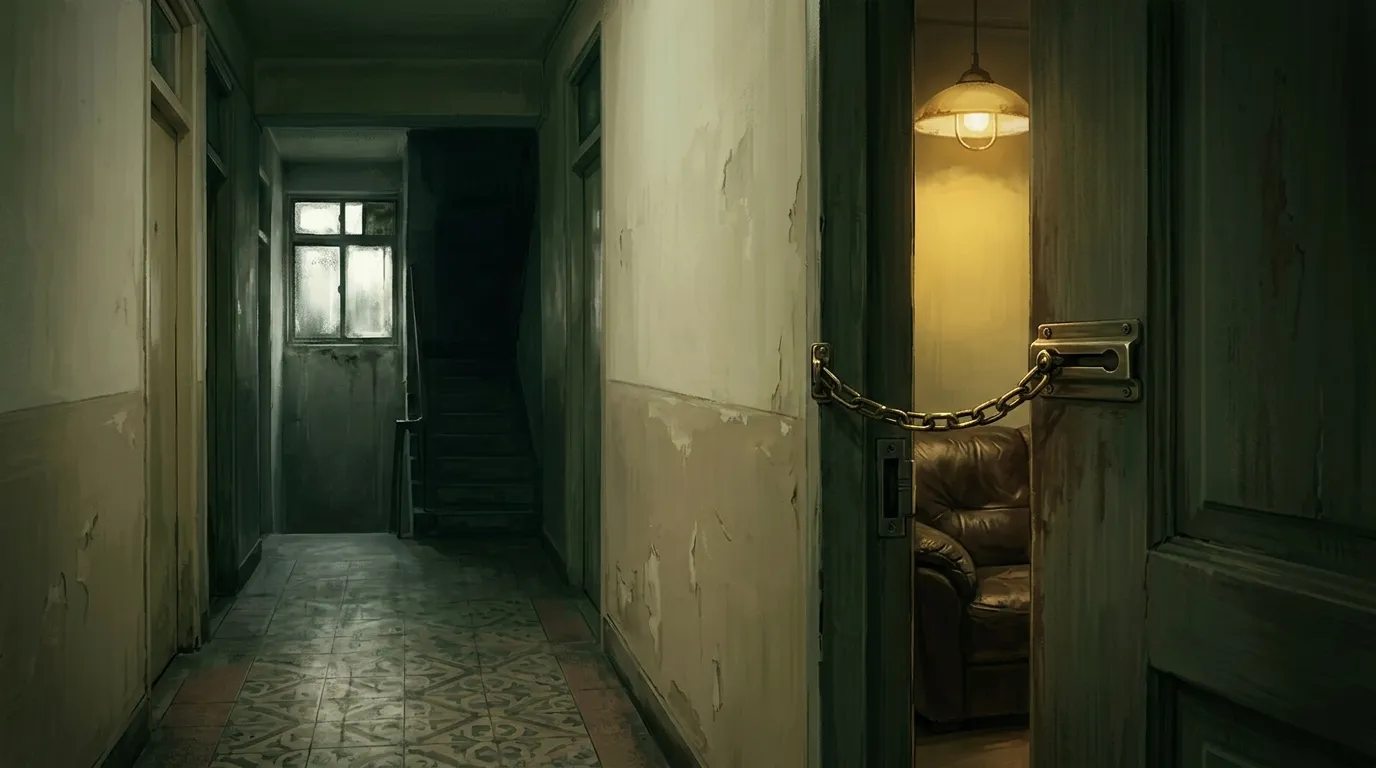
Chapter 5: She Hadn’t Forgotten to Lock the Door
Hóng Cǎiníng arrived twenty minutes early.
When Yīn Zhòngguāng came through the door at the top of the stairs, she was already seated at a two-person table against the wall, two empty cups in front of her. Not two cups for two people — two empty cups from one person drinking both. Lattes, the milk foam on the inside of the cups already collapsed, like snow that had half-melted.
He walked in through the second-floor entrance of the chain café beside Bǎnqiáo station. Thursday afternoon, three o’clock; the place wasn’t crowded. Jazz playing through the speakers, the volume louder than necessary. The air conditioning was too strong; someone by the window had wrapped themselves in a jacket and was working on a laptop.
Yīn Zhòngguāng crossed the room. When she saw him, Hóng Cǎiníng leaned forward slightly. She had on a dark hoodie, zipper pulled all the way up, arms wrapped around her own elbows.
“Mr. Yīn.”
“Ms. Hóng.” He pulled back the chair across from her and sat. He’d chosen this spot for the corner — wall at his back, a sightline that swept the whole second floor. Habit.
Her fingers were tearing at the paper rim of the cup sleeve. Her hands were trembling. Not the knuckle-rapping restlessness from their meeting at the precinct — something finer, a trembling seeping outward from somewhere inside. Caffeine. His gaze moved from her hands to the two empty cups, then back.
“Are you nervous?” he asked.
“It’s the caffeine, not nerves.” Hóng Cǎiníng’s pace matched what he’d heard on the phone — quick, no gaps between sentences. “I drink coffee when I’m anxious, which makes me more anxious, which makes me drink another cup.”
“A vicious cycle.”
“Yes.” She twitched one corner of her mouth. It didn’t quite become a smile. “Same as filing the report. The more I can’t find her, the more anxious I get. The more anxious I get, the less I can find her.”
The twitch held for less than a second and disappeared. Like a lighter that won’t catch — a spark but no flame.
Yīn Zhòngguāng went to the counter and ordered an Americano. While he waited, he stood at the bar and watched Hóng Cǎiníng’s back. She was rummaging through her bag, taking things out — her phone, a packet of tissues, a coin purse — and then, from somewhere deep inside, pulled out a small object and held it in her palm.
He carried his coffee back to the table.
Hóng Cǎiníng opened her hand.
A silver flash drive. Small — roughly half the length of a thumb. A white label had been stuck to it, handwritten: Backup. The characters were small, neatly formed, the strokes slightly rounded — a woman’s hand.
“This is Yìngcǐ’s.” Hóng Cǎiníng set the drive on the table, placing it with precision in the exact center between them. “She gave it to me for safekeeping before she disappeared.”
Yīn Zhòngguāng didn’t reach for it. His gaze rested on the drive.
“When did she give it to you?”
“Late January. Before Lunar New Year.” Hóng Cǎiníng’s pace slowed. Whenever the details touched Kē Yìngcǐ directly, her rhythm shifted — as if a different person had taken over the speaking. “She called me out for dinner. Afterward, outside the MRT station, she pressed this into my hand.”
“What did she say?”
“She said —” Hóng Cǎiníng closed her eyes briefly. “She said, if she suddenly went out of contact, give this to the police.”
Yīn Zhòngguāng’s breathing didn’t change. He moved his right hand from the table to his knee, thumb pressing without thinking against the seam of his trousers.
“What did you think at the time?”
“I thought she was doing it again —” Hóng Cǎiníng stopped. She stopped the way you stop when you’ve walked into a wall you built yourself. “Yìngcǐ has bipolar disorder. Did you know?”
“I know.”
“She could be — dramatic, sometimes.” Hóng Cǎiníng looked down at the tabletop. “At the time I thought she was overthinking things. I told her nothing was going to happen, she was worrying too much.”
Her voice dropped. It sank, down to a register where Yīn Zhòngguāng had to listen more carefully to follow it.
“And then she was gone.”
Yīn Zhòngguāng picked up the drive. A few small scratches on the silver casing. He ran his thumb along the edge of the label — pressed down tight, no corners lifting.
“Did you look at what’s inside?”
“Yes.” Hóng Cǎiníng nodded. Her fingers started on the cup sleeve again. “She organized it herself. You know, Yìngcǐ had this habit — she recorded everything. She kept a journal in a notes app, she sorted her phone photos by date. She even logged every time she took her medication every month.”
Hóng Cǎiníng drew a breath, the kind that comes before going underwater.
“There are screenshots of call records, audio recordings, and notes she wrote herself. She’d noticed that her mother was calling someone. Not a normal call — that kind of — you know what I mean. That tone. Discussing how to handle her ‘problem.’”
“What problem?”
“Her.” Hóng Cǎiníng tapped the table once with one finger, sharp. “Yìngcǐ was the problem. Her bipolar disorder was the problem. When she was in an episode she’d get very agitated, spend a lot of money, go days without sleeping. The family considered her a burden.”
Yīn Zhòngguāng didn’t respond. The jazz cycled to another track; the sound of wire brushes on a snare drifted through the overhead speakers, a soft, persistent hiss.
“In her notes she wrote that her mother called this person ‘the advisor.’” Hóng Cǎiníng’s voice steadied a little. She did better when she was anchored in specifics. “Just how her mother referred to him on the phone. ‘I’ll ask the advisor.’ ‘The advisor says he can arrange it.’”
Yīn Zhòngguāng wrote a line in his A5 notebook. He waited for her to finish before he wrote.
“Is there a number for whoever the mother was calling?”
“Yes. Yìngcǐ screenshotted quite a few. The same number, called many times.”
“I’ll need the drive.” Yīn Zhòngguāng’s gaze moved from the notebook to Hóng Cǎiníng’s face. “Do you have a backup?”
“Yes.” She answered without hesitating. “I copied everything to my own hard drive.”
He nodded. He slipped the drive into his inside jacket pocket. Through the fabric he felt the small object settle against the left side of his chest, the metal’s firmness transmitting through his shirt.
“Ms. Hóng.”
“Yes.”
“Why bring this out now?”
Hóng Cǎiníng’s hands went still. The paper rim she’d been tearing hung in the air, half-detached.
“Because I thought filing the report would be enough,” she said. Her voice had flattened, almost without inflection. “I thought you’d investigate. And then the case was withdrawn.”
She raised her head and looked at him. Not accusation in her gaze — Yīn Zhòngguāng knew what accusation looked like, that directed, purposeful anger he’d seen from family members in every interview. Hóng Cǎiníng’s gaze wasn’t aimed at him. It was aimed at something behind him. A system.
“You said you’d look into it.” She said. “So I came.”
Yīn Zhòngguāng understood what she needed. She needed to believe that someone was doing something. That need carried a weight of its own — a setting-down. She had placed this in front of him, and whether he was ready to catch it didn’t change the placing.
He picked up his coffee and took a sip. It had cooled. The bitterness was more pronounced than when it was fresh.
“I’ll look at it,” he said.
That same evening, Yīn Zhòngguāng plugged the drive in at the office.
Nine thirty. Xǔ Zhìmàn was still there — she worked a fixed late shift every Thursday, processing the weekly reports. The monitor light fell across her face, blue-white. She saw him insert the drive; her gaze paused for a moment and didn’t ask.
Three folders inside the drive.
The first was labeled Call Records. Inside: twelve screenshots. Screenshots of a phone’s call log, each one with the same number circled in red. A number beginning with 09 — a mobile. Yīn Zhòngguāng arranged the twelve screenshots by time: the earliest was from last September, the latest from mid-January of this year. The calls varied in length; the shortest three minutes, the longest forty-seven.
The second folder was labeled Notes. One PDF file. Yīn Zhòngguāng opened it — it was a PDF of photographed handwritten pages, Kē Yìngcǐ’s own hand. The same characters as on the drive’s label, small and rounded. She had recorded her observations in a list:
September 17. Mom was on the phone in her room. Voice very low. She closed the door when I passed by.
September 22. On the phone again. This time in the kitchen. I heard her say “she’s been unstable again lately.” She hung up when she saw me.
October 5. Looked at mom’s call history without her knowing. Same number, called six times. Saved in contacts as “advisor.”
October 12. Searched the number online. Nothing. Searched on Whoscall. Nothing.
November 3. Mom and dad had a fight. I heard it from my room. Mom said, “we can’t go on like this.” Dad said, “so what do you want to do.” Mom said, “I’m already asking around.”
November 15. I asked mom who she keeps calling. She said a friend. I asked what friend. She said someone you don’t know. Her eyes —
The line after that had been crossed out. Crossed out heavily, the strokes layered over each other many times, blotting out whatever had been written. The blacked-out area was small — about four or five characters.
Yīn Zhòngguāng stared at the blacked-out patch. He didn’t know what the words had been, but the force of that obliteration spoke on its own.
December 1. Decided to start recording.
The third folder was labeled Recordings.
Two MP3 files. Yīn Zhòngguāng opened the first, lowered the volume, leaned toward the screen.
Static. In the background, a television — distant. Then footsteps — the sound of slippers on a floor. A woman’s voice, pressed low, but close to the recording device — the phone must have been left nearby.
“—she’s been worse lately. Last month she spent over thirty thousand.”
Another voice. The person on the other end of the line — distorted through the phone speaker, gender indeterminate, possibly male, possibly a woman with a lower register. Unhurried, without emotional fluctuation.
“Yes, we’ve encountered this kind of situation many times.”
“She won’t take her medication.” The woman — Kē’s mother — spoke with a weariness worn smooth by long use. “The doctor prescribed medication and she won’t take it. Says the side effects are too strong. What can you do.”
“That’s common. In some situations, the family environment itself is the source of stress. A period of separation, for both parties, can help.”
“But she’d never agree to —”
“She doesn’t need to agree.” The voice on the other end remained level. “Our experience is that after the environment changes, most people come to accept it gradually.”
The recording cut off here. Yīn Zhòngguāng looked at the file length: two minutes and seventeen seconds.
His finger hovered above the trackpad, not clicking open the second file. His hand went still. Not hesitation — processing. Like a computer encountering an anomalous data format that requires a few extra milliseconds to parse.
He transcribed the first recording into his notebook, sentence by sentence. When he’d finished, he went back and read through it.
“She doesn’t need to agree.”
He underlined this sentence with a blue ballpoint pen.
Then opened the second file.
This one was shorter. One minute and forty-three seconds. The background was quieter than the first — possibly a different time, a different room. Kē’s mother’s voice was more relaxed than in the first recording, with less of the tentative probing, as if she’d already made a decision and was speaking from the other side of it.
“—Is it far away?”
“Not far. Within New Taipei City. Nice environment, good air.”
“After she’s there — can she call?”
“In the early period, we’d recommend against it. Let her adjust first.”
“All right.” Kē’s mother paused. “And — the fees —”
“Let’s discuss that in person. Not convenient over the phone.”
“All right.”
Another silence. About four seconds. Then Kē’s mother spoke again. Her voice was lighter than before — the voice of someone trying to convince themselves of something they haven’t fully accepted.
“I just want her to get better.”
“I understand. Many parents feel this way.”
The recording ended.
Yīn Zhòngguāng pulled the earbuds out. The sounds of the office came flooding back — the hum of the fluorescent lights, Xǔ Zhìmàn’s typing, someone coughing somewhere out in the corridor.
There was something in his throat. Not pain, not burning — a constriction. Like cotton packed into the airway — not enough to suffocate, but every breath required a little more effort.
“Xǔ Zhìmàn.”
Her fingers stopped on the keyboard. She turned.
“I need you to run a number for me.” He slid his notebook across to her; the 09-series number was written on the page. “Not call records — I know we can’t pull those. What I need is whether this number appears in any other cases in our system.”
Xǔ Zhìmàn looked at the number for three seconds. He’d already seen what her memory could do — she didn’t need to write it down.
“What are you looking for?”
“Whether this number has any connection to family members in other missing persons cases.”
Xǔ Zhìmàn didn’t ask why. Her gaze returned to the screen; her fingers began to move.
“I’ll have it for you tomorrow.”
Friday afternoon.
Xǔ Zhìmàn placed a stack of papers on Yīn Zhòngguāng’s desk. Six pages. Stapled at the upper left, the staple set precisely straight.
“Six,” she said.
He picked them up.
Six separate cases. Six separate families. Xǔ Zhìmàn had cross-referenced the family interview records and call log data to surface the same number — six families with no connection to each other, all with that 09-series number appearing in their records.
All six cases had been withdrawn.
Yīn Zhòngguāng went through them one by one. Xǔ Zhìmàn stood beside his desk; she didn’t return to her seat.
First: a thirty-two-year-old man. Schizophrenia. Case withdrawn three weeks after the family filed. Reason for withdrawal: “Family has confirmed they are aware of the missing person’s whereabouts and have handled the matter directly.”
Second: a forty-five-year-old woman. Major depressive disorder. Withdrawn one month after the family filed.
Third: a twenty-eight-year-old man. Addiction — alcohol and amphetamines. Withdrawn ten days after the family filed. Ten days. The shortest.
Fourth: a fifty-one-year-old woman. Bipolar disorder. Withdrawn five weeks after filing.
Fifth: a thirty-seven-year-old man. Long-term perpetrator of domestic violence — the victim had filed, and the perpetrator had “voluntarily left.” Withdrawn three weeks after filing.
Sixth: a twenty-four-year-old woman. Borderline personality disorder. Withdrawn two months after the family filed. Two months. The longest.
Yīn Zhòngguāng finished the last page and set the stack on his desk.
Six people. Six different “problems.” One outcome.
His gaze held on the six files, his hands still, his breathing shallow. Six families. Each with a member who made it impossible for the rest of the household to function. Each had called the same number. Each had withdrawn the report.
“The calls cluster in the one to two months before withdrawal.” Xǔ Zhìmàn’s voice came from his right — even, like reading from meeting minutes. “The heaviest activity is around the time of the filing. In some cases, the calls preceded the filing; in others, the calls began after filing and withdrawal followed.”
Yīn Zhòngguāng nodded. He drew a timeline in his notebook.
“So it didn’t just clean up afterward.” He said. His voice was lower than he’d expected it to be. “It was involved from the beginning.”
Xǔ Zhìmàn said nothing. She walked back to her desk and sat down. The smell of jasmine tea drifted over from her side of the room.
Yīn Zhòngguāng turned to the third case — the twenty-eight-year-old with the addiction. The reporting party was the mother. Family address: Zhōnghé district. He checked it against the four points he’d mapped earlier.
Inside the cluster.
Saturday morning. Yīn Zhòngguāng rode his motorcycle to Zhōnghé.
The apartment building sat on a slope. Five stories, a few tiles missing from the outer wall, raw cement showing through. On the rooftop, corrugated metal sheeting added after the fact threw back a white glare in the sunlight. The ground floor was a car wash, the rolling shutter half up; from inside came the sound of a high-pressure washer.
Yīn Zhòngguāng parked at the mouth of the lane, removed his helmet, and hung it on the handlebar. He’d worn civilian clothes — a thin dark blue jacket, dark trousers, trainers. No notebook. No ID.
Third floor. He rang the bell twice.
The woman who opened the door was somewhere in her early fifties. Hair pinned up with a single black clip, a few gray strands escaping at her temples. She was wearing house clothes — a light cotton top, loose trousers, indoor slippers. No makeup; the skin around her eyes was loose, with the blue-gray under the lower lids that comes from long-term exhaustion.
Her first expression was wariness. She left the door on its chain, watching Yīn Zhòngguāng through the narrow gap — first his face, then his body, then back to his face — the way you assess a threat.
“Hello.” Yīn Zhòngguāng gave a small bow. “I’m with the community development association — we’re doing a survey on residents’ quality of life. Would it be convenient to talk for a few minutes?”
The woman’s gaze stayed on his face for three seconds.
“What survey?”
“Things like — elder care support, disability services in the community. A new government program.” His pace was slow, his tone easy. “It won’t take much of your time.”
She hesitated. Her hand was still on the door, her knuckles gone pale from the grip. Then she unhooked the chain.
“Come in.”
The living room was small. Low ceiling, poor light — even in the daytime the lamp was on. The ceiling light was a round flush-mount fixture; the color temperature ran warm, and it bathed the whole space in a faintly aged yellow glow.
The sofa was a dark faux-leather piece, the surface of the armrests cracked open and foam showing through. On the coffee table: a box of tissues, a remote control, and a glass of water that had gone cold. A clock on the wall kept perfect time.
Yīn Zhòngguāng sat at one end of the sofa. The woman — he’d seen her surname, Chén, in the case file — sat in the chair across from him. A wooden chair with a back, a cushion placed on the seat, the fabric patterned with small flowers.
He noticed a few things.
On the floor beside the coffee table, there was a patch of discoloration — square, roughly sixty centimeters on a side. That spot had held something. Whatever it was had been moved; what it left behind was a shadow: darker gray at the perimeter, the original color lighter at the center.
On the wall beside the television, a few small nail holes. The spacing suggested framed photographs. The frames were gone.
At the end of the hallway, a closed door. A Do Not Disturb sign — the kind hotels use — hanging from the handle.
Yīn Zhòngguāng’s gaze rested on that door for a moment, then came back.
“Ms. Chén, how long have you been living here?”
“Over ten years.” Her voice was a little looser now than at the door. “After my husband died I moved here. It’s close to where I grew up.”
“Is it just you in the house?”
Her hands tightened on her knees.
“Yes.”
Yīn Zhòngguāng used three unrelated questions to establish footing. The garbage collection schedule for the neighborhood; the noise from the car wash downstairs; whether there was a park nearby for walking. Ms. Chén’s answers grew longer, her tone picking up a little ordinary-life warmth — the car wash too loud on weekends, the park a fifteen-minute walk, the dog next door barking at night.
The fourth question.
“In terms of disability support — if there’s someone in the household who needs long-term care, there are some new government programs. Is that something you might need?”
Ms. Chén’s lips pressed together. Not a lip-press — a brief muscular contraction, as if pulling something back before it could come out.
“No.”
Yīn Zhòngguāng nodded. “Understood. What about situations where a family member has had mental health difficulties — there are some resources —”
“My son isn’t here anymore.”
Yīn Zhòngguāng went quiet. Not a deliberate pause — the meaning caused it. Isn’t here anymore could mean many things.
“Do you mean —?”
“He left.” Ms. Chén’s gaze went to the glass of water on the table. “He didn’t die. He left. Went somewhere.”
Yīn Zhòngguāng waited.
Ms. Chén’s breathing quickened — the kind that comes just before something sealed begins to seep at the edges.
“You have no idea what our lives were like.”
Her voice changed. Not the volume — the texture. Like a piece of cloth that has been left to soak, then lifted: same cloth, same shape, but completely different weight.
“He started drinking at nineteen. Later it wasn’t just alcohol. I don’t know what it was; the doctor said amphetamines. Every time he came home, he stole things. The TV, the microwave, my husband’s gold ring. Stole them to sell.”
Yīn Zhòngguāng’s hands lay on his knees, still.
“Then he started hitting. Not every time. But you never knew which time it would be.” Ms. Chén’s gaze drifted from the water glass to her own hands, her knuckles. “We called the police. Many times. When the police came he’d be calm. Very obedient. The police left and he’d start again.”
She stopped. The clock on the wall ticked twice.
“Do you know what it means to have no options?” She looked at Yīn Zhòngguāng. That look wasn’t asking him. It was confirming something she had confirmed many times before. “The hospital won’t take him — not in an acute phase. Social workers came, assessed, said they’d follow up. Follow up to what? Did they follow up every day when he came home?”
Yīn Zhòngguāng didn’t speak. He wasn’t with a community association. He was a police officer. He had been, more than once, the officer who got the call, went out, found things had quieted down, and left.
“Eventually someone told us about a place.” Ms. Chén’s voice dropped. Not deliberate — the kind of automatic lowering the body does when certain subjects are approached. “Somewhere he could stay for a while. A quiet place. With people to look after him.”
“Who told you?”
“A friend. Her situation was similar to mine. Her daughter — also.” Ms. Chén didn’t say also what. The blank was filled without words.
“My friend said there was someone who could help. Just one phone call.”
“What call?”
“A number. A mobile. You call and someone picks up.”
Yīn Zhòngguāng’s breathing held at the same pace. His voice kept the same slow, easy warmth it had carried throughout. But somewhere between his shoulder blades — the place that had contracted once before, in Zhuāng Péi’ān’s office — something was happening again. A sustained, very light pressure this time, as if a coin had been laid flat against his spine.
“You called?”
“I called.” Ms. Chén’s eyes were beginning to redden. Not all at once — gradually, from the corners, a slow capillary process of saturation, like a tissue touching water and the water creeping upward along the fibers.
“The person asked a lot of questions. About the situation at home, his medical history, what he was using, how long it had been going on. Very thorough. More thorough than the hospital ever was.”
“Did they say who they were?”
“No.” Ms. Chén shook her head. “They only said they did this kind of work. That they could help.”
“And then?”
Ms. Chén’s tears came down.
Not sobbing — a quiet, exhausted flow. The tears slid from the corners of her eyes, followed the lines of her face, paused at her chin, and fell onto the backs of her hands folded in her lap. She didn’t wipe them away. She didn’t reach for the tissue box. As if this liquid had flowed so many times that her body no longer registered it as something requiring response.
“I just wanted the whole family to be able to sleep one night.”
As those words came out, the ceiling light blinked once. Not a malfunction — the kind of brief fade aging fluorescent lights occasionally show, a momentary lapse before recovering.
Yīn Zhòngguāng’s stomach moved. Not pain — something concrete, physical, a wringing. Like taking a wet cloth by the middle and twisting it a half-rotation, then stopping. The water neither up nor down, suspended in the fibers.
He knew he shouldn’t ask the next question. Not because he shouldn’t — because he already knew the answer. He’d heard it in the recording. But he needed to hear it from this woman’s mouth.
“How did they — reach you? Who told them about you?”
Ms. Chén raised the back of her hand to her eye. A quick gesture, efficient, handling an inconvenience rather than an emotion.
“They said —” She drew a breath.
“They were ‘Come Home for Dinner.’”
Four characters. The phrase hung in the air.
When Yīn Zhòngguāng heard it, his first response wasn’t in his mind. It was in his stomach. As if someone had reached in and gripped something — not the stomach itself, but the floor of the stomach, near the spine, a location he had never known had nerves passing through it — gripped it, and wouldn’t let go.
His face didn’t change. His breathing didn’t change. His voice didn’t change.
But his body, in the seconds after those four characters, spent about three seconds relearning how to sit on a sofa.
“This name —” he began. There was a thin film on the inside of his throat, like dust. “‘Come Home for Dinner’ — is that an organization? A service?”
“I don’t know.” Ms. Chén shook her head. “That’s what they said themselves. When you called, the person on the other end said it. ‘We’re Come Home for Dinner.’ Just like that.”
When Yīn Zhòngguāng stood up, his knee made a quiet sound. He walked to the door and put his shoes on. Ms. Chén followed, a tissue crumpled in her hand without his having seen her take one.
“That — sir.”
He turned.
“That survey of yours —” Ms. Chén’s voice had gone small. “No one is going to come looking for me, are they?”
Yīn Zhòngguāng looked at her. A woman in her early fifties, her hair not quite all white but almost, her knuckles deformed from years of housework, the lines at the corners of her eyes deeper than her age. Standing in the doorway of her own home, worried that answering a few questions had put her at risk.
“No one will.” He said. “Thank you.”
He went down the stairs. Each step sent an echo up the narrow stairwell. The door on the third floor closed when he was halfway to the second-floor landing.
Then he heard the chain lock slide into place.
She hadn’t forgotten to lock the door.
Yīn Zhòngguāng didn’t ride away immediately. He walked to the covered walkway at the mouth of the lane and stood beside a claw machine. The machine was lit up, stuffed with outdated cartoon plushies. Its speaker was playing an electronic jingle on a loop, the audio quality poor.
He leaned his back against one of the walkway’s columns. The tiles were cool.
“Come Home for Dinner.”
He turned those four characters over in his mind.
A family member goes missing. The family makes one phone call. The person on the other end says: We’re Come Home for Dinner. Then that person disappears. Then the family withdraws the report. Then nothing happens.
The words Kē Yìngcǐ’s mother had spoken in the recording. The words Ms. Chén had just spoken in the living room. The distance between them was close enough to make him uncomfortable. Not because they were similar — because they were true. Every word had been true. The exhaustion was true. The helplessness was true. I just wanted the whole family to be able to sleep one night was true.
This wasn’t abduction.
The recognition surfaced from somewhere at the base of his mind, a bubble rising through water — unhurried, working through each layer.
This was a service. A service that had responded to a genuine need. When the family system fractured, the hospital couldn’t catch you, the social workers couldn’t keep pace, the police came and left, and the law had no authority over a person who hadn’t committed a crime. And in the gaps between those systems, someone had extended a hand.
What that hand did: it took people away.
His stomach twisted again.
Yīn Zhòngguāng took his phone from his pocket. He pulled up the number from the drive’s screenshots — he’d already memorized it — and opened the six families’ contact information from his notebook.
A prepaid SIM. He knew it was prepaid. Unregistered, untraceable. But the call pattern was clear: the same number, in each case, beginning intensive contact one to two months before withdrawal. Each family had been reached independently — they didn’t know each other, weren’t connected, each finding the same exit point inside their own separate despair.
Word of mouth. As Zhōng Zìfāng had said: We don’t advertise; we have no website. It’s all referrals from people who know each other.
Then he thought of the social media accounts. He’d checked the three missing persons from earlier — Cài Cháoyáng, Chén Bǎixùn, Yóu Yǎhán — and all of their accounts were still live, but with activity that had gradually tapered off to nothing. At the time it had only struck him as strange. Now he understood. The accounts hadn’t been abandoned by the missing persons themselves. Someone had logged into those accounts. Logged in, cleared any content that might reveal something, and logged out. The accounts remained, seemingly intact, just quiet. Like a room where no one had switched off the light.
Cleanup. From the phone number to the withdrawal form language to the social media accounts, every step had been managed by someone.
He put his phone away. The claw machine’s jingle kept cycling. A man on a bicycle turned into the lane at the far end, two bags of rice on the rear rack. The sounds of motorcycle engines, a dog barking in the distance, the car wash running. A normal Saturday morning in Zhōnghé.
Yīn Zhòngguāng walked back to his motorcycle. When he buckled his helmet, the clasp took slightly longer than usual to catch. His fingers were a fraction less precise than normal.
Back at the office.
Xǔ Zhìmàn wasn’t in. She had Saturdays off. The room held only him, and the intermittent sounds of the Criminal Investigation Unit’s duty officer next door.
Yīn Zhòngguāng plugged the drive into the computer and opened the second recording.
He had already listened to it once. But he needed to listen again.
The second recording. One minute and forty-three seconds. Kē’s mother’s voice. “Is it far away?” “After she’s there — can she call?”
He paused at the one-minute-twelve mark. Rewound. Listened again.
He was listening past the content. Not these recordings — the drive held only two. But Kē Yìngcǐ’s notes mentioned December 1. Decided to start recording. She had recorded more than this. She was the kind of person who logged everything — there was no way she’d recorded only twice.
Where were the others?
Deleted. Or not on this drive. Kē Yìngcǐ had put the two clips she considered most important into Backup. The others might still be on her phone — the phone that was now a dead number.
Yīn Zhòngguāng listened to both recordings again from the beginning. This time he noticed something he’d missed before.
In the first recording — after Kē’s mother said “She won’t take her medication”, as the person on the other end responded, there was a sound in the background. Very faint. Like the sound of a page turning — or someone swiping a phone screen. The person on the other end was listening and recording something at the same time.
The same as a doctor taking a patient history. Just without a medical form, without a health insurance card.
Yīn Zhòngguāng removed his earbuds. He stared at the waveform of the audio file on the screen. The waveform was very level — no arguments, no threats, no sound signature of any violence. This was a normal, polite, efficient service call.
He understood.
The “service” Xiāo Zhònghéng had spoken of. The work Zhōng Zìfāng did. Come Home for Dinner as Ms. Chén had said it. The fragments were rearranging themselves in his mind. Not a puzzle — a puzzle implies a final, complete image. More like sand. Every grain was real. But the shape they made depended on the angle from which you looked.
From the family’s angle: a lifeline. A last resort that appeared only after every proper channel had failed. From the missing person’s angle: a decision made by others, with no one asking whether they agreed. From the law’s angle: nothing had happened. An adult who left voluntarily. A family that withdrew voluntarily. The door had been open the whole time.
Yīn Zhòngguāng felt sick at this understanding. Not morally sick — cognitively sick. His mental framework had a slot for perpetrators and a slot for victims. This case didn’t fit either slot. The perpetrators were exhausted mothers. The victims were sons who made it impossible for the whole family to sleep. Or the other way around. Or both. Or neither.
He turned his notebook to a fresh page. He wrote three lines:
One: the need the network answers is real. Two: the people taken away were never asked. Three: every family who has used this service will not speak.
He drew a line under the third.
Because they were all complicit.
Four o’clock in the afternoon. Sunlight came through the window at a low angle, stretching Yīn Zhòngguāng’s shadow across the desk belonging to Xǔ Zhìmàn on the opposite side of the room. He sat in his chair without moving; the computer screen in front of him had gone into sleep mode, showing nothing but black with a screensaver drifting occasionally across it.
His phone rang.
The screen lit up. Caller ID: Mom.
Yīn Zhòngguāng looked at the word on the screen. His phone lay face-up on the desk; the vibration made it drift slowly across the surface with each pulse, shifting a little to the left. He watched it move.
The third vibration. He picked up.
“Zhòngguāng.” His mother’s voice came through the receiver. A slight Taiwan Mandarin lilt — her phrasing trailed off gently at the ends, like a river widening and slowing as it reaches its lower reaches.
“Mm.”
“Are you free this weekend? Come home for dinner.”
Four characters. Buried inside the most ordinary sentence in the world.
The place in Yīn Zhòngguāng’s stomach — that exact place — the one he had first become aware of two hours ago in Ms. Chén’s living room, the place where he now knew nerves ran — was gripped again.
This time the grip was harder. Before, those four characters had come from a stranger’s mouth. Now it was his mother’s voice — the same four syllables, just with a softening particle tacked on at the end. That particle was the most natural thing in the world. But those four characters no longer were.
His mind knew this was his mother. His body didn’t. His body received five syllables and activated the new neural circuit that had formed two hours ago. The floor of his stomach contracted. The cotton in his throat thickened by a layer. His breathing required conscious control to stay at a normal rhythm.
“Zhòngguāng?” His mother’s voice carried a trace of puzzlement. “Are you busy?”
”— No.”
“We haven’t eaten together in a while. I’ll make your favorites.”
Yīn Zhòngguāng closed his eyes for a moment. Behind his closed eyelids: Ms. Chén’s living room, the silver flash drive in Hóng Cǎiníng’s palm, Kē’s mother’s pressed-low voice from the recording, Zhōng Zìfāng’s figure watching him from the doorway as he left — these images didn’t appear in sequence. They existed simultaneously, stacked on top of one another, like a photograph that had been overexposed.
He opened his eyes. The screensaver was still drifting.
“All right,” he said.
After he hung up, the phone screen went dark. Yīn Zhòngguāng turned his phone over, screen down, against the desk.
The office was quiet. The Criminal Investigation Unit’s duty officer next door had probably gone for dinner. No footsteps in the corridor. Out the window, in the alley below, a cat was walking alongside the trash bins, stopped, looked at something, and walked on.
Yīn Zhòngguāng laid both hands flat on the desk. Between his right thumb and forefinger was a coin — he couldn’t have said when he’d taken it from his pocket. The rim of the coin was caught in the web between his fingers; the pressure of his two fingers was perfectly equal, the coin suspended — not falling, not moving.
A coin held in place.
He looked at it. The metal surface caught the afternoon light coming through the window. Ten dollars. Heads up. Chiang’s profile.
He didn’t spin it. Didn’t rub it. Didn’t walk it over his knuckles. No gesture of any kind. Just held it. With a force precise to the point of excess, keeping a coin fixed between two fingers.
Like holding something you cannot put down and cannot throw away.
He sat there for a long time. Long enough for the light outside the window to go from yellow to orange, then from orange to gray. The streetlamp in the alley below came on, its amber light falling across the wall of the building opposite. Same spot as yesterday. Same spot as the day before.
He didn’t move.
The coin remained between two fingers.
The streetlamp outside held its light. From down the corridor came the slow return of footsteps — the duty officer was back. The sound of a key turning in a lock, carrying clearly from the far end of the hallway.
Yīn Zhòngguāng’s fingers loosened. The coin fell onto the desk, bounced once, produced a brief, clear ring of metal on wood. Then was still.
He picked it up and put it back in his pocket.
Stood. Shut the computer. Picked up his jacket.