Chapter 6
I Didn't File This Case
Chapter 6: I Didn’t File This Case
Yīn Zhòngguāng heard the television before he reached the elevator landing.
Not the content — the volume. It carried through the fire door. He stood in the third-floor corridor, a box of peaches in his left hand. He’d bought them at the morning market: the vendor had lined the box with a page of expired newspaper and slipped it inside a red plastic bag. He hadn’t planned to buy them. But as he passed, the vendor said it was the last box of the day, and he stopped. Not because he wanted peaches — because his mother had mentioned something the previous month, in passing: I wonder if this year’s peaches are sweet.
That kind of offhand remark. But Yīn Zhòngguāng’s mind had a particular flaw — if someone dropped a sentence that contained an object, a time, or a judgment, he kept it. He didn’t always act on what he kept. But that morning, walking past the fruit stall, the sentence resurfaced from somewhere, and he paid.
He pressed the doorbell.
The television inside didn’t lower. About ten seconds passed before the lock turned and the door opened.
His mother was wearing a light gray cotton top, the hem tucked into her house trousers. On her feet, the blue slippers — the soles worn flat, making a faint scraping sound against the tiles when she walked. Her hair was pinned up with a clip that had gone slightly loose; a few white strands lifted from above her ears.
“You’re here.” Her eyebrows rose slightly when she saw the plastic bag. “Aiya, you didn’t have to.”
“Peaches.”
“Look at you.” She took the bag, pressing through the plastic to test for firmness. “Are they soft yet? …Mm. They’ll do.” She turned and walked inside. “Almost done with lunch. Wash your hands, then we can eat.”
Yīn Zhòngguāng changed into slippers — the pair she kept for him: dark blue, half a size too small, worn for years without replacement because every time he said not to bother, she didn’t bother.
The living room was the same as his last visit. Three cushions on the sofa, spaced equal distances apart — brown, beige, brown. The coffee table wiped clean, nothing on it but the remote and a box of tissues. The television was on a political talk show, the volume too loud — his mother’s hearing had been going for a few years, though she wouldn’t admit it. The clock on the wall kept good time: eleven forty-seven.
His gaze settled on the dining table.
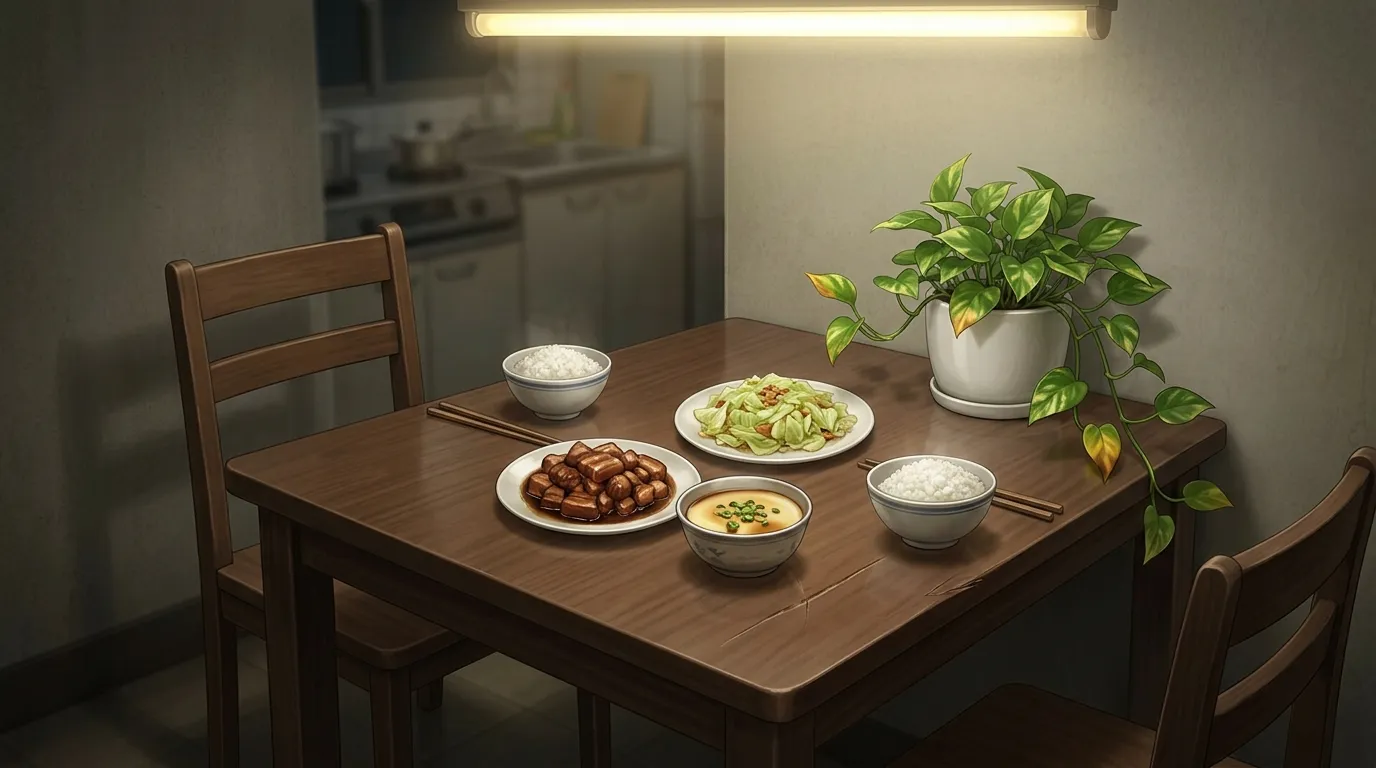
A square table for four, wood, the corners worn round, a shallow scratch running from the center toward the right side. Two place settings.
His mother’s position faced the kitchen: bowl, chopsticks, soup spoon, a folded paper towel pressed under the bowl’s edge. His own place was to the right, the same arrangement. Across from him — his sister’s old seat — a pothos sat in a white ceramic pot, its leaves trailing over the edge of the pot and touching the table. A plastic saucer underneath.
The left side, his father’s place, was empty. Even the chair had been pushed to the wall.
Yīn Zhòngguāng sat down. The chair gave a wooden creak. His right hand settled naturally on his knee; his fingers found the edge of a coin in his pocket. Found it, didn’t take it out. His fingers rested between fabric and metal, unmoving, the way you rest your hand on something to confirm it’s still there.
“Zhòngguāng, bring me that plate.” His mother’s voice from the kitchen, half-swallowed by the range hood.
He stood and walked to the kitchen doorway. Three dishes on the counter: braised pork belly, garlic cabbage, steamed egg. The egg’s surface was smooth as water on a windless day, scattered with scallion greens and a few drops of soy paste.
Three dishes. Two people.
Yīn Zhòngguāng carried the pork and the cabbage to the table; his mother carried the egg, then scooped two bowls of rice from the cooker. Her portion was noticeably smaller than his.
“Eat.” She sat down. Her chopsticks moved first to the braised pork, lifting a piece into his bowl. The motion was quick, precise — the meat landed squarely in the center of his rice, its ring of brown sauce spreading into the grains.
Yīn Zhòngguāng didn’t say thank you. He lowered his head and ate.
His mother added a chopstick-load of cabbage to his bowl.
“You’re too thin,” she said. Not the tone of someone worried — a verdict.
Yīn Zhòngguāng ate more slowly here than anywhere else. His mother’s cooking was good — that was simply true — but what made him slow was the table itself. This table had a kind of gravity. Sit down and everything slowed. It had always been this way. When his father was alive, the table had its unspoken rhythms: Mother was first to sit, last to rise; Father ate without speaking, the sound of his chopsticks against the bowl his way of saying fine; his sister always finished first, always left first; Yīn Zhòngguāng last.
Now there were only two sets of bowl-and-chopstick sounds.
“Busy lately?” his mother asked.
“Not particularly.”
“Eating properly?”
“Yes.”
“Don’t eat out so much.”
“Mm.”
His mother moved a piece of steamed egg into his bowl. The bowl was already stacked two layers deep — rice on the bottom, braised pork, cabbage, and steamed egg on top. He hadn’t finished the first layer yet.
He paused his chopsticks in the air.
“Mom.”
“Mm?”
“Has Jie called lately?”
The sound of chopsticks catching the bowl’s rim. Light. Once.
His mother’s expression didn’t change. Her hand continued moving — she picked up a piece of cabbage, put it in her own mouth, chewed twice. But her other hand — her left hand, resting at the table’s edge — the fingers curled inward slightly, as though grasping at a fistful of air under the table.
“She’s busy.” His mother said it after she swallowed. She used the tip of a chopstick to chase a single grain of rice. “She’s in America. The time difference.”
Yīn Zhòngguāng registered two things. First, the present tense — she’s busy, not she was busy lately, not she seems to be busy these days, but a statement so spare it was barely more than a habit, the particle at the end attached like inertia rather than feeling. Second, what was missing: his mother hadn’t said she’s doing well.
Every other time he’d asked about his sister, his mother’s answer came as a set: She’s doing well, busy with work in America, the time difference, not easy to call. Four elements — doing well, America, busy, time difference. This time only three. Doing well had been skipped.
He couldn’t tell whether it was an unconscious omission or a kind of erosion. Thirteen years. Any set of words repeated for thirteen years would start to drift. Like a song played so many times you stop hearing the lyrics; you hear only the skeleton of the melody.
His mother stood and came back from the kitchen with a bowl of soup — green, miso with tofu, thin slices of young ginger floating on top.
“Have some soup.” She set the bowl in front of him. The base of the bowl met the table with a soft sound — enough to fill the silence his question had left behind.
Yīn Zhòngguāng took a sip. Young ginger. As a child he wouldn’t eat ginger, so his mother had cut it very fine and hidden it in the dishes to slip it past him. Later, when he grew up, she stopped hiding it and just added it directly.
His gaze crossed the bowl’s rim again toward the opposite seat.
The pothos. White ceramic pot. A few leaves draped to the tabletop. One of them had a slightly yellowed edge — too much water or too little; he couldn’t tell. That plant had occupied that position for at least five years. The first time he noticed it, he hadn’t asked. The second time, he hadn’t asked. The third, fourth, tenth — still hadn’t asked. The pothos had become part of this table now, as though that seat had always been intended for a plant.
He brought his gaze back. Lowered his head. Kept eating.
After dinner, his mother was at the sink.
Yīn Zhòngguāng sat on the living room sofa. The television had been switched to a variety show rerun; canned laughter poured from the speakers at a volume that made it less background noise than a houseguest who wouldn’t leave. His mother moved between the sound of running water and the sound of the television — washing bowls, wiping the stovetop, spooning leftovers into containers, sliding the containers into the refrigerator, rearranging whatever was already in there.
He listened to the rhythm of her movements. Fixed, always fixed — first the bowls and chopsticks, then the pots, then the stovetop, then the refrigerator. He had grown up inside this sound sequence. Faucet on and off, the regular intervals between clanking bowls, like a piece of music that never varies.
Yīn Zhòngguāng stood.
“Mom, I need the bathroom.”
“Go ahead, go ahead.” Her voice half-swallowed by the water.
He didn’t go to the bathroom. He walked down the corridor — the bathroom was the first door on the left, he passed it — all the way to the end, where the door on the right waited.
The door was closed.
No dust on the knob. That detail made him stop. Third-floor unit in an old building, the corridor poorly ventilated — the knob on a closed room shouldn’t be dustless. Unless someone wiped it regularly.
He turned the handle. Unlocked.
Inside, the light was off. He felt for the switch on the wall. The fluorescent tube flickered twice before it held.
The room was smaller than he remembered. Or rather, the last time he had walked into this room was more than ten years ago, and his body had been smaller then. Now, standing in the doorway, his shoulders nearly touched both sides of the frame.
His mother called it the study now. There was indeed a desk — set against the window, wooden, a sewing machine sitting on top, a few pieces of fabric stacked beside it. The curtains were beige and drawn; sunlight filtered through the weave, drawing thin lines across the floor. Across from the desk: a wardrobe, white, a long scratch along one of its doors — a scratch he recognized. His sister had made it in high school, moving a bookshelf.
A rug on the floor, dark red, the edges already fraying. Under the rug: tile. He remembered his sister complaining that tile was too cold in winter; she had bought this rug herself.
Yīn Zhòngguāng walked to the wardrobe.
Opened it.
On the right side hung a few of his mother’s coats on plastic hangers. The left side was empty. The lower compartment had two shelves: folded quilts on the upper shelf, and on the lower — a cardboard box.
Not a large box. About the size of one that holds reams of paper. The lid was placed on top rather than sealed. A word on the side, in his mother’s handwriting.
Miscellaneous.
Yīn Zhòngguāng lifted the box out and set it on the rug. He crouched down and opened the lid.
On top, a photograph. A graduation portrait. Department of English, National Taiwan Normal University, a year no longer legible, some class. Four rows of people in academic gowns. Yīn Zhòngguāng didn’t find his sister immediately — he scanned the entire photo over a few seconds before locating her in the second row, toward the right. Yīn Ruòchéng. Twenty-two years old. Hair to her collarbone, undyed. Smiling very hard — the corners of her mouth pulled up at too steep an angle, like someone caught at the last second and told to smile.
Beneath the photograph, several notebooks. He picked up the first one. Hardcover, A5, off-white. He opened it. The script was small, dense, written in blue ink. Not a diary’s format — no dates, no dear — more like notes. Some passages written quickly, the handwriting too hurried to be fully legible; others written slowly, the script neat, as though copying something.
He turned to the middle.
I don’t know what normal means. They use that word as if it’s a line — stand on this side and you’re right, stand on the other and you’re wrong. But who drew the line?
Yīn Zhòngguāng’s hand stopped on that page. He didn’t turn it. He read it again. Who drew the line. No question mark at the end of the sentence. She wasn’t asking. She already knew the answer.
He kept going.
Dates appeared. His sister had started recording dates in the latter half — not every day, only when something happened. From the yellowing of the paper and the oxidation of the ink, these entries were from thirteen or fourteen years ago.
4/12. Went home for dinner today. The moment I walked in, Dad asked if I’d found work yet. I said still applying. He said what can you do with an English degree. He’s been saying that line for four years. I didn’t answer.
5/3. Mom called to ask about Dragon Boat Festival. I said I’d see. She said the rice dumplings were already made, my share is set aside. She always sets mine aside. No matter if I come or not, there’s always a share. I don’t know if that’s love or accounting.
6/20. Brought Sīqí home.
Yīn Zhòngguāng’s fingers stopped on that name.
Dad didn’t look away from her the whole time. Not avoiding — seeing through. As if she were made of glass. Mom worked very hard at being normal. Serving food, pouring water, asking what she did for work, where she was from. Each question as normal as a job interview. Sīqí kept smiling when she answered. I knew what that smile was — I’d worn it myself — the smile of making yourself smaller, trying to fold yourself into someone else’s frame.
After dinner, Dad went to the study and closed the door. Mom was at the sink. Sīqí and I sat in the living room with the TV on, neither of us watching. She held my hand. Her hand was shaking.
When we left, Mom walked us to the door. She glanced at Sīqí. Just a glance, less than a second. Then she looked at me.
She said: Ruòchéng, if you were normal, everything would be fine.
Yīn Zhòngguāng’s breath caught for one beat at that line. Not because of what the sentence said — because of how it was built. If you were normal, everything would be fine. A conditional sentence. A conditional sentence for love. You have to satisfy the first half before the second half applies.
His fingers left the page. He noticed, as they left, a very small hesitation — the way you hesitate when you’ve touched something whose surface is hot but not yet hot enough to pull back from; there was just an extra layer of judgment inserted between touching and letting go.
He kept reading.
The dates jumped further and further apart. Two or three months between entries, then three entries in a single month, then six days in a row.
9/1. Sīqí left.
Nothing else. Three characters. One line. The rest of the page was blank — the blankness a notebook is born with: paper fiber, faint blue printed lines, nothing.
Yīn Zhòngguāng turned the page. The dates and context that followed confirmed it: Sīqí had left as in a breakup, not a death. But for Yīn Ruòchéng, the difference may not have been large.
9/15. Started not being able to eat. Not no appetite — my throat clenches when I swallow. The doctor said anxiety. Prescribed medicine. Took it for a week. No effect.
10/3. Mom called. Same tone as always. Same questions in the same order: are you busy, have you eaten, when are you coming back. She didn’t ask about Sīqí. She never says that name. As if that person never existed from the beginning.
10/28. Dad hospitalized. Heart. Mom cried on the phone. She rarely cries. When she cries, her voice doesn’t change — still the same voice, just with water added. She said on the phone: Your father’s health is bad. It’s all from being upset.
Yīn Zhòngguāng set the notebook on his knee. He was crouching in front of the wardrobe; his legs had already started going numb. He didn’t move.
It’s all from being upset.
He had heard this line before. In many interviews, in many living rooms. Different households, different family members, different tones — but the same sentence structure. It’s all because of him/her. An attribution. An attribution that compresses an entire system’s collapse into one person’s name.
He kept reading. The speed of his page-turning increased. Not impatience — a different kind of momentum, the kind you feel walking down a slope when you’re not trying to speed up but the incline is making the decision for you.
The last several pages.
11/12. I feel like I’m surplus to this family. Not unwanted — my existence itself is the problem. When Dad was in the hospital, I stood at the door to his room. Mom was inside holding his hand. The image was complete. Two people. If I weren’t there, the image would have no crack in it.
11/25. Thirty-eighth day of insomnia. Not that I can’t fall asleep. It’s that when I close my eyes I keep hearing the last thing Sīqí said. She said: I can’t hold on. It’s not your fault. But I can’t hold on.
12/1. Mom said there’s someone who can help. She didn’t say it quite that plainly — but that was the meaning. She said there’s a place, quiet, clean, you can rest. Her eyes weren’t on me when she said it. She was looking at the television.
Yīn Zhòngguāng’s right hand left the notebook. His hand hovered over the open page, fingers slightly spread, palm down. Like pressing something in place. His breathing shifted — shallower at the same pace; each breath only reaching the upper half of his chest, the space below occupied by something that had moved in.
He heard his own pulse. In his ears. Very close.
His left hand — he wasn’t sure when it had slipped into his pocket — was doing something without orders: his thumb pushed a coin up between his index and middle fingers, then released it, let it slide back to his palm. Up, back down. Up, back down.
Not any of the variations he’d had before. Not the push, not the scrape, not the rub, not the rest, not the pinch. A new pattern — a loop. Pushing up was intention; sliding down was gravity. He had built a perpetual motion machine between his fingers and the metal, to substitute for what his breathing wasn’t willing to do.
Last page.
Date: 12/10.
Tomorrow Mom cooked my favorite dishes and asked me to come home for dinner. I don’t want to go, but I’ll go.
Yīn Zhòngguāng closed the notebook.
The motion of closing it was slower than opening had been. He placed the notebook back in the box. As he did, his fingers brushed something else at the bottom — hard, rectangular, with the texture of buttons. He took it out.
A mobile phone. Nokia. Old model, a flip phone. The screen’s surface was covered in fine scratches, as though it had spent a long time at the bottom of a pocket alongside keys. He pressed the power button. Nothing happened. The battery had died long ago.
He put the phone back. Replaced the lid.
From the far end of the corridor came the sound of the faucet shutting off — his mother was done with the dishes. Then the sound of a cloth on a table. Then the soft scrape of slippers on tile.
Yīn Zhòngguāng stood up. His legs had gone numb; he stood in place for two seconds to let the blood return. Then he lifted the box back onto the wardrobe’s lower shelf and closed the wardrobe door.
He turned off the light. Walked out. Pulled the door shut behind him.
In the corridor, the sound of his mother’s slippers stopped.
“Zhòngguāng? What are you doing in there?”
“Looking for something.” He walked back toward the living room.
“What?”
“A charger. Mine broke. I thought you might have an old one here.”
“A charger… let me look.” His mother turned toward the television cabinet and pulled open a drawer, rummaging through it. Her back was bent toward him, the shape of her shoulder blades visible through the thin cotton.
Yīn Zhòngguāng stood at the border between the corridor and the living room. He looked at his mother’s back.
She had lost five kilograms over three months. Then she made a phone call. Then her daughter came home for one last dinner.
He hadn’t known. He was twenty-one then, living in the police academy dormitory. He hadn’t known what his sister’s notebook said. He hadn’t known who Sīqí was. He hadn’t known what his father’s hospitalization had to do with his sister. He hadn’t known —
He had known.
He had known his sister’s relationship with the family was difficult. He had known the timing of her “going abroad” was too convenient — right when his father was in the hospital and the family was in chaos, his sister had suddenly “gone to America.” He had known his mother never mentioned any details — no flight number, no American address, no photo sent back from abroad. He had known these things were wrong.
But he had chosen not to ask.
The same as those families.
“Nothing here.” His mother straightened up, holding a tangle of charging cables. “These are all old ones. No idea if they’ll work. Take a look.”
Yīn Zhòngguāng accepted the bundle. “Thanks.”
He didn’t look at the cables. He stuffed them in his pocket.
Monday morning. Yīn Zhòngguāng rode his motorcycle to the precinct.
When he hung his helmet on the handlebars, he felt it — not a sound, but a shift in attention. The way you feel someone watching you in a crowd before you’ve turned around; the back of your skull already knows.
He walked into the precinct. A few people were queuing in front of the front-desk booth on the first floor. He passed by the side and took the stairs. Third floor.
The office door was open. Xǔ Zhìmàn was already at her desk. Her computer screen was lit, her white ceramic cup beside it — today’s tea was osmanthus, a faint sweetness in the air. When she saw Yīn Zhòngguāng she looked up, and something entered her gaze that he couldn’t quite name.
“Zhòngguāng.”
“Mm.”
“There’s something on your desk.”
He walked to his desk. A yellow sticky note sat on the surface, folded once in the middle. He opened it.
The handwriting was Xǔ Zhìmàn’s — small characters, clean strokes, perfectly horizontal.
This morning, the front desk received a civilian call. Asking “what cases is Officer Yīn currently investigating.” Caller did not leave a name. Desk officer passed it along.
Yīn Zhòngguāng turned the note over. The back was blank. He set it on the desk.
“What time was the call?”
“Just after eight. You hadn’t arrived yet.” Xǔ Zhìmàn’s voice maintained its usual pitch and pace, but her hands — resting on the keyboard — had all ten fingers lightly on the keys without typing. “The desk officer said it was a man. Very polite. No threatening tone. Just asking.”
“What exactly did he ask?”
“Just what you were investigating. The desk officer said he couldn’t disclose the details of individual officers’ duties. The caller said understood, thank you, and hung up.”
Yīn Zhòngguāng sat down. His chair rolled a short distance on the floor. He picked up the note and read it again.
“Caller ID?”
“Payphone.”
He nodded. Put the note in the drawer.
Xǔ Zhìmàn didn’t turn back to her typing. She watched him. She wasn’t someone who used her eyes to transmit emotion — her gaze was usually instrumental, looking at a thing to extract information from it. But now her gaze rested on his face longer than information extraction required.
“One more thing,” she said.
Yīn Zhòngguāng waited.
“Supervisor Zhuāng took leave this morning. But he called me yesterday — Sunday evening — asking whether you had come into the office last Saturday.”
Yīn Zhòngguāng said nothing.
“I said you had. He asked what time you’d arrived, what time you’d left.” Xǔ Zhìmàn’s pace didn’t change, but her index finger tapped the J key once. Not typing — her hand needed somewhere to put the motion. “I said I didn’t know — I wasn’t in on Saturday.”
“What else did he ask?”
“Nothing.” She paused for a second. “He took leave but called to ask about that.”
She offered no judgment. She just added one more line to the outline of the facts, sharpened the edges. That Xǔ Zhìmàn had chosen to tell him about Zhuāng Péi’ān’s call was a judgment in itself — she wasn’t relaying information. She was issuing a warning.
The noise of the Criminal Investigation Unit filtered through from outside the office as always. Someone on a phone call, speaking loudly about a statement. Yīn Zhòngguāng opened his computer and logged in. The screen lit up. Default blue wallpaper.
He didn’t look at Xǔ Zhìmàn. But he knew she was still watching him.
“Zhòngguāng.”
“Mm.”
“Someone is asking about you.”
The way she said it didn’t feel like conveying a fact. More like drawing a line — up to here was what she could observe; the other side was territory she wasn’t sure she should step into.
Yīn Zhòngguāng turned his head toward her.
“I know,” he said.
At noon he walked to the convenience store across the street to buy coffee.
Iced Americano. The clerk was someone he knew — a college-age man with glasses, name tag reading Yǒuchéng, working the early shift. Yīn Zhòngguāng paid and was waiting for the machine to finish when the clerk leaned over with something to say.
“Mr. Yīn, someone was just asking about you.”
Yīn Zhòngguāng’s hand was still raised at the cup pickup point.
“What kind of person?”
“A man. Mid-forties maybe, well-dressed. He bought a bottle of water, then he asked me —” the clerk nodded toward the precinct, ”— he asked whether the officer who rides the motorcycle over there lives around here.”
“What did you say?”
The clerk pushed up his glasses. “I said I didn’t know. He smiled, said nothing more, and left. Very polite.”
“What did he look like?”
“Just… ordinary. Medium height. Short hair. He had on a — gray polo shirt? I didn’t pay much attention.”
Yīn Zhòngguāng took his coffee. “Thanks.”
He walked out of the convenience store. Stood at the entrance. The sun was strong; the reflected light off the precinct’s outer wall made him squint. He turned his head left, then right. Arcade, parked motorcycles, an elderly woman pushing a cart selling ylang-ylang garlands, two middle schoolers in uniform waiting at the light.
No gray polo shirt.
He took a sip of the coffee. Iced, but his throat tightened as it went down — not from the cold; whatever was there made him feel every passage through that point with heightened attention.
Yīn Zhòngguāng walked back to the precinct. Up the stairs. At the landing between the second and third floors, he paused. He took out his phone and opened his call log. No missed calls. No unknown numbers.
He put the phone away. Kept climbing.
Half past five in the afternoon. Yīn Zhòngguāng rode out of the precinct’s underground parking garage.
He rode for about ten minutes to the lane near his apartment in Yǒnghé. He pulled into his usual spot — the motorcycle bay at the lane’s entrance, third stall, the one he parked in every day. Took off the helmet, hung it on the handlebars, then reached under the seat for his jacket — not because it was cold; his jacket was stored in the storage compartment. He lifted the seat.
Inside the storage compartment, there was something that hadn’t been there before.
A business card.
Yīn Zhòngguāng’s hand stopped in mid-air. He didn’t touch it. He looked at it for three seconds.
The card was white, standard size. Lying on top of his jacket, face-up. No name. No phone number. No company. Only a single line printed in the middle, in a plain, unassuming font:
We just want everyone to be able to eat well.
Yīn Zhòngguāng pulled his hand back. He stepped away from the motorcycle. A street light at the lane’s entrance — not yet on, the sky not quite dark. From somewhere down the slope came the metallic sound of a hardware store rolling its shutter down. An old man walked slowly under the arcade overhang, an elderly dog on a lead beside him.
His compartment had a lock. He locked it every time he parked.
He looked at the lock. No marks from a tool. The face of the lock was clean.
Someone had opened his lock, placed a business card inside, and locked it again. Without breaking anything. That itself was the message — we could get in, but all we left was a greeting.
He took the card out. Heavy stock — not the kind printed at a copy shop, with a slight thickness, the edges clean. No fold marks. He turned it over. Blank.
He put the card in his pocket. Took out the jacket. Put it on. Locked the seat down.
Then he stood at the lane’s entrance, helmet in hand, looking at the lane he walked through every day. Buildings on both sides at uneven heights — five stories, four, five, three. Laundry racks hung with clothes of different colors; someone had draped bed sheets out a window, the sheets hanging flat against the outer wall. Somewhere in the lane, a woman was calling her child in for dinner.
He knew this lane. He knew which building’s iron gate closed at ten, which air conditioning unit dripped to the first floor, which apartment’s dog barked twice whenever he walked past. He had thought of himself as an observer in this lane — a police officer, observation was instinct.
But now someone had placed a card in his storage compartment that he hadn’t put there.
He wasn’t just the observer. He was also being observed.
And whoever was watching him hadn’t even bothered to threaten him. No phone call, no following, no appearing in front of him. Just a card. A polite, gentle, even well-meaning card.
One line. Fifteen characters. Every one of them warm.
Yīn Zhòngguāng buckled his helmet strap. He walked into the lane. When he reached the foot of his building, the motion-sensor light in the stairwell came on. He stood on the first step, the light falling on him.
He thought of the last line in his sister’s notebook.
Tomorrow Mom cooked my favorite dishes and asked me to come home for dinner. I don’t want to go, but I’ll go.
She went.
And then?
Late at night.
Yīn Zhòngguāng sat on the floor in front of the coffee table. His own laptop on the table, not the work computer. The screen’s light lit his face and hands; everything else settled into the dark. He hadn’t turned on the living room light.
He logged into the police information system.
VPN. Username and password. Verification code.
As his fingers moved across the keyboard, he was entirely clear about what he was doing. Officers had clearance to query immigration records — through the National Immigration Agency’s system, routed through the National Police Agency gateway. But queries required a case number. He was looking up his sister. He had no case number. He was equally clear about something else: every query left a record — account, timestamp, subject. If someone pulled the logs, everything he typed would be there.
His sister was not his case.
He had never filed a missing persons report for her.
Yīn Zhòngguāng typed his sister’s name into the query field. Yīn Ruòchéng. He had her ID number memorized — he had seen it on the household registration booklet too many times growing up. He entered the number; he left the case number field blank and typed four characters in the notes field: investigative reference. This wouldn’t make the query legal, but it at least kept it from looking entirely unmotivated.
He pressed search.
The system processed for three seconds. Results appeared.
Yīn Ruòchéng. Departure date: February 17, Republic of China Year 102. Destination: United States (Los Angeles). Entry records: none.
He stared at those three characters: entry records: none.
Left Taiwan. Never returned. Thirteen years.
He opened another browser tab. The U.S. Customs and Border Protection I-94 website — publicly accessible, anyone could search, with just a traveler’s name, date of birth, and passport number. He had seen the passport number in the departure record he’d just pulled.
He entered the information. Searched.
Result: no matching record found.
Yīn Ruòchéng had departed Taiwan on a Taiwanese passport from Taoyuan Airport, destination Los Angeles. But the American public system had no record of her entry.
He leaned back in his chair. Drew one slow breath, then let it out.
This wasn’t a certain conclusion. I-94 records could have gaps — system migrations, name transcription differences, other administrative irregularities; paper I-94 forms hadn’t been fully digitized until 2013. But taken with Taiwan’s entry records: none, the two databases pointed the same direction: her passport showed she had cleared Taiwan’s exit inspection, but she had never appeared at her destination. And she had never come back.
Thirteen years.
Yīn Zhòngguāng’s hands came off the keyboard. He laid them flat along the edge of the coffee table. A small patch of wood beneath his palms warmed. He sat with his head slightly bowed, staring at the query results on the screen. White background, black text, table lines neatly dividing the fields. Like a medical report. Every value in normal range — except one cell that was empty.
His mind started working. The emotion set aside. Investigation.
Possibility one: Yīn Ruòchéng had genuinely cleared exit inspection and boarded the flight, but something went wrong in Los Angeles — denied entry and deported, record lost to administrative error. But a deportation would have generated a Taiwan-side entry record. There was none.
Possibility two: she cleared exit inspection but never boarded. At some point in the controlled zone, after the checkpoint and before the gate, she left. Or was taken. An exit record only proved she passed passport control; it didn’t prove she got on the plane.
Possibility three: she never went to the airport at all. The exit record was arranged — someone had passed through departure inspection using her documents, creating a record of her leaving Taiwan.
Yīn Zhòngguāng leaned against the chair back. The chair was hard. When his spine met the backrest, the coin in his pocket pressed against his thigh, the metal edge biting slightly.
He thought about those cases. Six families. Each missing person had a plausible explanation — went down south, went to do religious practice, went abroad. Each explanation just sufficient to stop any further questions. No excessive detail required. Just a direction and a reason everyone was willing to accept.
His sister. Gone to America.
He had heard it for thirteen years. His mother had said it: she went to America, working over there, busy, the time difference. He had listened. He had accepted it. He had never once asked for an address, a phone number, a photograph, a letter.
He thought about the sticky note on the refrigerator. Come home for dinner on Sunday. His mother’s handwriting.
He thought about the last page of the notebook. Tomorrow Mom cooked my favorite dishes and asked me to come home for dinner. I don’t want to go, but I’ll go.
She went.
Then, two months later, the immigration record showed she left Taiwan. But she never arrived where she was said to have gone.
Yīn Zhòngguāng picked up his phone. He scrolled for a long time — through his contacts, through numbers he didn’t know why he had never deleted. He found it.
Yīn Ruòchéng. A number from thirteen years ago. He had never called it.
He pressed dial.
One ring. Then: The number you have dialed is not in service.
He set the phone on the coffee table. The screen faded.
The laptop screen was still bright. Immigration record. Entry records: none.
Yīn Zhòngguāng reached into his pocket and took out the coin. He placed it on the coffee table, in the space between the laptop and the phone. Ten-dollar coin. Face up.
He didn’t touch it.
He looked at the three objects arranged in a row — laptop, coin, phone — like a scale that wasn’t moving. A coin at the center. Belonging to neither side.
He sat there. The living room was dark. Outside, the sounds of Yǒnghé at night came in from a distance — somewhere a motorcycle engine, somewhere a television, somewhere water moving through pipes. These sounds composed the city’s background hum, a record that would never fully stop.
He closed the laptop screen. He didn’t shut it down. Just closed it.