Chapter 7
The One Who Wasn't There
Chapter 7: The One Who Wasn’t There
On a Wednesday evening, when Yīn Zhòngguāng parked his motorcycle at the foot of his mother’s building in Zhōnghé, he had three things in his pocket.
The first was the business card.
The second was his sister’s diary — he had spent an entire night going through her apartment in Yǒnghé, and in the end had slid it into a clear ziplock bag, which he tucked inside the folder he brought to work. He’d carried it for two days without opening it again, but he knew it was there.
The third was a printout from the police information system: an immigration query. He had paused for three seconds before printing it. The act of printing turned it into paper. Paper was harder to deny than words on a screen.
He stood outside the building for a minute. The third-floor light was on — he knew that color of light, yellow, warm. His mother preferred that color temperature. She said white fluorescent lights made a place look like a hospital.
After a minute, he walked into the stairwell.
Third floor. He didn’t press the doorbell.
He stood at the door and listened for a few seconds. Inside: the sound of the television, and from the kitchen, the sound of water. She was cooking.
He knocked twice.
The water stopped. The shuffle of slippers moved toward him from inside. The lock turned. The door opened.
His mother was wearing an apron. She still held a spatula in her right hand; its metal surface had a faint streak of moisture. When she saw Yīn Zhòngguāng, her eyebrows shifted — not surprise, but a kind of recalibration. Her baseline assumption was that he would not show up unannounced.
“Zhòngguāng? You didn’t say you were coming.” She stepped aside. “Come in, I’m in the middle of cooking, just give me a minute —”
“Mom,” Yīn Zhòngguāng said, “I need to talk to you.”
No rise in his voice. Not a question.
His mother wiped her hand once on her apron. She looked at his face. She had lived past sixty years, and found something on his face that made her go still.
“Come in,” she said. Her tone had changed.
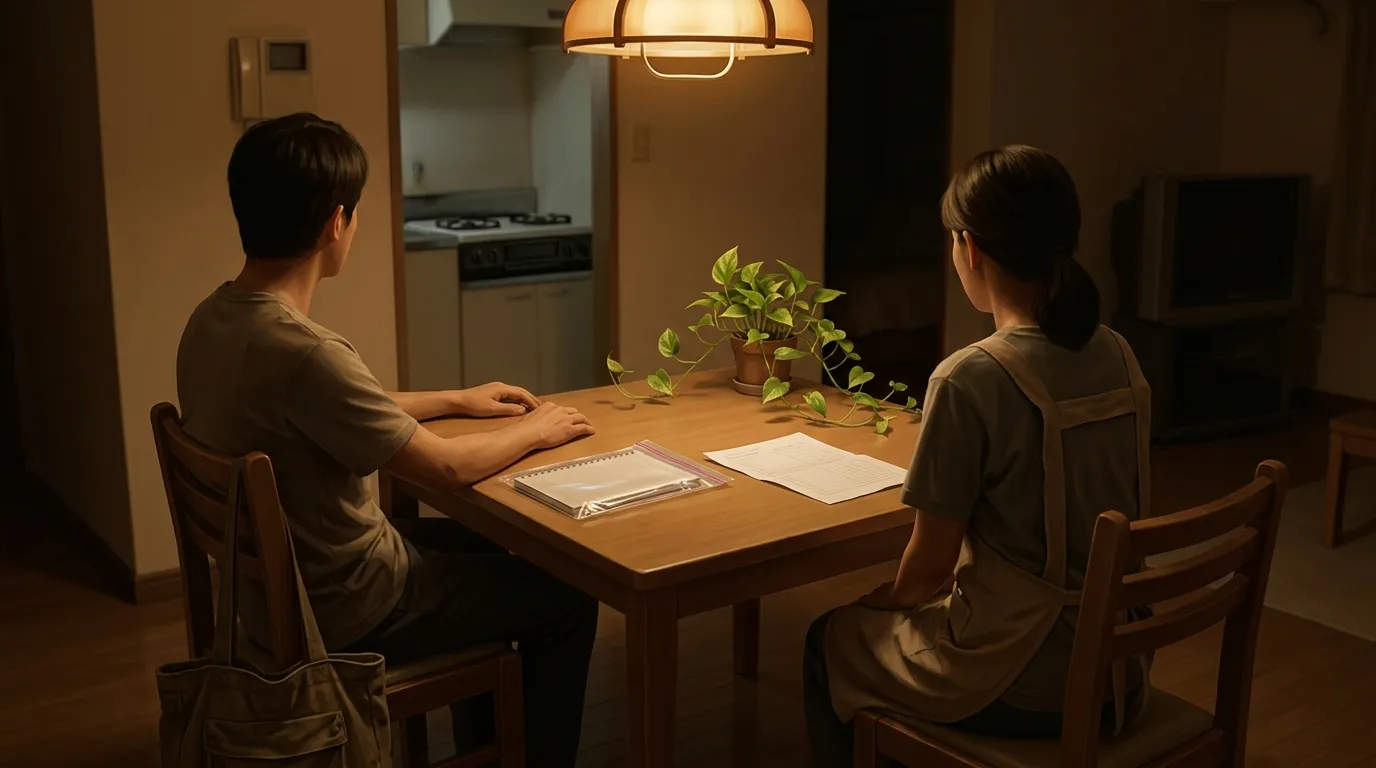
Yīn Zhòngguāng sat down at the dining table.
What was different from the last time: he had taken his mother’s seat, the one facing the kitchen, instead of his usual place on the right. He set the folder on the table, opened it, and took out two things.
The diary, still in its ziplock bag.
The immigration record, an A4 page, folded and then opened flat.
The stove was still on in the kitchen. His mother walked back and turned it off. He heard the spatula placed on the stovetop, then her footsteps returning — slower than usual. She hadn’t changed out of her apron; she stood at the side of the dining table, looking at the two things on it.
She recognized the diary.
Her face didn’t change much. But the way she stood shifted — her weight stepped back half a pace, as though verifying where the floor was.
Yīn Zhòngguāng didn’t speak. He waited.
His mother stood beside his father’s chair for two seconds — that chair had been pushed to the wall; she couldn’t sit there — then she walked around to the other chair, the one behind the pothos, pushed the pot to one side, and sat down. The plant stood between them, a few leaves hanging in the space.
She didn’t look at him. She looked at the table.
“Is this Ruòchéng’s?” she asked. Her voice was level. Hakka-accented Mandarin.
“Yes. The cardboard box in the wardrobe.”
“I know it was there,” she said. The sentence made Yīn Zhòngguāng pause. She had said I know it was there, as though she had always known that box was waiting to be opened someday.
“She’s in America,” his mother said.
“No.” Yīn Zhòngguāng pushed the immigration record across the table. “Departure, February 17 of the Republic of China Year 102, destination Los Angeles. No Taiwan-side re-entry record. US entry records: no match found.”
He spoke slowly, pausing between each piece of information, giving her time to take it in, and giving himself time to confirm that what he was saying was fact, not anger.
His mother did not look at the paper. Her eyes rested on the table surface — on the wood grain, on the shallow scratch running from the middle toward the right. Her hands were on her knees; from this angle he couldn’t see them, but he could sense from her posture a motion of drawing inward.
Silence.
Not the awkward kind of silence — the kind that had been waiting somewhere for a very long time, and someone had finally opened a door and let it walk in.
In the kitchen, cooking oil still hung in the air, mixed with a faint sweetness of onion.
“Mom.” His voice had dropped a register from before. Not because his anger had subsided — because he had entered a mode he recognized from his years of working with families of the missing: you had to make the other person feel that what you wanted was the truth, not punishment. “Where is she?”
His mother’s head lowered slightly.
“She…” she began, her voice a little rough, “she’s being taken care of.”
“By whom?”
”… Someone said they could help.”
Yīn Zhòngguāng waited.
“Your father was in the hospital at the time,” she said. “His heart wasn’t good, and with everything that was happening… Ruòchéng was not in a good place then — not that she was bad as a person, she herself was suffering. I know. But your father — the doctors said he couldn’t be under too much stress, your father was really —”
She stopped. She was rearranging a story she had been arranging for thirteen years, and now that it had to be spoken aloud, she needed to put it together again.
“Someone introduced us — said there was a place, quiet, for Ruòchéng to go and rest. Start over. The people there would take care of her, let her live well, not worry about things here.” Her hands came up from her knees and rested on the edge of the table, fingers pressed against the wood. “I only knew she would be well taken care of. They said she was doing better there… than she had been here.”
“Who said this?”
“A friend introduced us — that friend said a friend of hers whose child —” His mother shook her head. “I didn’t know the person. It was just a phone call. They said there was a way, a place Ruòchéng could go, a place to start over.”
“Where?”
“I don’t know the specific location. I… they didn’t say. They said quiet, clean, that the people there would make her well.”
“You didn’t ask for the address?”
”… I did ask. He said it wasn’t convenient to say — it was the rules of the place, outside people couldn’t come directly.”
Yīn Zhòngguāng watched her.
His mother’s lips moved without sound. Her eyes reddened — a deep redness rising from inside, something that had nothing to do with her complexion.
And then she cried.
But the way she cried tightened something in Yīn Zhòngguāng’s throat — what she was crying was not guilt. Guilt is a sinking cry, an admission of having done wrong. She was crying with grievance. The aggrieved tears of someone who had done the only right thing she knew how to do, and was now being cross-examined by the son sitting across from her.
Her tears fell, but her body did not bend. She sat straight.
“I thought this was the best thing.” Her voice did not break, only became wet. “She was in so much pain then — you didn’t know, you were still at school, you didn’t know what was happening at home. She was, every day — your father every day — that girl was gone, your father was hospitalized, Ruòchéng — she was in her room crying, I was outside listening, I stood in that hallway for a long time, not knowing what to do.”
She wiped her eye with the back of her hand.
“I told her to eat and she said she wasn’t hungry. I told her to come sit down and she said she didn’t want to. I called her on the phone and said Mom made all your favorite dishes, and she said okay, she came home, she walked in with her head down, she ate and said she had to leave, she didn’t even stay to wash her own bowl —”
Yīn Zhòngguāng’s hand was beneath the table, knuckles pressed against his thigh. His breathing had stalled in his chest, unable to go down any further.
— She walked in with her head down.
He thought of the line in the diary. I don’t want to go, but I will. She had gone. She had walked in with her head down, eaten her favorite food, and then walked out.
He didn’t know what expression she’d had on her face.
“I only wanted her to be well.” His mother’s voice continued. “I didn’t — I wasn’t trying to make her disappear. I wanted her to be well. That person said the people there would take care of her, that she could start over. I… I believed them. I know it wasn’t right, but I believed them.”
“Come home for dinner,” Yīn Zhòngguāng said. “You told them that?”
His mother’s gaze went blank for a second. Then: “He asked me — what would make Ruòchéng come back normally. I said — tell her to come home for dinner, and she’ll come. He said fine, then that’s what they’d say.” Her fingers stayed on the edge of the table. “Just that. Come home for dinner.”
“Come home for dinner.”
Yīn Zhòngguāng closed his eyes. One second. Two seconds.
He opened them.
He looked at his mother. Her eyes were still red, her hands on the table’s edge, her back still straight. The way she looked now made him think of a certain kind of animal — one that has been backed into a corner and hasn’t abandoned the logic it was using, still asserting itself in the only way it has left.
He didn’t tell her she was wrong.
Because this was the thing he was least able to say — he understood her.
He understood the woman who had stood in that corridor, listening to her daughter cry, not knowing what to do. He understood if you were normal, everything would be fine — that line was cruel, but he understood the logic of the person who said it. She didn’t love her daughter any less; she had said love in the only language she knew, and in that language there was a conditional clause she had never recognized as a condition.
He understood this because he had grown up in this same family.
He, too, knew the weight of that family system — the years after his sister came out, his father’s silence, his mother’s hard work at being normal, the television always on to fill what couldn’t be said. He had been twenty-one, in the police academy dormitory, when he heard “there’s a situation at home” on the phone. He asked what situation. His mother said it’s nothing, focus on your studies. He said okay. He kept studying. He didn’t ask further. He let that “it’s nothing” pass, let it pass, let it pass, let it pass for thirteen years.
The distance between him and those families was only that he hadn’t made the phone call.
He had chosen not to ask. She had chosen to make the call. The structure was the same.
His knuckles pressed against his thigh, the pressure slowly increasing until he felt a small ache. That ache relocated him — he was sitting in his mother’s seat, facing her, with the kitchen at his back.
He stood up.
Not the pushing-back-the-chair kind of standing up, not the I’m leaving kind. His chair slid back half a body’s width; he rose, pushed the diary back into the ziplock bag, slid the bag back into the folder. The immigration record he left where it was — that paper stayed on the table.
His mother watched him.
“Ruòchéng is in Taiwan,” he said. “Not in America.”
”…”
“I’m going to find her.”
His mother’s lips moved. She did not say don’t. She didn’t say all right either. She looked at the immigration record for a long time, the way you look at a document where you know all the words but have chosen not to fully receive the meaning.
“That person said she was doing well,” his mother said. The sentence came out with a hollowness to it — said to herself more than to Yīn Zhòngguāng. A sentence she had been saying for thirteen years, one last time before the person who believed it was gone.
“Mom.”
She looked up at him.
“That person’s phone number — do you still have it?”
She shook her head. Slow. Certain. “I’ve changed phones many times. Numbers from back then are gone.”
Yīn Zhòngguāng picked up the folder. Placed it in his bag, pulled the zipper.
“I’m leaving.”
“Zhòngguāng.”
He turned.
His mother’s hands were still at the table’s edge. Her eyes were still red, but she had stopped crying. She looked at him; he looked at her. He wasn’t sure what she wanted to say. He wasn’t even sure she knew.
In the end she said: “Go find her.”
Three words. Flat. Not a plea, not permission — something she had not had the chance to say for thirteen years, said now in today’s voice.
Yīn Zhòngguāng nodded. He walked out. The door closed behind him with a sound slightly heavier than when he had come in.
The motion-sensor light in the corridor came on. He stood on the third floor, listening. No sound from inside. Then the television sound returned — she had turned up the volume, filling in what had just been left empty.
He walked down the stairs.
He stopped at the landing between floors.
Right hand. Pocket.
The coin was there. He took it out, placed it in his palm, and looked at it for three seconds.
He drew a breath, and said a single word: “Okay.”
He said it to no one in particular. He just said it out loud.
Then he placed the coin in the inner pocket of his jacket — the one where he usually kept his earphones, with a small zipper that could be sealed. He pulled the zipper shut.
The coin was still there, but he had locked it away.
He went downstairs.
His phone rang while he was riding toward the Zhōnghé precinct.
An unknown number. He stopped at an intersection and answered.
“Officer Yīn?”
The voice was a woman’s, speaking quickly, with a slight roughness — the voice of someone who drank too much coffee. Yīn Zhòngguāng placed it.
“Ms. Hóng.”
“You know what,” Hóng Cǎiníng said, “yesterday I got in touch with one of Ātóng’s friends, a high school classmate — are you listening?”
“I’m listening.”
“She said she received a letter last month. No return address, postmarked from Taidong — the postmark, not the return address. The letter said she was working at a farm, doing well, not to worry, said she was busy, told everyone not to come looking.”
Yīn Zhòngguāng leaned against his motorcycle. The intersection light was still red; traffic flowed past on either side.
“Was the handwriting Ātóng’s?”
“The friend said… she said it looked like it. But she said it didn’t sound like Ātóng’s way of writing — meaning the handwriting looked right, but —” she said Ātóng didn’t write letters that way normally. The wording was strange, like someone had been dictated to.”
“The place name on the postmark?”
“She said it was just the Taidong city post office stamp — no specific address. But there was a name on the envelope; she said she couldn’t quite remember what the farm was called, but it definitely had Taidong in the name. The friend said —” Hóng Cǎiníng paused, ”— a friend in Taidong said there are a few places like that in the Lùyě area, farm-type operations, but she didn’t know which specific one.” Hóng Cǎiníng’s breath quickened slightly. “I’m going to go find her.”
Yīn Zhòngguāng said: “Don’t move yet.”
“But —”
“Ms. Hóng,” he said, “going there alone won’t accomplish anything. You know how these places work — without legal grounds, you can’t get in. Even if you get in, you can’t take anyone out.”
“So you —”
“I’m pulling things together.” He said it as a fact, though he also knew how many unknowns were packed into the phrase pulling things together. “Send me the information from the letter — address, date, any details. Don’t go out there alone.”
Silence.
He could feel the emotion on her end of the line — that urgency you have when you’ve finally gotten a direction and don’t know where to put it. Like touching something in the dark, uncertain whether it’s an exit or another wall, but certain you have to move that way.
“Okay,” she said at last. “I’ll send you the information. But Officer Yīn —”
“Mm.”
“Are you really going to keep going?” she asked. “Do you mean it?”
Yīn Zhòngguāng looked at the traffic ahead. The red light had turned green. Cars began moving; he didn’t.
“Yes.”
He ended the call.
Third floor of the precinct. The office.
Xǔ Zhìmàn was there. When Yīn Zhòngguāng walked in, she was retrieving something from the printer — the machine clattering in the corner. She glanced at him, said nothing, and took the printed pages from the output tray.
Yīn Zhòngguāng sat down and opened his computer.
He opened a new text file on his desktop and began entering the details he had been organizing over the past few days — not in the official case system, just his own notes, plain text, no formatting. He was connecting all the points so he could see the line.
Six cases. Six families. Six withdrawal requests with matching patterns. Kē Yìngcǐ, Hóng Cǎiníng’s friend, Taidong, a letter with the wrong tone. His sister, his mother, someone said they could help, a place without an address, thirteen years. The business card, the inquiry at the convenience store, the anonymous call to the duty desk.
Come home for dinner.
His fingers stopped on the keyboard.
Xǔ Zhìmàn set a stack of documents on her desk, turned, and looked at his screen. Not looking covertly — she was simply looking. She had never pretended in this office not to see things.
“These past few days?” she asked.
“Mm.”
She came over and stood at the edge of his desk, leaning down to read a few lines. She was reading for structure — she usually looked at the skeleton first.
After a moment she said: “Have you considered — these families, if they’d had other options — if someone had told them what else they could do, what resources existed — would they still have done this?”
Yīn Zhòngguāng took his hands off the keyboard. He turned to look at her.
“So you think what they did was right?”
“No.” Her tone was level, not arguing. “I think it was a choice made when no choices remained. But no choices remaining doesn’t make it permissible.”
The sentence sat in the office. From the Criminal Investigation Unit, someone was on the phone, speaking loudly, giving case numbers and suspect names. The printer clicked again; a paper-jam warning lit up.
Xǔ Zhìmàn walked back to deal with it, pulling out the jammed sheet with her characteristic lack of drama, unfolding it, checking for tears, returning it to the tray.
Yīn Zhòngguāng watched her.
“Have you ever done something,” he began, his voice a shade lower, “that you couldn’t quite say afterward was right or wrong?”
Xǔ Zhìmàn didn’t turn around. She was still adjusting the tray.
“Everyone has,” she said. “The difference is whether you admit it.”
She closed the tray, pressed resume, and the printer started up again. She turned around and looked at his face — pausing longer than usual.
“You look pale,” she said. A statement, not a question. “You went to your mother’s today?”
Yīn Zhòngguāng didn’t answer, but he didn’t deny it either.
“How did it go?”
He thought for a moment. “She cried.”
“And then?”
“She said go find her.”
Xǔ Zhìmàn crossed her arms, leaning back against the filing cabinet. Her expression was the kind he recognized — measuring something, the way she measured things, but with something visible at its edges that she rarely let anyone see.
“Zhòngguāng,” she said, “I ran something.”
Yīn Zhòngguāng waited.
“Missing persons in the Zhōnghé jurisdiction. Fifteen years back, adults, withdrawn cases, last known contact in Zhōnghé or Xīndiàn.” She paused. “Twenty-seven cases total. Of those, the withdrawal requests in four match the six you showed me before at a high level — same formatting signature.”
Yīn Zhòngguāng’s chair went still.
“You ran this yourself?”
“On the understanding that you don’t need to know this, yes.” She looked at him. “If Team Leader Zhuāng asks, I didn’t do this.” She picked up the stack from her desk, walked over, and placed it in front of him. “Four of the twenty-seven fit the pattern. The contact addresses for all four families are in the Zhōnghé jurisdiction, time range —” she tapped the top sheet with one finger, ”— the earliest is the Republic of China Year 92. The most recent is Year 110.”
Yīn Zhòngguāng’s gaze settled on the papers.
“Thank you,” he said.
Xǔ Zhìmàn had already turned and walked back to her desk. She sat down, opened her computer, and resumed what she had been doing before, as though the preceding exchange had been something she completed on the side.
But Yīn Zhòngguāng noticed, as she turned away, that her shoulders released slightly — the particular kind of loosening that comes after finishing something you had to finish before your body would let go.
She hadn’t waited for him to ask. She had done it herself.
He put the papers in his folder, the folder in his bag.
The letter was on his desk the following morning.
Not an email. Paper — white envelope, A4 size, plain photocopy paper. No postage stamps. It had been placed directly on his desk. The night shift officer said it had been left in the first-floor mail slot early that morning, addressed to Officer Yīn, Zhōnghé Precinct, for your attention. The duty officer hadn’t identified the source and had sent it upstairs per procedure.
Yīn Zhòngguāng turned the envelope over. No return address.
He put on a pair of disposable gloves and slit the envelope open with a letter opener.
Inside was a folded sheet of white paper. He opened it.
The text was printed, not handwritten. Standard Song typeface, twelve-point, one-point-five line spacing.
Dear Mr. Yīn,
We have noticed your sustained interest in several closed cases. We understand your professional obligations, and we respect the investment you have made in these matters.
However, we believe you may also understand: for some people, their departure — for everyone involved, including the person who departed — has been a kind of relief. Far from harm, what we provide is an arrangement, benevolent in nature, for which we find it difficult to find better words.
If you are willing, we would be glad to speak with you in person. You choose the location; you choose the time.
We believe that after meeting, you will have a different understanding.
Respectfully,
— Come Home for Dinner
Yīn Zhòngguāng placed the letter back in the envelope.
He sat without moving.
Outside the office, the Criminal Investigation Unit continued as normal — ringing phones, the roll of chair wheels, someone looking for a document he thought was in his drawer but wasn’t there, cursing once, then asking a colleague. In the corridor, a shadow crossed the gap under the door and was gone.
He pulled open the drawer, placed the envelope inside, then took out the business card and set it beside it.
Business card: We just want everyone to be able to eat well.
Letter: for everyone involved, including the person who departed — has been a kind of relief.
Two formulations. The same logic.
He sat with that logic for a while. His training told him this kind of phrasing was a technique — framing harm inside goodwill, getting victims and bystanders to accept a reality they would otherwise reject. His training also told him that someone who could speak this way either genuinely believed it, or had been saying it for so long they could no longer tell the difference.
He thought of the way his mother had said that person said she was doing well.
He thought of the way Chén’s wife had said they just want everyone to be able to eat well.
He thought of the way he himself had said she’s in America — every time someone asked about his sister. Thirteen years.
He closed the drawer.
He adjusted the angle of his computer monitor — turning it to where he could see it clearly, but where someone walking in from the door couldn’t easily see it directly.
Then he opened a new search window and typed: Taidong, Lùyě, farm, care facility, ecology.
At two in the afternoon, Yīn Zhòngguāng compiled a list in the office.
He wrote it on a sticky note, which he pressed onto the outer face of the bottom drawer — the position you couldn’t see sitting down; you had to bend to read it.
Two items.
The first: Taidong, Lùyě. Find Hóng Cǎiníng, confirm the address, verify Kē Yìngcǐ’s current situation before going — whether there was any chance she had already been moved.
The second: Keep the meeting.
He thought for a long time about the order.
Logically, the meeting first made more sense. Meet the person behind Come Home for Dinner, learn more, then look for his sister. Without enough information before going to Lùyě, he’d either get nothing, or tip them off about how much he knew.
But he paused longer on the word logically.
Because he knew: putting the meeting first in front of logic — part of that was because finding his sister meant confronting something he had spent thirteen years avoiding. Keeping a meeting was a familiar action for him — a detective walks into a situation, observes, gathers information, manages the setting. Finding his sister was not like that.
His training had not prepared him for that scene.
He sat there, acknowledged his own avoidance, and then picked up the sticky note and changed the order.
Find my sister first.
Then keep the meeting.
He pressed the note back into place, stood, walked a few steps in the office, and stopped at the window, looking down at the drying rack in the alley behind. Someone had hung an orange raincoat out today; it hung still — no wind — its shape like a person.
His phone buzzed. Hóng Cǎiníng, a message: the address, the addressee’s name, and the line friend says the handwriting in the letter looked a little shaky, not like Ātóng’s usual script.
Yīn Zhòngguāng entered the address into his map app, noted the distance, and put his phone back in his pocket.
He tallied what he had: one letter, one postmark area, four additional withdrawal requests, a mother’s someone said they could help, and a Come Home for Dinner that had agreed to a meeting.
Enough to walk in a direction. Enough, if the whole game was still out of sight.
He turned, switched off the office light, pulled the door shut, and walked out.
At the end of the corridor, he ran into Xǔ Zhìmàn coming up the stairs, holding a cup of milk tea she’d bought outside, the straw still unsealed against the lid.
She saw him.
“Where are you going?” she asked. Just gathering information.
“Taidong,” he said, “this weekend.” Then: “And then I’m meeting someone.”
Xǔ Zhìmàn put the straw into the milk tea and took a sip, watching him.
“What does Team Leader Zhuāng know?”
“I’m taking leave.”
A beat of silence.
“Understood,” she said, her tone unchanged. But her gaze stayed on his face one beat longer than usual, as though confirming something, and then she pulled it back. “Keep your phone on.”
“Mm.”
He left.
Xǔ Zhìmàn stood in the corridor with her milk tea, watching his back as he walked toward the staircase — the pocket of his coat with that slight bulk to it, his stride a fraction wider than usual.
She turned and walked back to the office.
The letter was in his drawer.
That night, in his apartment in Yǒnghé, the laptop on the coffee table was open this time, its screen lit, a map of Taidong’s Lùyě area stretched across it. A small marker indicated the location Hóng Cǎiníng had given him. Hills and farmland surrounded it; the nearest town center was twenty minutes by road.
His phone, his laptop, the address, the letter.
No coin this time. He had locked the coin away — in the inner pocket of his jacket, which hung on the hook behind the door. That coin was there, not on the desk, not in his hand.
He looked at that marker on the map for a long time.
He thought of the line in his sister’s diary — I don’t want to go, but I will.
He thought of what he was doing now.
Not because he was an investigator who made a habit of being thorough. Because he was her brother, and for thirteen years he had let that not asking pass — let it pass, let it pass, let it become like the pothos on their family’s dining table. Put it there, and there it stayed, became furniture, and no one ever said anything about whether it should be replaced.
He shrank the map until he could see the outline of the whole island — Taidong on the east, himself on the west, a mountain range running between them.
He left the laptop screen open, stood, and walked toward the bedroom.
This time, he did not close the screen.
(end of chapter)