Chapter 8
Everyone in Their Own Seat
Chapter 8: Everyone in Their Own Seat
Saturday, 4:50 in the morning. Yīn Zhòngguāng lifted his jacket from the back of the chair and pulled the zipper open.
The outline of the coin in the inner pocket pressed through the fabric. He zipped the jacket up and put it on. His hand did not pause at that spot.
He picked up the keys to the secondhand car from the desk.
The photocopied exit and entry records, folded in thirds, along with the address screenshot Hóng Cǎiníng had sent, were in a folder on the passenger seat. Taidong, Lùyě Township. The address was a registered farm. A thread connected it to Zhōng Zìfāng’s network in the financial records: agricultural produce purchases, once a quarter, buyer listed as that restaurant with no sign. The vegetarian place.
Yīn Zhòngguāng had checked the map before setting out.
Taidong. Lùyě. The Rift Valley. The marker on the map sat beside a patch of pale green, indicating farmland.
He closed the laptop screen — this time he closed it.
He drove out, taking the Beiyí Highway. It was still dark.
He had chosen this route. It was not the fastest one.
He took the mountain road because at that hour there were no other cars, no lights to wait at, no need to coordinate with anyone else’s schedule. He only had to follow the shape of the mountain.
He stopped once at a service area in Yílán and drank a cup of vending machine hot coffee. Plastic cup, small, the smell stronger than the taste. He drank two sips, dropped the cup in the bin, and kept driving.
Past Huālián heading south, the mountains slowly retreated east. The sea appeared on his right.
He didn’t make a point of looking at it. His eyes stayed on the road. But he was aware of that blue, somewhere at a distance to the right — bluer than he expected, or perhaps the early light made it look that way.
He drove for four and a half hours. It was 9:20 when he reached Lùyě.
The air in the Rift Valley was different from Taipei. A weightier kind of different, carrying earth and straw, damp without being stuffy. Farmland lined both sides of the road; occasionally a row of casuarinas, occasionally a concrete farmhouse. The navigation took him down an unnamed road. Packed dirt, no asphalt, weeds and trees on either side. He drove to the end and cut the engine.
The farm was there.
No wall. No gate. Only a wooden sign nailed to a casuarina tree, the characters written in dark brown paint: Organic Farm — No Trespassing.
He parked at the roadside and got out.
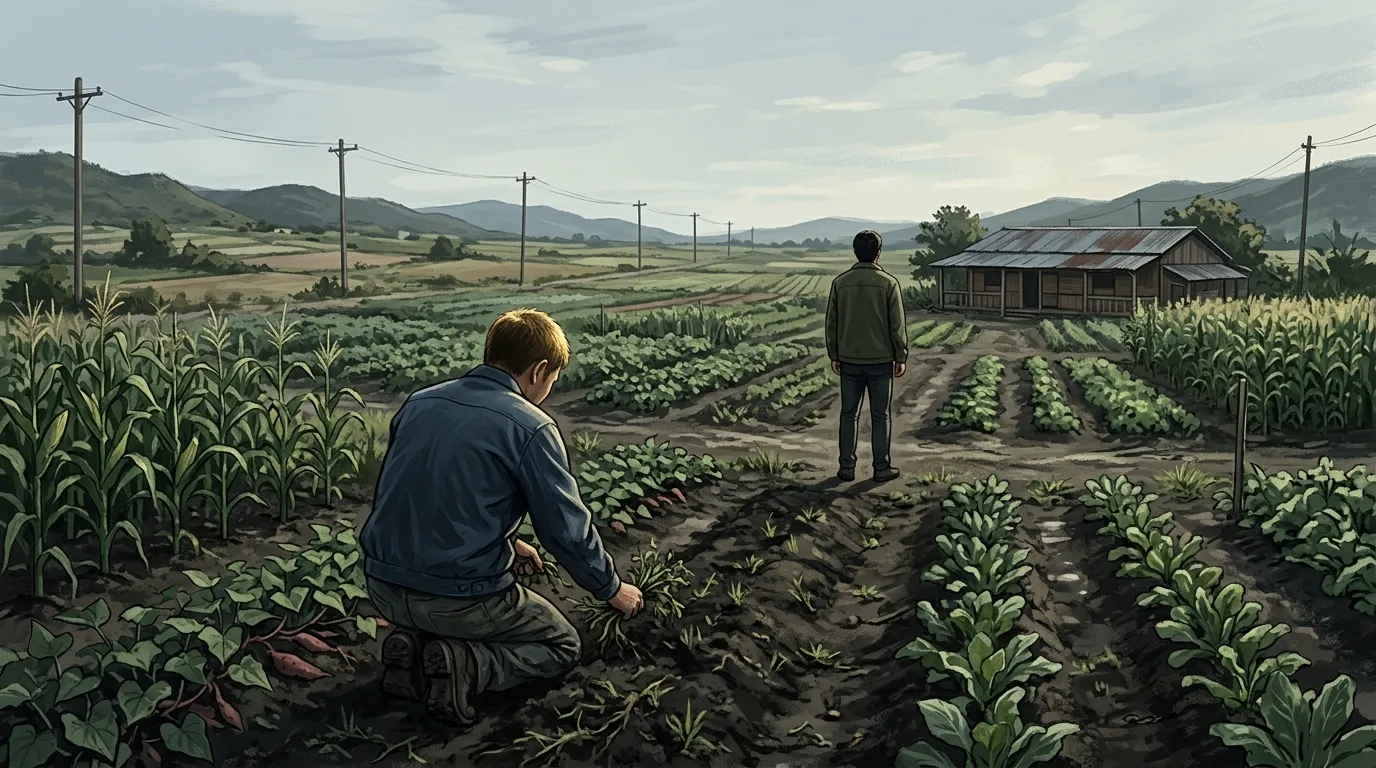
Quiet all around. Insects. Birds. The distant rumble of farm machinery from some unknown direction. To the left, a large vegetable plot — sweet potato leaves, corn, a few rows of leafy greens he couldn’t name. To the right, an orchard — lychee or longan, the leaves dense, a few orange plastic crates stacked under the trees.
Straight ahead, beside a low flat-roofed building, someone was crouching in the vegetable beds, pulling weeds.
Yīn Zhòngguāng walked toward them.
He had walked about thirty paces when the person still hadn’t looked up.
Coming closer, he saw the hair — cut short above the ears, the skin of the back of the neck deeply tanned. Both hands were in the soil; where her fingers met the earth, skin and dirt were indistinguishable.
He stopped.
“Ruòchéng.” He said her name.
That action was not “calling out.” His voice came out lower than he expected — he was testing whether that name still existed.
She stopped.
Her hands didn’t move. Her back didn’t move. The whole shape of her simply went still — that stillness not the stillness of being startled, but the stillness of someone who has heard a sound they haven’t heard in a very long time and needs a moment to confirm it is real.
Then her right hand closed into a fist, quick and natural, like a motion compressed into muscle memory.
She stood and turned around.
Thirty-seven years old. Yīn Zhòngguāng knew she was thirty-seven, but the last time he had seen her she was twenty-four, and so both numbers existed at once without completely overlapping. She was thinner than he remembered. Her face had sharpened. That sharpness made her look older than thirty-seven, but also more awake. She looked at him — no surprise, no reddened eyes, none of the expression he had readied himself to receive.
“You finally came.”
She said it in a level tone, like the full stop at the end of a prophecy — not a question, not an exclamation, just a statement of something that had at last been completed.
Yīn Zhòngguāng stood there.
He had rehearsed what he would say on the way. He had prepared several versions. I’m sorry. Or I found you. Or say nothing at all and just walk over.
He stood there and said nothing.
She waited two seconds. Then she said: “You had lunch yet?”
The way she said it was identical to how he remembered her voice, down to the last inflection. That voice made something in his chest pull tight suddenly — a feeling harder to name than grief, like a sentence whose subject was still there but whose predicate had become an entirely different sentence.
“Not yet.” He said.
“Come,” she said. “It’s almost noon.”
The farm’s dining space was a large flat-roofed building with wooden walls, a corrugated iron roof, and open windows that let the wind through. Inside: one long wooden table, two long benches, six or seven people eating, their voices low. On the table were several large bowls — the dishes were shared across the table, family-style, or perhaps a deliberately designed atmosphere.
Yīn Zhòngguāng followed Yīn Ruòchéng in. A few people glanced at him, then kept eating.
No one asked who he was.
She took two bowls, scooped rice into both, set one in front of him, and sat down at the end of the bench, in the corner position. He sat down beside her. The bench was wood with no backrest — there was a directness to it that offered no ease.
The dishes were sweet potato leaves, stir-fried tofu, and a dark braised dish with sauce. Yīn Zhòngguāng couldn’t place what it was, but he recognized the color: soy sauce, star anise, and something sweet he couldn’t name.
He picked up a bite with his chopsticks and ate.
The flavor was not unfamiliar.
He didn’t say so. He kept eating.
The conversation at the table was low — he didn’t deliberately listen, but the gist of it was that someone’s vegetables weren’t getting enough water, and where to go shopping tomorrow. Ordinary sounds. Slow, unhurried, nothing like any conversation in Taipei.
When the others had begun to take their bowls to the wash station, Yīn Ruòchéng finally spoke.
“How did you find me?”
“Exit and entry records. Financial transfers.” He said. “You didn’t go to America.”
“No.”
“You’ve been here the whole time?”
“Not the whole time,” she said. “At first I was somewhere else. Then I came here.”
Silence. Somewhere in the distance someone was washing dishes; the sound of water came through the open windows.
“You know what Mom did.” He said. It wasn’t a question.
“Yes.”
“When did you know?”
She picked up a piece of tofu with her chopsticks and placed it in her bowl without eating it, just rested it there.
“I suspected from the beginning,” she said. “Later I confirmed it.” She paused and added: “Someone here told me.”
“Zhōng Zìfāng?”
“Not her,” she said. “Someone else here. She’s been here longer than I have.” She said those last words at the same pace as everything else, like a simple statement of fact with no lament in it. “She said you’d been looking into this lately. Said you’d show up sooner or later.”
“And then?” Yīn Zhòngguāng asked.
Yīn Ruòchéng put the tofu in her mouth, chewed, swallowed. She drank a sip of water, set the bowl on the table, placed both hands on either side of it, and looked at the tabletop.
“Then,” she said, “I was angry. For a long time. Later —” She stopped. “Do you know that feeling? Something is too heavy, and you carry it for a long time, and then one day you realize you’ve been trying to hold it up, to keep it from coming down — but it came down anyway, and the truth is you always knew it would. That… that recognition makes you suddenly very tired.”
Yīn Zhòngguāng said nothing, letting her continue.
“After that it was… numb. For a long stretch.” She gave a small shake of her head — a very light motion, not a shake of denial, but the kind that rearranged the structure of a sentence. “Then it became familiar. This place isn’t bad.” Her tone carried no defensiveness, just a statement.
Yīn Zhòngguāng pushed his bowl to the side and laid his hand flat on the table, fingers spread. No coin. He noticed his hand didn’t know where to place itself, and let it rest there.
“Do you want to go back?” he asked.
She didn’t answer right away.
Her gaze moved from the tabletop to the window. Outside, a corner of the vegetable garden lay in the morning sun, vivid green. She looked in that direction for a long time.
“Go back,” she said. “You mean there?” She didn’t say home, she said there — the same way she said she instead of Mom, said here instead of the farm, her entire vocabulary routed around certain words.
“Yes.”
She turned back to face him.
“Tell me honestly,” she said. “Does she… does she think she did something wrong?”
Yīn Zhòngguāng was silent for three seconds.
“She thinks she did the right thing,” he said. “She still thinks so now.”
Yīn Ruòchéng nodded, slowly, as if this answer was within her expectations — or as if she simply needed to hear it confirmed.
“There,” she said. “She thinks she did right, you think you didn’t do wrong. If I go back, it’s still there. I’m not saying whether you can accept me. I mean the place itself — the way I exist in that place is still the same. Whatever kind of person I am, in that place, needs to be… needs to be handled.” She paused slightly on handled — a pause for precision, with no emotion in it.
She went on: “Here… at least no one thinks I’m a problem.”
“Are you free?” Yīn Zhòngguāng asked.
She looked at him.
“What do you mean by free?” she asked. “I can leave. Do you know that? No one is locking me up. Everyone here can leave.”
“Then why haven’t you?”
“Where would I go?” she asked — the tone not rhetorical, genuinely asking. “Back to Taipei, rent a room, find a job? Then every weekend someone asks if I want to come home for dinner? Then sit at the table with her, keep pretending things are still whole?” She paused. “Or — do you have a different plan?”
He set his chopsticks on the rim of the dish.
“No,” he said. “I don’t have a plan.”
That admission came out plainly, with nothing attached to it.
She looked at him. Something in her expression shifted — not softening, but something else: as though one thing she had been bracing against had, because of those words I don’t have a plan, changed its posture. Loosened one notch, still there, just holding on less hard.
“Why did you come?” she asked.
“Because I’m your brother,” he said. “Because thirteen years ago I let that not asking pass. Let it pass, let it become a pot plant on our table. I came because that wasn’t right, and I knew it wasn’t right.”
She was silent for a long time.
Outside, the cicadas grew louder for a moment — or the other sounds inside Yīn Zhòngguāng’s ears dropped away, leaving only that.
“You know,” she said, very slowly, every word placed deliberately, “you came here today, found me — and then what? What are you going to do next?”
He didn’t answer right away.
“Are you going to report her?” she continued. “Are you going to make this into a case? Have me come back there, have the whole world know what my family did? Have her prosecuted, have me standing there with a victim’s statement?”
“I haven’t decided yet,” he said.
“That’s fine,” she said. “You don’t have to decide now. But before you decide, you need to think about one thing: if I don’t want to go back, do you have the right to force me?”
Yīn Zhòngguāng said nothing.
“No,” she said. “You’re an investigator, I’m an adult. Adults have the right to choose where they live. I live here, I was not forced, I can leave any time — I choose not to leave, because I’m better here than I am there. This isn’t Stockholm, isn’t trauma bonding, isn’t a lack of choice. This is my best available option, because every other option is worse.”
She said this quickly, each word precise, like a knife laid on a table ready to be picked up — she picked it up, used it, and put it back down.
His sister. The sister he had known for thirty-four years. In this restaurant with a corrugated iron roof, explaining her freedom to him.
“I know,” he said, his voice very low.
“And yet you still came.” She said.
“Yes,” he said. “I still came.”
Silence again.
Then she said: “What time do you need to leave this afternoon?”
He wasn’t sure what she was asking.
“Where are you going this afternoon?” she asked. “To meet the people there?”
“Yes.”
“What time?”
“No specific time. They said come whenever.”
She nodded. She stood up, lifted both bowls, and walked toward the kitchen. She had taken a few steps when she stopped at the kitchen doorway, without turning around.
“Finish eating before you go.” She said.
She went into the kitchen. The sound of water followed.
Yīn Zhòngguāng stayed at the farm until two in the afternoon.
In those two hours, Yīn Ruòchéng took him on a walk around the farm. She didn’t say much, but what she said was practical — what that patch planted this year, who lived in that building, what was being made in the processing room. She moved like someone who had long been at home here, showing a first-time visitor around, without forced warmth and without deliberate coolness.
Once, standing at the edge of the orchard, she was pointing at something and saying words he didn’t catch. His attention was on her hands — the fingers of her left hand had deep calluses. The kind that came from years of the same repeated motion — farm work alone didn’t explain them. He thought of how she used to play piano. She had stopped in university and never gone back to it.
That detail came from somewhere — maybe something his mother had mentioned, maybe something he had seen himself. By now there was no way to tell.
Seven people lived at the farm full-time. Yīn Ruòchéng was called Xiǎo Ruò here. The others’ names Yīn Zhòngguāng didn’t ask, and they didn’t introduce themselves. A middle-aged man in the processing room stirring something. An old woman resting in the shade of the orchard. A few others who appeared to be around Yīn Ruòchéng’s age, each doing their own thing.
No one looked to be in pain. This made Yīn Zhòngguāng find it harder to understand, or harder to explain.
Near two o’clock, Yīn Ruòchéng walked over to his car and handed him a paper bag. Inside were several vacuum-sealed packages, deep red, with handwritten labels.
“Pickled plum sauce the farm makes,” she said. “Looking at you, you probably won’t think to bring anything back. Take these.”
He took it.
She looked at the secondhand car for a moment, then said: “How old is this car?”
“Twelve years.”
“As long as it runs.” She looked at him. “You live alone?”
“Yes.”
“Eating properly?”
“Eating.”
She nodded — as if some habit their mother had shaped was still there in her without her knowing it. Then she turned and walked back toward the farm. A few steps in, she looked back: “Drive safe.”
He stood by the car, paper bag in hand, watching her walk away.
He got in, put the bag on the passenger seat, started the engine.
On the way north, his hand did not reach into the jacket’s inner pocket.
The vegetarian restaurant was on the mountain road, not far from the complex he’d visited once before — a few hundred meters ahead, a concrete flat-roofed building on the roadside, a plank by the door with the single word Vegetarian and nothing else.
Yīn Zhòngguāng arrived at half past six in the evening.
He had driven three hours north from Taidong, then followed Zhōng Zìfāng’s message up the mountain road — a text message, from a number he didn’t recognize, like a letter that already knew what he was investigating; it said any time would be fine, she’d be there.
Three tables of customers inside. None of them were talking. The food smelled good — light, with a depth he couldn’t articulate, as though the smell of steamed things and the smell of stir-fried things had mingled without any trace of oil.
Zhōng Zìfāng was at the table in the far corner, a cup of tea in front of her, a small dish, a pair of chopsticks placed in careful parallel at the exact center of the dish’s rim.
When she saw Yīn Zhòngguāng she didn’t stand. She gestured with one hand for him to sit across from her.
She looked darker than when he had last seen her — weathered by years of sun rather than made-up, uneven, her forehead and cheekbones deeper than her neck, her knuckles deeper than her palms.
A server came over; she signaled with her eyes, and the server left and returned quickly with a bowl of rice and a few small dishes, set them in front of Yīn Zhòngguāng.
“Eat,” she said. “You’ve come from Taidong. Seven hours of driving today. You haven’t eaten.”
Yīn Zhòngguāng looked at the bowl.
“Thank you.” He picked up his chopsticks and ate a few bites. The food was genuinely good — better than he had expected.
Zhōng Zìfāng took a sip of tea, set the cup back in its place, precisely.
“You found her,” she said. Not a question.
“I did.”
“She talked to you.”
“Yes.”
Zhōng Zìfāng nodded, turned her teacup half a circle on the table, and turned it back.
“You think I’m a bad person.” She said.
“I think what you did is illegal.” Yīn Zhòngguāng said.
“Those aren’t the same thing,” she said. “I know what the law says. I’m asking what you think — not what the law thinks. You’ve done seven years of investigation. You’ve seen more cases than I have. Your judgment of people doesn’t come from the law.” She paused. “Do you think I’m a bad person?”
Yīn Zhòngguāng set his chopsticks on the rim of the dish.
“I don’t know,” he said.
She received this without any change of expression.
“You found your sister,” she said. “You saw where she lives, you saw how she looked today. Can you honestly say that place has made her life worse?”
“That’s not the point,” he said.
“That is the point,” she said — her voice didn’t rise, but the force was direct, like pushing something forward. “Your sister’s family sent her to me because she couldn’t live properly in that house. Then she’s been here thirteen years. She eats. She sleeps. She has things to do. No one asks her those questions. No one looks at her with those eyes. You say it’s not the point — what is the point, then?”
“Her choice,” Yīn Zhòngguāng said. “You didn’t ask for her choice.”
Zhōng Zìfāng lifted her teacup, took a sip, set it down.
“Your sister’s mother made a choice,” she said. “Your sister’s father chose not to speak. You chose not to ask. Everyone was making choices. I just made one more — I made a place where people who couldn’t be properly cared for in their homes had somewhere to go.”
“That’s not your responsibility.”
“Whose responsibility is it, then?” she asked. “The government’s? The social work system can’t handle this kind of situation, and I’ll tell you why — because the families didn’t break any law, and those people didn’t break any law. No one is in violation, so no one intervenes. The system doesn’t move, and those people stay in those homes, and every morning they wake up, and they face those looks, and they go on pretending they aren’t the one making the family tired.” Her voice remained at the same volume, but the spaces between words shortened. “You tell me — who should have stepped in?”
Yīn Zhòngguāng’s hand under the table made a fist, opened, made a fist again.
“Your logic,” he said, “isn’t without merit. But the people you arranged — did they have the ability to say no?”
“No one forced anyone,” she said. “No one held a knife. The farm you visited today — no walls, no locks, they can leave any time. Did your sister tell you that?”
“She did.”
“Then you know.”
“She said she can leave, but there’s nowhere to go,” he said. “You’re describing a dead end and calling it a choice. You created an environment where the only way out is through the options you provide, and then you say they chose to stay. That’s control, dressed up as freedom.”
Zhōng Zìfāng was quiet for a few seconds.
“You’ve put it well,” she said, her voice level, no sarcasm. “You’ve put it accurately. I can’t refute that.”
“Then you —”
“But,” she said, “go look at the families who sent their people away. Their state now. Do you know? The children in those families are going to school now. The elderly can sleep — because they no longer stay up every night waiting for the door to open, no longer keep the knives locked in the kitchen. I keep a record, my own, you won’t find it in any system. Those families — the number whose quality of life improved after I intervened.” She lifted the teacup, set it down again. “I’m not lying to you. That record is real.”
“And the people you placed,” he said. “Is there a record for them?”
“Yes,” she said. “I keep records on them too. Each one. I know what they eat, whether they sleep well, whether they’re unwell, whether they need to see a doctor. I know their condition better than their families do.”
“You have no right to decide for them,” Yīn Zhòngguāng said.
“Their families had no right either,” she said. “But the families did it. I only did it… a little cleaner.”
Yīn Zhòngguāng watched her say this — watched a little cleaner come out of her mouth, those words standing in the air, and he felt something tilt inside his thinking — not a collapse, but the kind of tilt when a table leg has gone a centimeter short, everything still on the table.
“You,” he said. “You know what you did made them impossible to find. You know they carry the legal status of the missing, when the truth is they were placed. You know your entire network is built on that ambiguity — because adults who go missing aren’t subject to mandatory investigation, because families can withdraw the case at any time — that’s why you can keep going.”
“I know,” she said. “I know every thread, every boundary, where I’m walking.”
“Doesn’t that strike you as wrong?”
“I think,” she said, “the line of the law isn’t the line of what’s right. Some things exist in the legal gray zone and are still right. Some things are legal and still wrong. You’re an investigator — you work on that line every day. You should understand this better than I do.”
Yīn Zhòngguāng said nothing.
She was right. He knew she was right. And that rightness made it harder to process than any simple lie would have.
“I have a question for you,” she said. “You don’t have to answer now.”
He waited.
“Your sister’s case,” she said. “Are you willing to make it public?”
Something tightened in his chest.
“Are you willing to have your mother prosecuted?” she continued. “Are you willing to have the whole world know what your family did? To have your case appear in the news, to have your colleagues learn you’ve been investigating a case your own mother was involved in? To have your sister — the person you met today — placed in front of media cameras and asked about her thirteen years at that farm, asked why she didn’t leave sooner?”
She stopped.
The restaurant sounds faded, or his ears filtered them out — leaving only the silence after Zhōng Zìfāng finished speaking.
“You don’t need to answer me,” she said, her voice settling back to that calm register, as if the entire shape of the conversation had been designed, a known beginning, a known end. “Go home and think it over. When you’re clear, when you decide it’s worth doing — do it. I won’t say anything more.” She lifted the teacup and took one last sip, set the cup down in the exact spot where she had placed it when she sat down — perfectly returned. “Your food is cold. Eat a little more before you go.”
He sat in the car for a long time without starting the engine.
The mountain dark was deep — the kind with no streetlights, no buildings to give off light, only an occasional moving point of brightness in the distance, a car.
His phone was on the passenger seat beside the paper bag. The screen lit up once, faded, lit up again.
He picked it up and looked.
Two missed calls.
One from Hóng Cǎiníng. Nineteen minutes ago.
One from his mother. Seven minutes ago.
He looked at the two names on his phone screen, side by side in the missed calls list. He didn’t know which you were supposed to call back first when these were the two, and maybe there was no supposed to, only whichever he chose.
He pressed Hóng Cǎiníng’s name.
Two rings.
“Hello?” Her voice when she picked up told him immediately she’d been crying — the texture of it was different, the pace different from her usual way of speaking, carrying the weight of someone who had just finished crying and was now trying to make their voice sound normal. “Officer… Officer Yīn?”
“I’m here,” he said. “What’s wrong?”
“I… ” She drew a breath. “I found Yìngcǐ.”
Yīn Zhòngguāng held his phone without moving.
“She doesn’t want to come back,” Hóng Cǎiníng said, her voice breaking slightly. “She said… she said her family said… she said her family said if she doesn’t come back, everyone else can eat well.”
That sentence came through the phone, into the car, into the night, and stopped somewhere.
Yīn Zhòngguāng sat in that dark, and said nothing.
Outside the window there was nothing — or there was everything. He couldn’t say which.
(End of Chapter)