Chapter 9
Come Home for Dinner
Chapter 9: Come Home for Dinner
On Sunday morning, Yīn Zhòngguāng sat in the precinct office and cleared the things off his desk to make room to work.
He hadn’t gone home to sleep. He’d driven from the mountain roads of Taidong to the Zhongshan Freeway, arriving at his door sometime after one in the morning. He stood at the threshold for a few seconds. He didn’t go in. He took his keys, rode his motorcycle to the precinct, and locked himself in the office.
On the desk there were now five things.
The fund-flow tracking chart, listing eleven nodes, the farmland purchases at the far end. The record of leads Hóng Cǎiníng had sent, organized in her methodical way — names, dates, summaries of conversations, the handwriting neat enough that he’d briefly wondered if she’d once worked in clerical. The four additional cases Xǔ Zhìmàn had turned up on her own, each with a complete disappearance timeline and family contact records. A copy of Xiāo Zhònghéng’s old memo, which he had searched a long time before finding in the system’s archived files, the rejection annotation still there in red ink, the strokes confident. And his own field notes from the past two weeks — more than twenty pages on A5 notepaper, the handwriting messy but in clear sequence.
He arranged these five things in a line from left to right across the desk.
Then he sat there, looking at them, thinking for a long time.
Zhōng Zìfāng had been right: he had enough to trace how the whole network operated, but not enough to constitute any line of criminal referral — no one had reported being forced, not a single person who’d been “placed” had said she’d suffered anything he could prosecute, every family denied knowledge, or “was just helping their child find somewhere to rest.” The conditions on those farms were better, frankly, than most of the rental market: food to eat, work to do, a bed to sleep in, no one asking who you were.
The reason this system worked was that everyone involved believed they were doing the right thing.
He picked up the fund-flow chart and looked at it for a long time. It was clear enough in itself — the directions, the nodes, the timestamps — but all it proved was a complex movement of money. A crime was something else.
He found a pencil on the desk and started writing in the margin.
Not in the format of a report. First, a question.
What can these things actually do now?
Then, below, the answer.
At the edge of the memo copy, he noticed something. Among the attachments was a draft notice — a letter to be sent to missing persons, the format clean, stating that a channel existed, that options were available. The letter had never been sent, because the memo had been rejected, the whole matter suppressed. He unfolded that page and looked at it for a long time, then put it back.
Xǔ Zhìmàn arrived at the office at half past eight. When she saw him, she paused.
“You were here last night?”
“Came last night.”
She hung her bag over the back of her chair and walked to his desk, looked at the arrangement of five things, said nothing. She went and poured two cups of water, placed one on his desk, and took the other back to her own seat.
Silence for a while.
“What are you planning to do?” she asked.
“I can’t pretend I haven’t seen this.”
She didn’t say right or of course. She set her cup on the desk, placed both hands on the keyboard, but didn’t type.
“So who do you want to see it?” she asked.
The question was short — seven words — but it landed heavy in the office.
Yīn Zhòngguāng put the pencil down.
“I’m thinking,” he said, “of getting it into the system’s field of vision. Making it impossible to keep being ignored.”
“How?”
“A complete investigation report, submitted to the precinct, with copies sent to several offices — the Domestic Violence Prevention Center, the social work supervisor at the Social Affairs Bureau, and Child Protective Services —” he paused, ”— though these people are all adults, there’s one case where she was still a minor when it happened. That part can go through.”
Xǔ Zhìmàn didn’t speak. She let him continue.
“Once the report is submitted, this thing is in the system. Maybe nobody moves on it. But it’s there. It becomes very hard for anyone to say they didn’t see it.”
“And then?”
“Contact the Legal Aid Foundation. Tell them what I know, let them build a channel. A way to make sure those people know options exist, without anyone being forced back.” He said, “Right now they think the only way out is to stay there, or go back to a place that didn’t want them. That’s not true. Let them know that’s not true.”
Xǔ Zhìmàn looked at him.
“Is that enough?” she asked.
“No,” he said, “but it’s the range of what I can do, finish, and not rely on anyone else for.”
She nodded, slowly.
“You’ve thought it through,” she said. This was not a question.
“Not all the way,” he said, “but I’m done thinking. I’ve thought to a point where going further is just going in circles, and this thing needs to start moving.”
She didn’t say all right. She turned back to her screen, opened her keyboard, and started typing. After a few seconds she said: “I’ll find you the Legal Aid Foundation contact window in Taidong.”
He watched her back, her hands on the keyboard, typing fast.
“Thank you,” he said.
She didn’t turn around. She kept typing.
On Monday he went to Taidong.
This wasn’t something that could be relayed through Hóng Cǎiníng, or said over the phone. He knew Yìngcǐ didn’t answer calls. Some things had to be said with a person standing right there.
He rode his motorcycle to the MRT station, switched to the high-speed rail, transferred at Tainan to an express train toward Taidong, and arrived at Lùyě a little after three in the afternoon. The location Hóng Cǎiníng had sent was a different farm from Zhōng Zìfāng’s — further south, closer to the mountains, no name on the map, only a street number.
When he walked in, Kē Yìngcǐ was there.
That farm was smaller than Yīn Ruòchéng’s, with only three people on it; Yìngcǐ was the youngest. When she saw him she didn’t stand up. She stayed sitting on the wooden steps, using an old rag to wipe mud from a pair of garden boots.
“Hóng Cǎiníng sent you,” she said. Not a question. “She sent you to confirm I’m still alive.”
“She found you because she cares about you,” Yīn Zhòngguāng said. “I came because I have something to say.”
“Say it.”
He crouched down beside the steps — nowhere to sit, so he crouched. The position was uncomfortable, but he had no interest in making himself more comfortable.
“I’ve put everything together,” he said. “How the network works, where the money comes from, how people enter, where they go. I’m planning to file a report.”
She kept wiping the boots, watching the clots of mud peel away from the rubber soles.
“And then?”
“Then I want the Legal Aid people to talk to everyone here, tell them options exist — if anyone wants to leave, there’s someone who can help.”
She stopped, cloth in hand, head lowered.
Then she said: “Options.”
The way those words came out of her mouth was strange, as though she were testing their weight, confirming whether that concept still held up in reality.
“My mom said that when I wasn’t coming home, everyone could eat properly,” she said. “She meant it. Not blaming me. Just meaning it. She said if I was there, everyone suffered. She said if I left, everyone could —” she paused, ”— could breathe.”
Yīn Zhòngguāng didn’t speak.
“My mom was crying when she said this,” Yìngcǐ continued. “She was crying and telling me all this. I kept thinking — she was crying, meaning she really didn’t want to let me go, but she still said it.” She put the boots down on the ground, laid the rag beside them, and clasped both hands in her lap. “Do you know what the worst part is?”
She looked at him.
“It wasn’t being sent away,” she said. “It was that after my mom did it, she finally smiled.”
Yīn Zhòngguāng’s breath stopped in his chest for half a beat. He let it continue, but the pause had already happened.
“She hadn’t smiled in a long time,” Yìngcǐ said. “She told the neighbors I’d gone south for further study. Her voice sounded… lighter. I hate her.” Her tone didn’t rise or fall. “I hate her, but I understand.”
She moved her gaze from his face, looked out toward the garden ahead, at that expanse of bright green.
“Understanding is what’s worst,” she said.
The air didn’t move after those words.
Yīn Zhòngguāng crouched beside those steps and said nothing, because nothing he could say was closer to the heart of it than what she had said, and anything he added would only make it smaller.
He waited a long time before he spoke: “I’m not here to ask whether you’re going back. If you don’t go back, that’s your choice.”
She looked at him.
“I came to tell you that options exist — if there’s ever a day you want to use one, that option will be there.”
She was silent for a long time, long enough that he thought she wasn’t going to answer.
Then she said: “Was that letter yours too?”
He didn’t ask which letter. “No. That was a draft I found in an old case I turned up — not mine.”
She nodded, lowered her head, and moved the boots to the rack beside her.
“Thank you for coming,” she said, in the tone of someone wrapping up. “I need to stay here. Not because there’s nowhere to go — because here I can,” she paused, “breathe better.”
Yīn Zhòngguāng stood up. His legs were a little numb.
He walked a few steps, stopped, didn’t turn around.
“Hóng Cǎiníng — if you ever want to reach her—” he said.
“I know,” Yìngcǐ said. “I know how to find her.”
He walked out. Behind him the sound of the steps went quiet. The farm was still in the afternoon light, only the distant sound of insects and somewhere the wind pushing through leaves.
On the path to the station, his right hand rested in his jacket pocket. Empty — the coins were in the inner zip pocket. His hand had no particular intention of finding them. It only stopped there out of habit, then kept moving.
Yīn Ruòchéng’s farm was not far from Kē Yìngcǐ’s. He went the same afternoon.
She was in the orchard. When she saw him come in, her expression was neutral.
“Back again,” she said.
“Something to say.”
She set down what she was holding, came over, and stopped a few paces in front of him, waiting.
He said: “If you want to stay, you can stay. If you want to leave, I’ll help you leave. But this time it’s your choice.”
She looked at him. Something shifted in her expression — less an emotion than a reappraisal, the way you pick something up and look at it from several angles to check its weight.
“Help me leave — how?” she asked.
“Whatever you need, I’ll figure it out,” he said. “Documents, a place to stay, work — I can’t promise I’ll manage it, but I’ll try.”
She crossed her arms over her chest. A way to hold herself steady, without any defensiveness in it.
“You know if I leave, what happens on her side,” she said. “She’ll know it was you who helped.”
“I know.”
“And you still said it.”
“Yes.”
She was quiet for a long time. Something in the soil beside the orchard was moving, a fine rustling sound that stopped right away.
“Let me think,” she said.
“All right.”
“How do I reach you?”
He took a slip of paper from his pocket. On it were his mobile number and Xǔ Zhìmàn’s, with her name written beside her number. He handed it to her.
She took it, glanced at it, folded it, and put it in her pocket.
“Safe travels,” she said.
He nodded, turned, and walked out.
At the end of the dirt road, he looked back once. She was still standing in the orchard, not looking his way, had already picked up whatever it was and gone back to her work.
The report took two days to write after he returned.
He used the structure of Xiāo Zhònghéng’s memo as a reference — just the underlying framework: state the facts, attach the sources, identify the possible legal issues, specify the recommended next steps. Xiāo Zhònghéng’s had been rejected with the annotation: Inconsistent with current operational guidelines. Yīn Zhòngguāng expected a similar response to his own. Prosecution was never his aim. He was writing to put the thing on record, to move it off his desk and into somewhere that no single person could decide to bury.
He submitted the main copy to the precinct chief — knocked first, placed it on the desk, gave a five-minute explanation. The chief said he understood. He said nothing else.
Copies went to six places. The Domestic Violence Prevention Center. The Social Affairs Bureau’s social work supervisor. The Taidong County Government’s Social Affairs Department. The Legal Aid Foundation’s main office. An NGO he’d found that specialized in adult protection work. And one sealed envelope he locked in his own drawer.
Xǔ Zhìmàn found him the Legal Aid contact. That person answered the phone in a businesslike tone, listened through, and said they could try, but she would need to first confirm they could reach the relevant individuals and that those individuals were willing. Yīn Zhòngguāng said he understood. He was only letting them know the channel existed.
On Wednesday evening he arrived at his mother’s building.
He parked his motorcycle downstairs and sat there for a while.
The third-floor lights were on — yellow, his mother’s color temperature. The area where the kitchen was showed a brighter light, indicating the stove was on, indicating she was cooking.
He took off his helmet, hung it on the handlebars, and went up.
He didn’t ring the bell. He knocked twice.
Slippered footsteps. The lock turning. The door opening.
His mother saw him. One eyebrow moved — that micro-recalibration when her default expectation broke. Then she stepped to one side: “Come in, come in, good timing, I’m just finishing up.”
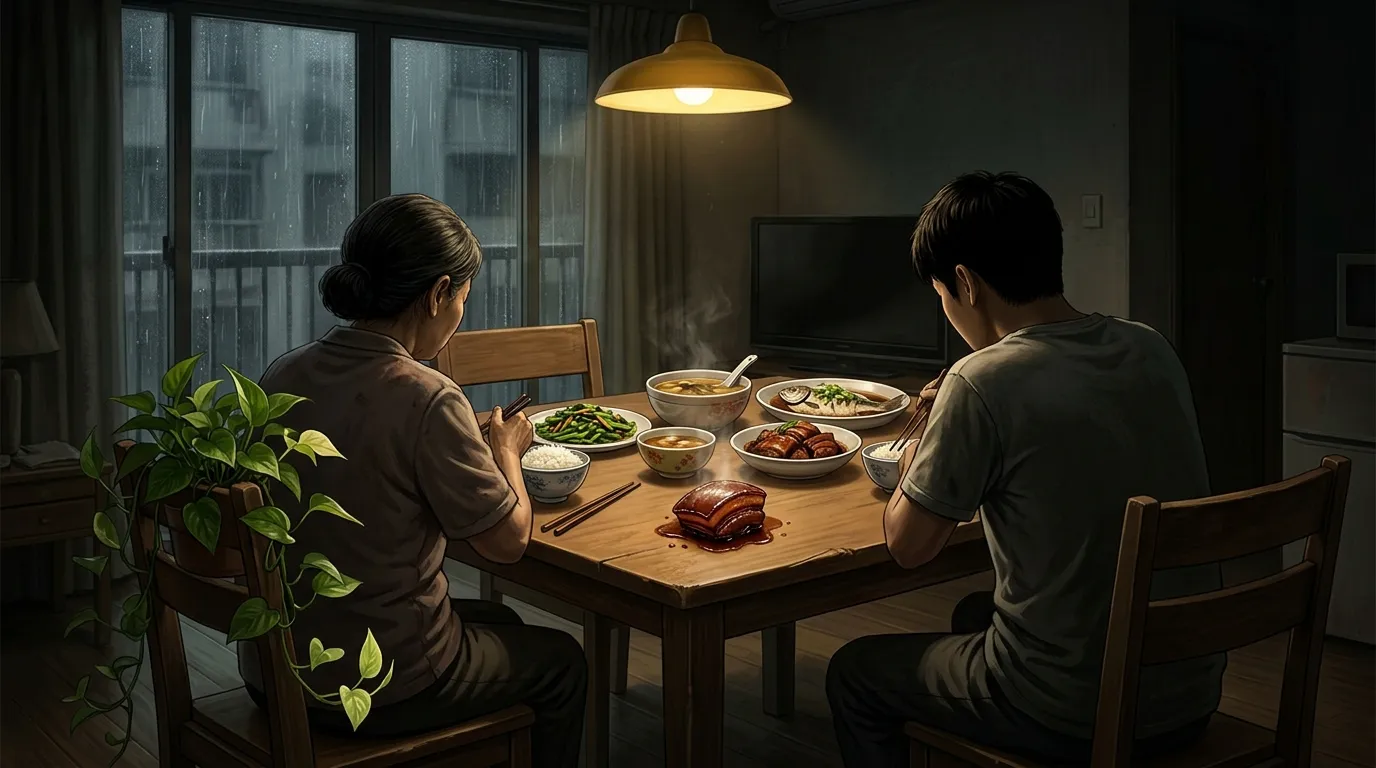
From the kitchen came the sound of scallions hitting hot oil, and the smell of braised pork — the deep fragrance of something that had been braising for a while already. Yīn Zhòngguāng stopped one moment at the kitchen doorway. He knew this smell. The smell itself was ordinary, but he knew when it appeared — holidays, or when something had happened at home, when she wanted everyone to eat well.
“Sit, sit, almost ready,” his mother said. She stirred the pot with the spatula. “Where did you come from?”
“Taidong.”
The spatula paused for a beat, then kept moving.
“Taidong,” she said, her voice even. “A case?”
“Something to take care of.”
She didn’t ask further. She kept cooking, the spatula’s sound steady, neither fast nor slow.
Yīn Zhòngguāng sat down at the dining table.
On the table there were already two bowls, two pairs of chopsticks, a soup bowl, and an empty plate. Exactly two people’s worth. She’d set them out beforehand — had she known he would come today, or did she always set it this way? He didn’t ask. The position by the plant was empty, no bowl there.
The pothos was still in that spot, its leaves denser than last time, a few new ones, lighter in color than the old — the pale yellow of something recently grown.
His mother brought out the braised pork, then went back for a stir-fried green vegetable, steamed fish, a bowl of soup. More dishes than he’d expected.
“Eat,” she said, sitting down and pushing the serving chopsticks to his side.
He picked up his bowl and scooped rice.
She scooped her own, then started serving — first a piece of braised pork into his bowl, then a slice of fish, then she picked up a little of the vegetables for herself, eating with the steady rhythm of a motion repeated for many years.
He started eating too.
The pork was very tender, the braising liquid deep in flavor, carrying a slight sweetness — exactly as he remembered it, with no variation at all, the kind of thing whose recipe hasn’t moved in decades.
The television wasn’t on.
Two people ate in the quiet, only the sound of chopsticks touching bowl, clear in that still apartment.
After a while, he looked toward the opposite side — the pothos, the empty spot beside it, where the kitchen light came in at an angle and made it brighter than his end.
He didn’t say Ruòchéng’s name. Neither did his mother.
Then his mother paused, extended her chopsticks toward that side, picked up a portion of braised pork, and set it on the table’s surface, just beside the plant, near that position that held no bowl.
The motion was natural, without hesitation, without ceremony — the motion of something done so many times it no longer required thought.
Yīn Zhòngguāng’s chopsticks stopped at the bowl’s rim.
He watched that portion of braised pork placed on the table — deep brown, still giving off a little heat, catching the light. That position. The position that had been empty for thirteen years.
Something became clear to him in that instant.
It was something that had always been there, never new to him, though other things had always been pressing down on top of it. In this moment it was finally seen.
His mother had never forgotten Ruòchéng.
She remembered with full clarity. She remembered every day. The way she remembered was a portion of food set beside an empty place, was she’s in further study in the south when someone asked, was the voice she kept steady and ordinary when she said it. She had chosen a way she could bear to carry the memory, and held herself in place inside that way, one day at a time.
That was not forgetting.
That was also not forgiveness, not atonement, not a lie — it was all three at once, and also not fully any one of them.
He watched that portion of food, chopsticks still at the bowl’s rim, not set down.
He sat there.
Outside, somewhere, a car engine rose in the distance, then was gone.
Then he lowered his head and kept eating.
His mother kept eating too. She wasn’t looking at him. She looked at her own bowl, served herself, ate — the rhythm exactly as it had been before he walked in.
Outside, rain began.
It came on slowly — first a few drops on the windowpane, then gradually thickening, the rain sound joining the sounds already in the apartment: chopsticks on bowl, ladle in soup, the slight scrape of a chair against the floor, and from a distance the sound of rain falling on a metal roof somewhere, light and close and far all at once.
Yīn Zhòngguāng suddenly thought of what Kē Yìngcǐ had said — Understanding is what’s worst.
He finished the meal.
(the end)