Chapter 1
The Words Left Unsaid
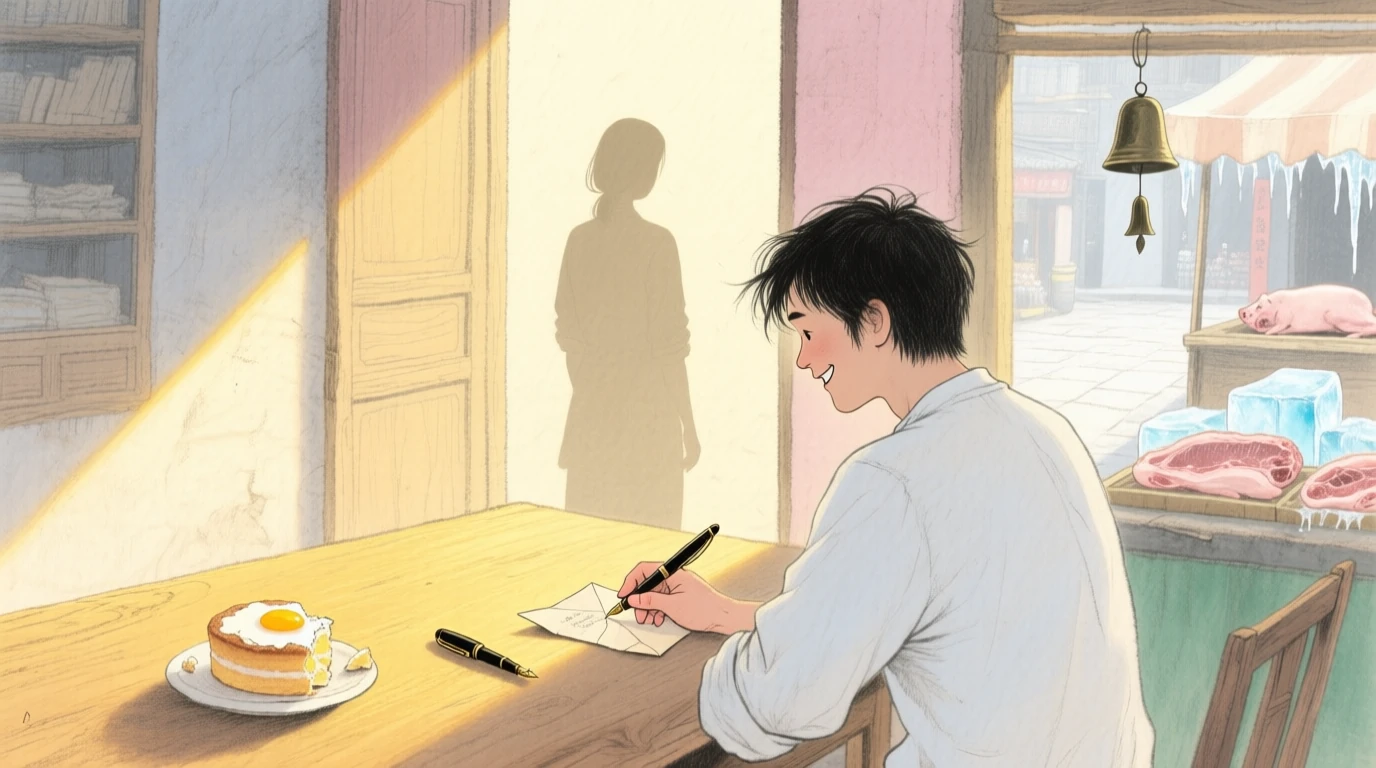
The Ren’ai Market in the afternoon felt like it had run out of steam.
The pork stall had already packed up, leaving only a few oily gleams on the steel racks. The crushed ice at the fish stall had melted into a puddle, slowly trickling down the drainage gutter. Even the old cat from the grocery next door couldn’t be bothered to meow; it sprawled under the arcade with half-closed eyes, wearing an expression that said, “Who the hell still works at this hour?”
Inside the letter-writing shop, A-Jie was polishing his fountain pen.
He did this every afternoon—taking apart the old fountain pen his father had left him, carefully wiping the nib, the barrel, and the cap with a soft cloth, then reassembling it. The movements were slow, like performing some kind of ritual.
The wind chime at the door rang.
Pork Rong didn’t bother knocking; he pushed the door open and walked right in, carrying a cardboard box in his hand. The smell of pork on him arrived before he did, mingling with the market’s characteristic dampness and instantly filling the five-ping shop.
“Hey, have some egg cakes.” He plopped the box on the table, not waiting for A-Jie’s consent, and pulled out a chair to sit down. “That new stall across the way—claims to be some old brand. Tastes just like regular egg cakes to me, but it’s pricier. Try one.”
A-Jie glanced at him, set down his pen, and opened the box. The egg cakes were still warm, golden brown, shaped like little animals, with some edges burnt.
“You didn’t come all the way here just to bring egg cakes, did you?”
“What, I can’t?” Pork Rong’s voice boomed. “I, Wu Rongfa, am just that good of a guy. I thought about you cooped up in this little room writing all day, afraid you’d starve to death, so I specially bought these to supplement your nutrition. What kind of attitude is that?”
A-Jie took a bite of an egg cake and said nothing.
Pork Rong paused, and his voice suddenly dropped a notch. “Alright, fine. There is something I wanted to ask you.”
“Spit it out.”
“That… you know A-Zhen, right? The one from the noodle stand next door.”
A-Jie nodded. The noodle stand owner. She had a mixed-breed dog named “A-Fu,” who was chubby but had a terrible temper.
“That dog of hers,” Pork Rong said, frowning, “has been going crazy these past few days. Starts barking around two or three in the afternoon, nonstop till evening. You know that sound? It’s like ‘Woof woof woof woof woof’—continuous, no breaks, like an alarm siren.”
“Did you talk to her about it?”
“Yeah, I did! Of course I did!” Pork Rong’s voice got loud again. “The day before yesterday, I stood in front of her stall and said nicely, ‘A-Zhen, can you do something about your dog? I need to take a nap in the afternoon.’ You know what she said?”
A-Jie had a guess, but he asked anyway: “What?”
“She said: ‘The noise from your pork stall chopping meat is way louder. My A-Fu is just barking normally. Yours is an occupational hazard.’” Pork Rong mimicked A-Zhen’s tone, deliberately drawing out the last syllable. “Occupational hazard! I’m chopping meat, not tearing down a house!”
A-Jie couldn’t help but chuckle.
“What are you laughing at? This is serious!” Pork Rong slapped the table, but not hard—more for emphasis. “I’ll tell you, I was gonna write a complaint letter and stick it right on her stall, let everyone see how irresponsible she is with her dog.”
“So you came to me to write it?”
“Yeah. My handwriting’s ugly; it wouldn’t be convincing.” Pork Rong said it without a hint of shame. “And when I write letters, it’s always in that tone—‘You better watch it.’ If I wrote it, she’d probably hit me with her noodle ladle.”
A-Jie didn’t rush to pick up his pen. Instead, he leaned back in his chair and looked at Pork Rong.
“Do you really want to write a complaint letter?”
Pork Rong blinked. “Well, yeah?”
“I mean, do you really want to burn that bridge with her?” A-Jie’s tone was flat. “Your stalls are separated by one aisle. You see each other at least three times a day. After you send this letter, you might have to take the long way around to buy noodles.”
Pork Rong opened his mouth but said nothing.
A-Jie continued: “And you just said ‘I don’t want to make it awkward.’ You don’t really want to complain. You want to let her know about it without making her think you’re just looking for trouble.”
Pork Rong was silent for a few seconds, then let out a heavy sigh.
“Man, how do you know everything?”
“I guessed.”
“Sure, you guessed.” Pork Rong rubbed his hands together. “So what do I do? I can’t just let her dog keep bothering me, right? I really need to nap in the afternoon. You know we pork stall guys have to start prepping at four in the morning. If I don’t get enough sleep, I might chop my hand off.”
A-Jie thought for a moment, then picked up his notebook and flipped to a blank page.
“Alright, I’ll help you write a letter. But it won’t be from you to her.”
“Then who’s it from?”
“The dog.”
Pork Rong’s eyes went wide. “What?”
“In the dog’s voice. Write an apology letter to her,” A-Jie said. “Something like: ‘I’m sorry, I’ve been barking a lot in the afternoons lately, and I’ve been bothering Uncle Pork Rong next door. Mom, don’t be mad, I’ll try to do better.’ What do you think?”
Pork Rong’s expression shifted from confusion to amusement to a subtle “this guy’s gotta be nuts” look.
“…You serious?”
“Dead serious,” A-Jie said. “Think about it. When she gets this letter, her first reaction will be to laugh. When people laugh, half the anger is gone. And this letter has no bite to it; she can’t even get mad if she wants to.”
Pork Rong thought it over for a long time. Finally, he said, “Alright, write it. But make it sound like the dog. Don’t get all fancy. A-Fu doesn’t say stuff like ‘I deeply apologize.’”
A-Jie nodded and started writing.
First, he had Pork Rong describe how A-Fu barked—“He throws his head back, tail up high, and barks really loud.” Then he asked what A-Fu liked to eat and where he liked to sleep. Pork Rong said A-Fu loved the bones from chicken leg bento boxes and slept at A-Zhen’s feet at night.
A-Jie wove all those details into the letter.
Half an hour later, he read the finished letter aloud to Pork Rong:
“Dear Mom: This is A-Fu. I’m sorry I’ve been barking in the afternoons lately and bothering Uncle Pork Rong next door. I know you love me a lot, but lately I’ve been hearing the sound of chopping meat from next door in the afternoon, and it makes me nervous, so I can’t help barking a few times. Uncle Pork Rong says he needs to take a nap in the afternoon, and I think he has a point. From now on, I’ll try to be quieter in the afternoons. If I really feel like barking, I’ll go chew on my slippers instead. Mom, don’t be mad. I’m still your goodest A-Fu. P.S. Uncle Pork Rong gave me chicken leg bones once. He’s a good guy.”
When Pork Rong heard it, the corner of his mouth twitched, and he finally burst out laughing.
“You little bastard. This dog even says ‘I think he has a point’?”
“Can’t a dog be reasonable?” A-Jie folded the letter paper and put it into an envelope. “Give this to her. Tell her the owner of the letter-writing shop wrote it. If she asks why it’s from the dog, just say, ‘I don’t know either. He said it would work better.’”
Pork Rong took the envelope, flipped it over, and asked how much.
“Whatever you think.”
Pork Rong pulled a two-hundred-dollar bill out of his pocket, thought for a second, and added another hundred.
“Three hundred. Keep the change.”
He stood up, walked to the door, then turned back to look at A-Jie.
“Hey, I’ve been meaning to ask you.”
“Yeah?”
“You write so many letters for other people. Why don’t you ever write one for yourself?”
A-Jie’s smile didn’t change, but his eyes flickered.
“I don’t have anything to write.”
“Bullshit,” Pork Rong said. “Everyone’s got something they can’t say out loud. You help so many people write theirs. There must be something you want to say yourself, right?”
A-Jie didn’t answer. His finger paused on the fountain pen for a second, then he placed it back in the pen holder.
Seeing that A-Jie wouldn’t respond, Pork Rong shrugged and didn’t push further. He pushed the door open, the wind chime rang once more, and he disappeared into the market’s afternoon shadows.
A-Jie sat back down, looking at the half-eaten box of egg cakes on the table.
He remembered a saying his father had once told him: “The pen is held for others.”
He had always remembered that, and always followed it. He never wrote a single word for himself—no diary, no memos, not even a shopping list; he kept everything in his head. It was as if writing down a single word about himself would cause the meaning of this letter-writing shop to crumble.
But sometimes, he wondered. Pork Rong was right. Everyone has something they can’t say out loud.
What about him?
He stared at the market walkway outside the window, gradually growing quiet. He didn’t follow the thought further.
The wind chime rang again.
This time, a young woman stepped in—Xiao Lin, about twenty-seven or twenty-eight, wearing a simple white top and jeans, a canvas bag slung over her shoulder. In her hand, she clutched a letter, its edges already crumpled from being handled. There was no postmark on the envelope, like she had written it herself.
She stood at the entrance, looking hesitant, as if unsure whether she should come in.
A-Jie stood up and pulled out the chair beside him.
“Please, have a seat.”
She nodded, walked in slowly, and sat down. She placed the letter on the table but didn’t push it toward him. She just held it down with her hand, as if afraid it might blow away.
“Hello,” she said, her voice soft. “I heard that… you can write letters for people here.”
“I can,” A-Jie said. “Who do you want to write to?”
She was silent for a moment.
“To… myself.”
A-Jie paused.
“To yourself?”
“Yes.” She looked up, her eyes complicated. “I’d like you to help me write a letter to myself.”
Outside the market, the afternoon sunlight slanted in, casting a long shadow across the table.
The letter still lay pressed beneath her palm, unopened.