Chapter 2
A Letter to Myself
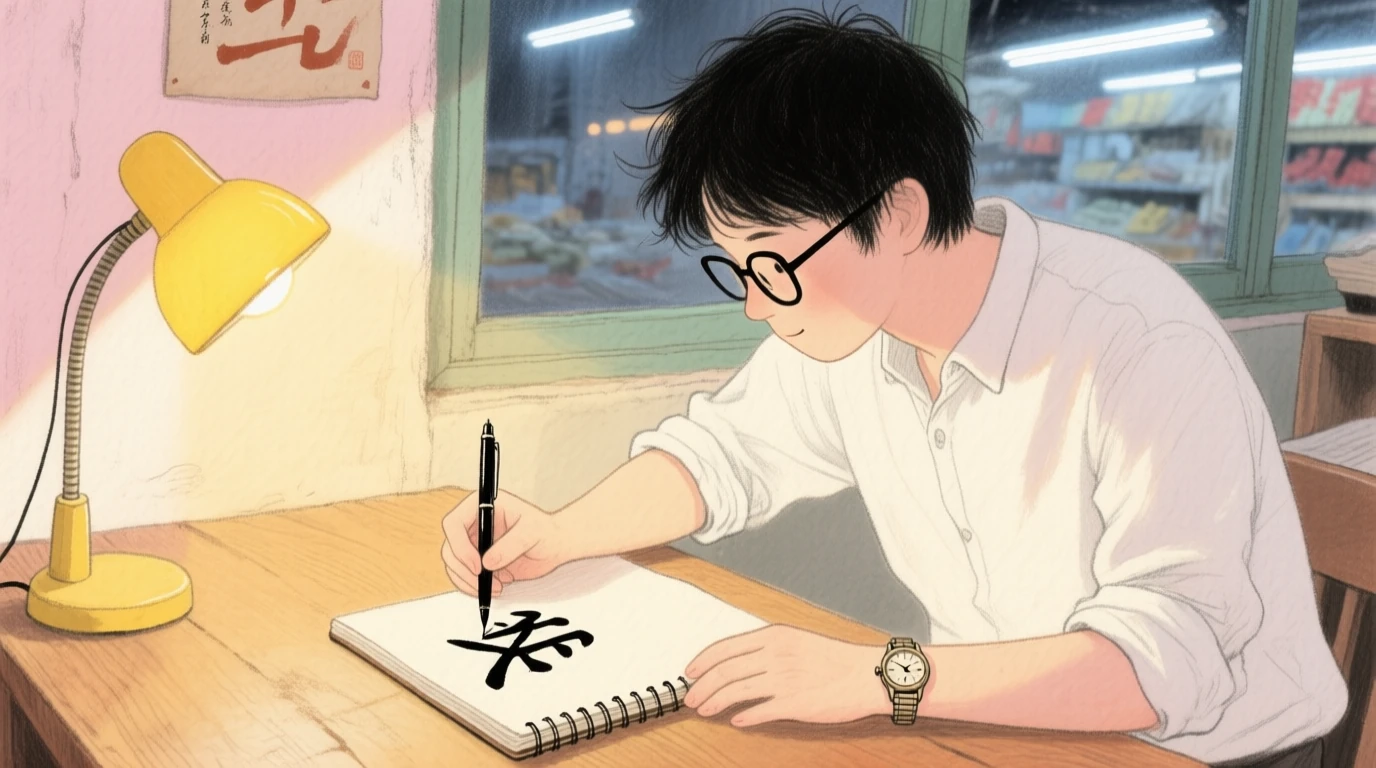
The wind chime rang again.
Xiao Lin sat in the chair, her hand still pressing down on the letter, as if afraid it might sprout legs and run off. A-Jie didn’t rush her. He was wiping down the fountain pen his father had left behind. When he heard the sound, he stopped, put the pen back in the drawer.
“You said… write to yourself?” He confirmed once more.
“Yeah.” Xiao Lin took a deep breath, like she’d finally made up her mind. “That pork seller guy told me you’re really good at writing letters—you can mimic anyone’s voice. So I thought, if it’s possible…”
She trailed off, her fingers rubbing the edge of the envelope.
“Take your time,” A-Jie said.
“I quit my job three months ago.” Xiao Lin started speaking faster, as if afraid she’d lose the nerve if she paused. “I was an admin assistant for three years. Pay was okay, coworkers were fine, the work wasn’t terrible—but it’s just… you know that feeling? Waking up every morning and feeling like today is exactly the same as yesterday, and tomorrow will be exactly the same as today.”
A-Jie nodded, not interrupting.
“I’ve actually always wanted to study abroad.” She went on. “I applied to schools, got in. I have enough savings for the first year’s tuition. I’ll figure out the rest later. Sounds brave, right?”
“It does,” A-Jie said.
“But the thing is, there’s this voice in my head, keeps saying—” She put on a stern tone. “‘Who do you think you are? Your English isn’t even that good. What if you go there and can’t understand a thing?’”
After she said it, she laughed a little, but the laugh was bitter.
“So I wrote this letter.” She slid the paper she’d been pressing under her palm toward A-Jie. “I wrote it myself, several versions. But after every draft I thought, ‘This is garbage,’ and crumpled it up.”
A-Jie looked at the letter but didn’t pick it up right away. “Can I read it?”
Xiao Lin hesitated, then nodded.
He unfolded the paper. The handwriting was neat—you could tell she’d put a lot of effort into it. But it was so careful it felt stiff. The content went something like: “Dear self, you are very brave. Don’t be afraid. You can do it.” The sentences were correct, but they read like something copied from a self-help book. No voice of her own.
“You wrote this?”
“Yeah. Took me a week.”
“Is this how you normally talk?” A-Jie asked.
Xiao Lin blinked. “What do you mean?”
“When you chat with your friends, do you say things like ‘Dear self’?”
“…No.” Xiao Lin laughed. “With my friends I’m like, ‘Hey you idiot,’ stuff like that.”
A-Jie smiled too. “Then you could start your letter with ‘Idiot Lin Xinyi.’”
Xiao Lin froze, then burst out laughing. “Huh… yeah, that could work.”
He gently pushed the letter back toward her.
“So why do you have to say ‘Dear self’?”
Xiao Lin stared at the paper, silent for a moment.
“…Because I felt like I had to be formal when talking to myself? Otherwise it wouldn’t seem serious enough.”
“But you don’t sound like yourself,” A-Jie said. “If a friend wrote this to you, what would you think?”
Xiao Lin thought. “I’d think… it sounds really corporate. Like one of those inspirational cards from a pyramid scheme.”
“Exactly. That’s the feeling.”
A-Jie pulled a notebook out of his drawer and flipped to a blank page.
“Tell you what. I’ll try to write a version for you. Take it home and see. If it’s not right, we’ll tweak it.”
Xiao Lin nodded and sat up straight.
“First, I need to ask you a few questions,” A-Jie said. “When you describe yourself, what words do you usually use?”
“What do you mean?”
“For example, do you say you’re ‘lazy,’ ‘impatient,’ ‘can’t stick with anything’—or ‘hardworking,’ ‘responsible,’ ‘overthinker’?”
Xiao Lin didn’t hesitate. “I’m ‘useless,’ ‘procrastinator,’ ‘overthinker.’”
“You’re pretty hard on yourself.”
“I’m used to it.” Xiao Lin shrugged. “My mom always said I ‘think too much and do too little.’ After a while, I figured she was right.”
“Do you think she is?”
Xiao Lin opened her mouth, then closed it.
“…I don’t know. Sometimes I think she’s right. But other times I think, if I’m really that useless, how did I manage to apply to schools myself, save up my own money, and get my own visa?”
As she said this, her voice changed a little—less hesitant, more like she was arguing with someone.
A-Jie jotted a few words in his notebook.
“Okay, second question: If your best friend told you she quit her job, wanted to study abroad, and was scared, what would you say to her?”
Xiao Lin thought. “I’d say, ‘You idiot, what are you scared of? You’ve already saved the money. If you don’t go, it’s a waste.’”
“Would you curse?”
“Yeah.” Xiao Lin laughed. “I’d probably say, ‘For fuck’s sake, if you keep hesitating, you’ll regret it when you’re old.’”
“And when you talk to yourself, what’s your cursing ratio?” A-Jie asked.
Xiao Lin paused. “Maybe thirty percent, depends on my mood.”
A-Jie nodded. “Okay, I’ll aim for twenty.”
He made another note.
A-Jie started writing.
He wrote fast, the tip of the pen scratching against the paper. Xiao Lin sat across from him, occasionally stealing a glance at his face—his brow slightly furrowed, no hint of a smile, like he was solving a math problem.
After about fifteen minutes, A-Jie stopped and turned the notebook toward Xiao Lin.
“See if this works.”
Xiao Lin leaned in and read aloud:
“Hey Lin Xinyi. What the fuck are you so afraid of? You applied to the school. You saved the money. You got the visa. You’re already a hundred times better than those people who just say ‘I want to go abroad’ and then keep scrolling on their phones. Go. If you can’t understand, ask more. If you can’t keep up, study more. Worst case, you waste a year and come back. But think about it—if you don’t go, will you regret it ten years from now? The answer is yes. So shut your eyes, buy the ticket, get on the plane. And when you get there, remember to call your mom.”
Xiao Lin finished reading and was silent for several seconds.
“What do you think?” A-Jie asked.
“…I think,” Xiao Lin said slowly, “if my mom saw this letter, she’d have a heart attack.”
A-Jie laughed.
“But,” Xiao Lin added, “I don’t think I would actually talk to myself like this.”
“Too harsh?”
“Not harsh—it’s just…” She thought. “It’s too sure. Like everything is simple and certain. But the problem is, I feel really uncertain inside.”
A-Jie looked at her without arguing.
“So you want the letter not to pretend you’re brave?”
“Yes!” Xiao Lin said. “I want it to admit that I’m a coward right now, but still tell me to go. You know? Like, ‘I know you’re scared, but you still have to go.’”
A-Jie nodded and turned the notebook back.
“I’ll try again.”
He wrote for another twenty minutes, slower this time, occasionally stopping to cross out a few words and rewrite them. Xiao Lin didn’t interrupt. She sat quietly, watching the market outside grow dim through the window.
“Done.” A-Jie turned the notebook toward her.
Xiao Lin took it and read:
“To Lin Xinyi, who’s being a coward right now:
Yeah, you’re scared. Nothing to be ashamed of. Your English isn’t great. You might not understand the lectures. You might not make friends. You might regret it.
But you know what you’d regret even more? Ten years from now, still sitting here, doing the same admin job, and telling people, ‘I was going to study abroad back then.’
So, scared or not, you still have to go. If you don’t understand, raise your hand and ask. If you can’t make friends, start a conversation. If you really regret it, come back.
At least you tried.
That’s it.
— From a Lin Xinyi who’s just a tiny bit braver than you”
Xiao Lin finished reading, put the paper on the table, and said nothing.
A-Jie watched her expression. “How is it?”
“…This.” Xiao Lin pointed to the second-to-last line. “‘A Lin Xinyi who’s just a tiny bit braver than you’—that’s good.”
“So this version works?”
Xiao Lin thought. “The tone is closer. But that last line—‘a Lin Xinyi who’s just a tiny bit braver than you’—I wouldn’t call myself that normally. I’d say ‘a fucking coward Lin Xinyi.’”
A-Jie looked at her, not rushing to answer.
“You want me to mimic your voice?” he asked.
“Yes, but—” Xiao Lin hesitated. “I’m not really sure what my voice is. Because the way I talk to myself is different from how I talk to other people.”
“How is it different?”
“When I talk to others, I think before I speak. I’m afraid of saying the wrong thing.” Xiao Lin said. “But when I talk to myself, it’s usually when I’m tired, annoyed, or had a bit to drink. What I say then is more real, but also uglier.”
“So you want it real, but not too ugly?”
“Yeah.” Xiao Lin smiled. “You summed it up really well. I wish I could sum things up like that.”
A-Jie smiled faintly, wrote a few words in his notebook.
“Let me ask you one question. You don’t have to answer now. Think about it at home.”
“What question?”
“If you could say one thing to yourself right now—not ‘you should,’ ‘you must,’ ‘you’d better’—but something you truly, from the bottom of your heart, want to say to yourself—what would it be?”
Xiao Lin was silent for a long time.
Outside, the sky had darkened. The fluorescent lights in the market flickered on one by one, casting yellow-white reflections on the damp ground. The wind chime chimed occasionally, stirred by a draft.
“…I don’t know,” Xiao Lin finally said.
“That’s okay,” A-Jie said. “This letter isn’t in a hurry.”
He tore the second draft out of his notebook and handed it to her.
“Take this home. Look it over whenever you have time. If you think of anything you want to change, come find me.”
Xiao Lin took the paper, folded it carefully, and put it back in the envelope.
“How much?”
“Free this time,” A-Jie said. “Because it’s not finished yet.”
Xiao Lin froze for a second, then laughed.
“Doing business like this, won’t you go bankrupt?”
“Not yet,” A-Jie said.
Xiao Lin stood up, walked to the door, then turned back.
“Hey, boss.”
“Yeah?”
“The pork seller guy said you never write for yourself. Is that true?”
A-Jie’s smile didn’t change.
“It’s true.”
“Why?”
The question came bluntly. A-Jie was silent for a second.
“…No reason. Just a habit.”
“Huh.” Xiao Lin didn’t press. She just shrugged. “Then next time I come, I’ll ask you again.”
She pushed open the door. The wind chime rang again.
After the door closed, the letter-writing shop fell quiet.
A-Jie sat in his chair, looking at the fountain pen his father had left on the desk—he hadn’t wiped it this afternoon yet. He reached out, picked up the pen, unscrewed the cap. The nib glowed faintly silver under the light.
He remembered the question he’d just asked Xiao Lin.
“If you could say one thing to yourself right now, what would it be?”
He held the pen in his palm. The barrel was still a little warm.
No answer.
But he picked up the pen, and on the blank page of his notebook, he wrote a single character—
“I.”
And then he stopped.
Like a child learning to write for the first time, not knowing where the next stroke should go.