Chapter 3
The Weight of That Pen
The wind chime rang as A-Jie was wiping his pen.
It was a daily ritual. Unscrew the cap, take a soft cloth, start from the nib, slowly work down the barrel to the end, then back up. His father used to say a fountain pen needs constant writing to keep the ink from clogging, but A-Jie preferred wiping—writing was work, wiping was rest.
Today he wiped longer than usual—he’d been up all night. Lying in bed, tossing and turning, a single image kept looping in his head: him writing the character “I” in a notebook, then the nib stopping midair, like a bird that didn’t know where to fly.
He hadn’t had insomnia in a long time.
The last time he couldn’t sleep was right after his father passed. He’d sat alone in the letter-writing shop, staring at the fountain pen on the desk, thinking how no one would ever reach over from the side again when he wrote a wrong character, tapping his finger lightly with the back of the pen.
“You’re going too fast here,” his father would say. “Slow down. That’s how words gain weight.”
Back then, he thought his father was too naggy. Now, no one was around to tap him even if he wanted it.
A-Jie put the pen back in the drawer, stood up, and decided to do something to distract himself.
He started sorting through old things.
Well, “sorting” meant pulling things out of the cardboard box in the corner and rearranging them. The box held odds and ends his father had left behind: a few old notebooks, a stack of blank letter paper, a tin box full of buttons, several handwritten receipts from market vendors.
He took each item out one by one, wiped off the dust with a cloth, then put them back.
Then he came across a notebook.
He’d never seen this one before. Dark blue cover, edges worn white. Inside was his father’s handwriting—but it wasn’t letters. Just scattered sentences.
“Today A-Rong came to complain about his wife. Said she won’t let him raise racing pigeons. I told him, ‘Your wife isn’t stopping you from raising pigeons—she’s afraid that if you raise pigeons, you’ll ignore her.’ A-Rong blinked and said, ‘Really?’ Then he went home. The next day he told me his wife said he’d finally gotten it.”
A-Jie smiled.
He kept flipping. Another page.
“That old vegetable-seller grandma at the market entrance comes every time and says, ‘My grandson’s handwriting is terrible, can you write a thank-you card for his teacher?’ But what she really means is, ‘My grandson hasn’t called me in a long time. I want to know if he’s doing okay.’ Every time I finish the letter, I draw a little turtle on the back of the envelope—her grandson loved drawing turtles when he was little. The grandma always smiles when she sees it.”
A-Jie’s hand paused mid-flip.
He knew his father’s handwriting well, but he’d never seen content like this. So his father had also recorded these things—the unspoken words behind the clients’ requests, the real wishes hidden inside “Could you please write a letter for me?”
He turned another page.
This one was blank, but from the inner pocket a yellowed slip of paper fell out.
He picked it up.
On the front, in his father’s handwriting—the strokes heavier than the others in the notebook:
“One day, you will meet someone who needs you to write a letter for yourself.”
A-Jie froze.
He stared at the line, read it several times. He recognized every character, but put together, he wasn’t sure what it meant.
Write a letter for yourself?
He didn’t write for himself. That was what his father had taught him. Ever since he started learning letter-writing from his father at fifteen, his father had told him: “The pen is for others. Your own matters—think them through clearly, no need to write them down.”
He’d never questioned that.
But now the note his father left said, “One day, you will meet someone who needs you to write a letter for yourself.”
What did that mean?
—That he might break the rule someday?
—Or that his father already knew who he would meet?
He tucked the slip back into the notebook and put it in the drawer. His mind felt a little tangled.
He decided to make some tea to calm down.
The water had just boiled when the wind chime rang again.
Xiao Lin stood at the door, holding the folded letter—the second draft he’d written for her yesterday.
“Morning,” A-Jie said.
“Morning.” Xiao Lin walked in, sat down, and placed the letter on the table. “I thought about it a lot last night.”
“And?”
“And I feel—” she paused, “this letter is still too correct.”
“Too correct?”
“Yeah. Like—” She thought for a moment, then made a square with her hands. “It’s all right, but it doesn’t hit my spot. Look, you wrote, ‘Your English isn’t great, you might not understand the lectures when you go’—that’s a fact, right?”
A-Jie nodded.
“But the real voice inside me isn’t ‘My English is bad.’ It’s—” She took a deep breath. “‘You fucking shake when you talk to foreigners on the phone—how the hell are you going to survive when you go?’”
A-Jie looked at her, not interrupting.
“You know what I mean?” Xiao Lin said. “You wrote it gently, but I’m not gentle with myself at all. So this letter reads like—” She thought for a long time. “Like it was written by a better version of me, not by me.”
“So you want it to sound more like your real tone?”
“Yeah,” Xiao Lin said. “I want—” She paused. “A letter that would make me cry.”
A-Jie was silent for a few seconds.
“You asked me that question yesterday, and I thought about it last night,” Xiao Lin said again. “‘If I could say one thing to myself right now, what would it be?’ I thought all night, but I still don’t have an answer.”
“Because you’ve never said anything real to yourself?” A-Jie asked.
Xiao Lin froze. “…Maybe.”
“Then how do you usually talk to yourself?”
“Like—” She thought. “‘You’re useless,’ ‘You can’t do it,’ ‘Who do you think you are’—stuff like that.”
“Are those the real words?”
Xiao Lin was silent for a long time.
“…I don’t know,” she finally said. “I thought they were. But after you asked yesterday, I suddenly wasn’t sure.”
A-Jie looked at her, didn’t rush to answer.
He thought of the note he’d just seen.
“One day, you will meet someone who needs you to write a letter for yourself.”
When did his father write that? Was it after he’d already figured something out, or while he was still figuring?
A-Jie suddenly felt that between him and his father, there were many words that had never been spoken.
Just like between Xiao Lin and herself.
“How about this,” A-Jie said. “Let me try a different approach.”
He took out the draft Xiao Lin had brought, flipped it to the blank back.
“Don’t think about ‘writing a letter to yourself’ right now. Just think—you’re someone who just quit your job, about to go abroad, and you’re scared. You’re sitting here, next to your best friend. She won’t judge you. She’ll just listen.”
A-Jie looked at her.
“Now you’re talking to that friend. Not to yourself—to her. What would you say?”
Xiao Lin opened her mouth, then closed it.
She looked down at the table, her fingers rubbing the edge.
“…I would say,” she began slowly, “‘I’m actually really scared.’”
“Mm.”
“‘I’m afraid that after I go, I’ll find out I’m not as brave as I thought.’”
“Mm.”
“‘I’m afraid I’ll blow all my savings, learn nothing, and come back to the same job.’”
Her voice started to tremble a little.
“‘I’m afraid my mom was right—I think too much and do too little, and I won’t last long.’”
She lifted her head and looked at A-Jie.
“But I’d also say—”
She stopped.
“Yeah?”
“I’d also say—” She took a deep breath. “‘But if I don’t go, I’ll definitely regret it.’”
After she said it, she froze.
A-Jie didn’t say anything. He just picked up the fountain pen and wrote a few words on the back of the draft.
“That line you just said,” A-Jie said, “‘If I don’t go, I’ll definitely regret it’—was that to yourself, or to your friend?”
Xiao Lin thought. “…Seems like both.”
A-Jie nodded.
He looked down at the line.
“Then I’ll put that in the letter.”
He took a fresh sheet of letter paper and began to write.
The nib scratched against the paper. Xiao Lin sat across from him, not interrupting. She just watched his nib, watched the words appear line by line.
About ten minutes later, A-Jie stopped.
He picked up the letter, read it once, then handed it to her.
Xiao Lin took it and read aloud:
“To Lin Xinyi:
You’re scared right now. That’s nothing to be ashamed of. Your English isn’t great, you shake when you talk to foreigners on the phone. You might not understand the lectures, you might not make friends, you might regret it.
But you know what you’d regret even more? Ten years from now, you’re still here, doing the same admin job, telling people, ‘I was going to go abroad back then.’
Your mom says you think too much and do too little. She might be right. But this time, at least you can do first, then think.
Go. If you don’t understand, raise your hand. If you can’t make friends, go talk to someone. If you really regret it, come back.
At least you tried.
Because if you don’t go, you’ll definitely regret it.
—From a slightly braver Lin Xinyi”
Xiao Lin finished reading and was silent for a long time.
She stared at the letter, didn’t speak.
A-Jie didn’t rush her. He sat across, waiting quietly.
After a while, Xiao Lin looked up.
“…That last line, ‘If you don’t go, you’ll definitely regret it’—”
“Yeah?”
“That was me.”
“Right.”
Xiao Lin looked at the letter, silent again.
Then she let out a small laugh.
“…This version works.”
A-Jie smiled too.
“So, final draft?”
Xiao Lin nodded, but she didn’t put the letter down.
She looked at it, as if confirming something.
“Can I… read it out loud here?”
A-Jie was surprised: “Now?”
“Yeah,” Xiao Lin said. “I want to hear what it sounds like in my own voice.”
A-Jie nodded.
Xiao Lin took a deep breath, brought the letter up.
She began:
“To Lin Xinyi:”
She paused, as if adjusting to her own voice.
“You’re scared right now. That’s nothing to be ashamed of.”
Her voice trembled a little.
“Your English isn’t great, you shake when you talk to foreigners on the phone.”
She let out a bitter laugh, trying to steady her voice.
“You might not understand the lectures, you might not make friends, you might regret it.”
She stopped there.
“But you know what you’d regret even more?”
Her eyes started to redden.
“Ten years from now, you’re still here, doing the same admin job, telling people, ‘I was going to go abroad back then.’”
Her voice cracked.
She put the letter down, wiped the corner of her eye with the back of her hand.
“…Fuck,” she muttered, then laughed. “You actually made me cry.”
A-Jie handed her a tissue.
Xiao Lin took it, dabbed her eyes, then laughed again.
“I’ll keep this letter.”
She carefully folded it and put it in her bag.
“How much?”
A-Jie thought for a moment: “Three hundred.”
“Only three hundred?” Xiao Lin blinked. “I cried, man. This service should cost extra.”
“Come again next time, I’ll add it on,” A-Jie said.
Xiao Lin laughed: “Okay, I’ll come again then.”
She stood up and walked to the door.
Turned back.
“Hey, boss.”
“Yeah?”
“You never answered my question from last time.”
A-Jie paused: “What question?”
“Why do you never write for yourself?”
A-Jie was silent for a second.
“…It’s a habit,” he said.
“A habit?”
“Yeah. Got it since I was a kid.”
Xiao Lin looked at him, didn’t press.
“Fine,” she shrugged. “I’ll ask again next time.”
She pushed the door open. The wind chime rang once.
After the door closed, the letter-writing shop fell quiet again.
A-Jie sat in his chair, looking at the fountain pen on the table.
He thought of his father’s notebook, the yellowed slip, the line written on it—
“One day, you will meet someone who needs you to write a letter for yourself.”
He reached out, picked up the fountain pen, unscrewed the cap.
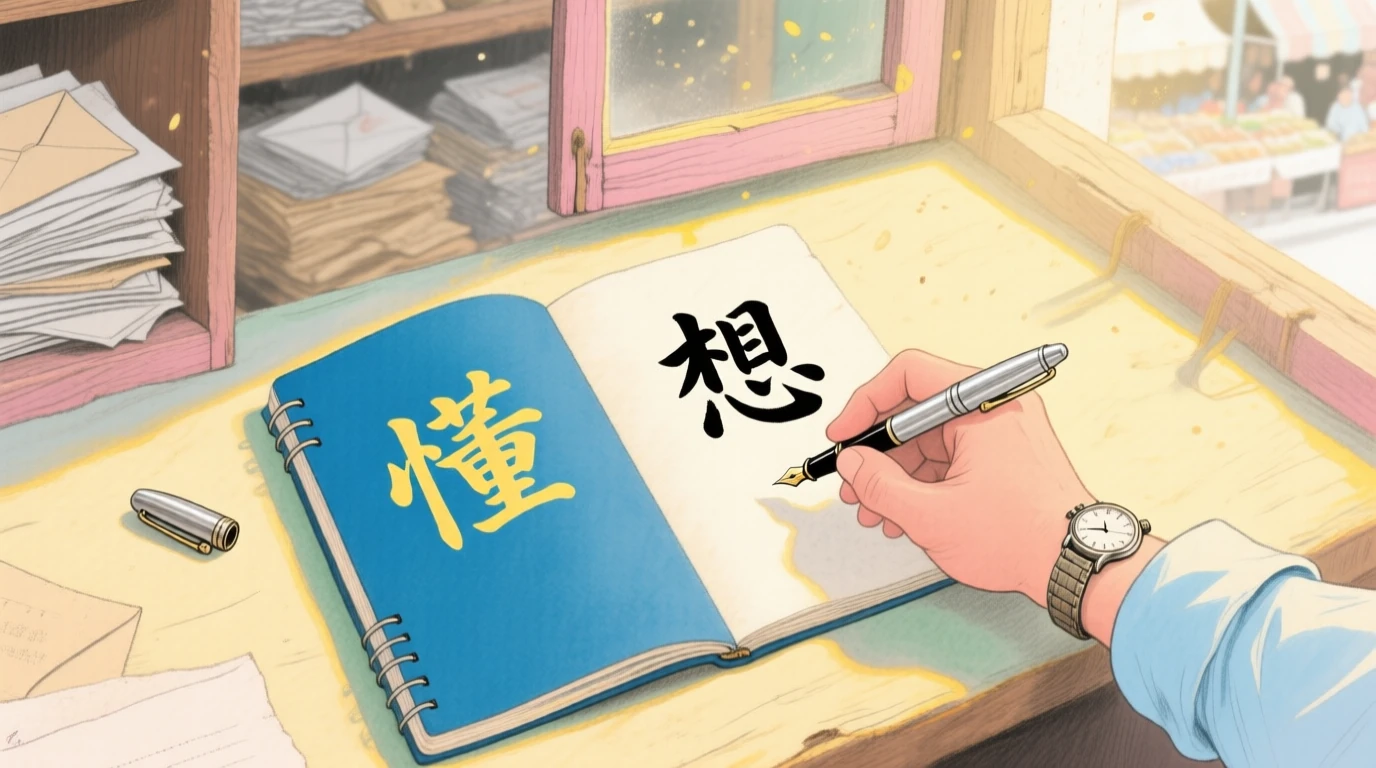
Then he flipped to a new page in his own notebook and wrote one character on the blank space:
“Think.”
He stared at the character for a long time.
Then he wrote a second character:
“Understand.”
The two characters stood side by side.
Both written by him. One “think,” one “understand”—he was still thinking, and he still didn’t fully understand, but this time, he’d left the words on the page.
A-Jie looked at those two characters and smiled faintly.
He put the pen back in the drawer and closed the notebook.
Outside, the market rang with vendor shouts and the thud of cleavers. Life went on as usual.
But A-Jie knew—some things had already started to change.