Chapter 4
Three Requests
The wind chime rang twice.
A-Jie looked up. An old man stood at the door, holding a plastic bag with a few tangerines inside.
“Young man, do you write letters for people?”
The old man was about seventy, with graying hair, a hunched back, and a white undershirt washed so many times it was nearly see-through. His voice was a little raspy, carrying that old-market cadence—every word’s last syllable floated upward.
“I do.” A-Jie put down his fountain pen. “Please, have a seat.”
The old man sat down, set the plastic bag by his feet, hesitated, then picked it up and placed it on the table.
“These tangerines are for you. I grew them myself. They’re sweet.”
“Thank you, Uncle,” A-Jie said. “What kind of letter do you want to write?”
The old man was quiet for a moment, his fingers rubbing back and forth on the tabletop.
“I want to write to my wife.”
“Alright. What do you want to say?”
“I want to tell her—our grandson doesn’t study at all. Just scrolls on his phone all day. I’m worried.”
A-Jie picked up his pen. “Who’s the recipient?”
“Her name is A-Yue.”
“And the address?”
The old man fell silent again.
“…No address.”
A-Jie stopped writing.
“She passed away two years ago.”
A-Jie paused, then nodded. He didn’t ask further.
“Then this letter—do you hope she’ll receive it?”
“Of course I do,” the old man said. “But I know she won’t.”
“Then what’s the purpose of writing it?”
The old man thought for a moment.
“I just… want to talk to her.”
A-Jie understood.
This wasn’t a letter to be mailed. It was a letter to someone who had passed—the writer knew it would never reach her, but he needed to say the words anyway.
“Then what do you want to say?”
The old man let out a sigh.
“Before she left, the thing she worried about most was our grandson. She said, ‘You have to take care of him. Make sure he studies.’ I promised her.”
He paused.
“And now that little brat—comes home from school every day and just scrolls his phone. When I tell him to do homework, he says ‘I’m done.’ His test papers come back with scores in the sixties.”
His tone shifted from complaint to regret.
“I feel like I haven’t kept my promise to her.”
A-Jie didn’t rush to write. He asked, “What do you usually call your grandson?”
“Just—‘Ah-Di.’”
“And what do you call your wife?”
“A-Yue.”
A-Jie nodded.
“Alright. Let me try.”
He bent his head and began to write.
The nib scratched across the paper. The old man sat quietly, not disturbing him.
After about five minutes, A-Jie stopped.
“I’ll read it to you.”
The old man nodded.
“‘A-Yue:’”
“‘Ah-Di isn’t studying again.’”
“‘I’m telling you—these days he comes home from school and just scrolls his phone. When I tell him to do homework, he says he’s done. His test papers come back with sixties. I yell at him, and he says, “Grandpa, you can’t even read anyway.”’”
When the old man heard that, he laughed a little, but it was a bitter laugh.
“‘I told him, I can’t read, but I know scores. Sixty is failing. He shut up after that.’”
“‘But I’m really scared. I’m scared I can’t control him. Scared he’ll end up like his dad—bad at school, bad at work, and then blame us for not raising him right.’”
A-Jie’s voice was steady, but every word seemed to tap lightly.
“‘Before you left, you told me to take care of him. I promised you. But I don’t know if I’ve done a good job.’”
“‘A-Yue, if you can hear me, please watch over him. See if he cries at night when he’s asleep.’”
“‘Because he never cries in front of me.’”
When A-Jie finished this part, he stopped.
The old man didn’t speak.
He lowered his head and wiped the corner of his eye with the back of his hand.
“…Yeah. That’s it.”
He coughed, cleared his throat.
“My grandson… his mom ran away. His dad’s in prison. He only has me.”
He looked up at A-Jie.
“He’s a good kid. Really good. He just doesn’t know how to say it.”
A-Jie nodded.
“Then this letter—do you want to sign it?”
“Yes,” the old man said. “Just write ‘A-Rong-a.’”
A-Jie wrote “A-Rong-a” at the bottom of the letter, then handed the paper to the old man.
The old man took the letter and stared at it for a long time.
“…It sounds like me,” he said. “Like something I’d say.”
He carefully folded the letter and put it in his pocket.
“How much?”
“Whatever you think.”
The old man pulled out a crumpled two-hundred-dollar bill from his pocket and placed it on the table.
“Is this enough?”
“Enough.”
The old man stood up, picked up the bag of tangerines, then set it back down on the table.
“Keep the tangerines for yourself,” he said. “I’ll come again next time.”
He turned and walked toward the door. Halfway there, he looked back.
“Young man.”
“Hmm?”
“Thank you.”
The wind chime rang once. The old man was gone.
A-Jie looked at the bag of tangerines on the table. He picked one up and sniffed it.
It smelled sweet.
He put the tangerine back in the bag. Just as he was about to continue wiping his pen, the wind chime rang again.
This time, a young woman walked in—about twenty-five or twenty-six, wearing a suit and high heels, her makeup impeccable, but her eyes a little red.
“Excuse me, do you write breakup letters here?”
Her tone was calm, but A-Jie noticed her fingers gripping the strap of her bag were white at the knuckles.
“I do,” A-Jie said. “Please, have a seat.”
The woman sat down, pulled a business card from her bag, and placed it on the table.
“This is my boyfriend.”
A-Jie glanced at the card: XX Tech, Sales Manager.
“He cheated,” the woman said. “I want to break up with him.”
“Alright. What tone do you want for the letter?”
The woman thought for a moment. “Dignified. Not whiny.”
“Specifically?”
“Like—no crying, no cursing, no making him think I can’t let go. But I want him to know I know what he did.”
A-Jie nodded.
“What do you usually call him?”
“…Baby.”
A-Jie didn’t laugh.
“And what do you want to call him in the letter now?”
The woman was silent for a second.
“…Just his name.”
“Alright.”
A-Jie picked up his pen, then put it down again.
“Do you mind if I ask a question?”
“Go ahead.”
“Are you sure you want to write this letter?”
The woman blinked. “What do you mean?”
“Some people write breakup letters because they want a ‘ceremony’—to say the words, and then really let go,” A-Jie said. “But some people write them because they hope the other person will regret it and come back.”
He looked at her.
“Which one are you?”
The woman was quiet for a long time.
“…The first one.”
She paused again.
“Okay, fine. Maybe both.”
A-Jie nodded.
“Let me try.”
He bent his head and began to write.
This time he wrote faster—stopped after about three minutes.
“I’ll read it.”
“‘Dear So-and-So:’”
“‘When this letter is done, we’re done.’”
“‘You know what you did. I don’t need to say it again, and you don’t need to explain.’”
“‘These two years, I’ve learned a lot. Thank you for walking a stretch of the road with me. But from here on, I’ll walk the rest alone.’”
“‘No need to reply.’”
A-Jie finished and looked at the woman.
She didn’t speak.
She stared at the letter, her expression complicated—like she was relieved, but also a little unwilling.
“…‘No need to reply.’” She repeated it. “That’s good.”
She nodded.
“That’s it.”
A-Jie handed her the letter.
She took it, read it over, then carefully folded it and put it in her bag.
“How much?”
“Two hundred.”
She took two hundred-dollar bills from her wallet and placed them on the table.
Then she stood up, took a deep breath.
“Thank you.”
“You’re welcome.”
The woman walked to the door, then looked back.
“Hey, boss.”
“Hmm?”
“If… if he really doesn’t reply… does that mean I’ve really let go?”
A-Jie thought for a moment.
“Letting go isn’t about whether he replies. It’s about whether you want to receive his reply.”
The woman was stunned.
Then she smiled—the kind of smile that was a little bitter, but finally relieved.
“…You’re right.”
She pushed the door open. The wind chime rang once.
A-Jie watched her walk out, then went back to wiping his pen.
He hadn’t finished wiping when the wind chime rang again.
“Boss!”
A high school student in uniform burst in, holding a letter, his face bright red.
“H-h-help me write a letter!”
A-Jie looked at him. “Slow down.”
“I—I cursed at my teacher in class today!” the kid panted. “My homeroom teacher! I said, ‘Can you even teach, you motherf***er!’”
A-Jie blinked.
“…You’ve got guts.”
“I know I’m an idiot!” the kid said. “But now I’m about to get a major demerit! My mom says if I don’t write an apology letter, she’s cutting off my internet!”
“So you want to write an apology letter to your homeroom teacher?”
“Yeah!”
A-Jie nodded. “Alright. Sit down first. Take a deep breath.”
The kid sat down, took three deep breaths.
“Okay, why did you curse at him?”
“Because he really can’t teach!” the kid said. “Math! He was teaching quadratic equations, and nobody understood, but he just kept going, so I—”
A-Jie finished: “You exploded?”
“Yeah.”
“And do you regret it now?”
The kid thought for a moment. “…Half and half.”
“What do you mean?”
“I regret it because I’m about to get a major demerit. I don’t regret it because he really can’t teach.”
A-Jie nodded.
“Alright. What do you want this apology letter to achieve?”
“Make him not give me a demerit,” the kid said. “And also—” he hesitated, “don’t make him think I’m apologizing just because I’m scared of getting in trouble.”
A-Jie looked at him.
“Then why are you apologizing?”
The kid was quiet for a moment.
“…Because cursing at someone like that is really wrong. He can’t teach, but that doesn’t mean I can talk to him like that.”
A-Jie nodded.
“What do you usually call him?”
“Homeroom teacher.”
“Alright.”
A-Jie began to write.
This time he wrote slower than the previous two letters.
The kid sat across from him, nervously rubbing his fingers together.
After about ten minutes, A-Jie stopped.
“I’ll read it.”
“‘Dear Homeroom Teacher:’”
“‘Today in class I cursed at you. I know that was wrong.’”
“‘You don’t teach well. I shouldn’t have used curses. I could have raised my hand and said, “Teacher, I don’t understand,” instead of “Can you even teach, you motherf***er.”’”
“‘I’m apologizing—not because I’m scared of getting a demerit, and not because my mom’s cutting off my internet.’”
“‘I’m apologizing because I think when you do something wrong, you should own up to it.’”
“‘You don’t teach well. I cursed at you. Those are two separate things.’”
“‘From now on, I won’t talk to you that way again. And I hope you don’t think I’m just a kid who curses at teachers.’”
A-Jie finished and looked at the kid.
The kid was silent for a long time.
“…‘Two separate things.’” He repeated it. “That line is sick.”
He nodded.
“Alright. This works.”
A-Jie handed him the letter.
The kid took it, read it over, then carefully folded it and put it in his backpack.
“How much?”
“What do you think it’s worth?”
The kid fumbled through his wallet, pulled out two hundred-dollar bills and a bunch of change.
“…I only have two-thirty.”
“Two hundred is fine.”
The kid put two hundred on the table and let out a sigh of relief.
“Thanks, boss!”
He turned to run, then looked back.
“Hey, boss, have you ever thought—you could totally be a writing teacher?”
A-Jie smiled faintly. “No.”
“Too bad,” the kid said. “You write way better than my homeroom teacher.”
He dashed out the door, the wind chime jingling several times.
A-Jie put the change into the drawer. Just as he was about to sit down, a familiar voice came from outside.
“Young man! You busy?”
Pork Rong walked in, holding a plastic bag with a piece of pork belly inside.
“Just finished,” A-Jie said.
“Perfect.” Pork Rong set the pork belly on the table. “For you.”
“That generous?”
“Not generous—it’s good news.” Pork Rong grinned smugly. “That letter, remember?”
“The dog letter?”
“Yeah!” Pork Rong said. “After A-Zhen got it, she pretended nothing happened at first. But the next day she came to my stall and said, ‘Tell Ah-Fu to bark a little quieter from now on’—you know what? She talked to me!”
He laughed until his eyes squinted.
“And then she said, ‘That letter-writing shop owner is really good. You have to thank him for me.’”
A-Jie smiled. “Did she say ‘the letter-writing shop owner’ or ‘that weirdo’?”
Pork Rong froze for a second, then burst out laughing.
“Hell, both!”
He patted A-Jie’s shoulder.
“Anyway, thanks. This piece of meat—I saved it for myself. Guaranteed delicious.”
“Thanks.”
Pork Rong turned to leave, then looked back.
“Hey, young man.”
“Hmm?”
“You write letters for so many people. Have you ever written one for yourself?”
A-Jie was silent for a moment.
“…No.”
Pork Rong looked at him, didn’t pry.
“Alright,” he said. “When you feel like writing one someday, tell me. I’ll treat you to some meat.”
He waved his hand and walked out the door.
The wind chime rang once.
A-Jie sat in his chair, looking at the pork belly on the table, then at the drawer where Xiao Lin’s case file lay.
He thought about the three clients from this morning.
The old man’s letter was written to someone who couldn’t hear him.
The woman’s letter was written to someone she never wanted to see again.
The kid’s letter was written to someone he had offended.
Every letter was about helping people say the words they couldn’t say out loud.
But Xiao Lin’s letter was different.
The person Xiao Lin wanted to write to was herself.
A-Jie opened the drawer and took out Xiao Lin’s file—inside were his notes from when she came to the shop, and the three drafts.
He stared at the notes, and suddenly a thought hit him.
Everything he had heard about Xiao Lin so far had been said when she was in the shop.
But the way a person was in the shop and the way they were outside—they were usually different.
Pork Rong complained about the dog barking in the shop, but what he really meant was, “I hope my neighbors don’t hate me.”
The old man said, “My grandson doesn’t study,” but what he really meant was, “I’m afraid I haven’t done enough.”
The woman said, “I want to break up,” but what she really meant was, “I need a ceremony to let go.”
So—were the things Xiao Lin said in the shop really her true voice?
Or were they just what she thought she was supposed to say?
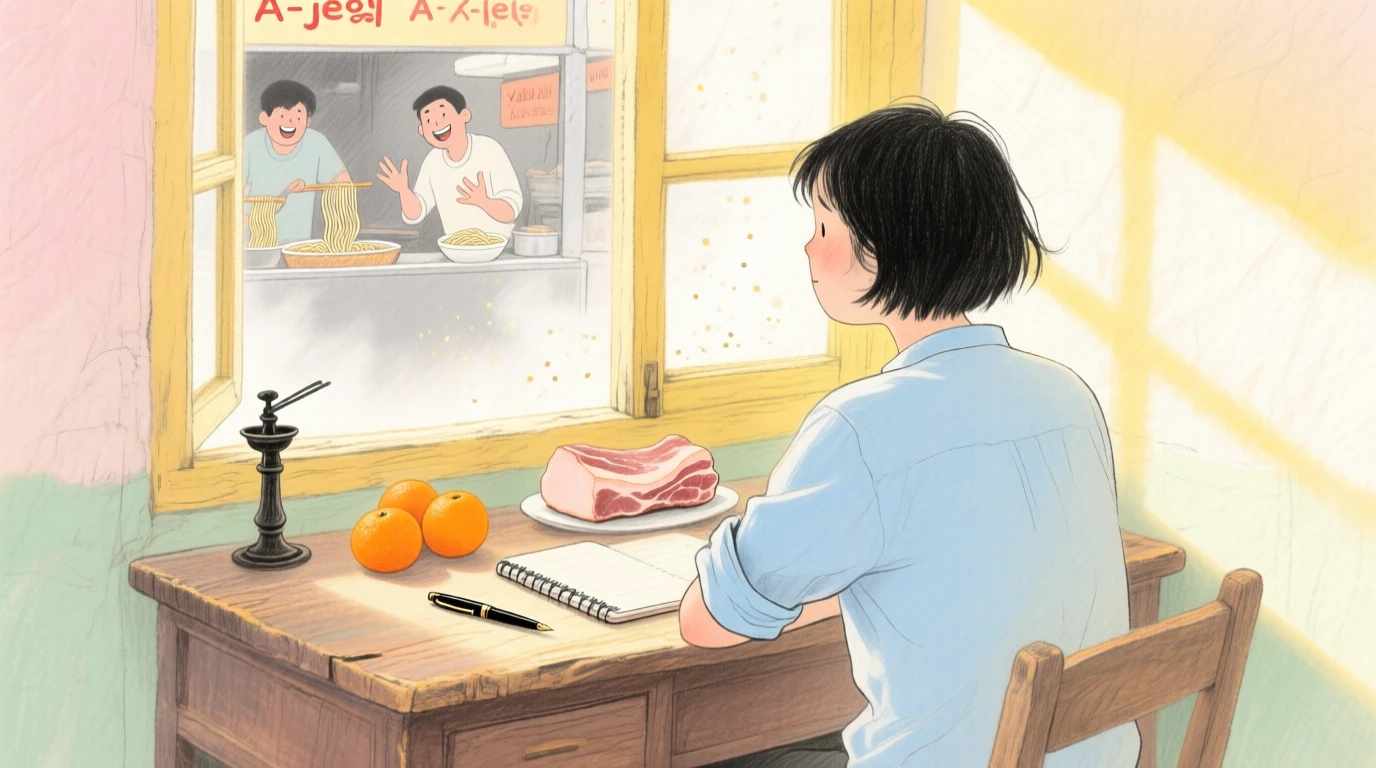
A-Jie looked out the window.
In the market, people came and went. He saw A-Zhen at her noodle stall, cooking noodles. Next to her sat a customer—the person’s back was to him, but he recognized that silhouette.
It was Xiao Lin.
She was sitting at A-Zhen’s noodle stall, eating noodles and chatting with A-Zhen.
A-Jie watched her, not moving.
She was laughing—not a polite laugh, but a real laugh, the kind that made her eyes squint. When she talked, her hands flew around. She rolled her eyes, she made self-deprecating jokes, she laughed out loud.
A-Jie had never seen her like that in the shop.
A wave of curiosity washed over him. He wanted to know what she was saying at the noodle stall.
A-Jie picked up his fountain pen, wanting to write something in his notebook. The nib hovered over the paper, but in the end, it didn’t touch.
He stared at the blank page, silent for a moment.
Then he closed the notebook and stood up.
He decided—tomorrow he would go sit at the noodle stall for a while. Maybe order a bowl of wonton soup.