Chapter 6
Pork Rong's Secret
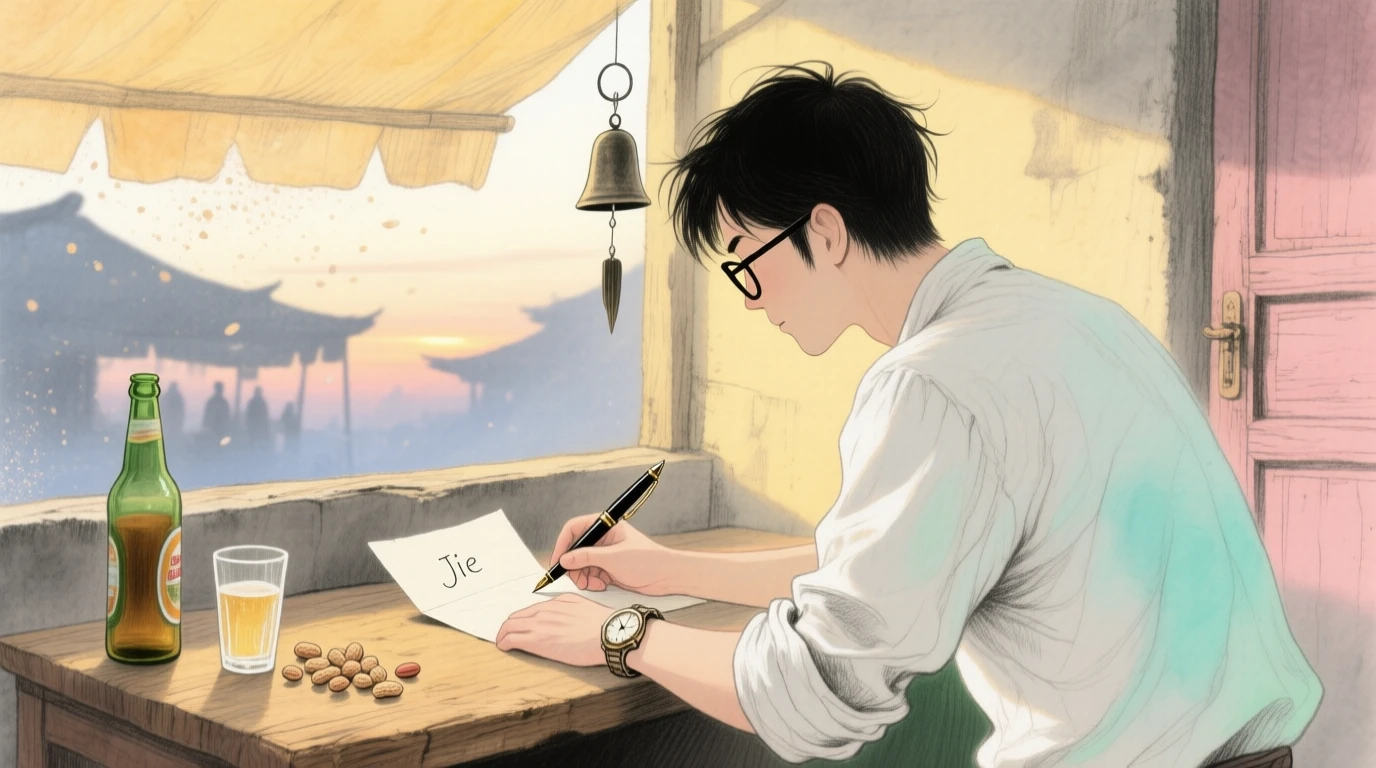
Pork Rong showed up at four in the afternoon.
A-Jie was organizing some letter paper when he heard the wind chime. He looked up. Pork Rong was carrying a plastic bag with two bottles of beer and a packet of peanuts.
“Hey, close up shop already,” Pork Rong said, setting the bag on the table. “Come have a drink.”
A-Jie looked at the two beers. “It’s four.”
“So? Can’t drink at four?”
“Don’t you need an afternoon nap?”
“Not today.” Pork Rong pulled out a chair and sat down. He took a bottle from the bag, twisted off the cap, and took a gulp.
A-Jie watched him, said nothing, then went to the cabinet, grabbed two glasses, and set them on the table.
Pork Rong poured him one.
“What’s up?” A-Jie sat down, lifting the glass.
“Nothing. Just felt like drinking.”
“Last time you said that was on your ex-wife’s birthday.”
Pork Rong paused, but didn’t deny it.
“What’s today?” A-Jie asked.
Pork Rong was quiet for a moment, then took another sip.
”…It’s her wedding day.”
A-Jie said nothing.
“I saw A-Zhen’s newspaper this morning. There was a wedding announcement.” Pork Rong’s voice was flat. “She married some guy who works at the post office. Looked real steady.”
He took another sip.
“I thought, not my business, right? Been divorced five years. But the more I thought about it, the more wrong it felt. The more pissed I got.”
“Pissed about what?”
“Pissed that I never fucking wrote that letter.”
A-Jie looked at him.
“What letter?”
Pork Rong set the glass down, spinning its rim with his finger.
“Before she left, I thought about writing her a letter. A long one. Apologize. Tell her I’d change. Beg her not to go.”
He paused.
“Sat down at my desk for three hours. Didn’t write a single word.”
“Why not?”
“‘Cause I didn’t know what to say.” Pork Rong said. “I knew I had to apologize. But how do you write an apology? Three words—‘I’m sorry’—that’s easy. But after that? How was I supposed to convince her I’d change? I didn’t even believe it myself.”
He gave a bitter smile.
“So I gave up. Figured, forget it. Writing wouldn’t change anything anyway. And she left.”
A-Jie stayed silent.
Pork Rong took another drink, then looked up at A-Jie.
“Hey, A-Jie.”
“Yeah?”
“You ever regret anything?”
“Regret what?”
“Regret never writing a single letter to yourself.”
A-Jie froze.
“I mean, you write letters for other people every day—breakup letters, apology letters, letters to the dead. You write their words perfectly, so they have no regrets. But what about your own words?”
Pork Rong’s voice wasn’t its usual rough bark. It was soft.
“You never write for yourself. Don’t you think someday you’ll regret that?”
A-Jie was quiet for a long time.
”…I don’t know.”
“See? Even your answer is ‘I don’t know.’” Pork Rong laughed. “When you write for other people, every word is certain. When it’s your turn, you don’t know anything.”
He stood up and patted A-Jie on the shoulder.
“I’m heading back. Gotta wake up early tomorrow.”
At the door, he turned back.
“A-Jie. Don’t wait until you’re sitting here drinking alone, like me, before you regret not writing that letter.”
The wind chime rang once.
Pork Rong’s figure disappeared into the market’s twilight.
A-Jie sat in his chair, looking at the empty glass and the half-finished bottle on the table.
He reached into the drawer and pulled out his father’s fountain pen.
He held it. The cool metal reminded him of his father’s hand.
He wanted to write something.
For himself.
But he didn’t know what.
He hesitated for a long time. Finally, he put the pen back in its holder.
He stood up to start packing.
Just then, the corner of his eye caught the note from his father, still in the drawer.
He picked it up and turned it over.
There was a line on the back.
Small, faint, as if written long ago.
“The pen is held for others, but the heart is your own.”
A-Jie stared at the line.
The wind chime hung quietly on the door, silent.
The sounds of the market drifted in from outside—the clatter of spatulas, chatter, the occasional motorcycle.
He picked up the fountain pen again.
This time, he didn’t put it down.