Chapter 7
The Final Draft
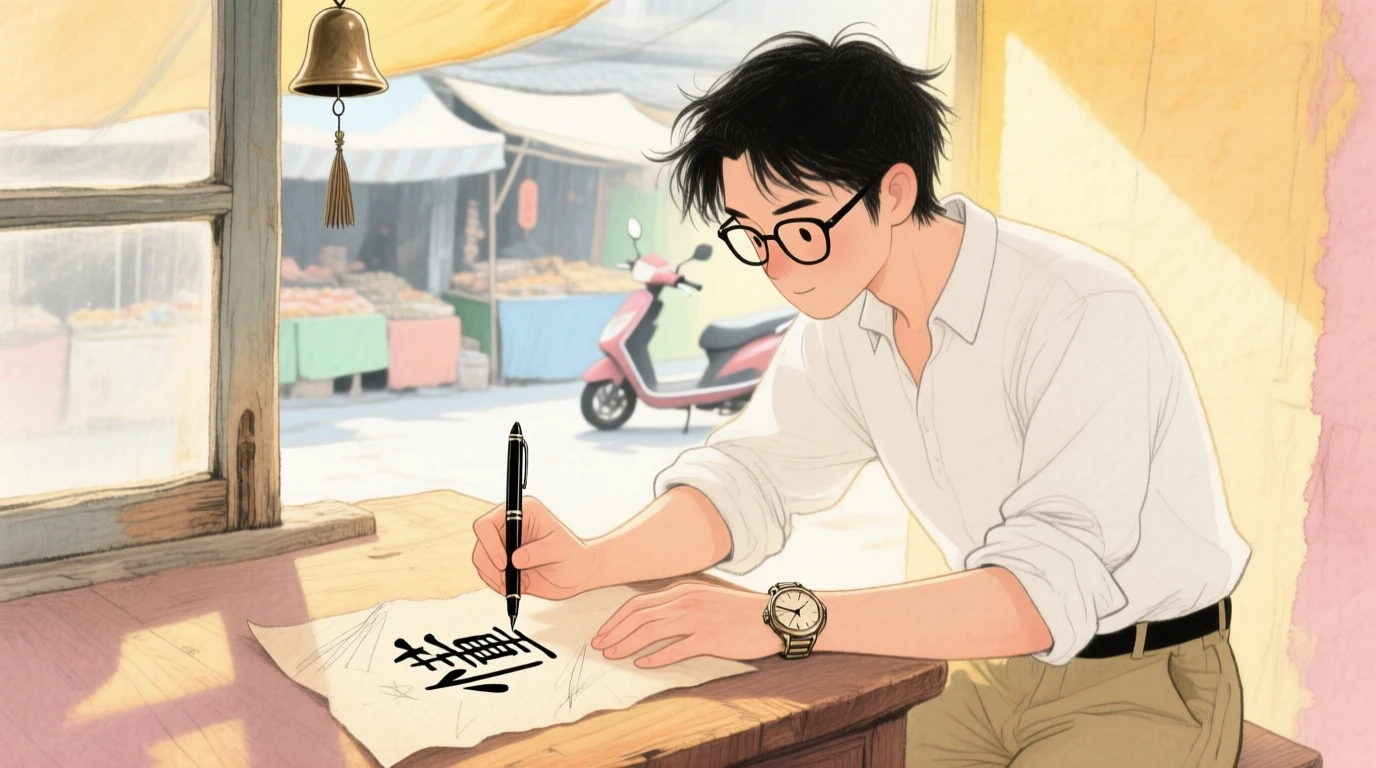
The third time Xiao Lin came was Thursday at three in the afternoon.
The wind chime rang once. She walked in, the letter not in her hand.
“I’ve made up my mind,” she said.
A-Jie looked up from the stack of letter paper. “And?”
She sat down across from him, without hesitation—more decisive than the last two times.
“I’ve decided to go abroad.”
A-Jie watched her.
“When did you decide?”
“Yesterday,” Xiao Lin said. “I sat in my room all night and thought everything through. When I woke up, I called the agency and told them I was going.”
Her voice was calm as she said it.
A-Jie nodded. He didn’t say congratulations—she didn’t seem to need it.
“So—” She paused. “I have one more request.”
“Name it.”
“Can I read the letter out loud to you? In front of you?”
A-Jie looked at her.
“Why?”
“I don’t know,” Xiao Lin said. “It’s just—you wrote this letter for me. I want to read it properly, from start to finish, while you’re here. I want you to hear what it sounds like when I say it.”
A-Jie didn’t refuse.
He pulled the letter from the drawer and slid it across the table.
Xiao Lin took it. She looked down.
The paper bore A-Jie’s handwriting—neat, clean, in the tone she’d asked for: direct, no fluff, no embellishment.
She took a deep breath and began to read.
“Lin Xinyi, you idiot.”
Her voice was a little tight on the first line.
A-Jie said nothing, just watched her.
“You quit your job three months ago. You have enough savings. But you’re still hesitating.”
She paused.
“What are you afraid of? Not enough money? Not finding a job when you come back? Afraid you’ll discover you’re not as brave as you thought?”
Her voice steadied.
“You already know the answers. The money’s enough. You’ll find work. Bravery—that’s something you build as you go.”
She paused again.
A-Jie noticed she lingered on the line: “Bravery—that’s something you build as you go.”
“So what are you really afraid of?”
She kept reading, but her voice grew quieter.
“The real fear is—if you actually go and find out you don’t like it. Then what?”
She looked at the words he’d written for her.
But she didn’t continue.
She lifted her head and met his eyes.
“I want to change this part.”
A-Jie raised an eyebrow. “Change it?”
“Yeah,” Xiao Lin said. “I want it to say—‘If you actually go and find out you don’t like it, then just come back.’”
She blinked.
“Right,” she said. “That’s it.”
She kept reading, but now she started changing every line as she went.
A-Jie had written: “You’re no longer at an age where you need to answer to others.”
She read it as: “You’re no longer the kind of person who needs to answer to anyone. Not your parents. Not your friends. Not even me.”
A-Jie had written: “Go.”
She read it as: “Go. Worst case, you end up back here selling noodles.”
She laughed after she said it.
“Selling noodles isn’t so bad. A-Zhen’s noodle stand does good business. I bet she’d let me work for her.”
A-Jie watched her.
She kept reading, kept changing, growing smoother and more comfortable with each edit, until the words sounded entirely like her own.
When she reached the last line, she stopped.
A-Jie had written: “This letter is finished. It’s time for you to go.”
She looked at that sentence for a long time.
“I’m not changing this one,” she said.
Then she read the last line aloud.
“This letter is finished. It’s time for you to go.”
She set the paper down and looked at A-Jie.
“I’m done.”
A-Jie didn’t speak.
“You know what?” Xiao Lin said. “I thought I’d cry when I read this.”
“And?”
“I didn’t.” She smiled. “I feel solid, actually.”
She folded the letter and placed it on the table.
“I’m still not taking it with me.”
A-Jie blinked. “You’re not?”
“No,” she said. “I don’t need this letter anymore.”
“Why?”
“Because I already know how to talk to myself now.”
She stood up.
“Thank you, A-Jie.”
She turned and walked to the door.
The wind chime rang once.
She looked back.
“Hey. Your letter was really good. But you know what?”
“What?”
“That letter you wrote for me? It was mine all along. You just put the words down on paper for me.”
She smiled.
“So really—you’ve already written a letter for yourself. You just didn’t know it.”
She pushed open the door and stepped into the market’s afternoon sunlight.
A-Jie sat in his chair, staring at the letter on the table.
Xiao Lin hadn’t taken it.
The paper still bore the marks of her edits—lines she’d scored with her fingernail, words circled in pencil, new phrases written in the margins.
Those words had made the letter more her own.
A-Jie picked up the paper and looked at it for a long time.
He remembered Pork Rong’s words: “Will you regret not writing a single letter to yourself?”
He remembered the line on the back of his father’s note: “The pen is held for others, but the heart is your own.”
He remembered what Xiao Lin had just said: “That letter you wrote for me? It was mine all along.”
A-Jie was silent for a long time.
Then he picked up his father’s fountain pen.
He looked at the blank space on the letter.
There was still one empty spot.
Without hesitation, he wrote a single word there.
The camera held on the paper.
It was the word “understand.”
The strokes were light, as if uncertain—yet firm.
From outside the window came the sounds of the market: Pork Rong haggling, A-Zhen’s spatula clanging, a scooter passing in the distance.
The wind chime at the letter-writing shop hung quietly.
There was no wind.
But the word had already been written.