Chapter 8
Write for Yourself Once
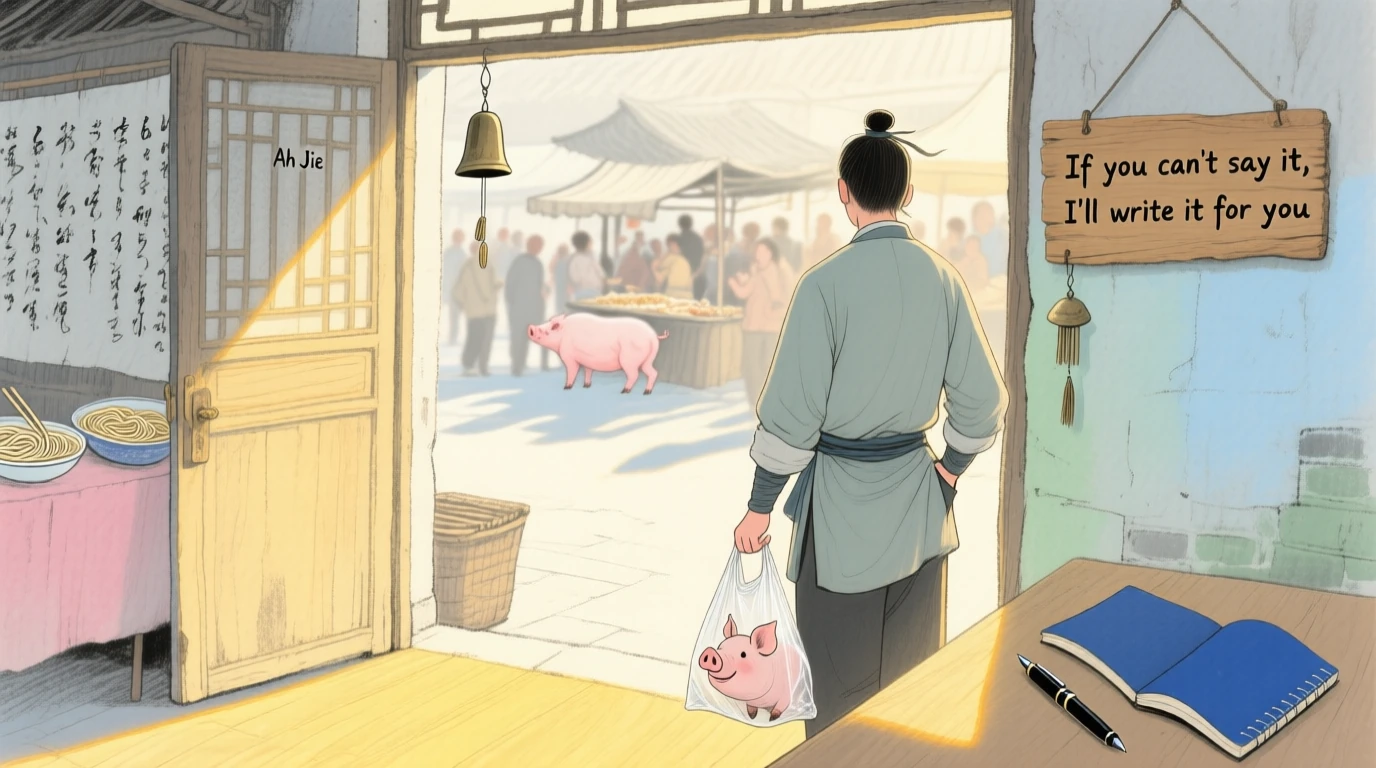
The wind chime didn’t ring.
Because the door was open.
A-Jie sat at the table, his father’s notebook spread open in front of him. The deep blue cover had worn to a pale, dusty shade, the corners frayed—like it had been flipped through too many times. Sunlight slanted in through the doorway, carving a golden line across the desk.
He had been sitting like this for a long time.
The page the notebook lay open to held his father’s handwriting. Not that note—something written earlier, a market record in pencil, the strokes uneven:
March fifteenth. Pork Rong said he’d raise the price, but he didn’t in the end. A-Zhen’s dog barked again, got three complaints from the neighbors. In the afternoon a young man came in, wanted to write a letter to his girlfriend to apologize. When he finished he said thank you, his eyes red.
A-Jie stared at those lines and couldn’t help smiling.
He remembered what Pork Rong had said.
Pork Rong had said it a few days ago—or longer? A-Jie wasn’t sure. He only remembered that Pork Rong had come to the shop that afternoon, not complaining about the dog, not complaining about the market, just sitting in that chair, drinking beer from the convenience store, telling stories from back in the day, one after another.
“Before she left, I wanted to write her a letter,” Pork Rong had said. “Apologize, tell her not to go. But I sat at the table and couldn’t write a single word, so I gave up. You know what? What I regret isn’t that she left. It’s that I didn’t write even one word for her.”
He took a sip of beer.
“If I’d actually written it, even if it was crap, at least she’d know I tried.”
A-Jie remembered not saying anything then. He hadn’t known what to say.
Now he knew.
He picked up his father’s fountain pen.
The barrel was cool in his hand, a familiar weight. Every afternoon he wiped this pen clean, used it to write letters for other people, but he had never written a single sentence of his own with it—except for those three words.
I. Want. Understand.
Three single words, scattered across different pages of the notebook, like some kind of code waiting to be cracked.
A-Jie flipped to the last page of the notebook.
The note was still tucked there. He took it out and smoothed it flat on the table.
On the front was his father’s handwriting: One day, you’ll meet someone who needs you to write a letter for yourself.
He stared at it for a long time.
Before, he had always thought those words were about someone else—that he would meet a client, someone who needed his help to write a letter to themselves. Like Xiao Lin.
But now he understood.
The person who needed him to write a letter for himself had been him, all along.
He turned the note over.
The pen is held for others, but the heart is your own.
A-Jie took a deep breath.
Then he began to write.
The tip of the fountain pen touched the paper, making a faint scratching sound.
He didn’t hesitate.
“Dad:”
He wrote those two characters, then paused.
“Business at the letter-writing shop has been pretty good these past few years. Everyone at the market knows me. Pork Rong drops by now and then. A-Zhen’s noodle stall is still busy, and her dog still barks.”
“I’ve written a lot of letters for people.”
“Pork Rong’s apology letter to the neighbor. An old man’s letter to his late wife. A girl’s breakup letter to her cheating boyfriend. A high school student’s apology to his teacher. And a girl’s letter to herself.”
“I tried to make each one sound like it came from them.”
“You taught me that the most important thing about writing for someone else isn’t whether it’s good, but whether it sounds like them. So the person reading it knows who wrote it, even if someone else put the words down.”
“I’ve always remembered.”
A-Jie stopped writing.
He looked at the characters on the page—neat and orderly, the way he wrote when he was writing for others. But these characters were his own.
He kept writing.
“That girl, Xiao Lin, came to me to write a letter to herself.”
“I wrote it for her. After she read it, she said she didn’t actually need the letter, because she’d already learned how to talk to herself.”
“She left the letter at the shop.”
“Later, in the blank space on that letter, I wrote one character.”
“‘Understand.’”
“When I finished writing that character, I suddenly felt like something had loosened inside me.”
“Like you used to tell me—when you write a letter, you have to lend your heart to someone else. But I never lent my heart to myself.”
A-Jie put down the pen and rubbed his eyes.
He wasn’t crying.
Just a little sting.
He continued.
“I finally understand that note you left.”
“You said one day I’d meet someone who needs me to write a letter for myself.”
“That person is me.”
“You said the pen is held for others, but the heart is your own.”
“It doesn’t mean I can’t write for myself. It means I had to learn to write for others first, before I could write for myself.”
“Because only after you’ve written letters for other people do you know how to say what’s in your own heart.”
“You didn’t tell me all this back then because you knew I’d figure it out on my own someday.”
A-Jie smiled as he wrote.
He remembered those last days with his father.
His father lay in bed, thin as a skeleton, but his eyes were still bright. He held A-Jie’s hand and said, “This pen—it’s held for others.”
Back then, A-Jie thought his father was telling him not to write for himself.
Now he knew.
What his father meant was: You’ve already learned to hold the pen for others. Now you need to learn to hold it for yourself.
A-Jie kept writing.
“I’ve spent the last few years wondering why you didn’t tell me what was on the back of the note.”
“Then I figured it out.”
“Because if you told me, I wouldn’t have realized it on my own.”
“You wanted me to discover it myself.”
“Like when you helped people write letters—you didn’t give them the answer outright. You guided them until they said it themselves.”
“That’s how you treated me, too.”
A-Jie paused.
From outside the window came the sounds of the market—Pork Rong shouting about something, the words unclear but the voice loud. A-Zhen’s spatula clanged. A customer said, “Boss lady, don’t cook the noodles too soft.”
Everything as usual.
A-Jie lowered his head and wrote the last few lines.
“Dad, I understand now.”
“I understand why you didn’t let me write for myself from the start.”
“I understand why you made me keep writing for others.”
“I understand why you said the pen is held for others.”
“And I understand why you wrote that line on the back of the note.”
“Everything you didn’t say—I understand now.”
“Thank you.”
He signed his name.
Not “A-Jie,” not “the letter-writing shop owner.” His full name.
He put the fountain pen down.
The letter was finished.
A-Jie looked at the letter, at his own handwriting, at the sentences that belonged to him.
He didn’t cry.
But he felt something in his chest finally settle.
He tore the letter out of the notebook and folded it.
Then he opened the drawer and took out an old leather suitcase.
It had been his father’s.
He opened the suitcase. There wasn’t much inside—a few old photos, a yellowed market map, an old leather belt.
He placed the letter inside.
Then he closed the suitcase.
He didn’t mail it.
He didn’t need to.
Because this letter was never meant to be sent to anyone.
It just needed to be written.
A-Jie put the suitcase back in the drawer and closed it.
He stood up and walked to the doorway.
The sunlight was just right.
Market afternoon—noisy and chaotic. Pork Rong was chopping meat at his stall. A-Zhen’s noodle stand was full. The owner of the grocery store was dozing by the entrance.
Everything as usual.
A-Jie stood at the door, watching it all.
“A-Jie!”
He turned around.
Pork Rong walked over from his stall, holding a plastic bag.
“Are you free this afternoon?”
“What’s up?”
“A-Zhen’s dog is barking again!” Pork Rong said. “She yelled at me this morning, said I chop too loud and it disturbs her dog. She said her dog was napping and I woke it up, so now it’s been barking all day. I told her, your dog only barks in the afternoon, I’ve been chopping meat since four in the morning—who’s disturbing who?”
A-Jie laughed.
“So you want me to write her a letter?”
“No, no letter—just talk to her directly,” Pork Rong said. “I’m asking if you want to go grab a drink. My treat.”
A-Jie looked at him.
Pork Rong’s face was a little embarrassed, like he wasn’t used to saying things like that.
“What are we celebrating?” A-Jie asked.
“Celebrating the fact that you finally fucking wrote a letter to yourself.”
A-Jie froze.
“How did you know?”
“I knew your father for decades. I’ve seen what he looked like after finishing a letter—and right now, your face is exactly the same.” Pork Rong grinned. “So, you in?”
A-Jie didn’t speak.
“Yeah.”
Pork Rong shoved the bag into his hands. “Pig ears. Snacks for the beer. I’ll close up shop first. See you at six, same place as always.”
He turned and strode back to his stall.
A-Jie stood at the door, looking at the bag of pig ears, and smiled.
He turned and walked back into the shop.
The fountain pen was still on the table, its cap off.
He picked it up, capped it, and put it back in the pen holder.
Then he looked at the notebook on the table.
The deep blue notebook, open to the last page—the page he had written his letter on, now torn out, leaving only a faint fuzzy edge.
He reached out and gently touched that edge.
The letter wasn’t there anymore, but the trace of writing remained.
A-Jie closed the notebook and put it back in the drawer.
The wind chime rang once.
Someone walked in.
A young woman, maybe twenty-five or twenty-six, wearing a suit, holding a manila envelope.
“Excuse me, can I get a letter written here?”
A-Jie looked at her.
“Yes.”
“I want to write a letter to my dad,” she said. “But I don’t know how to start—you know that feeling? When you have so much to say, but the moment you open your mouth, you just end up fighting.”
A-Jie nodded.
“That’s okay. We’ll take it slow.”
He pointed to the chair across from him.
“Sit down first. Tell me what you want to say.”
The woman sat down and placed the manila envelope on the table.
“I had a fight with my dad. We haven’t spoken in three months.”
A-Jie listened.
Sunlight poured through the doorway, falling across the desk.
The wind chime at the letter-writing shop hung quietly.
Everything as usual.
A-Jie picked up a pen.
Not his father’s fountain pen—an ordinary ballpoint.
He began to take notes.
“You said—what was the fight about?”
“Because I want to quit my job and study what I actually like.”
“He objected?”
“Yeah. He said I’m wasting my time.”
A-Jie nodded.
“Okay. Let’s start from there.”
He wrote down the first word.
From outside the window came the sounds of the market—Pork Rong shouting, A-Zhen’s spatula clanging, a scooter passing in the distance.
The sign of the letter-writing shop hung quietly at the entrance.
“Words you can’t say—I’ll write them for you.”
Sunlight fell on the sign.
Warm and calm.