Chapter 1
The Route
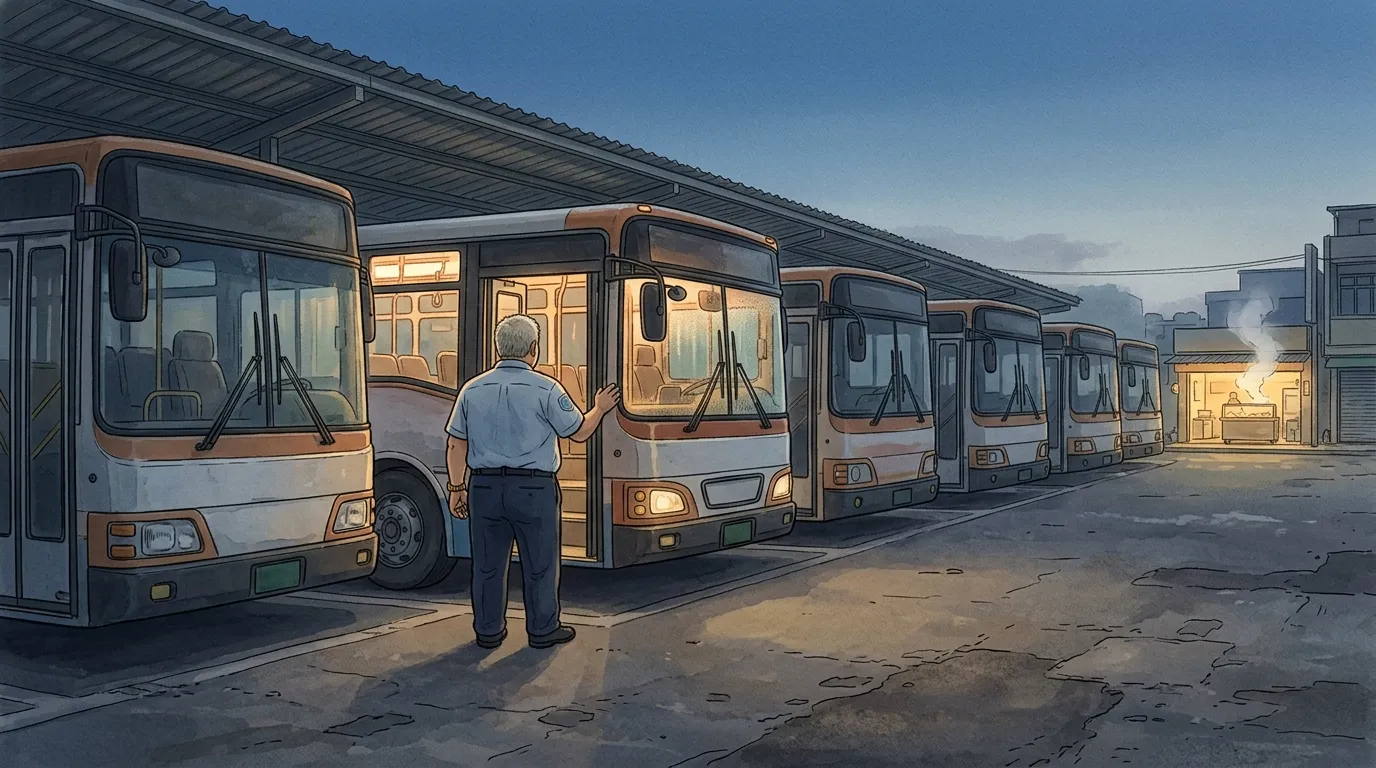
The alarm went off at four-thirty. Chen Zaifa was already awake.
Not because he slept badly. His body was more reliable than the alarm. Twenty-three years of rising at the same hour, and the internal clock needed no outside help. The alarm was just confirmation — that today was the same as yesterday, the same as the day before, the same as some Wednesday the previous April.
He switched it off and rolled out of bed. His wife shifted, didn’t wake. He left the bathroom light off and brushed his teeth in the dark. How much toothpaste to squeeze, where the towel hung, how far to turn the faucet — all of it muscle memory.
On his way out he stopped in the kitchen. The lunch box sat on the second shelf of the refrigerator, already wrapped in cling film. His wife had mentioned it the night before: braised pork and cabbage. He tucked it into the canvas tote, picked up the keys from the entrance, and pulled down the metal shutter. The sound echoed down the lane. He tried to be quiet. It scraped anyway.
Fifteen minutes on the scooter to the depot. The streets of Tainan at that hour were emptied past belief — traffic lights blinking amber, the shutters of the breakfast stalls still down. Only the soy milk shop was lit, the one across the way, open since four-thirty. You could hear the oil crackling from a full block away.
The depot was behind the train station. Six or seven bus bays under a corrugated iron awning, the asphalt cracked and patched and cracked again. The shift board on the whiteboard was written in marker. His name was on the second line: Zaifa 05:30 Anping Line. Three plastic chairs were stacked in a corner. Someone’s water bottle from the day before sat uncollected on the folding table.
His bus was in Bay Three. As he walked toward it, the smell reached him: diesel mixed with the metallic cold of corrugated iron that had baked in yesterday’s sun and then cooled overnight. He circled the bus — right side, rear, left side — crouched to check the front tires, then the rear, reading pressure by eye. Twenty-odd years behind the wheel and he knew by looking. He stood up and patted the body three times. Not a ritual. Just the way his hands worked.
He climbed in. The driver’s seat was dented where he sat — his own shape pressed into the foam. The steering wheel was black plastic, the grip worn bright. On his left, the door controls: two buttons, red for close and green for open. On his right, the handbrake. He hung his towel over the seatback, wedged his water bottle into the side compartment, set the lunch box by his feet.
He turned the key. The engine coughed twice, the whole frame trembling, like a large old animal called out of sleep. The steering wheel began to vibrate. The frequency traveled from his palms up through his arms into his shoulders. He released the handbrake, clicked on the right turn signal. Clack. Clack. Clack.
Five-thirty. He pulled out on time.
The sky shifted from deep blue to gray-blue. The streetlights were still on; his headlights fell across empty road. First stop, one person waiting under the shelter.
The pneumatic doors hissed open. Xu Jinfeng stepped up onto the platform, a patterned cloth tote on her left shoulder. She held her Senior Card to the reader — beep — a half-step lower in pitch than a regular card. She made her way to the third row on the right. She was already talking before she sat down.
“Morning. A bit cooler today, hm?”
Chen Zaifa caught her in the rearview mirror for a moment. Looked away. Closed the doors, hiss. Pulled out.
She didn’t wait for a response. The vegetable seller at the Shuixian Temple Market — that one, she couldn’t even remember his surname — had raised the price of cabbage by five dollars a catty last week, and she’d complained for three days straight, and then yesterday she went back and the price was down again. “I told him, raising prices like that won’t work, everyone will go elsewhere. That woman behind the counter had a face like bad weather. I don’t care. You have to say what needs saying.”
Chen Zaifa kept his eyes on the road ahead. Red light. Stop.
“Does your wife buy her vegetables? The pork stall near Shuixian Temple is good — fresher than the other places.”
“Mm.”
Green light. He pulled out. A slight correction to the left as the steering wheel, a small pothole, the bus jolting once. Xu Jinfeng’s voice continued without break, moving from cabbage to the yam vendor two stalls over, then to her grandson who had called from Taipei to say the weather was cold. Chen Zaifa retained none of it. But the back of his head registered that she was talking, the way it registered that the engine was running.
The bus passed Chihkan Tower. The air picked up a faint thread of incense. Someone was already exercising in the square out front, arms swinging wide. The road surface changed from asphalt to stone slab, and the vibration coming up through the tires grew finer, and the steering wheel followed with a slightly different tremor.
Shuixian Temple. The doors opened and the smell of fish and damp heat and market calls pushed in. Xu Jinfeng stood. Her patterned tote brushed the seatback.
“I’m getting off.”
He applied the brake. Opened the doors. Hiss. She stepped down. In the rearview mirror, her tote swung twice and disappeared into the crowd.
Closed the doors. Pulled out.
At the Shennong Street junction, no one boarded. The stop announcement read the station name into an empty bus. The next stop was empty too. With no one in the bus, the sound of the air conditioner’s compressor came through clearly, carrying the faint underlying smell of plastic seats and cleaning solution. Sunlight came through the left windows at a low angle, falling across his left forearm, flashing briefly on the watch face. A Casio digital, the band yellowed from white with age. The display read 05:58.
The first run’s return was emptier still. Heading back from Anping Fishing Harbor, only one old man remained, dozing in the last row. A salty wind pushed through a gap in an improperly closed window, mixed with the distant smell of frying oil. The surface of the canal was gray-blue, the light off the water not harsh.
He brought the bus back to the depot at six fifty-two. Next run at seven forty-five. During the break he stayed in the driver’s seat, adjusted the backrest slightly, drank some water. The smell of youtiao from the soy milk shop drifted in. He didn’t move.
Seven forty-five. Second run. Rush hour.
The bus started filling before the third stop. He could identify the school by the uniform color — dark blue for that one, khaki for the other — but he didn’t remember names, saw no reason to. Students pressed in through the front doors one after another, beep beep beep, like fish through a gate. Bags knocked into bags, someone stepped on someone, the people in the back pushed forward, the people at the front were still fumbling for their cards.
“Move back when you board, don’t crowd the front.”
His voice wasn’t loud. Everyone in the bus heard him. The cluster of students shifted, opening a path.
Through the wall of uniforms he noticed the usual one — the one who always stood by the rear door. Tall and thin, hair long enough to tuck behind the ears, a wired earpiece in the left ear, a large hard-shell folder clipped to the outside of his bag. Every day he boarded and went straight to stand by the rear door, one hand on the pole, the other arm hanging loose at his side, fingers moving against his thigh. Practicing from memory.
Confucius Temple stop. The bougainvillea had bloomed across the entire wall in solid hot pink — from the bus window it looked like a bolt of cloth. A few birds were startled from the trees by the engine. The doors opened and an elderly gentleman stepped on. Long-sleeved shirt buttoned to the collar, trousers with a pressed crease, white hair combed neat. He swiped his card, gave a brief nod in Chen Zaifa’s direction, said nothing, walked in and sat down. Same every day. Chen Zaifa didn’t turn around — a sweep of the rearview mirror was enough.
Hospital stop. The smell of disinfectant entered the moment the doors opened — faint but definite. Somewhere in the distance an ambulance wail stretched long and then shortened, not heading this way. Among the boarding passengers was the one who got on here every day: dress shirt, trousers, black briefcase, color not quite right — something grayish about the complexion — though his stride was steady and he swiped his card without fumbling. Fine-framed glasses. He found a window seat and set the briefcase on his lap.
Chen Zaifa didn’t look further. Closed the doors. Pulled out.
During rush hour the whole route was red lights. At the stops he heard the sounds inside the bus sorting themselves into layers — students chattering, someone playing a video with the volume up, the compressor humming, the low-frequency rumble of the idling engine coming up through the floor. The smells layered too: egg crepe, milk tea, the stale trapped smell of a plastic sandwich bag.
His hands were on the wheel, left at ten o’clock, right at two. Knuckles thick, nails cut short. The engine’s vibration had become part of his body, like a heartbeat no longer noticed.
After nine the crowd began to thin. Students got off at their various stops, and the bus emptied in sections. When the quiet returned, so did the faintly musty smell from the air conditioning filter.
Ten o’clock. Mid-shift break.
He brought the bus back and set the handbrake. Xiao Yang’s bus was in the next bay, Xiao Yang himself sitting under the corrugated iron awning on a folding chair, scrolling his phone. On the table sat a metal lunch box, the lid pried half open, chopsticks resting across it after a couple of bites.
Chen Zaifa took his lunch box and climbed down, sitting across from Xiao Yang. He peeled back the cling film. The braised pork was a deep dark color; the cabbage still had some bite.
“Hey, Brother Zaifa — you run into any of those types yesterday? The ones who try to pay with a thousand-dollar bill.”
Xiao Yang was chewing and talking at the same time, chopsticks gesturing.
Chen Zaifa shook his head and picked up a piece of braised pork.
“Ridiculous, I told him three times: no change given. He just kept staring at the coin slot like if he looked long enough, change would materialize. Then at the end he asked if he could owe it and pay tomorrow.” Xiao Yang’s voice went up a notch. “Probably thought the bus was a convenience store.”
“Convenience stores don’t take thousand-dollar bills either.” Chen Zaifa didn’t look up.
Xiao Yang stopped for half a second. Then laughed. “Really? No way — huh. Whatever.” He shoveled in two more mouthfuls of rice, chewing, and then sighed. “The pay really isn’t sustainable. My cousin works at the Southern Science Park, on the assembly line — eight days off a month, base salary still beats ours by seven thousand.”
Chen Zaifa didn’t pick up the thread.
“I’m seriously thinking about it. Running this bus until I’m sixty, knees gone, and then that pension. You’re not bothered?”
“Eat your lunch while it’s warm.” Chen Zaifa pointed with his chopsticks at Xiao Yang’s already-cold rice.
Xiao Yang looked at his lunch box, then at Chen Zaifa. “Are you genuinely not bothered, or just too lazy to be bothered?”
Chen Zaifa finished the last of his rice and put the lid back. “Done eating.”
He got up and went to use the toilet. The depot bathroom was around the back of the awning; the door didn’t close all the way and bounced open if you let go. He came back out and stood under the awning for a bit, scrolling through his phone — nothing worth looking at. Someone in the LINE group had sent a good-morning image. He didn’t open it. The sun was high by now, the shadow at the edge of the corrugated iron pulled short. He pocketed his phone and checked his watch. Ten fifty-eight.
Back to the bus. Third run.
Third run, off-peak. The route was inside his body — where to ease off the throttle, where the red lights ran long, which intersection required giving way to oncoming traffic on a left turn — all automatic. His hands and feet were working; his mind was empty. Two or three passengers in the bus, the air conditioner steady, a white noise. Past Haian Road, the buildings on either side changed from shopfronts with covered walkways to low houses, and the sky suddenly widened. The canal stretch was the best part of the run — the water at that hour caught the afternoon light and glinted, not harsh, like a layer of scattered brightness had been laid across it.
One-thirty, fourth run. Last of the day.
The afternoon bus was sparse. Out of the train station, a young mother with a stroller boarded along with an old man carrying a plastic bag; they both got off after two stops. The air inside grew empty enough that the musty smell from the cooling filter surfaced again. The stop announcement filled the hollow bus and seemed to speak to no one in particular: “Next stop, Shuixian Temple.”
He pressed the brake and opened the doors. The same stop where Xu Jinfeng had boarded in the morning. The shelter was empty now — just a metal bench baking in reflected light.
No one boarded. Closed the doors. Pulled out.
Turn signal, clack, clack, clack. Right onto Anping Road; the sun came straight through the windshield, lighting up every scratch in the glass. He flipped down the sun visor and squinted on. Crossing the canal bridge, wind pushed through the gap in the badly shut window, carrying salt. A few seconds of fried shrimp cracker smell from the Anping snack shop, and then it was past.
Return leg. The second half was emptier still, only one passenger left toward the end, sleeping in the priority seat. Hospital stop — he pressed the brake and opened the doors; no one on, no one off. A man on the bench beside the shelter was eating bread. Not the morning one. The afternoon light fell on the hospital’s glass wall and threw back a flat glare.
Confucius Temple stop, no one either. April’s Taiwan flame tree, new leaves a pale green, looked from the bus window like a fine gauze had been laid over the branches.
Three-thirty. Back at the depot.
He sat in the driver’s seat for a minute. He drank the rest of his water. He wiped his face and neck with the towel, packed the lunch box into the canvas tote. Then he walked from the first row to the last, checking the seats. A receipt was wedged in the gap by the window. He picked it up and crushed it. In the gap of the five-seat back row, something caught the light. He reached in and felt a coin. Ten dollars. He put it in his pocket — later it would go into the depot’s unclaimed-money jar, the one no one knew the origin of, the one everyone kept throwing things into.
He walked back to the front, checked the door controls twice, confirmed locked. Turned off the lights: headlights, taillights, interior. The engine was already off but he turned the key once more to be certain.
He climbed down.
The depot was mostly empty by then. Xiao Yang’s bus was gone — still on the route somewhere. On the folding table under the awning, the water bottle from noon sat uncollected. The shift board was the same as this morning.
He got on his scooter. The helmet was the open-face type; the chin strap buckle had worn a groove into the clasp from years of use.
Right turn out of the depot. He didn’t take the main road — he threaded through the back lanes to Beimen Road. Passing the front of the train station, a few people stood under the bus shelter. Not waiting for his line. A different route. He rode past all of them and didn’t recognize a single face.
Red light. Stopped at the intersection. A bus went by beside him — same model as his. He looked at it from the outside, through the window. The shapes of passengers inside were blurred; you couldn’t make out anyone’s face. The fluorescent tubes inside lit the bus like a fish tank moving down the road.
He thought: that’s where I sit all day. From the inside, every stop, every intersection, every tree comes in clear. But from the outside, you can’t see anything.
The light changed. He opened the throttle.
Wind pushed through the gaps in the helmet. The scooter’s vibration was different from the bus — smaller, more direct. His body spent a few seconds switching over: hands no longer gripping a steering wheel but a handlebar, feet no longer working a throttle and brake pedal but a platform and a rear brake lever, and the layer of heat baked into his left arm all day beginning to cool in the wind.
He turned into the residential lane. The neighborhood grocery’s light was still on; the owner sat at the door watching television. His house was mid-lane, a narrow three-story row house. His wife’s scooter was already parked in front of the metal shutter.
He pulled the shutter up. Two pairs of slippers in the entranceway — his wife’s on the left. The living room light was on, the television running, no one watching. The sound of water from the kitchen.
He set the lunch box on the counter and went to the bathroom to wash his hands. The face in the mirror — square jaw, sun spots across the forehead, hair gone gray-white — he looked at it for a moment and looked away.
From the kitchen his wife called: “Did you eat?”
“I ate.”
“Was there enough?”
“Enough.”
He went into the living room and sat down on the sofa. He didn’t notice what was on television. As he leaned back, both hands settled on his thighs, palms up. No steering wheel. No vibration. His palms seemed to still feel something trembling.
He glanced at his watch. Four-oh-six.
Four-thirty tomorrow.