Chapter 2
The Regulars
May’s humidity arrived slowly. At the end of April there was barely any need for the air conditioner; by mid-May the cabin was close enough to suffocate. Chen Zaifa’s morning routine gained one step after turning the key — press the AC. The compressor groaned to life with a low hum, and the cool air took half a minute to actually cool anything, the stuffy air inside stirred apart first, then settling lower.
Five-thirty. Pulled out. The sky was fully light, none of April’s gray-blue transition remaining. The streetlights were off. The shadows under the bus shelters stretched long.
Xu Jinfeng boarded at the first stop, Senior Card to the reader — beep — one tone lower. Her tote had changed — not last month’s floral one, this one had a checked pattern — but her path through the bus was the same: third row on the right, talking before she sat down.
“Hey, you know the neighbor of ours who grows tomatoes — he grows them right by the front door, everyone can see them — someone stole some.”
Chen Zaifa caught her in the rearview mirror for a moment. Looked away. Pulled out.
“Not many, just two or three. But you think about it — he grew them himself, tended them all that time, someone just takes them like that. How would you feel?”
“Mm.”
“Yesterday he stuck a piece of paper next to the tomatoes. Said ‘Conscience will hurt the thief.’ Big characters, written in red pen. I walked by and saw it — almost laughed out loud.”
Her voice moved around the cabin like something that needed no reply, self-propelled. Chen Zaifa applied the brake, waited at the red light. Outside the window, steam from the soy milk shop drifted white for a few seconds and dispersed.
“The tomatoes really aren’t that good though, I’ve had one — sour as anything.”
Closed the doors, pulled out. Shuixian Temple. The smell of fish hit him. Xu Jinfeng stood, her checked tote hooked off the seat back.
“I’m getting off.”
In the rearview mirror, her checked tote swung twice and disappeared into the morning market crowd.
The next day she boarded again. Her tote was bulging with something.
“I’m telling you, the note worked — no tomatoes stolen last night. But the note was gone.” She sat down, the tote on her lap. “So the thief came and looked, read the words, took the note, left the tomatoes. Would you say that counts as having a conscience or not?”
Chen Zaifa turned the wheel through a small bend, the bus swaying once. “Is that right.”
“I think it might be the person from the alley next door — don’t even know their surname — they walk past there early every morning, always have a look.”
She talked the whole way, from the tomatoes to the stray dogs at the mouth of the lane to her son who hadn’t called that month.
“Young people are like that, they don’t think of their old mothers when nothing’s wrong. That’s fine, no news is good news. Fine like that.”
Shuixian Temple. She got off. Rearview mirror. Checked tote. The crowd.
On the third day she boarded with a plastic bag in her hand.
“Tomatoes got stolen again. Two more. The note’s gone too. So the thief came, read it, thought about it, and went ahead anyway.” She held up the plastic bag. “These are from my neighbor — he said he grew too many and can’t eat them all, told me to take some. I brought two for you.”
Two tomatoes in the plastic bag, not large, the skin cracked. She set them down by the front railing. Chen Zaifa didn’t reach for them.
“Don’t be difficult about it — they’re not great, but they’re homegrown.”
“Mm.”
The tomatoes sat there the whole run. Shuixian Temple; she got off. The tomatoes stayed. When Chen Zaifa reached Anping and turned back, the tomatoes rocked through several more runs. At his mid-shift break he returned to the depot, and when he climbed down he picked up the tomatoes, put them in his canvas tote alongside the lunch box.
At home his wife asked: “What’s this?”
“A passenger gave them.”
His wife looked at them. “Small ones, that’s fine — good for soup.”
He didn’t say who had given them. His wife didn’t ask.
That afternoon, at the Hospital stop, a wheelchair appeared in the rearview mirror.
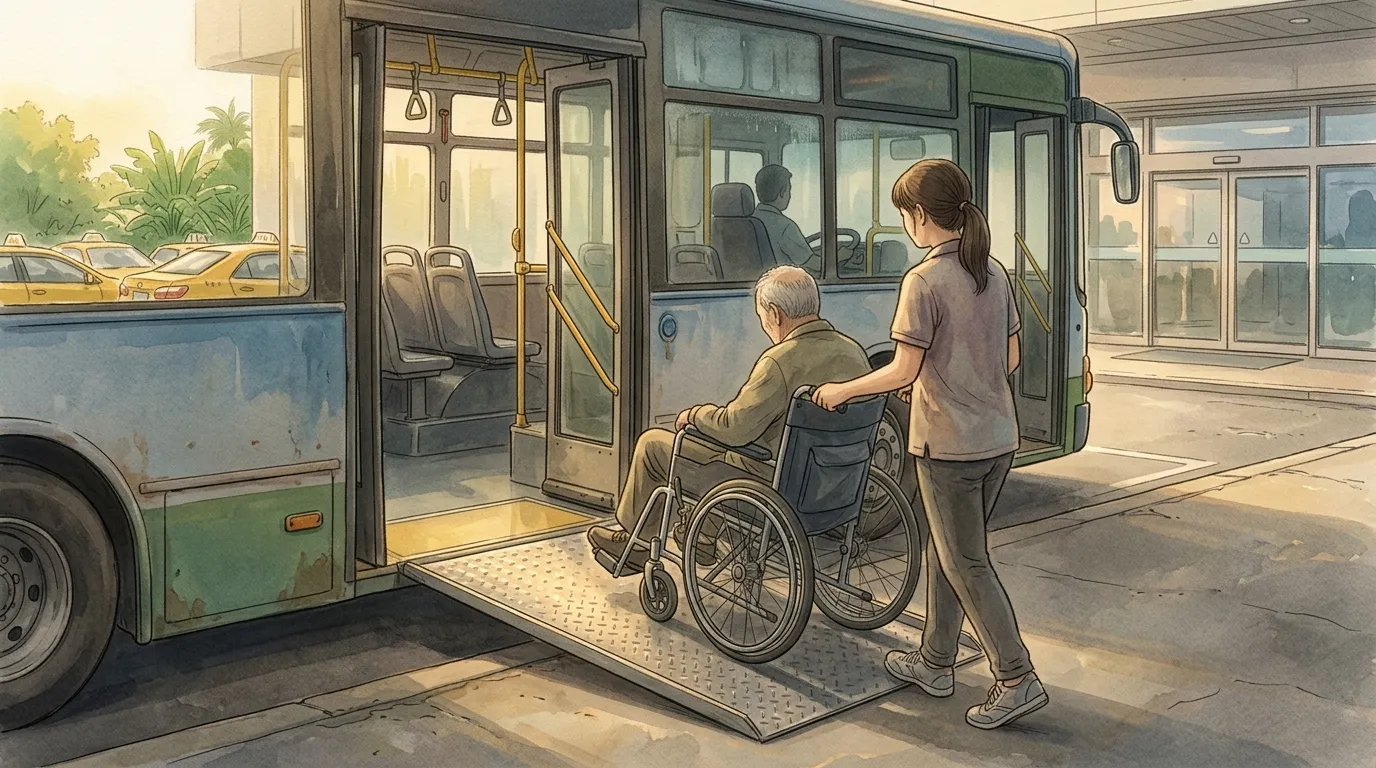
Behind the wheelchair stood a woman — low ponytail, polo shirt, darker complexion. One hand on the push handles, one hand out in front to stop it rolling forward on its own. In the chair sat an old man, body listing to the left, right hand trembling slightly at the knee.
Chen Zaifa pressed the ramp button on his left. The mechanical sound ran for a few seconds, and the steel plate under the front door slowly extended, unfolding section by section until it rested against the edge of the platform, a crisp sound of metal meeting concrete. The whole operation took about fifteen seconds. He looked sideways at the join between the ramp and the ground — no gap.
The woman pushing the chair looked down at the ramp’s width, then turned the wheelchair around and backed it up. Her movements were quiet, without hesitation. The wheels pressed onto the steel plate in two sounds — front wheels, rear wheels — evenly spaced. Once inside she pushed the chair to the wheelchair bay on the left and secured it with the straps.
The straps were yellow nylon, the buckles slightly rusted. As she crouched to fasten them, a faded woven bracelet showed at her wrist. Done, she stood and placed her hand on the old man’s shoulder.
The old man’s lips were moving, murmuring something. Not to anyone — to himself.
The woman standing beside the wheelchair didn’t sit down. There were open seats; she didn’t take one. Her hand stayed on the old man’s shoulder.
Chen Zaifa retracted the ramp. Doors closed, pulled out.
From the Hospital stop to Confucius Temple was about twelve minutes. The cabin gained a new sound — each time the bus hit a pothole or passed over a joint in the road surface, the wheelchair’s frame gave off a very faint metallic ring, light enough that in a quiet cabin you could hear it. Each time it rang, the standing woman’s hand pressed down once on the old man’s shoulder.
Chen Zaifa swept the rearview mirror: the old man’s lips still moving. The standing woman looking out the window.
They got off one stop before Anping Old Street. Chen Zaifa stopped, activated the ramp. The woman released the straps and backed the wheelchair down the slope. Once off the bus she turned it around to face forward.
“Thank you.”
Just that. Her tones were different from the locals’. The final sound settling soft, as if carrying an extra vowel.
Chen Zaifa gave a small nod. Retracted the ramp. Closed the doors. Pulled out.
After that she appeared regularly at the Hospital stop.
Same wheelchair, same old man, same procedure. Ramp down, board, secure, hand on the shoulder. Arrive, release, disembark. Thank you.
What she said to the old man as they rode, Chen Zaifa couldn’t make out clearly — occasional fragments drifted over. “Sit still, uncle.” “Almost there.” Mandarin, but with a different rhythm, like the same song sung in a different meter. She didn’t talk to the other passengers. The other passengers didn’t talk to her. When Xu Jinfeng was on board she kept talking as always; the woman behind the wheelchair stood quietly beside the chair. The passengers sorted themselves into clusters: the old man up front, students standing at the back, caregiver and wheelchair on the left, each cluster separated from the next by the full width of the cabin’s air.
Mr. Hong also boarded at the Hospital stop, usually just ahead of or just behind her. He turned right when he boarded; she pushed left. The two of them crossed at the front doors without any eye contact. The student with the score folder was still standing by the rear door, one earbud in, fingers moving on his thigh.
Same every day.
Xu Jinfeng’s knees were one of her long-running subjects.
“The doctor says to be careful, can’t walk too much. But how am I supposed to not walk? Walking to the market, walking home, walking up the stairs. That rehabilitation he mentioned — twice a week, and it does help — but then you walk out and by the time you reach the bus stop it’s aching again.”
She boarded with a steady walk, no need to grip the rail. You wouldn’t see anything wrong. But her knees had been in bad shape for years, at least in conversation.
“Nothing too serious, just aches sometimes. That’s old age — all the parts are secondhand.”
Chen Zaifa thought: her parts are newer than this bus. He didn’t say so.
Her topics cycled through every day: the market, her son, the neighbors, her knees, the weather. Sometimes the cycle went out of order — the son segment jumping to the neighbors, the neighbors looping back to the market — but it always landed on “Fine like that.”
Her stream of complaints was continuous, unparagraphed, without punctuation. One thing hadn’t finished before the next one started, transitions handled with a long drawn-out “hey——” held as a pivot.
“Hey—— it’s been absolutely scorching out there, I was sweating the moment I stepped outside, practically soaked through to the stop. You’ve got the AC on in here, right? Yes yes, I can feel it. But if the wind hits my knees they start aching, you know —— hey —— I dreamed last night my son came home, turned out it was just a dream, woke up and not a single call on the phone. Young people, that’s how they are, being an old mother——”
Chen Zaifa changed lanes.
”—— hey are you listening? Where was I —— oh right, my son. He’s in Taipei, the company keeps him terribly busy, I don’t dare call and bother him. But a mother’s feelings, you know, no voice to hear and you start thinking. Thinking gets you nowhere, fine like that.”
She alone could fill an entire cabin. The other passengers in her wake were as good as silenced.
One Tuesday morning at the end of May, Chen Zaifa pulled up at the first stop and opened the doors. Hiss.
No one under the shelter.
He looked at the platform. No checked tote on the bench, no short hair dyed brown-black. The light post beside the shelter fell on empty ground; a puddle left by last night’s rain sat on the pavement.
He didn’t think anything in particular. His foot on the accelerator paused for a moment.
Fifteen seconds later he pulled out. Closed the doors, hiss. The bus moved forward.
Chihkan Tower. Incense. Shuixian Temple. Fish. The cabin’s AC came through more clearly than usual, because one sound was missing. The third row on the right was empty. The plastic seat surface caught the light, nothing pressing down on it.
That first run of the day felt wrong in a way that had nothing to do with quiet. It wasn’t actually quiet — the engine ran the same, the AC blew the same, the stop announcement called the same — but a frequency was absent. Like a radio with one channel gone: the other channels could be as loud as they liked, and still you could hear where the empty space was.
Chen Zaifa finished that run without a second thought.
The next day. Five-thirty. First stop.
Hiss. Checked cloth tote. The checked one.
Xu Jinfeng stepped up, Senior Card — beep. She walked to the third row on the right and sat down.
Said nothing.
About thirty seconds passed.
“The fish at the market is fresher today — after a rain like last night’s everything’s fresher.”
Chen Zaifa pulled out. The vibration from the wheel traveled into his palms.
Her voice filled back in the frequency the cabin had been missing. He didn’t turn to look at her.
“Mm.”
She kept talking. He kept driving.
Zhang Bo boarded near the start of the route and got off at Confucius Temple. On the return trip he boarded again at Confucius Temple and rode back. Every day.
Chen Zaifa could have described Zhang Bo’s boarding routine with his eyes shut: swipe card, beep, a nod toward the driver’s seat, walk in and sit down. Long-sleeved shirt, top button fastened, trousers with a crease. White hair combed neat. Said nothing.
By the end of May, Tainan was already hitting thirty-two degrees. Chen Zaifa wore short sleeves and still felt the heat. Zhang Bo wore long sleeves every day, buttoned to the throat. He’d thought about it once: that button done up all day — wouldn’t it give you a rash on the neck? He thought it and let it go. Not his business.
When Zhang Bo got off at Confucius Temple, Chen Zaifa could see the scene around the stop in the rearview mirror. The goldenrain trees on Nanmen Road were deep green by late May, the whole street roofed over. The red walls of the Confucius Temple showed in patches through the leaves, where the sun hit them saturated enough to look wet. Zhang Bo walked from the stop toward the temple at a steady, unhurried pace. After about twenty steps the tree shadows swallowed him.
Every day the same. Get off, nod, walk forward, swallowed by the shadows.
One afternoon on the last run, only Zhang Bo was left on the bus. He sat in the priority seat by the window; the light from the direction of Anping pulled his shadow all the way across the aisle.
The cabin was quiet. Engine, AC, tires against the road surface, stop announcement. Nothing else.
As the bus approached Confucius Temple, Zhang Bo spoke.
“Walk the same road every day.”
Chen Zaifa looked up in the rearview mirror. Zhang Bo was looking out the window.
“Keep walking long enough and the road starts carrying you.”
The bus stopped. Confucius Temple. The pneumatic doors hissed open. Birdsong poured in from outside, the goldenrain tree leaves rustling in the wind.
Zhang Bo stood, walked to the front door. He gave Chen Zaifa a small nod, same as every day. Got off.
Chen Zaifa watched in the rearview mirror as Zhang Bo’s back moved toward the temple, the tree shadows cutting him into sections, until there was nothing left to see.
He closed the doors. Pulled out.
The words stayed in the cabin for a moment. Not heavy, no particular meaning, but they stayed. Like the last tremor in the wheel after the engine cuts out.
He kept driving. Next stop. Next run.
At his mid-shift break he returned the bus to the depot and sat under the corrugated iron awning to eat his lunch. He took out his phone and checked the weather forecast — a full row of sun icons, thirty-three, thirty-four, thirty-five, climbing. Summer had arrived.
He put the phone away and looked at the lot. Six or seven buses lined up under the awning, side by side, quiet. All engines off. Sunlight leaked through the gaps in the roofing and struck the bus tops, reflecting off the metal hard enough to make you look away.
He drank some water, put the lid back on the lunch box. Ten fifty-two.
Two more runs in the afternoon.