Chapter 3
Afternoon
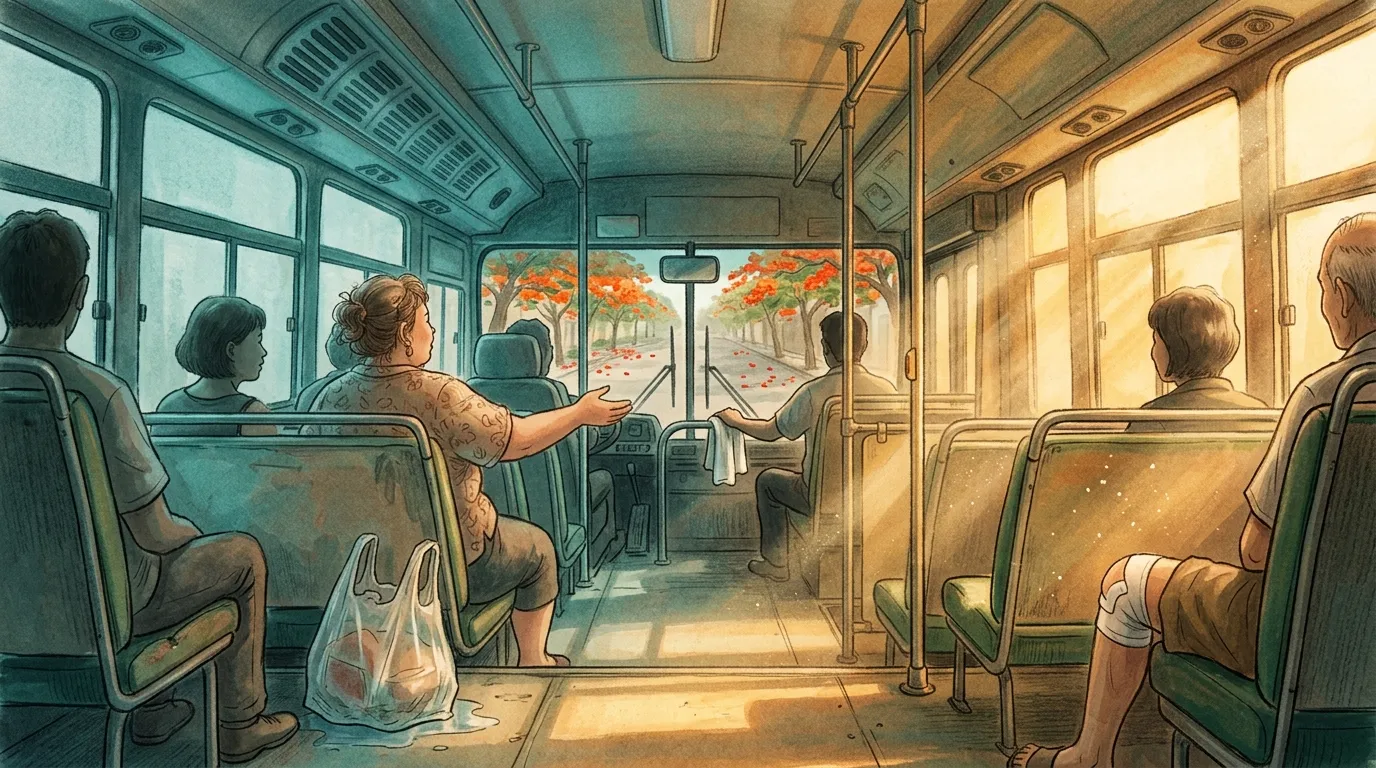
July’s sun came straight down like a hammer blow.
Not burning — hammering. The asphalt gave off a layer of shimmer, and the road in the distance seemed to ripple, as if viewed through water. The thermometer under the depot’s corrugated iron awning read thirty-seven degrees, but that thermometer hung in the shade. Out in the open, only the body knew.
When Chen Zaifa climbed in, the steering wheel was hot to the touch. He laid his towel over it. The seat was hot too — he lifted himself slightly before sitting. The air conditioner’s compressor came on with a hum, and the air that blew from the vents carried the mold of a filter that had sat all through May and June. That smell would take ten minutes to thin out, after which it would give way to the chemical sweetness of plastic seats softened by sun.
Eleven o’clock. The third run.
Second week of summer vacation. The crowd on the bus had changed. No more uniform tidal waves in the morning — in their place, tourists dragging suitcases, mothers with children, aunties and uncles appearing from nowhere. Tourists would hesitate at the front doors: does the EasyCard work here? How much cash to put in? The people behind them were already baking.
Six people boarded at the train station, a lot for off-peak. A young man in a baseball cap, two women who looked like tourists carrying drinks, a woman with a grocery basket. Last on was an old man — white undershirt, shorts, flip-flops — left hand gripping a red-and-white striped plastic bag. The bag was full. The bottom was wet and dripping.
He set it down on the floor. A small puddle spread across the boards.
The woman seated beside him shifted her feet to one side.
“Caught fresh today. Just dug up. Fat ones.” The old man was talking to the air beside him, but the volume was addressed to the entire bus.
Something in the bag was moving. Chen Zaifa caught it in the rearview mirror for a moment — couldn’t make out what it was, only the plastic bag trembling faintly, as if holding something that didn’t want to be held.
Three people boarded at Chihkan Tower. A thread of incense from the temple mouth drifted in as the doors opened and closed. With more people in the bus the air conditioning struggled, and the seats along the right windows were in direct sunlight — the foreheads of passengers over there all had a slick shine, as if rubbed with oil. Every spot along the left side near the vents was taken; the right still had seats, but no one wanted them.
The bus cabin was divided in half by light — the left side cool, the right side hot. The cool side crowded, the hot side empty.
Shuixian Temple. The doors opened and the smell of fish mixed with damp heat came pushing in.
Xu Jinfeng boarded at this stop.
She had switched to the third run after summer started. She’d explained the reason — the morning sun was too fierce, no shade at the bus stop, she’d gotten burned a few times and was done with it. “Back in June I waited at the shelter and before five minutes were up I was soaked through, clothes completely wet, sun beating down, my head started spinning.” She had told him for three days running. Chen Zaifa had listened for three days running.
Her patterned cloth tote was green with small scattered flowers today. She swiped her card, made her way to the third row on the right, already talking before she sat down.
“Hot enough out there today — do you have the air conditioning at full blast? I know, I know, but that wind only reaches down to your knees and then your knees start aching — oh, did you hear, the carambola juice vendor at Shuixian Temple, today it’s two bottles for fifty. Two for fifty! So I got two — better value, one for me and one for you.”
She placed a bottle of carambola juice by the front railing. Plastic bottle, beaded with condensation on the outside.
Chen Zaifa didn’t reach for it. The bus was moving. His hands were on the wheel.
“Don’t be shy about it. Two bottles is cheaper — one bottle would’ve been thirty. This is a math problem, not a favor.”
The carambola juice rocked against the railing with the motion of the bus. Droplets ran down the sides of the bottle.
Past the Shennong Street junction, a loud voice exploded from the back rows.
”— Hey! Oh my goodness! You take this bus too?”
Chen Zaifa didn’t need to turn around to gauge the volume — the bus interior had suddenly become a television turned up to maximum.
There was a stout woman on the bus who’d been there since the second run. Solidly built, thick arms, hair pinned up with a clip, a ballpoint pen tucked behind her ear. She’d boarded carrying a polystyrene box, its corners leaking a briny smell — not fish exactly, more salt and raw, like the underside of tidal rocks. She’d shoved the box down by her feet and taken her seat as if the chair belonged to her.
Now she’d run into someone she knew.
The two of them began talking across the aisle. In Taiwanese, at a volume completely indifferent to the other humans present in the bus.
“Ah-mei’s daughter got married, you know? Married someone from outside — from Taipei.”
“Oh? Taipei?”
“That Taipei man came to Anping to eat, said the food in Tainan was too sweet. Too sweet!” Her tone was that of someone recounting a crime. “The rice cake was sweet, the sticky rice was sweet, he even said the fish soup was sweet. That’s fresh sweet! That’s the taste of the sea!”
“He’s a man who doesn’t know how to eat.”
“I told Ah-mei: if your son-in-law says Tainan food is too sweet again, you tell him — what you eat in Taipei isn’t flavor. That’s seasoning.”
The passenger in the next row let a corner of a smile escape.
Chen Zaifa’s gaze stayed on the road ahead. On the right, Anping Road’s sunlight came straight at the windshield; even with the sun visor down it couldn’t be fully blocked. He squinted slightly. The towel over the steering wheel had already been dampened by his sweat in a patch.
The two women’s voices circled the back half of the bus like a broken public address system that couldn’t be switched off. From the son-in-law’s palate they moved on to how Anping oyster fritters were properly fried, which shops were no good, how the whole street’s standards had collapsed since the old master retired. The noise was loud enough that the old man in the priority seat up front turned around to look.
Chen Zaifa showed no reaction. Twenty-three years of every volume imaginable. Her voice layered over the engine’s diesel rumble and became part of the bus’s background noise.
The conflict started with a smell.
Medicinal ointment. Camphor, menthol, something else — hard to name, but strong. An elderly man in the priority seats, a white medicated patch on his knee below his shorts, the smell radiating outward from him in layers. The air conditioning spread it through the entire front half of the bus.
The young man sitting beside him — the baseball cap one, who had been on his phone since boarding — first wrinkled his nose, then turned his face away. Thirty seconds later he reached over and turned up his phone’s volume. No earphones — open speaker. Heavy bass punched out of the phone’s speaker and bounced between the seats.
The old man turned his head and looked at him.
The young man didn’t look back, eyes fixed on the phone.
The old man’s mouth moved slightly. Then he turned his body toward the window — his aisle-side knee pointed directly at the young man. The medicinal smell was now closer.
The young man turned the volume up another notch.
The air pressure in the bus changed. Not the air conditioning — the invisible thing between the two of them was expanding. Passengers in the front rows began exchanging glances. The woman with the grocery basket looked down at her own phone, pretending not to hear. The old man with the dripping bag was watching with apparent enjoyment, turning first to look this way then that, like a spectator at a match.
Finally the young man spoke: “Sir, can you maybe — that ointment—”
The old man cut in immediately: “Turn off your music first and then come talk.”
Both of them looked forward. At the driver.
Chen Zaifa caught them in the rearview mirror for a moment. Looked away.
Red light. The bus stopped.
He rested his hands on the wheel, thought for two seconds. Then he pressed the button for the interior PA. The speaker gave a beep.
“The air conditioning is already at full blast. If it’s still not enough I’ll open the windows and we’ll all be hot together.”
The bus went quiet for a second.
From somewhere in the back came a laugh — short, like something pinched but still leaking through. Then someone beside that person joined in. Then the old man with the dripping bag laughed aloud: “The driver’s got a point.”
The young man turned his phone down. The old man didn’t move, but the set of his mouth relaxed.
Green light. Forward.
The woman with the polystyrene box called out from the back: “Don’t worry about it! This hot, you can’t smell anything anyway.”
The whole bus laughed again.
Hospital stop.
The antiseptic smell rushed in faster than the air conditioning.
Chen Zaifa pressed the brakes, opened the doors. Hiss.
A wheelchair appeared on the platform, and behind it the same person as always. Low ponytail, polo shirt, sneakers. The movements were the same as every time — backing up the ramp, two metallic contacts against the floor, the wheelchair wheeled into the accessible area, bending to fasten the securing straps.
The old man in the wheelchair was alert today. His mouth was moving — he said something. The one pushing the wheelchair leaned down to listen, then replied quietly: “Okay. I’ll let you know when we get there.”
She stood beside the wheelchair, didn’t sit. Her hand stayed on the old man’s shoulder.
Mr. Hong boarded behind her.
Chen Zaifa caught him in the rearview mirror for a moment.
He was walking slowly.
It was the slow of something catching at the space between his feet and the ground. Dress shirt, trousers, fine-framed glasses, dressed as neatly as every day. He swiped his card smoothly enough. But those few steps from the card reader into the bus — they were slow.
He had always stood before. Today he found a seat and sat down.
When his left hand came out of his trouser pocket, Chen Zaifa saw the bruise on the back of his hand. Purple, the edges going yellow. On the back of his hand near the wrist, roughly two centimeters across — like something had pressed there.
Chen Zaifa’s gaze came back.
Closed the doors. Forward.
Cai the student was also on this run. During summer vacation he didn’t come every day — he showed up occasionally. Today he’d brought a classmate; the two of them were crammed into the back row, without the hard-shell score folder. The commotion from back there wasn’t small — laughter, shoving, kicking the seatback. The world of seventeen-year-olds fitted itself into that back five-seat bench and had nothing to do with anyone else.
The return trip was half-full. The afternoon sun had angled long, and outside the window along Anping Road the flame trees were almost done blooming; red petals on the road were run over by the bus and pressed flat.
The commotion in the back was still going. Cai the student and his classmate were pushing each other around, laughing loudly; one of them — unclear if he’d stood up or been shoved — lurched forward and knocked into the seatback ahead.
That seat was Mr. Hong’s.
The seatback jolted.
Mr. Hong’s body rocked with it. He turned around.
Cai the student’s classmate froze for a moment. Cai the student himself hadn’t registered bumping into anyone.
Mr. Hong looked at them. He smiled slightly.
“It’s fine.”
Not too loud, not too quiet — just enough for the two students to hear. The words finished and he turned back. The smile folded away very cleanly — an expression that had already been arranged, taken out and used for a moment and then put away.
Cai the student’s classmate patted Cai the student on the arm and said something quietly. The two of them were quiet for about a minute. Then the noise started up again, but a notch lower.
Chen Zaifa watched in the rearview mirror as Mr. Hong settled back into his original posture. His hands were resting on the briefcase on his knees, backs up — the bruise under the fluorescent light was a gray-purple, the edges indistinct, like something that had taken a knock and spread out from there.
He brought his gaze back.
The bus kept moving. The air conditioning’s noise covered the low resumed sound of the back row.
Hospital stop. Chen Zaifa pressed the brakes, opened the doors.
The wheelchair attendant undid the straps, backed the wheelchair out down the ramp. Off the bus, she turned to face the doors.
“Thank you.”
He retracted the ramp. The hum.
Mr. Hong got off behind her. He was slower standing up than he had been sitting down, bracing a hand on the seatback. The few steps to the front doors were steady — nothing to see — but looking from the rearview mirror, his shoulder line was a little lower than last month.
Chen Zaifa’s gaze rested on the rearview mirror for a beat longer. Under two seconds.
Then came back.
Closed the doors. Forward.
One-thirty in the afternoon. The fourth run.
The sun’s angle had shifted — from directly ahead to ahead and to the right — and the shaft of light through the windshield now cut across the aisle. Dust drifted in the shaft, blown by the air conditioning into a slow spiral.
There were more tourists than in the morning. The Anping line was a tourist route; there were always a few people on summer afternoons photographing everything with their phones. A young couple got off at the Anping Old Street stop; on their way out they asked him: “Excuse me, how do you get to Linmo Niang Park?” He pointed in a direction with his hand. “Ahead.” Two words. Enough.
Xiao Rou boarded at the canal stop.
She hadn’t come on her own — her grandmother was holding her hand, the two of them stepping up onto the boarding platform one after the other. Last time he’d seen this little girl, her grandmother had been carrying her on. Now she was walking herself. Her two braids were crooked. A round charm dangled swinging from her school bag.
“Grandma — let’s sit there.” She pointed at a seat with her finger.
Her grandmother led her over to sit down. Xiao Rou’s feet hung over the edge of the seat, kicking at air, three kicks and done.
Chen Zaifa didn’t look longer. Closed the doors, forward.
Zhang Bai boarded at the Confucius Temple stop, same as every day. A nod. No words. Sat down.
When the last run ended the sun had already gone down, but the temperature hadn’t dropped. The heat in the air was sealed in by something, unable to disperse.
Chen Zaifa pulled the bus back into the depot, set the handbrake. The thermometer under the corrugated iron awning still read thirty-four degrees. He sat in the driver’s seat and drank some water. Wiped his face and neck with the towel. The sweat had mostly stopped — it was the kind that lay trapped under the skin and couldn’t steam its way out.
He walked from the first row to the last. Checking the seats.
There was a drink cup wedged into the gap of the back five-seat row. He picked it up, crushed it, pushed it into the trash bag. The middle rows had nothing. A flyer was wedged in the window slot — he crumpled it. On the floor beside the priority seats near the front there was a small water stain — left by the old man with the dripping bag. He got the mop and wiped it once.
Walking up to the front passenger seat, he saw something on the seat.
A plastic bag, transparent. Oranges inside. Five or six of them, round, deep orange, a white bloom of natural sugar on the skin. He couldn’t say who had left them. Not Xu Jinfeng — he’d already drunk the carambola juice she’d left during the mid-shift break, and the bottle was still in his canvas tote. Not tourists — tourists don’t leave things like this.
He stood there and looked at them for two seconds.
Couldn’t work it out.
He took one, stood in the bus and peeled it. When his nail broke into the skin, a burst of citrus came up — sharp, it swept over every smell that had accumulated in the bus all day — diesel, sweat, medicated ointment, air conditioning mold, the seawater smell from the plastic bag, the salt brine from the polystyrene box — all of it pressed flat by this one smell.
He ate a segment. The juice was sweet, the kind of sweetness untouched by any seasoning; it arrived in his mouth and rested on the tongue for a moment before spreading.
Outside the depot’s corrugated iron awning, the sky shifted from orange-red to gray-purple. The streetlights came on. The heat was still rising from the asphalt surface, but now you couldn’t see it.
He finished the orange, wrapped the peel and put it in the trash bag. The bag of oranges he placed in his canvas tote, up against the lunch box.
Engine off. Lights off. Down from the bus.
The sound of the iron gate locking was clear in the quiet depot. He got on his scooter. It was already dark; wind pushed through the gaps in his helmet — still hot.