Chapter 4
Absence
The radio was playing a song he couldn’t name. He knew the melody — that kind of Taiwanese ballad from the eighties, saxophone first, a woman’s voice easing in, something about a harbor, something about waiting. No one remembered who had brought the radio to the depot; it sat on an iron shelf beside the folding table, its antenna snapped halfway off and taped back together, pulling in only two stations.
September now.
The air under the corrugated iron awning was different from July. The pressure that had pushed down on you all summer was gone; it wasn’t cool yet, just easier. When the five o’clock temperature moved across his skin, it no longer pulled out a sticky sweat. The diesel smell was still there, and the metal smell of the iron sheeting, but that scorched-rotten smell that the sun had baked into everything was gone.
Chen Zaifa walked the bus. Front tires, rear tires, pressure by eye. Three pats on the body. He climbed in.
Five-thirty. He pulled out on time.
First stop. The doors opened.
Xu Jinfeng stepped up, Senior Card beep. Her tote was blue with white flowers — he hadn’t seen this one before. September, she was back on the early shift. Not so brutal now; you could wait a few minutes under the shelter without going dizzy from the sun.
She made her way to the third row on the right and sat down.
“September already. Two-thirds of the year gone. Can you feel it? I think it goes faster and faster. A year used to feel so long. Now it just whooshes by.”
Chen Zaifa pulled out.
“I couldn’t sleep last night. Nothing in particular — just couldn’t sleep. I lay there listening to the sounds outside all night. Do you know what sounds a back lane has in the middle of the night? There are sounds — dogs barking, scooters going by, sometimes wind against a door. All small sounds. You can’t hear them in the daytime. At night they come out.”
Her pace was a little slower than usual. The kind of pace you fall into when you’re thinking out loud, nowhere to be.
“When you live alone, the nighttime sounds get louder. You don’t know — you’re not living alone. I didn’t know either. After the old man passed, the whole house was just me, and that’s when I found out. Oh, so this is how many sounds night has.”
Red light. The bus stopped.
“My son keeps saying I should move up to Taipei to live with him. I said no need. Moving to Taipei at my age, I’m not used to that weather. And besides, to say something blunt — I wouldn’t even know where the market is. How am I supposed to buy groceries?”
She laughed, briefly.
“He said just use Uber Eats. I said what are you doing, the market is right there, and you want me to use my phone and have someone deliver? The delivery fee costs more than the vegetables.”
Green light. He pulled out.
“He means well, I know. But he doesn’t understand — old people and young people need different things. He needs convenience. I need to go out and walk around. If I don’t leave the house in a day, that day feels like it didn’t happen.”
Shuixian Temple. The smell of fish pushed in through the doors.
She stood, her patterned tote going up onto her shoulder. At the front door she paused.
“Well, that’s that. Let’s hope today’s fish is a bit fresher.”
She stepped down. In the rearview mirror, the blue-and-white-flower tote swung twice and was absorbed into the morning market crowd.
What she’d said was a little different from her usual — usually it was vegetable prices, neighbors, tomatoes; today it had suddenly turned to sounds in the night. Chen Zaifa didn’t follow the thought. The road ahead required a right turn.
First week of school, and the uniform tide was back.
Beep beep beep beep beep — the card sounds ran together in a stream as students poured through the front door onto the bus. Bags knocking bags, sneakers stepping on sneakers, someone’s breakfast smell spilling straight from its plastic bag. The bus filled at once, standing passengers from front door to rear door, hands all over the poles.
The student with the score folder boarded at his usual stop.
Chen Zaifa recognized him by sound, not sight — not seeing him first, but hearing him. The other students’ footsteps were a lump, blurred together, indistinguishable. This one’s footsteps were different. He didn’t push through — he waited until the others had boarded, then stepped up, swiped his card cleanly, one beep, and went straight to stand by the rear door.
He’d grown.
Before the summer break, the top of his head had come about level with the crossbar of the rear-door pole. Now he was nearly even with it. His hair was still tucked behind his ears, the earphone cord still trailing from his left ear. But the hard-shell score folder was thicker than before. In the rearview mirror you could see the clip had been pried open to an angle, something stacked inside, the paper edges uneven.
He stood by the rear door, one hand on the pole, the other hanging loose. Fingers moving against his thigh. Same as always.
But there was no one talking to him anymore. Before the break he would sometimes joke around with classmates, laugh, kick the back of the seat in front. Now those classmates were gone — not really gone, just split to different classes, different routes, or senior-year morning sessions on a different schedule. Whatever it was, he stood at the rear door alone, earphones in, fingers moving, face turned to the window.
He was different from the other quiet people in the bus, though Chen Zaifa couldn’t have said how.
In early September, Mr. Hong was on the bus almost every day at Hospital stop.
When the bus approached Hospital stop, Chen Zaifa’s foot would touch the brake before it needed to. Just touch — the front edge of his sole finding the pedal, feeling the metal face, confirming the distance. Not a press. He did this at every stop; twenty-three years of reflex. But that touch at Hospital stop had changed lately.
He couldn’t say how. Maybe a little heavier. Maybe half a second earlier. But different, definitely.
The first few days, Mr. Hong’s pace boarding was about what it had been in July — slow, but steady. Dress shirt buttoned to the second button, trousers, fine-framed glasses. Swiped his card, walked in and sat down. He sat every time now, where before he had stood. Left hand on his knee, briefcase beside him.
After a week or two, he started to be absent.
Sometimes two days in a row the Hospital stop doors would open, the disinfectant smell would drift in, other people would board, but the man in the dress shirt wouldn’t be there. Chen Zaifa’s foot would rest on the brake an extra beat, then he’d pull out. It wasn’t like Xu Jinfeng’s absences — with Xu Jinfeng he still knew she was absent. With Mr. Hong he wasn’t even sure he’d been counting.
But the body knew. At Hospital stop, foot touches brake, doors open, what should be there isn’t — the body logged it. The head did not.
By the end of the month, there were only one or two appearances.
That day, Chen Zaifa caught him in the reflection off the windshield — a narrow angle in the lower right corner that happened to catch the front door, not the rearview mirror. He was standing at the bus shelter differently than before. Before, he always stood waiting; now he sat in the shelter seat and stood only when the bus came.
Standing up took him a moment.
He boarded. Swiped his card. Walked in and sat down. The whole sequence with no wasted movement, dressed neatly, no expression on his face. But his color — gray. Not the white of someone who doesn’t see sunlight. Gray from the inside, like concrete that has absorbed water, that shade after the rain.
Chen Zaifa closed the doors.
The one pushing the wheelchair had changed too.
She herself hadn’t changed — her rhythm had. Before, she appeared at Hospital stop every day, without fail. From September, sometimes she’d be gone two or three days in a row, then appear again. The wheelchair loading routine was the same — backing up the ramp, positioning in the wheelchair space, crouching to fasten the restraint straps. But the sound of the buckle was a little different.
It wasn’t that she buckled harder. The old woman had gotten lighter. When the strap fastened at the end, there was a gap between the strap and the body; nothing bracing against the buckle, metal meeting metal, the sound sharper.
One day as she was pushing the wheelchair up the ramp, the old woman’s blanket slipped. The thin blanket that had been covering her knees swayed once on the ramp and dropped to the floor. She had one hand on the wheelchair and couldn’t reach.
A young man sitting in the priority seat — a stranger, probably a tourist — bent down and picked up the blanket, held it out.
“Thank you.” She took it with a brief smile, tucked the blanket back over the old woman’s knees. Her hand patted the old woman’s shoulder once.
As Chen Zaifa retracted the ramp, he could hear her speaking to the old woman. Her voice was quieter than before; he caught only the last few words: ”…I’ll tell you when we get there.”
Same as last time. Every time: I’ll tell you when we get there.
Mid-shift break.
Under the corrugated iron awning, Chen Zaifa sat in a plastic chair and ate his lunch. Today: fried noodles with a braised egg and blanched greens. The noodles were a bit oily; a small grease stain had soaked into the bottom of the canvas tote.
Xiao Yang was across from him, his lunch box open — pork chop rice. He took two bites, then set down his chopsticks, picked up his phone, looked at it, set it down.
“Hey, Brother Zaifa.”
Chen Zaifa chewed a mouthful of noodles. Didn’t look up.
“I’m leaving next month.”
Chen Zaifa’s chopsticks stopped. Less than a second. Then he finished chewing, swallowed.
“Going where.”
“Driving freight. My cousin has an opening — fixed route from Southern Science Park to Kaohsiung Port. Better pay.” Xiao Yang turned his phone around; some kind of salary table on the screen. Chen Zaifa didn’t look.
“That works.”
Xiao Yang had probably expected more. He waited a few seconds, saw that Chen Zaifa had gone back to his noodles, and picked up the thread himself.
“It’s not just the money, honestly — okay, it’s mainly the money. But don’t you feel it? Running the same route long enough, same road, same time, same people every day — sometimes you start to think you’ve become part of the route.”
Chen Zaifa bit into the braised egg. The yolk was a little crumbly.
“I’ll take your silence as agreement.”
Chen Zaifa looked up at him. “Your cousin’s setup has labor insurance, right?”
“Of course, official. All proper.”
“Then it’s fine.”
Xiao Yang laughed. “You really only care about that one thing.”
Chen Zaifa put the other half of the braised egg in his mouth. He didn’t only care about that. He just didn’t think of anything else. Twenty-three years and the people around him had cycled through — every year or two, someone at the depot left, someone new arrived. Some retired, some couldn’t take the pay, some had bad knees. For every person who left he’d said that works or oh or nothing at all. He couldn’t remember if he’d ever said anything else.
Xiao Yang was back on the freight truck — what model, how many tons, whether he’d be handling the refrigeration unit himself, how long to clear unloading at Kaohsiung Port. His voice was light, the way you talk about something you just bought. Thirty years old talking about leaving, nothing heavy in his voice.
The radio on the iron shelf played on. It had changed to a man’s voice, slow.
Chen Zaifa finished his lunch, pressed the lid back on, gathered the cling film into a ball. He picked up his water bottle and drank. Xiao Yang was still talking, laughed partway through: “Apparently once they were hauling a full load of frozen chicken legs and the refrigeration unit broke down halfway, by the time they reached Kaohsiung Port the whole truck had a smell — unbelievable.”
Chen Zaifa stood up, packed the lunch box into the canvas tote.
“Ten fifty.”
“All right, all right.” Xiao Yang stood too, tapped his chopsticks twice on the lunch box.
Chen Zaifa walked back to the bus. Started the engine. The seat was room temperature — not like July, when you had to half-rise before sitting down. September’s bus didn’t need to wait for the air conditioning to push the heat down before it was livable.
He glanced at Xiao Yang’s bus in the next bay. Same model, two years newer, the blue stripe on the body a little brighter than his. Next month that bay would have someone else’s bus in it. Or it would sit empty.
Third run. He pulled out.
The afternoon route was quiet. Fewer tourists than in summer; after school started, the gap between peak and off-peak had widened. The morning uniform tide and the afternoon emptiness felt like two different worlds sharing one bus.
Mr. Zhang boarded at the Confucius Temple stop. Long-sleeved shirt, the top button fastened, a nod, no words, walked in and sat down. The Taiwan flame trees outside the Confucius Temple were still deep green, but a few branches had sprouted scattered yellow flowers — small ones, easy to miss.
Four or five people on the bus. The air conditioning not straining anymore; the airflow from the vents was steady and calm, no need to fight the temperature down. The bus was quiet enough that you could hear the plastic seats compressing on a turn — creak, creak — like old joints working loose.
Past the canal stretch. The water’s light was different from July — July’s water had been sharp-white, making you squint; September’s water was a faint yellow, the light settled lower, softer.
Anping old street. Drop-off. Turn around.
On the return leg, the student with the score folder had gotten on at some point. Maybe the turnaround stop, maybe the harbor — Chen Zaifa hadn’t noticed him board. It was two stops into the return before he caught him in the rearview mirror.
He was sitting in the front section.
Second row, window seat.
That had never happened before. Since the first day he’d boarded, he’d always stood by the rear door, one hand on the pole. Occasionally, when the bus was nearly empty, he’d take the last row. But never the front.
Chen Zaifa looked, then looked away.
The student sat there, score folder on his lap, not opened. Earphones in, face turned to the window. Fingers still. September sunlight came through the window and lit up half his face. His features were different from a year ago — the line of his cheekbones had come through, the curve of his jaw had narrowed. The round softness of a boy’s face was gone.
Chen Zaifa thought of the first time he’d boarded.
When was that? Last year? The year before? He couldn’t remember exactly. Only a memory of a very short student, his bag bigger than he was, the hard-shell score folder clipped to the outside, walking slightly tilted. His bag had caught in the doorway when he boarded; the people behind him had to wait. When he squeezed through, his face went red for a moment, and then he went straight to the rear door, found the pole, and stood.
He’d stood there for over a year. Every day.
Now he sat in the front, face to the window, fingers still. His body had simply settled toward the quiet.
Chen Zaifa’s gaze moved from the rearview mirror back to the road.
For the first time, he noticed that a passenger looked different from before — not one thing changed, but the whole person moved from one version to another. Like the Taiwan flame trees by the road: you passed them every day, you didn’t pay special attention, and then one day you suddenly saw that a few yellow flowers had appeared on the branches, and only then did you realize that time had passed.
He let the thought go. A scooter cut in from the side; he touched the brake.
Last run.
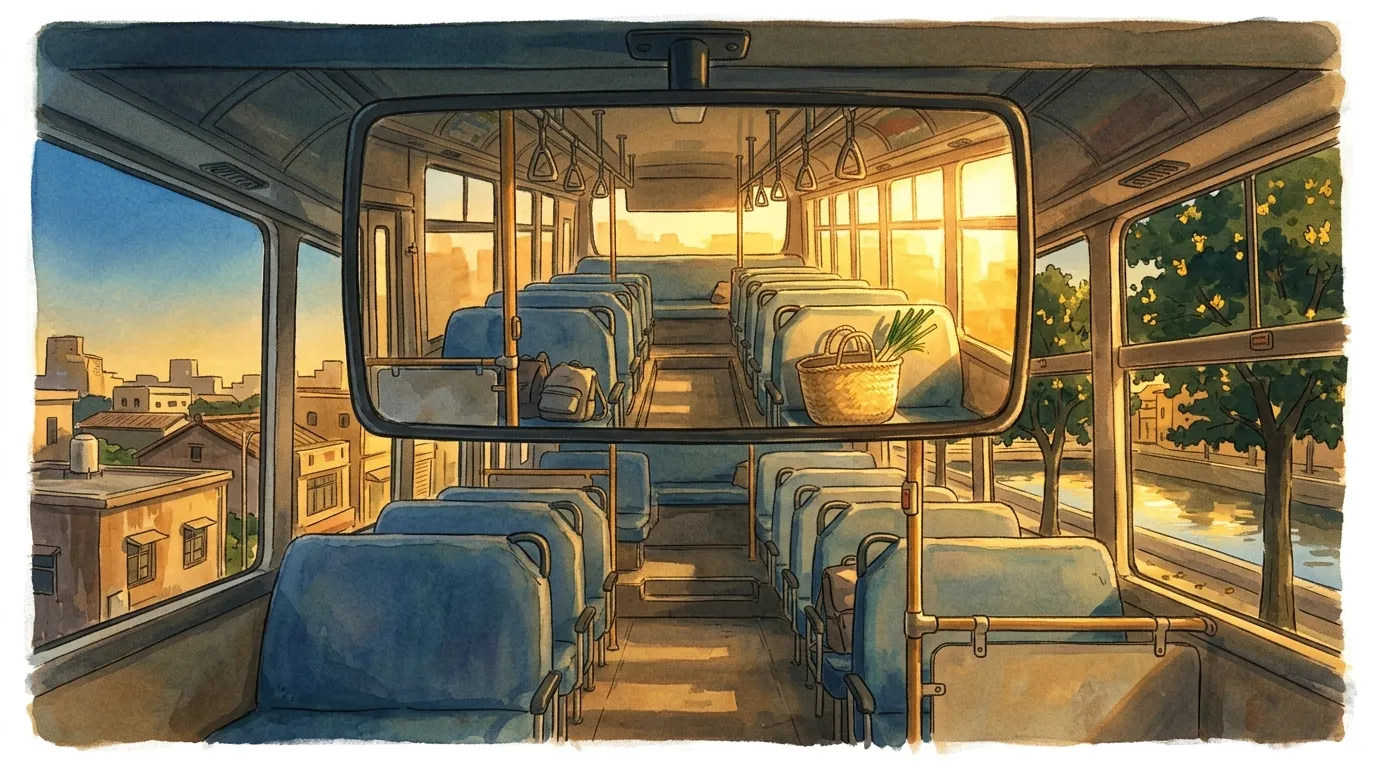
The evening light had changed. The angle had dropped. September’s sun fell earlier than July’s, already sinking from four-thirty onward, coming from behind the bus. The rear windshield turned into a wall of gold, light flooding through into the bus, spreading the length of the aisle all the way to the front.
Seven or eight people on board.
Second row on the left: a woman with a vegetable basket, green onions poking out. Right side, window: an elderly man in a short-sleeved floral shirt, head resting back against the seat, eyes closed. A couple of students behind — not ones he recognized, probably from a different school. A man in the priority seat scrolling his phone, the screen’s light on his face. In a middle row, a young woman with headphones, her head nodding faintly to some rhythm.
All strangers. Not his route’s regulars.
But the gold light had touched all of them.
Chen Zaifa looked in the rearview mirror.
What he saw: the onion tips had turned translucent in the light. The students’ uniforms had shifted from dark blue to a coppery brown. A few stray strands of the headphone woman’s hair were glowing at their edges.
He looked for maybe three seconds.
Not a sweep. A look.
Looking at a bus full of people washed into warmth by the setting sun. He must have seen this kind of light many times before — twenty-three years of the last run, the evening sun chasing the bus from behind every day — but he had never before looked at the people inside it in this light.
Or he had. But hadn’t held onto it.
The smell of roadside stalls drifted in through a gap in the window. Salt-and-pepper chicken, oyster fritters, the smoke of frying oil mixed with grilling meat. Along the canal bank, someone was sitting on the embankment wall, feet hanging above the water. The streetlights weren’t on yet; the sky was that color where blue and gold had run together.
Chen Zaifa brought his gaze back to the road.
Anping Fishing Harbor. Turn around.
The return bus had fewer people. The setting sun had moved from behind to the right-side windows, now deep orange, long shadows pulling from the buildings along the road onto the asphalt. He pressed the brake, cleared an intersection, throttled forward again.
Hospital stop.
His foot touched the brake. The doors opened. A faint thread of disinfectant. No one on, no one off.
His foot rested on the brake pedal two seconds longer.
Then he pulled out. Closed the doors. Next stop.
The depot. End of run.
He parked in Bay Three, pulled the handbrake. Engine off. He walked from the first row to the last — checking the seats. A crumpled tissue in one of the rear rows; he picked it up. The gaps in the last row were clean. In a middle-row floor he found a bottle cap; picked it up. The priority seat area was clear.
He walked back to the driver’s seat, picked up the canvas tote, climbed down.
Under the corrugated iron awning, Xiao Yang’s bus was already parked, Xiao Yang nowhere in sight. On the folding table were a metal lunch box and two foil-pack drinks — Xiao Yang’s. The radio was off.
The plastic chairs were empty.
At this hour, if they’d both brought their buses back, Xiao Yang would usually be here scrolling his phone, waiting, trading a few words. Now Xiao Yang had probably left early — leaving next month, his mind already somewhere else.
Chen Zaifa stood under the awning, looking at the buses in Bay Three and Bay Four. The corrugated iron on the rooftops caught the last light of the evening. The diesel smell had thinned. The soy milk shop far off had closed; from the neighboring cafeteria the smell of braised sauce had drifted out in its place.
The radio was off. Under the corrugated iron awning, it was quiet.
He stood for maybe ten seconds. What he heard was the sound of the buses cooling. After the engine goes off, metal and plastic contracting from heat back to cold — a very fine irregular clicking, like something slowly releasing inside the body of the bus.
He hadn’t noticed this sound before. Maybe Xiao Yang’s talking had covered it.
He got on his scooter. Buckled the helmet, started it. Out of the depot, right turn.
Wind came through the helmet’s gap. September evening, and the wind carried a thread of coolness now — just a thread, mixed into the warm air, there and then not there.
Red light. He stopped at the intersection. A bus went by beside him, its windows lit, a few silhouettes inside.
He didn’t look twice.
Green light. He opened the throttle. That cool thread in the wind came through again.