Chapter 5
Weight
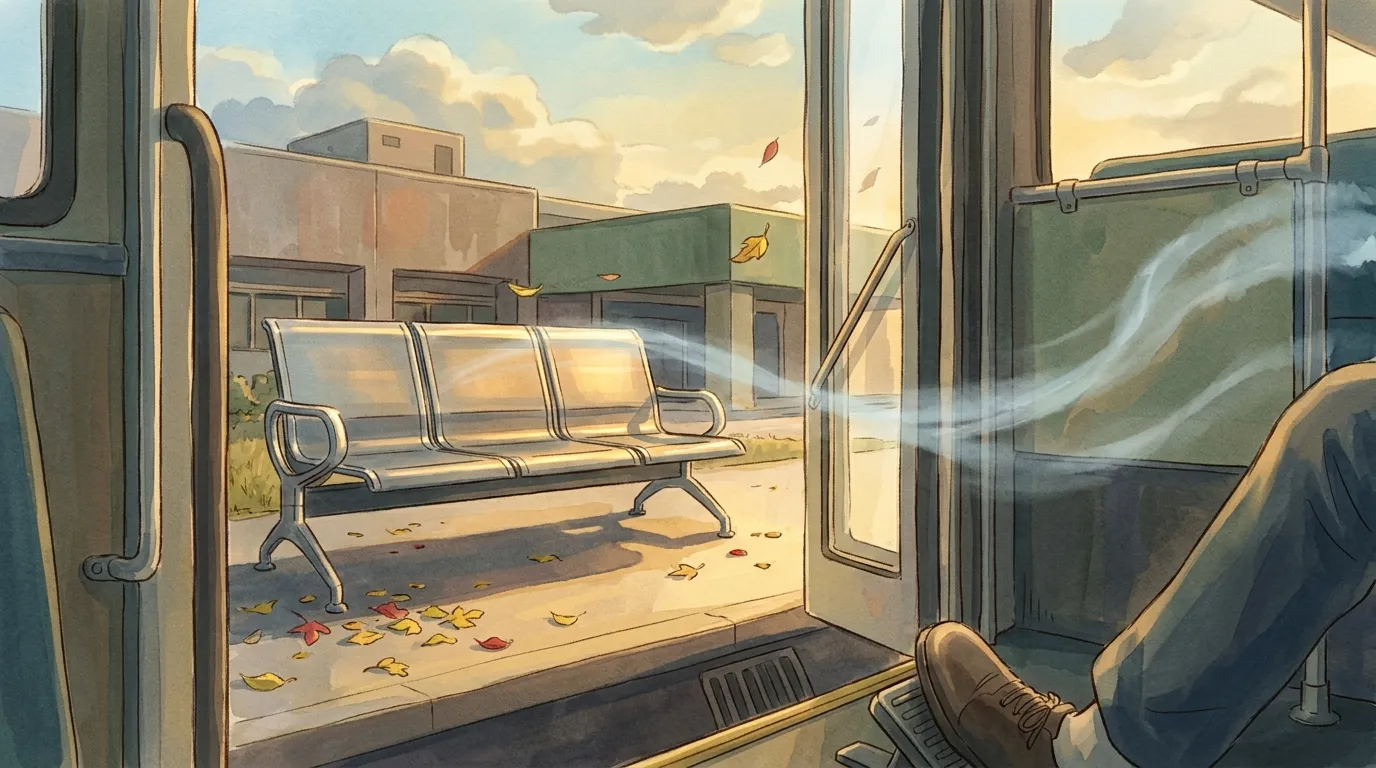
Chen Zaifa’s foot touched the brake.
Hospital stop. The doors opened. The smell of disinfectant drifted in from outside — fainter than in September. It might have been the wind direction; November wind was dry, thinning every smell out. Two people were waiting at the shelter. A middle-aged woman carrying a medicine bag, and a young man in a tracksuit.
Both boarded. Tapped their cards. Walked on.
Chen Zaifa’s foot was still on the brake pedal.
Not waiting for anyone. The platform was empty. He could see the waiting bench was vacant — the stainless steel seat reflecting the white November light, no sign of recent use.
His foot came off the brake. Doors closed. Pulled out.
Next stop.
Tuesday was the same.
Doors opened. Disinfectant. A woman who looked like a nurse boarded, her uniform a shade of green, a plastic bag of breakfast in her hand. No one else.
Wednesday. An old man in a wheelchair was pushed up the ramp by a family member — not that wheelchair. This one was electric, newer, and the family member was a middle-aged man whose movements were clumsy, needing two tries to get the ramp angle right. He fumbled with the securing straps for a long time. Chen Zaifa turned from the driver’s seat to look.
“That lower buckle — just press it down.”
The man crouched and worked at it, then it clicked. “Thank you.”
Chen Zaifa turned back. Doors closed. Pulled out.
The sound of the wheelchair securing straps was different from before. When this set clicked into place it was muffled — metal meeting body weight, a heavier sound. The old one — there had been a gap between strap and body, buckle against buckle, a dry snap.
He didn’t follow the thought. The light ahead had turned red.
Thursday. Friday.
The Hospital stop opened and the people who boarded were strangers to him. The waiting bench was sometimes occupied, sometimes empty, but never by that person.
It hadn’t been a sudden disappearance. September was already less, October less still, only scattered appearances toward the end. He remembered the last time — mid-October, or late October? He couldn’t be sure. He only remembered that the platform had been in full sunlight that day, that the man had risen from the waiting bench, taken a couple of seconds to stand, boarded, sat down. Dressed neatly. Complexion the color of a cement wall.
And then nothing.
Not “vanished” — that word carried weight. It was a frequency that had moved from daily to every other day to every few days to once a week to zero. Like tuning through a radio station: the signal going from clear to static to silence, the dial moving on to the next position.
Chen Zaifa didn’t know his name. Didn’t know where he lived. Didn’t know why the man came to the hospital every day — though the answer wasn’t hard to guess. He didn’t want to guess. What happened on the bus stayed on the bus. When you got off, whatever two lines had run parallel simply each disappeared over the horizon. He could barely remember the man’s voice — only one phrase remained: “It’s fine,” from the time a student had knocked into the back of his seat that summer.
A week. Hospital stop, no sign of him for a straight week.
Chen Zaifa hadn’t counted. His foot had counted. Every approach to the Hospital stop, the touch on the brake was heavier than at other stops. The doors would open, no one in a dress shirt on the platform. His foot would linger on the brake one extra beat. Then pull out.
His body had kept track for seven days.
Saturday, early shift. Xu Jinfeng boarded, her Senior Card giving a single beep. The patterned cloth tote was deep red with white flowers today, full and rounded, packed with something unknown.
“Morning.”
She made her way to the third row on the right and sat down. Her mouth opened.
“Did you hear — that pork vendor at Shuixian Temple Market changed hands. The old woman who used to be there — she had a daughter in Kaohsiung — she retired, said she couldn’t manage anymore. The new one, this young person, doesn’t know how to cut right. The piece I bought yesterday, the thickness was all uneven. Has your wife been buying from them? I wouldn’t recommend it, not yet — let him get some practice first.”
Chen Zaifa pulled out. Red light. Stop.
“Also, last night I couldn’t sleep again. Nothing really going on — well, actually I don’t know why, just woke up in the middle of the night, looked at the clock, three-thirty. Three-thirty. What are you supposed to do at that hour?”
Green light. Pulled out.
“Got up and went to the kitchen for a glass of water, sat there drinking it. Not a sound outside. Not even a dog barking. So quiet that — how to say it — so quiet you start listening to your own heart beating.”
She paused for a moment. Chen Zaifa thought she was about to change topics.
“When you’ve lived alone long enough, what you’re most afraid of in the middle of the night isn’t the dark — it’s the quiet. Sound means people are out there somewhere. No sound, and you start to think — right now I’m the only one awake. The whole lane, just me.”
Shuixian Temple. A smell of fish drifted in. She stood, slung the patterned tote over her shoulder.
“Still, it’s fine. Going in to see whether that new pork stall has improved at all.”
“I’m getting off.”
She stepped down. The deep-red-and-white bag swayed twice and disappeared into the morning market crowd.
The bus went quiet. The road ahead ran straight; a gust of wind shook loose a few dried seed pods from somewhere, and they tapped against the windshield. Light. Like fingernails knocking.
Chen Zaifa drove through them.
November’s bus was fuller than September’s.
The students were all back, the office crowd settled in, and once the weather cooled the elderly came out too. The morning-shift uniform flood still jammed the front doors to spilling, beep beep beep, bag knocking into bag. The student who practiced from memory boarded at his usual stop — one beep — and walked to stand by the rear door, one hand on the pole. He’d grown taller, or thinner; the line of his cheekbones was more defined, the way a rubber band looks when it’s been pulled out longer. His fingers moved against his thigh. Earbuds in.
Old Zhang boarded at Confucius Temple stop. Long-sleeved shirt, top button fastened, brief nod, no words. The Chinese flame trees outside the Confucius Temple were at peak bloom — yellow flowers and red seed pods on every branch. Sunlight came through in fragments, falling across the bus windows in shifting pieces.
Third afternoon run, the priority seats had a grandmother and her granddaughter. The girl was maybe five or six, two braids, a pink charm on her schoolbag. When they boarded the grandmother swiped two cards; the girl stood beside her on tiptoe, watching —
“Grandma, I want to do mine myself.”
The grandmother passed her card over. The girl took it, lifted onto her toes, stretched her arm up. The reader was just above where her head reached; she pushed her arm straight up, card flat against the sensor — beep.
“There it is, good girl, very good.”
The girl’s face crinkled into a smile.
In the rearview mirror Chen Zaifa watched the girl follow her grandmother to a seat, her two braids bobbing behind her. The charm swayed twice.
He looked away.
The bus was full. November was the busiest month on this route. Every seat taken, people standing too. The sound inside the bus had density — voices, phones, zippers on schoolbags, and with the air conditioner not needing to run hard the engine became audible, the diesel’s low frequency coming up through the floor, steady.
Plenty of people.
But a few fewer than there should have been.
This wasn’t something you knew by thinking. The bus arrived at the Hospital stop, the doors opened, his foot touched the brake, no dress-shirted figure on the platform, no wheelchair, the doors closed, pulled out — the whole sequence took less than fifteen seconds. The bus kept going. Next stop.
Only in those fifteen seconds, the weight inside the bus felt slightly off. A little lighter. He couldn’t have said where.
The girl with the braids appeared again two days later. This time she swiped the card herself, without waiting for her grandmother to hand it over. Tiptoe, arm up, beep. The grandmother laughed behind her.
“Look at you, doing it all yourself now.”
As the girl walked to her seat, the charm knocked against an armrest and made a small hollow sound. She glanced back at the charm, confirmed it wasn’t broken, then sat down.
Five or six years old, and she already checked her own things. Chen Zaifa thought of his son when he was small, how the boy would tie his shoelaces and then untie them and tie them again before going out, no matter how many times anyone said anything. Then he grew up, switched to shoes with no laces. Problem resolved itself.
He sometimes thought that being a bus driver and being a parent had one thing in common: you watched a person move from one state to another, but you hadn’t done anything. You were just present.
That day was Wednesday. Or Thursday. He couldn’t quite recall.
Third afternoon run. Wu Jie boarded at the Anping Road stop. The polystyrene box as always, a thread of ocean smell from the corners. A ballpoint pen behind her ear — a different one, blue; the old black one had gone somewhere.
She started talking the moment she swiped her card.
“The oysters today, what a disappointment — I’m telling you, this year’s oysters, I don’t know what’s going on, all of them small. I asked our supplier and he said it’s the water temperature. Water temperature? Every year it’s the water temperature. Last year was water temperature too, the year before was water temperature. How long is the water going to stay warm?”
She wedged the polystyrene box against her feet and sat down. Her voice carried through half the bus.
“Customers complain too. Yesterday this young one came to buy oyster fritters, looked at the oyster, said ‘These are tiny.’ I told him, small ones are sweeter. Whether he believed me I have no idea, but he bought anyway. Two for fifty, same as always.”
Chen Zaifa’s eyes were on the road ahead. The flame trees along Anping Road were half yellow and half red; the wind carried a few leaves onto the asphalt, yellow and red like torn scraps of paper.
“Eh — I heard there was a man from around the hospital, someone passed.”
Her tone didn’t change. Same volume as the oysters, same rhythm. The way you’d report the day’s weather or the price of vegetables.
“I don’t know who it is, I only heard secondhand. They said he used to take the bus there regularly, then one day just stopped coming. Well, these things happen.”
She paused for less than two seconds.
“Oh, and you know that rice dumpling stall by the Anping temple? Word is they’re raising prices —”
Chen Zaifa didn’t respond.
His hands were on the wheel, ten o’clock and two o’clock. Eyes forward. A scooter ahead was moving slowly; he went around it on the left. Wu Jie continued with the rice dumpling, moved to the type of glutinous rice used, then to how the old proprietress used to wrap them better, then to how the taste had changed since the younger generation took over.
He didn’t say “mm.” Didn’t say “is that so.”
Didn’t say anything.
Wu Jie didn’t notice. She had never needed a response. Her voice made a circuit through the back half of the bus, bounced off the walls and came back, filling some gap that no other passenger would have noticed.
Anping. Wu Jie picked up the polystyrene box and made her way to the front doors.
“All right, that’s me. Tomorrow if the oysters are bigger I’ll buy more, otherwise I’ll wait.”
She stepped off. The ocean smell went with her.
When her voice left the bus, the quiet that returned had a different shape from before. The old quiet was neutral — fewer people, less sound. This quiet was the shape that remains when something has been removed.
Chen Zaifa drove to the turnaround point. The gravel lot beside Anping Fishing Harbor, the ground uneven underfoot. He parked, set the handbrake.
At the turnaround he usually did nothing. Sat, drank some water, checked the time on his phone. Same today.
Only, as he sat there, his mind went very quiet — quiet enough that he heard something he hadn’t wanted to hear: Wu Jie’s words from a moment ago. Not the whole sentence. Just the middle of it: someone passed.
He wasn’t certain it was that person. Wu Jie’s “used to take the bus there regularly” could describe many people. The hospital route had more than one passenger who came for treatment. He didn’t even know if the man had a name — he did, of course he did, but Chen Zaifa didn’t know it. He knew nothing at all.
He took a drink of water. Screwed the cap back on.
Time to turn around. Started the engine. Pulled out.
The return leg passed the Hospital stop.
His foot touched the brake. The doors opened. A young mother with a small child was waiting at the platform. The disinfectant smell was slightly fainter than on the outbound run.
The young mother boarded, the child lifted on. Beep.
Chen Zaifa’s foot came off the brake pedal, but the motion was half a beat slower than usual.
Doors closed. Pulled out.
That day was not the day Wu Jie had been talking. It was earlier — maybe the first week of November.
Chen Zaifa had opened the Hospital stop doors to find no one in a dress shirt on the platform, no wheelchair. Disinfectant smell drifting in. He was about to close the doors when a scene surfaced in his mind.
Sometime in October.
He’d been on the second afternoon run that day. Hospital stop doors opened; someone boarded. Low ponytail, polo shirt, running shoes. But no wheelchair.
He hadn’t thought much of it at the time. She boarded alone, swiped at the front, didn’t go to the wheelchair-accessible area, walked to the adjacent seat and sat down. The seat right beside it — when she used to stand waiting with the wheelchair, she’d rest her hand on the back of that seat. Now she was sitting in it.
She didn’t speak the whole ride.
When Chen Zaifa glanced in the rearview mirror — not a quick sweep, an actual look — her face was turned toward the window. The view outside was moving; her face was not. Her hands rested on her knees. The woven bracelet on her wrist was still there, its color more faded now, close to merging with the skin.
She rode all the way to the Hospital stop.
When she got off, she didn’t use the rear doors. She came to the front. She stopped for a moment beside the driver.
Chen Zaifa turned his head to look at her. Up close, he noticed she was younger than he’d thought — or rather, when she’d been pushing the wheelchair, crouching to fasten the securing straps, she had looked like someone working, ageless. Standing there now with her hands empty, she looked like a woman in her early thirties.
She said something. Taiwanese. Not entirely standard Taiwanese.
“Dō-siā.”
Thank you. The final syllable carried a softness from some other language, drawn out slightly.
What Chen Zaifa said in return, he couldn’t remember. Maybe “mm.” Maybe nothing.
She stepped off. Walked away.
At the time he’d really thought nothing of it. A passenger says thank you on the way out — that happened every day. Some didn’t say anything. Either way he hadn’t been keeping track.
But now — November, Hospital stop, doors open, disinfectant smell, no sign of her on the platform — now he remembered.
That had been goodbye.
He hadn’t known it then. But his body had stored the image. Her standing at the front doors, the woven bracelet on her wrist, those drawn-out syllables of dō-siā, then turning and stepping down — gently, as if afraid of disturbing something.
Doors closed. Pulled out.
He didn’t know where she’d gone after that. Contract ended? The old man had died and she’d left? He had no way to find out. What the bus connected ended with the bus. A person stopped boarding, and that was simply that. No conclusion. Just absence.
A few days later. Mid-shift break. The depot.
Under the corrugated iron awning, Chen Zaifa sat on a plastic chair. Lunch box open — spare ribs, the kind his wife fried then braised, skin crisp and meat soft. Beside it, a side of blanched sweet potato leaves and a square of tofu.
Xiao Yang’s bay was empty. A different bus sat in it, white, newer than Xiao Yang’s. The driver was a man he barely recognized — surname Lin or Cai, hadn’t been around long, didn’t say much, didn’t hang around the depot on breaks.
One lunch box alone on the folding table. The radio was on its bracket, switched off.
Cooling sounds came from the neighboring bus. Clank — clank. Clank. Irregular, faint, metal contracting from heat back to cold. Different from his bus’s sound, higher in pitch — a new frame that hadn’t been shaken loose yet.
He took a bite of spare rib. Skin was indeed crisp.
Chewed a few times, swallowed. Another bite. Tofu. A chopstick of sweet potato leaves.
His mouth was moving, but he noticed the chewing had slowed. Not because the ribs were tough — the ribs were fine, his wife had never gotten this wrong. It was that after the food in his mouth had been broken down, it reached the back of his throat and stalled.
Not really stalled. His body just didn’t much want to swallow.
His chopsticks stopped.
He’d had a couple of bites of the rib, half the sweet potato leaves, one chopstick of tofu. The rice maybe a third gone.
He looked at the lunch box. His wife’s lunches were always like this — just enough vegetables and rice, the rice packed just right. Over twenty years, he had never left anything. Not a question of taste. It was who he was — he didn’t leave loose ends. Run all four legs, finish the lunch, check the bus, go home. Routine.
Today he put the chopsticks down.
Didn’t put the lid back. The box sat open on the folding table. The cut side of the spare rib face-up, its glaze catching the November sun with a faint sheen.
He picked up his water bottle and drank. Room-temperature water, no flavor.
He sat for a while. He didn’t know how long. Maybe two minutes, maybe five. Cars went past outside the awning, someone far off was on a phone, the words inaudible. The sky was very high. November sky, as if someone had drawn off the whole sticky layer of haze, leaving behind a clean blue that seemed almost too clean to be real.
He put the lid back on the lunch box. Didn’t wrap it in cling film — no need, it was going back to his wife to wash.
Less than half the spare rib rice eaten.
He stood, tucked the lunch box into the canvas tote. Eleven o’clock. Third run.
Last run of the afternoon.
Sunset poured in from behind the bus. November’s sun was lower than September’s, the angle nearly horizontal — golden light ran from the rear windshield all the way forward to the driver’s seat. The sun visor made no difference; the light came around both sides.
Five or six passengers. Old Zhang was there. The student who practiced from memory was there. A young woman he didn’t know was reading in the seat near the priority section. The girl with the braids wasn’t on today.
Passing the Confucius Temple, the flame trees’ reds and yellows canopied the whole road. Sunlight through the red seed pods and yellow blooms fell across the top of the bus; the light inside was warm, like looking through amber. Old Zhang’s white hair went the color of pale gold in that light. His long-sleeved shirt, top button still fastened.
He was there every day.
The stretch past the Confucius Temple was under three minutes; Old Zhang watched out the window for the whole three minutes. Chen Zaifa didn’t know what he was watching. Possibly nothing — just habit. When a person has done the same thing enough times, it stops being a choice and becomes gravity.
Hospital stop.
Foot on the brake. Doors opened.
No one boarded. No one got off. The smell of disinfectant drifted in and was carried off by the wind. The platform was empty. The stainless steel waiting bench reflected the gold of the setting sun.
Five seconds. Doors closed. Pulled out.
As Chen Zaifa’s foot left the brake pedal, the sole of his foot registered something — not aching, not numb, just that the surface of the pedal seemed slightly cooler than at other stops. Impossible, of course. Same metal, same shoe, same route. But that was what his foot told him.
He didn’t give it any thought. Next stop.
The depot. End of run.
He parked in Bay Three and set the handbrake. Engine off. Front to back, he checked the seats — a tissue in the back row, crumpled and thrown away. A drink-cup lid on the floor somewhere in the middle, picked up. The front was clean.
He walked back to the driver’s seat, picked up the canvas tote.
He sat in the driver’s seat without moving.
The key was already out. Engine off. Interior lights off, only a small green indicator on the dashboard still lit — he’d never worked out what it was, some warning light he’d never tracked down.
The cooling sounds started. Clank. Clank — clank. Metal from heat back to cold. His bus was older than the one next to it; it made more sound cooling down, from more places — some from the roof, some from the undercarriage, some from the seams of the doors.
He sat and listened.
On normal days he left quickly after bringing the bus back. Park, check, get his things, off the bus, scooter home. The routine took under ten minutes. Today, after finishing the check, he had gone back and sat in the driver’s seat again.
Not tired. November shifts weren’t tiring. Good weather, stable roads, no rainstorms, no backups, no need to run the air conditioning full. Four runs in a day and the body felt fine.
He was just sitting.
In the canvas tote, the uneaten half of the lunch box. The spare ribs had probably gone cold. His wife would notice and might ask. He thought about what to say. “Wasn’t very hungry at lunch” — that would work. “The rib was too big” — she’d say she’d cut them smaller next time, then actually cut them smaller. Never mind. He’d figure it out when he got home.
Outside the corrugated iron awning, the sky was going dark. November went dark early, the light starting to fade by half past five. A scooter somewhere in the distance. The smell of braised sauce from the self-service restaurant down the way drifted over — stronger than in September, maybe because in the cold the steam carried further.
He checked his watch. Five minutes he’d been sitting there.
Five minutes. He never sat an extra minute ordinarily. He was the kind of person who moved from one task to the next without a gap. Not because he was in a hurry — because gaps contained nothing. He’d never thought much of letting his mind go blank, never felt he needed to “think things over.” For twenty-three years his greatest skill had been not thinking.
He picked up the canvas tote and stepped off the bus. The air under the awning was cool, dry and clean.
He walked to the scooter, buckled the helmet, started the engine. Out of the depot, right turn.
Wind pushed through the gaps in the helmet. November wind had no edge to it — in September there’d been one cool thread woven through the warmth, but November was all cool, uniform, pouring in from the ears to the back of the neck, no gradations.
Traffic light. He stopped at the intersection.
The bus in the lane beside him had its windows lit. People inside. He didn’t look.
Green light. Opened the throttle. Headed home.
His wife was in the kitchen. When he came through the door she glanced back.
“You’re late.”
“Traffic on the way.”
She didn’t follow up. Turned back to whatever she was doing. The sound of water from the sink.
Chen Zaifa set the canvas tote on the dining table. He knew that in a little while his wife would open the lunch box and find half still there. She might ask, or might not.
He changed into slippers and went to the bathroom. Closed the door.
He turned on the tap. The water was loud, covering the sounds from outside. He stood under the showerhead, water running down from above, warm. Steam began to fill the small space.
He didn’t think about anything.
Water moved across his face. His eyes were closed.
Twenty-three years, a shower every evening after work. The water temperature, where to stand, the order — head first, then body — all exactly the same. The feeling of water on his shoulders, too familiar to notice.
Today he noticed.
The weight of water on his left shoulder. Not heavy — how heavy could water be. But he felt it. Each drop landing, touching skin, then running down. Light, but landing on him with certainty.
He stood for a while.
Then he turned off the water. Dried off. Got dressed. Came out.
His wife was in the living room, watching television. The lunch box was already washed, drying upside-down on the rack.
She didn’t ask about it.
Chen Zaifa sat at the dining table. A note on the table in his wife’s handwriting: Temperature dropping tomorrow. Jacket by the door.
He looked at it for a moment. Turned it over, blank side up.
The television was on with some news. His wife on the sofa, feet tucked under a blanket. The clock moved past seven. Outside, full dark.
Chen Zaifa sat there and did nothing.
After a while his wife looked over from the sofa. “Aren’t you eating dinner?”
“I’ll eat.”
He stood up. Went to the kitchen. Opened the rice cooker. Rice inside, and beside it a plate covered in cling film — three-cup chicken and stir-fried water spinach.
He brought the dishes out. Sat down. Picked up his chopsticks.
Ate.
But slower than usual. Each mouthful chewed a little longer. His wife in the living room watching television, not paying attention.
Outside, wind. In November, wind through window frames made a low sound, a dull hum — like someone somewhere far away in the middle of a sentence they’d stopped finishing.
He finished dinner. Bowls and chopsticks in the sink.
“I’m going to bed.”
“Mm.” His wife’s voice from the living room.
He walked into the bedroom. Left the light off. Lay down. The pillow was cool.
Today someone might be gone. He didn’t even know if it was that person. He knew nothing.
He closed his eyes.
A thin strip of light from the street lamp outside came through the curtain, drawing a single horizontal line on the wall. Very fine. Still.
Chen Zaifa lay there, and felt the weight of his own body pressing into the bed. Back, shoulders, the back of his head. Every point of contact had weight. His weight.
A very light weight. There all along. Only today he felt it.