Chapter 6
Squeeze
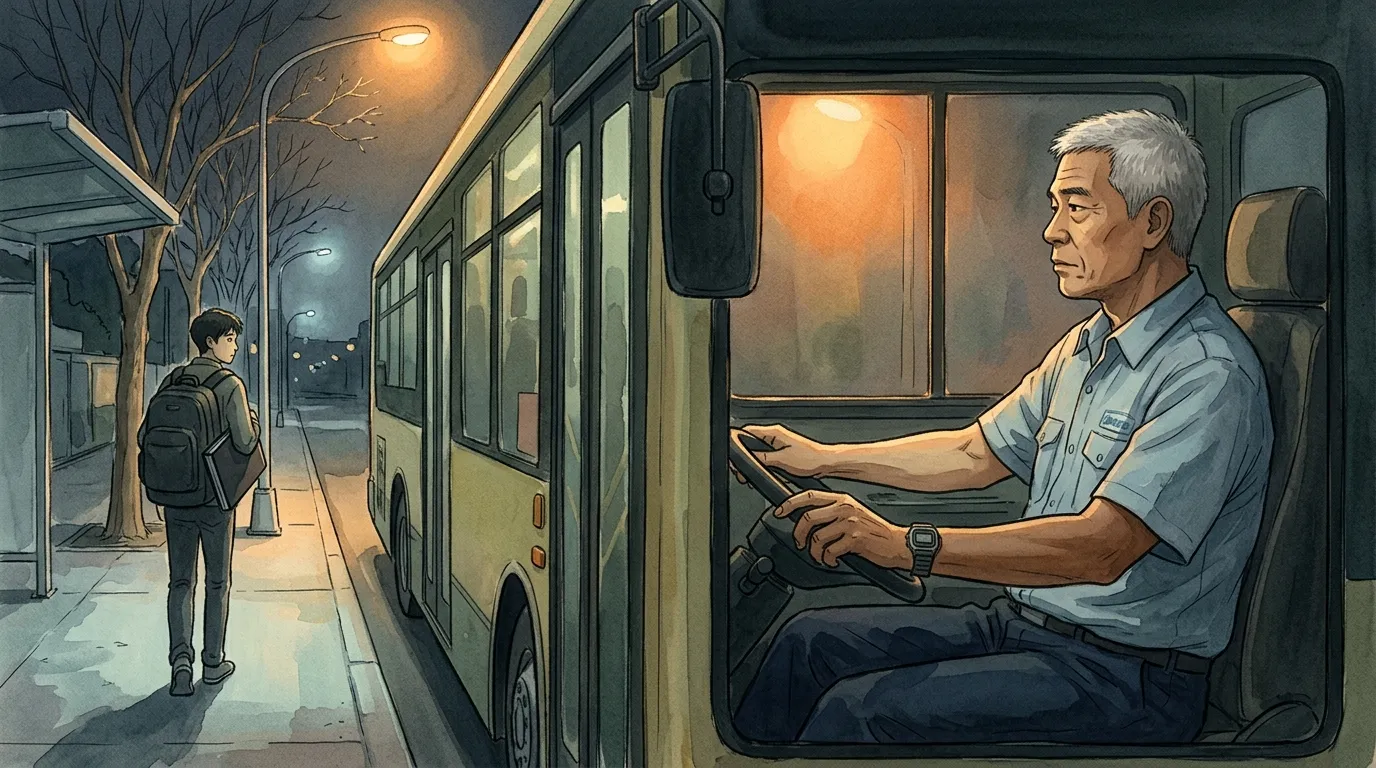
The steering wheel was cold.
Chen Zaifa’s hands pulled back when they touched it. January mornings — the metal was a few degrees colder than the air, a dull cold, not sharp. It moved slowly from his palms toward his wrists. He rubbed his hands together and gripped the wheel. Ten o’clock and two. The black plastic grip had worn bright; winter light fell across it in a dark ring of reflected shine.
He started the engine. The diesel vibration came up through the floor, the frame shuddering once before settling. Cold starts took half a beat longer in winter. Machines felt the cold too.
Five thirty-five. He pulled out.
The depot meeting was Monday morning, before the first run.
A row of plastic chairs had been set up under the corrugated iron awning, five or six drivers sitting in them. The dispatch supervisor stood beside a folding table with a sheet of paper in his hand. His name was Liao, early fifties, with a habit of pulling the left side of his mouth sideways when he talked, like he was chewing an invisible betel nut.
“Everyone — the company’s just come down with word. Starting February first, a few of the loss-making routes are getting their schedules trimmed. Our line—” He glanced down at the paper. “Going from four runs a day to three. Morning shift stays the same, the noon run is cancelled, and the two afternoon runs merge into one.”
Voices from the seats.
“Down one run? What about pay?” The driver on the far end — surname Wang, ran a different bus — voice rough.
“Per-trip fee follows the reduction. Base salary unchanged.”
“What good is an unchanged base salary when trip fees are half the paycheck.”
“I know. But that’s what management’s decided. The ridership isn’t there — they can’t justify four runs. You’ve seen it yourselves, some winter runs barely scrape ten passengers.”
Driver Wang kept at it; someone beside him joined in. Chen Zaifa sat in the second row, hands on his knees, and said nothing.
He was listening to all the numbers. Four runs down to three. Trip fee difference per run, roughly twelve hundred. One month, about thirty fewer runs — no, it depended on the schedule. He worked it out in his head: say he normally drove twenty-two days a month, one fewer run per day, twelve hundred a run — that came out to twenty-six thousand less a month. Under thirty thousand, but not a small number either. His wife’s tailoring income was irregular. Their son up in Taipei didn’t take money from home, but he didn’t have any to spare either.
The meeting broke up and he walked back to the bus. The seat was still cold; sitting down, he could feel it through his trousers.
He unzipped the canvas tote and opened the lunch box. Braised pork on rice today, with pickled cucumber and a fried egg. The yolk was half-set — press it and it would run.
A slip of paper was tucked to the inside of the lunch box lid, in his wife’s round handwriting: Dress warm, it’s cold. I made it spicy — up to you whether you want it.
He looked at it for a moment. Tore it off, folded it twice, put it in his coat pocket.
The chili was minced fine, mixed in with the braised pork, small red and green flecks. He took a bite. His tongue went slightly numb. His wife’s spicy wasn’t really spicy — it was the kind that warmed your stomach from the inside afterward.
He finished the lunch box.
January shaped the bus into emptiness.
Not actual emptiness — people were still there. Xu Jinfeng was there every day, her patterned tote switched to a deep brown one, winter colors. The gentleman — Zhang Bo — was there every day, dark long-sleeved shirt, the top button done. The office workers had thinned some. Students were taking more absence days around the joint university entrance exam; some mornings the early run saw no uniform wave at all, the front-door beeps scattered and sparse, like rain tapering off.
But once there were fewer people, the empty seats emerged. Vacant seats had a kind of visual weight in the cabin — the plastic surfaces catching light from the windows, row after row, clean, without any body warmth pressed into them.
Coming back from the first run, Chen Zaifa counted: fourteen passengers outbound, nine inbound. Winter had always been slow, but single digits were new.
He passed Hospital stop. His foot touched the brake. The doors opened. The disinfectant smell had been thinned by the northeast monsoon, nearly gone. One person was waiting at the shelter — puffer jacket, someone he didn’t know.
Boarded. Beep.
Chen Zaifa’s foot left the brake. That touch was still heavier than other stops. But the weight had changed — not waiting for something, just passing through. Like walking a familiar road where the pavement is slightly uneven at one spot: the foot adjusts on its own, no thought needed. The body remembers the dip.
Doors closed. Pull out.
The student with the score folder had been absent for a while.
Two weeks before the exams he’d stopped appearing. Maybe he was at a cram school, maybe he’d taken leave to study at home. Chen Zaifa didn’t know and hadn’t thought about it. The pole by the rear door stood bare — no hand gripping it, no fingers moving against a thigh.
One morning late in January, he appeared.
Chen Zaifa recognized him by sound — no, not sound. By the rhythm of his footsteps after the beep. Other passengers boarded in a jumble; this one’s footsteps had a gap from the crowd, stepping up only after the others were clear. But today it wasn’t just a gap. The footsteps were heavier than before.
He was carrying a large backpack.
Not his usual school bag. The school bag was soft and close to his back; this backpack was hard-sided, bulging wide, the zipper not quite shut, a strip of dark fabric showing at the edge. The hard-shell score folder was no longer clipped to the outside — it had been packed in, only one corner sticking out.
The student didn’t walk to the rear door.
He stood near the front for a moment. The cabin wasn’t crowded; the priority seats were empty, the back was empty. He walked a few steps toward the rear half of the bus, then stopped. At the rear door. His spot.
One hand on the pole. The backpack was too large; the strap slid down and he pulled it up with his other hand.
Seen in the rearview mirror, the top of his head cleared the horizontal bar of the rear door — not flush with it, over it, by a few centimeters. The line of his cheekbones had deepened. The angle of his jaw looked like something had pared it. An eighteen-year-old face, no longer round. But he stood the same way he always had: one hand on the pole, body slightly leaning against the door.
His fingers weren’t moving.
Earphones in. Face toward the window. Outside the window was Tainan in January — the flame trees stripped to bare branches, the sky gray-white, the northeast monsoon rolling fallen leaves into clumps that tumbled forward along the curb.
Chen Zaifa brought his eyes back to the road.
The stop came.
The stop where the student usually got off — the one near the banyan tree.
The rear doors opened.
The student didn’t get off through the rear doors.
He came away from the rear door pole and walked forward. Toward the front. The backpack swayed in the sparse cabin; one strap slipped, and he didn’t bother pulling it up. Past the middle section. Past the priority seats.
He reached the front doors.
As he passed the driver’s seat, he stopped.
Chen Zaifa turned — not a full turn, the periphery caught it first, and then his head followed just a little. The student was standing on the front door step, the backpack’s zipper pull tapping lightly against the bag’s surface as he’d walked, a faint soft knocking sound.
He opened his mouth.
“Thank you.”
Quiet. Two syllables. Like something that had been pushed up from somewhere deep, and by the time it reached his lips, the volume had gone down to almost nothing.
Chen Zaifa looked at him.
He saw an eighteen-year-old face. Cheekbones. Hair tucked behind the ear, longer now than three years ago. The earphone cord from the left ear hanging loose. His eyes weren’t looking at Chen Zaifa — they were looking out through the front doors, looking toward the direction he was about to walk. But he was standing there, turned toward the driver’s seat, and he had said those two words.
Chen Zaifa’s mouth moved.
The door timer was running. The front doors were open, winter air pouring in from outside, cold, carrying the damp of soil at the banyan tree’s roots. No bus behind — no, there was a scooter back there, still far off.
The student stepped down. One step. Two. He was on the shelter platform.
The doors closed. The pneumatic doors hissed, sealing the winter outside.
Chen Zaifa’s hands were on the steering wheel, ten o’clock and two. Still.
He looked out through the rearview mirror.
The student was standing under the bus stop sign. The large backpack on his back made his body look wider than it was. He glanced once in the direction the bus had gone — a brief look, under a second. Then he turned. He walked away.
In the rearview mirror his back grew smaller. The outline of the backpack, the corner of the score folder poking out, the shoulder strap that had slipped to one side. The banyan tree’s canopy swallowed half his shadow.
Then he turned into a side lane and was gone.
Chen Zaifa sat in the driver’s seat.
From behind, a horn. Short. Distant. As if passing through something — not distance, but a layer between his ears and the sound.
The horn again.
His foot pressed the accelerator. His hands moved on the wheel. The bus pulled out.
The road ahead was straight. The flame tree’s bare branches swayed in the wind — no leaves, only gray scaffolding. The January sky sat low, as if only one layer separated the clouds from the rooftops.
He kept driving.
Next stop. The stop after. Red light. Green light. A turn. A stop. Doors open. Doors close. A few people on, a few off. Every motion he made. Hands on the wheel, foot between accelerator and brake. He could drive this route with his eyes shut.
But from just now until now, something was lodged in his head. Not a thought — it hadn’t taken enough shape to be called a thought. It was a form. An eighteen-year-old standing on the front door step, carrying an oversized backpack, saying two words, and then walking away.
Three years ago, the first time he boarded. The school bag bigger than the boy, the hard-shell score folder clipped to the outside, body listing to one side from the weight. Stuck in the doorway, face flushing. Worked his way to the rear door, gripped the pole, stood steady.
Three years.
He stood there every day. Chen Zaifa swept the rearview mirror past him every day, catching a thin tall shadow gripping the pole, fingers moving. He didn’t know the student’s name, didn’t know what school he went to, what instrument he played, what he’d gotten into. For three years they’d never exchanged a word.
Today that person had walked from the front doors, past his seat, stopped for a moment, and said thank you.
Then that was all.
Afternoon. Second run.
The bus was folding back from Anping, coming through the canal stretch. The canal surface in winter was gray-green, the wind furrowing it into fine ripples. No one sat on the embankment — too cold. A few egrets stood at the water’s edge in the distance, legs planted in the shallows, motionless.
Three passengers in the bus. One sleeping office worker, head against the window, swaying with the bus. One woman carrying a plastic bag, something square inside — tofu, probably.
And Xu Jinfeng.
She was quiet today. She had boarded, beeped her card, settled into the third row on the right, tote on her lap. Her mouth stayed closed.
Chen Zaifa swept the rearview mirror over her. She was looking out the window. A quiet Xu Jinfeng in winter was rarer than a talking one.
Two stops before she spoke.
“I couldn’t sleep last night. Woke up around three. The wind was strong, the window kept banging. I thought I’d just lie there but my eyes wouldn’t close again. Got up and poured some water, sat in the living room, the wind outside going on all night.”
She paused.
“January wind is different from September wind. September is cool, gets into the cracks. January is heavy — comes at you all at once. You lie in bed listening and it sounds like someone moving furniture outside — can’t tell what they’re shifting.”
Confucius Temple stop. Zhang Bo boarded.
Dark long-sleeved shirt. The top button. A nod. No words. Sat down. Today he’d added a thin dark gray jacket over the shirt, zipper pulled up to his chest. But the top shirt button still showed above the jacket collar, done up properly.
Xu Jinfeng’s voice continued, lower now, as if speaking to herself.
Chen Zaifa drove. Outside the window, the Confucius Temple wall caught the winter light and went white; the bare flame tree branches against the gray sky looked like cracks. There were still bird calls, but fewer, thinner.
Winter night. Last run.
Darkness came early — by five o’clock the light had already started pulling back. The streetlights came on earlier than in summer, their amber glow sweeping past the windows one by one.
Only Zhang Bo in the bus.
He sat in his usual seat, window side. Dark long-sleeved shirt, dark gray jacket. The streetlights swept across his face every few seconds, light and dark, light and dark. His white hair went pale copper in the orange glow, darkened back to white.
Only the engine in the cabin. The diesel’s low frequency came up through the floor, steady, filling all the empty space. The air conditioning was off — no need in winter, but this bus had no heating. The interior temperature was just two degrees above outside, warmed by the engine and the heat trapped by the corrugated iron roof.
Outside, the wind drove something against the windows. Thwack. Thwack-thwack. Irregular — maybe the dried flame tree seed pods, maybe debris from the roadside. Like someone tapping with a fingertip, with no intention of being let in.
Chen Zaifa’s hands were on the wheel. Speed steady, thirty-five kilometers. Nobody on the last winter run was in a hurry.
Approaching the stretch before Confucius Temple stop. The flame trees in winter were down to bare skeleton, branches shifting in the wind. Streetlight fell on them and the shadows moved across the ground like weeds underwater.
The bus stopped. Confucius Temple stop.
The pneumatic doors opened. Outside air pushed in — cold, dry, carrying a faint mix of soil and dead leaves. The birds had gone quiet; after dark the Confucius Temple grounds were silent as a place no one lived in.
Zhang Bo rose. The sound of a zipper. He walked to the front doors.
He stopped for a moment.
“This bus has been getting quieter.”
His voice wasn’t loud. Not a question, not a lament. Like stating something — confirming it, then letting it stand.
Chen Zaifa looked ahead. A dead leaf was pressed against the windshield, one edge caught under the wiper blade, holding fast against the wind.
“Winter’s always like this.”
Zhang Bo didn’t respond. He stepped down onto the platform. The streetlight fell on his back — dark jacket, white hair, steady stride.
The doors closed.
Chen Zaifa looked out through the rearview mirror. Zhang Bo crossed the platform and moved toward the Confucius Temple. Between one streetlight and the next, a stretch of darkness; he walked into it and became a silhouette. Then the next light caught him — a little smaller. He walked on, dark again. Light again. Smaller again.
Until the rearview mirror held nothing.
The cabin was empty.
The engine’s sound filled every seat. The plastic seat surfaces caught the faint glow of the instrument panel, row after row, even, cool. Wind squeezed through the edge of a window seal, a thin hum, threading in with the cooling sounds of the bus.
Chen Zaifa kept driving. Over the next several stops no one boarded and no one got off. Doors opened, five-second wait, doors closed. Open, wait, close. Stop after stop. He ran the whole route empty.
Anping Fishing Harbor. The turning point.
He parked and set the handbrake. Engine left running — he’d have to make the return run in a moment.
The gravel on the turning apron scraped in the wind, a fine grinding sound. In the distance, the harbor lights lined up in the darkness, orange and white. Sea wind came through, salt-heavy, with the skin-scraping roughness that only January brings.
He sat in the driver’s seat and did nothing.
Winter’s always like this. He’d said it right. Winter ridership drops — it always does. The northeast monsoon blows and the people who might wait for a bus choose not to leave the house. A ridership dip was normal. It happened every year.
But that wasn’t what Zhang Bo meant.
They both knew.
End of service.
The depot’s lights were on; the glow under the corrugated iron awning was yellow, falling across the three buses parked there. Chen Zaifa’s bus was in the third bay, the white newer bus in the fourth — its driver had already left. Bay five was empty.
He set the handbrake. Killed the engine. Walked from front to back — a plastic bag under a seat, crushed it. A receipt on the floor partway down, picked it up. Rear row clean.
He walked back to the driver’s seat.
Sat down.
The canvas tote was on the passenger seat. The lunch box inside was empty, finished at noon. The slip of paper in his coat pocket, folded twice, the corners softened — his body heat had been working on it all day.
The depot’s amber light came through the windshield and spread a soft blurred orange across the instrument panel. The headlights were off; the only light in the cabin was this borrowed glow.
He sat there.
Today that student with the score folder had gotten off through the front doors. For three years he’d always used the rear. Three years. At the pole by the rear door, that fixed spot. And today he’d walked forward — all the way through the cabin, from the very back to the very front.
He’d stopped as he passed the driver’s seat.
“Thank you.”
Chen Zaifa’s hands rested on the steering wheel. The wheel had gone cold already; after the engine stopped, metal lost heat quickly in winter. Ten minutes and it was back to ice.
He thought of the student three years ago, school bag bigger than the boy. Stuck in the doorway, face flushing.
He didn’t know that person’s name. Three years of the same bus, and the name he’d given him — “the student with the score folder” — was one he’d made up, a label that had never left his own head. He didn’t know what school the student had tested into, where he was going, what he was heading toward with that large backpack.
Who was that “thank you” for? Said to a driver whose name he didn’t even know?
Three years and they hadn’t exchanged a single word.
Those two words today were the whole of it.
The bus’s cooling sounds started up. Clunk. Clunk — clunk. Metal contracting from warm to cold. His bus, old bus — cooling, the sounds scattered all over, roof, undercarriage, the seams of the doors. The newer bus next to him was ticking too, slightly higher-pitched, quicker. Both cooling sounds layered together, irregular, like two clocks running at different speeds.
He didn’t know how long he’d been sitting there.
The depot lights held. Wind outside. The edge of the corrugated iron awning shivered in the gusts, the sound of thin metal vibrating, a low hum mixing with the ticking from the bus.
His hands left the steering wheel. He picked up the canvas tote. Got out. Locked the door.
He walked over to his scooter. Buckled the helmet. Started the engine.
Out of the depot. Right turn.
Wind forced its way through the gaps in the helmet. January wind had no gradations — all of it cold, even, pouring through the ears down into the collar. His wife’s slip of paper had been right. He should have worn another layer.
The lights were on at home. When he came through the door he caught the smell of ginger — his wife was making soup.
“You’re back.” Her voice came from the kitchen.
“Mm.”
He changed his shoes, put the canvas tote down on the dining table. Went to the bathroom. Closed the door. Turned on the water.
Water from the shower head came down. Warm. Steam spread in the small space.
He stood under the water and thought of nothing.
Water on his shoulders. Water on his back. Each drop striking, he could feel it now — this ability had come in November and hadn’t left since. Once the body learned to feel, it didn’t forget.
He turned off the water. Dried off. Dressed. Came out.
His wife had brought the soup to the table. Ginger fish soup, a plate of stir-fried cabbage beside it, a plate of braised tofu.
“There was a meeting today?”
“Mm.”
“What about?”
“Schedule cut. Starting February, three runs a day.”
His wife’s hand paused. She was serving rice, and the spoon stopped once in the pot.
“One fewer run?”
“One.”
She finished serving and set the bowl in front of him. She didn’t ask more.
Chen Zaifa ate a spoonful of the fish soup. The ginger was right — it covered the fishiness but not the fish. Hot soup in winter, warmth from the throat down to the stomach.
His wife sat across from him, eating. The television was on, volume low, news covering some traffic accident.
He finished the rice. Two bowls of soup. Most of the vegetables.
He set the chopsticks in the sink.
His wife was clearing the plates from the table. He went to the living room and sat on the sofa. The television light flickered on the ceiling.
“That — the missing money, roughly how much?” Her voice came from the kitchen, under the sound of running water.
“Still working it out. Not a lot.”
The water kept running. She didn’t ask more.
Chen Zaifa sat on the sofa watching the television. The news had changed to coverage of an incoming cold front. On screen a weather map, a blue mass pushing down from the north, a number marked at Tainan’s location: twelve degrees.
Twelve degrees. Tomorrow morning the steering wheel would be even colder.
He turned off the television.
“I’m going to bed.”
“Mm.”
He walked into the bedroom. Didn’t turn on the light. Lay down. The pillow was cool. He pulled up the quilt; his body heat slowly built up the warmth inside.
On the ceiling, streetlight came through the curtains in one thin line. The same thin, unmoving line as November.
He closed his eyes.
Today a person who had ridden the same bus for three years had said thank you. He didn’t know that person’s name. Tomorrow that spot would be empty. The day after too. At that pole, no hand, no fingers pressing soundlessly against a thigh.
He hadn’t even had time to say anything. The doors had already closed.
Those two words were still caught in the cabin. Caught in the space above the front door step, in the position just before the pneumatic doors sealed. He knew the sound was long gone — the doors had closed, the wind had come in, the bus had driven on. But lying in bed, those two words were still there. Not in his ears. In a place he couldn’t name.
The wind outside was strong. The January wind passing the window frame was coarser than November — not a hum but a rush, like someone steadily flinging a fistful of sand against the wall.
He lay there. The quilt had warmed. Cold outside.
Everything was getting fewer. One fewer run per day. A good few fewer passengers. The person who had stood by the rear door for three years was gone today too.
Winter’s always like this. That’s what he’d told Zhang Bo.
But winter passes. Some things don’t come back.
Chen Zaifa turned over. Facing the wall. The streetlight’s thin line fell across his back, from shoulder to waist.
He didn’t sleep. But he lay there with his eyes closed, very quiet.
Quiet enough that he could hear his own breathing. One breath, and another. And the wind outside. And somewhere, water moving through a pipe, far away.
Everything getting fewer. But he was still here. Lying in this bed. Tomorrow he still had to drive.
The steering wheel would be cold.