Chapter 7
Last Run
Xu Jinfeng didn’t come.
Chen Zaifa stopped at the Shuixian Temple stop and opened the doors. The space under the shelter was empty. He waited a moment — not deliberately, just the pause his body had always built into this part of the run. The doors stood open; outside air came in. February’s cold was a degree or two warmer than January’s, but it was still cold. The smell of fish was faint. The market hadn’t fully woken yet.
Five seconds. Ten seconds. Fifteen seconds. Twenty seconds.
Closed the doors. Pulled out.
He made up the time on the stretch ahead. The light at Shennong Street junction happened to run long, absorbing what he’d added. By the time he reached Anping it was the same as always. Not late. Not early.
The body knows how to handle these things.
She didn’t come the second day either.
He stopped at the stop, opened the doors. Waited. Closed the doors.
The third row on the right was empty. The patterned cloth tote wasn’t hanging from the seatback. No one said zaǎo — the Tainan morning greeting. The stretch between Shuixian Temple and Shennong Street junction felt unusually quiet — only then did he understand that the stretch had always had a sound in it. Not the engine. Not the air conditioner. The murmur. A low, continuous, no-reply-required murmur, like background static. She talked every day from the moment she boarded until the moment she stepped off. Most of what she said he never caught, but the frequency had always been there.
Now it wasn’t. The engine seemed louder for it.
Third day. He waited.
Fourth day. Less.
Each day he trimmed a little. His foot on the throttle adjusted too — before, he would ease up slightly after passing Shuixian Temple, a small preparation for her getting off. That small preparation was gone now. Straight through.
The seventh day.
A full week.
When he opened the doors at the stop that morning, he waited about five seconds. Less than the first day by a wide margin. More than a regular stop by a few. He didn’t know where those few seconds would land — whether there would come a day when they reached zero.
There was someone under the shelter. Not Xu Jinfeng. A man in a dark down jacket, somewhere in his fifties, carrying a black briefcase. He swiped his card. Beep. Walked in.
He sat in the third row on the right.
Chen Zaifa caught him in the rearview mirror. The man sat back, legs spread, taking up more than his share of the seat. Xu Jinfeng had sat small — her tote on the seat beside her, feet not quite reaching the floor.
There was nothing wrong with this. It was just a seat. Anyone could sit there.
He looked away. Pulled out.
At mid-shift break that day, he opened the lunch box.
Braised pork over rice. Bamboo shoots in brine and a braised egg. His wife hadn’t put in a note — she hadn’t, these past few days. The lid opened clean, just a lid. Before, when there were notes, he’d give them a glance and fold them away. The lid without a note, he found himself looking at for longer.
He ate. The bamboo shoots were sharp and sour, a good match for the pork. The braised egg sliced in half, the yolk soft and loose.
Halfway through.
He set down his chopsticks. Closed the lid.
He wasn’t full. He had just stopped. That was all — just set it down.
In the canvas tote there was a bottle of water. He unscrewed the cap and took a sip. The water was cool.
The depot was quiet. A February noon. Sometimes the sun would leak through a gap in the clouds, warm — not the scorching kind, just warm. The shadow of the corrugated iron awning lay pale on the ground.
The next bay over held the new driver’s bus, white. No one around. The cooling clicks had stopped long ago.
He sat on the plastic chair outside the driver’s seat, the lunch box lid on.
She’d probably gone to stay with her son. Around the New Year, it was normal for older people to go stay with their children. Taipei. She’d mentioned her son in Taipei wanting her to come — no, what she’d said was that her son wanted her to move there. She didn’t want to. She’d said old people and young people needed different things.
But maybe the New Year was different. Maybe she’d gone to stay a few days.
Maybe.
He didn’t know her family name. More than twenty years she’d ridden his bus, and he didn’t know where she lived, how many sons she had, what any of them did. He knew she went to Shuixian Temple Market every morning for vegetables, that she liked tomatoes, that her knees hurt, that she couldn’t sleep well in winter. All things she’d told him herself. She had been telling him for over twenty years, and he’d taken in less than a fraction of it.
Now that he wanted to know, there was no way to find out.
People you meet on a bus — once they step off, they’re strangers. Less than strangers, even: a stranger you can at least ask for a name. She had never needed to be asked for hers. She boarded, sat down, murmured, got off. Over twenty years.
He wouldn’t even know where to begin asking around.
Shuixian Temple Market? Would those vendors recognize her? She went every day — the pork stall probably would. But he wouldn’t go and ask. How would he put it? There’s an old woman who rides my bus every morning to buy vegetables at your market. She hasn’t been coming lately. Do you know what happened to her?
He screwed the cap back on the water bottle and put it in the canvas tote.
He’d have to bring the lunch box home. His wife would see it wasn’t finished.
Two weeks.
Chen Zaifa opened the doors at the Shuixian Temple stop, waited two seconds. Same as any other stop. His body had finished recalibrating. Her spot had moved from a stop where someone would board to a stop he passed through. That was all.
There were still passengers. Zhang Bo came every day — boarded at the Confucius Temple stop, nodded, said nothing, sat down. Dark dress shirt, the top button done. February and still wearing that dark gray jacket, zipper pulled up to the chest.
One afternoon on the last run — in winter the last run was the emptiest, usually two or three passengers, sometimes only Zhang Bo — Chen Zaifa glanced into the bus through the rearview mirror.
The rear seats were mostly empty. Nobody in the third row on the right. Nobody standing by the pole near the rear door. The wheelchair space was folded up, the safety strap hanging loose. The priority seats — three of them empty.
Zhang Bo sat in his usual spot, face turned toward the window. The streetlights swept their light across his white hair, one after another.
Chen Zaifa watched for a few seconds. He wasn’t watching Zhang Bo. He was watching all those empty seats. He didn’t remember every face that had sat in them, but he remembered that when those seats were occupied, the cushions had been pressed down. The plastic surfaces held the shape of whoever had sat there, slowly springing back — it took the better part of a minute to recover completely.
Now those cushions were all flat. They’d been unoccupied for a long time.
Hospital stop. The doors opened. No one boarded, no one got off.
His foot brushed the brake. Very lightly. The way, when you’re walking and the ground goes slightly uneven, your foot adjusts automatically. He wasn’t waiting for anything. It was the terrain. His body remembered a rise here.
The doors closed. He drove on.
Wednesday, February seventeenth. Monthly day off.
Chen Zaifa got up at six-thirty. A man who normally rose at four-thirty — two extra hours and his body felt wrong, shoulders stiff. He sat on the edge of the bed and rolled his neck. Outside the window the light was gray-white, overcast, no rain.
His wife had already left. Her sewing studio was at the corner of the lane, opening at eight; she’d gone out just after seven. On the table she’d left breakfast — steamed buns, a bowl of rice congee, a small dish of fermented tofu. The congee bowl was covered with another bowl on top; it was still warm when he touched it.
He ate a steamed bun, drank half the congee. He picked up a piece of the fermented tofu — too salty.
Washed the bowls. Wiped the table.
Then he had no idea what to do with himself.
He turned on the television. The news was on. He watched for ten minutes and turned it off.
He walked to the door and put on his shoes. The helmet hung from the scooter’s handlebars.
He went out.
February in Tainan — riding a scooter felt different from January.
The wind was still cold, but there were gaps in it now. When turning, if the angle was just right, there would be a moment when the wind stopped and the sun came through a thin patch of cloud, and the back of his neck went warm. Then he’d straighten out and the wind would return. But the memory of the warmth stayed on his skin for a few seconds before fading.
He came out of the house, turned left, turned right, joined the main road.
No destination. He had no idea where he wanted to go. Tainan on a workday morning during someone else’s off-hours was loose: not many cars, the lights running easy.
He rode for a while.
Then he found himself on Minzu Road.
He drove this road every day in the bus. The bus came out of the back of the train station, joined Minzu Road, passed the roundabout, headed toward Chihkan Tower. The first third of his route.
He didn’t remember when he’d turned onto it. It might have been that junction — the fourth traffic light from his house, where you could turn left to go east or right to join Minzu Road. He’d turned right. His body’s choice.
The scooter and the bus gave you completely different views of the world.
From the bus driver’s seat, you looked down. Pedestrians were below you; shop signs were at eye level; the road ahead stretched far into the distance. The steering wheel framed a rectangle — the windshield was the picture frame, the A-pillars were its edges, whatever lay beyond them didn’t exist.
On the scooter it was level. His eyes were much closer to the road surface. Pedestrians were beside him, not beneath him. Shop signs were overhead. The wind hit him directly; he didn’t hear it filtered through glass. Road cracks, water stains, patched asphalt — invisible from the bus, all visible on the scooter.
The road was narrower than he’d thought.
That was the first thing he noticed. All those years driving the bus on this road, he’d thought of it as wide — at least two lanes and a margin, the bus taking up one lane with room to spare. But riding the scooter, he saw that what he’d called two lanes and a margin was actually quite narrow. When two vehicles passed each other, his scooter had to ride along the drain covers at the edge. With a row of parked scooters on one side, the usable space shrank to barely a lane and a half.
Every day he’d driven twelve meters of bus down this road. He’d never found it strange.
Chihkan Tower.
Riding past on the scooter, he caught the smell of incense. From inside the temple. Not the faint kind from the bus — not the version filtered through windows and air conditioning — but direct, pouring straight into his nose, thick, carrying the charred smell of burnt joss paper. The vibration of the stone-slab road came up through the tires differently than it did through the bus: the bus shook all at once, heavy, traveling up from the seat; the scooter’s vibration went straight from the handlebars into his palms, fine, sharp.
Shuixian Temple.
He slowed to the side. Not quite stopping — more like decelerating to almost nothing.
The shelter was there. Gray metal pole, route map and timetable posted to it. Beneath it a red plastic chair, left by a nearby shop, the kind they’d bring in when it rained.
No one there.
A little past nine in the morning. If this were before — if this were a month ago — Xu Jinfeng would have long finished her ride by now. She took the early run, the first one just past five. This hour she should be in the market, at that pork stall where she’d complained for years about the young new cutter not knowing his cuts — deliberating for a long while and then buying the same portion she always bought.
He looked at the shelter. There was a water stain on the plastic chair — it had rained yesterday, and no one had wiped it dry. One of the chair legs was slightly off; the left one was a little short, so the chair would wobble when you sat on it.
He knew these details. He’d been looking at this stop from the bus every day, but he’d never seen it from this angle, at this distance. From the bus, the shelter was something you swept past — doors open, passengers on, doors closed, gone. No time to notice whether a chair leg was uneven.
The scooter’s engine was idling. A quiet, light tapping. Much lighter than the bus’s engine. He listened to it and felt something was slightly wrong — passing this stop should come with a diesel engine’s low rumble.
He opened the throttle. Left.
Shennong Street junction. A narrow lane split off from the main road. In daylight you could see into it — from the bus you never could, but from the scooter you could, just by turning your head: an old man sitting in a rattan chair at a doorway, a towel spread over his knees, soaking up the sun.
The canal.
The bus crossed on the bridge. The bridge was narrow; the bus took up most of it. He had always kept his eyes straight ahead when crossing, watching for oncoming traffic. He had never once looked at the water — no time, and no angle.
On the scooter he could look.
The canal water was gray-green, the color of winter. The surface nearly still. Green moss had grown along the concrete embankment; near the waterline someone had tied several fishing rods, their tips bent toward the water, no one tending them.
He’d been driving past this canal for over twenty years. He didn’t know what its banks looked like.
Anping.
A salt wind came in from the sea, carrying brine and the smell of frying oil from somewhere farther on. Anping’s old street was shorter than he’d expected — the bus took a few minutes to get through; the scooter was past it in under a minute. Speed compresses distance. Or rather, the bus’s speed had been stretching it. The route he spent forty-five minutes to an hour covering by bus, the scooter covered in roughly twenty minutes.
Anping Fishing Harbor. The turnaround point.
He recognized the gravel lot. Every day he turned around here — stop, wait three minutes, swing around, head back.
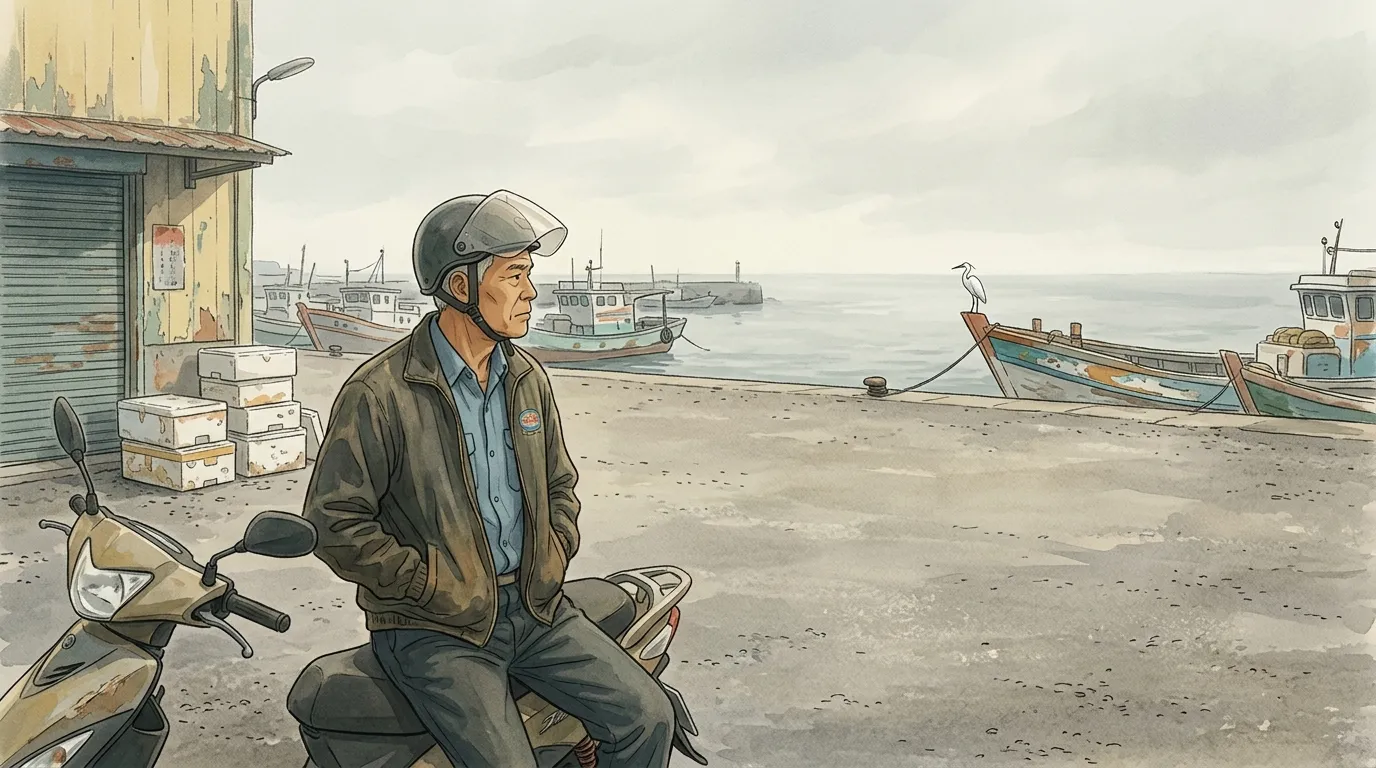
He parked the scooter at the edge of the lot.
No bus there today. Today was his day off; someone else was running the route. The gravel lot made no sound in the wind — the wind wasn’t strong enough. The seafood restaurant next door was still shuttered, a few polystyrene crates stacked at the door.
He stood there.
Helmet still on. He hadn’t taken it off. Hands in his jacket pockets. Wind from the sea, salty.
He’d just ridden the whole route. Beginning to end. On a scooter, in less than half the time.
The same road. The same direction. Passing the same shelters, the same junctions, the same turns. But everything was different. The road had narrowed; the signs had dropped lower; the shelters had become things with details — uneven chair legs, faded timetables, the shop sign next door changed at some point without his noticing.
He’d been driving this road for over twenty years, and today was the first time he’d walked it.
The sea in the distance was gray. February sea had no color, running together with the sky so you couldn’t tell where the water ended and the air began. A few fishing boats were moored at the harbor, their paint peeling. A white egret stood on the prow of the nearest one, motionless.
He watched for a while.
Then he got on the scooter and started the engine.
The return.
He didn’t take the same road back. He made a small detour — not a detour really, just a street construction ahead, and he went around one block to bypass it. The street he went through he didn’t know. He’d never been on it. A street he’d never been on, right beside the road he’d traveled for over twenty years.
That thought sat in his head for a moment. Not very long.
He got home just before eleven.
The metal shutter opened. Scooter pulled in. Helmet hung back on the handlebars.
His wife wasn’t back — she’d be back at noon. The living room was quiet. The television was off. The bowls from breakfast he’d washed; they sat clean on the counter.
He sat on the sofa. Jacket still on.
He sat there for about ten minutes. Did nothing.
Then he took the jacket off. Hung it on the back of the chair. Went to the bathroom to wash his hands and face.
His wife came home at noon.
When she opened the door he was in the living room, watching television. The news. Volume turned very low.
“Where did you go?”
She’d seen his jacket on the back of the chair — he didn’t usually go out on his days off. The jacket hanging there meant he’d been out.
“Went for a ride.”
His wife looked at him.
The look wasn’t long. Just over a second. But there was a great deal in that second — he could feel it. She was looking at his face, not a casual look, but the kind that was checking whether something was off. Her eyes moved from his eyes to the corner of his mouth, then back to his eyes.
Then she turned away.
“I’ll cook lunch.”
“All right.”
She went into the kitchen. The click of the gas burner. Running water. The cutting board.
Chen Zaifa sat on the sofa. The television was playing something about an industrial exposition.
He didn’t know what she had seen. Or maybe she hadn’t seen anything — just looked, confirmed he was there, confirmed he was fine, and that was that. Maybe she looked every day. Whether the lunch box was finished. What time he came home. How he took off his shoes when he walked in. The expression on his face when he came out of the shower. Maybe she had always been looking, and just never said.
Maybe what he didn’t know was much more than he’d assumed.
In the afternoon he dozed on the sofa. When he came to it was almost three. His wife was in the small room off the hallway, working the sewing machine — the quiet, steady tapping was going, da-da-da-da. That rhythm he’d been hearing for decades. His wife’s sewing machine was like the bus’s engine: always there, there until you forgot it was there.
His bus was at the depot today. No one else driving it. It sat there — a large animal on holiday, cooled down, gone quiet, waiting to wake again tomorrow.
Tomorrow he’d go back. Up at four-thirty. At the depot by five. The steering wheel — February’s wheel shouldn’t be as cold as January’s. But it would still be cool.
He’d start the engine. Pull out of the depot. Take the route. Past Chihkan Tower, Shuixian Temple, Shennong Street junction, the canal, Anping. Stop by stop. Doors open, doors closed. Passengers on, passengers off.
At the Shuixian Temple stop, he’d open the doors. Wait two seconds. Close the doors.
In the third row on the right, someone would be sitting, or no one would be sitting. Whoever sat there would not be Xu Jinfeng.
He shifted on the sofa. The sound of the sewing machine came through from the other room — da-da-da-da.
He closed his eyes, but didn’t sleep.
Listening to the sound. One beat at a time. Different from the bus engine — the sewing machine was faster, lighter, with occasional pauses in the middle where she was turning the fabric. He had never really listened to his wife’s sewing machine before.
Over twenty years. Same as the route. Alongside him, every day, every day, until he thought he knew what sound it was.
Today he heard it.
Da-da-da-da. Pause. Da-da. Pause. Da-da-da-da-da.
Outside there was wind. February wind was thinner than January’s — not a loud sound anymore, something finer, like someone slowly turning the pages of a sheaf of paper.
The sewing machine went on. He lay on the sofa and listened.