Chapter 8
Arrived
The light in late March is different from any other month.
Not the brightness. The color. The light in January and February is white — cold white, bleaching everything it touches. By late March it has started to turn yellow, soft yellow, and at five in the morning the line at the horizon isn’t gray-blue anymore. It carries a little pink.
Four-thirty. The alarm went off. Chen Zaifa switched it off and got out of bed. His wife shifted, didn’t wake.
Bathroom. Brush teeth. Wash face. Kitchen. Second shelf of the refrigerator. The lunch box wrapped in cling film, and beside it a small bag of pickles tied with a rubber band. He looked at it for a moment — when had she started including that? He couldn’t remember. Maybe it had always been there and he’d never noticed. Maybe it was something recent.
He tucked the lunch box and the pickles together into the canvas tote. Keys. The metal shutter. Scooter.
Riding to the depot, the wind was warm. Not hot — the temperature where skin has no complaints. Passing the soy milk shop, the oil was crackling as usual, but the dry cold that had sat underneath the air all winter was gone. The smell of frying drifted out wider, traveled farther.
The depot. The corrugated iron awning. The whiteboard. His name on the second line.
He walked the bus. Front tires, rear tires. Crouching, his knee made a sound — no pain, just a sound. He stood and patted the body three times.
Climbed in. Sat down. The dent in the seat cushion. The steering wheel —
Not cold anymore.
The late-March steering wheel was cool, not cold. He could put his hands on it without flinching, without rubbing them together first. That temperature sat exactly between felt and no adjustment needed. He gripped it at ten and two, the worn black plastic smooth in his palms.
Turned the key. The engine coughed once, the frame shuddering. Then steadied. The steering wheel began to vibrate, the frequency traveling from his palms up through his arms.
Five-thirty. He pulled out.
First stop. The doors opened.
A young mother with a small child boarded. The child was three or four years old, wearing a yellow waterproof jacket, a hood with two little ears. The mother swiped her card — beep — and took the child by the hand toward the back. The child’s feet landed on the bus floor one step at a time, each step planted firmly, as if making sure the ground was solid.
Chen Zaifa caught them in the rearview mirror for a moment. They sat in the priority seats on the left, second row. The child pressed against the window, face to the glass, one palm flat against it.
Never seen them before. New.
Closed the doors. Pulled out.
Chihkan Tower. A thread of incense in the air. Someone was doing tai chi in the square out front. The road surface changed from asphalt to stone slab, and the vibration through the tires grew finer. The luan trees had put out new shoots — pale green, pushing out in clusters from branches that had been bare all winter, as if someone had dabbed green spots across dark brown cloth. The bougainvillea on the wall next door had opened, hot pink hanging over the top of the wall, its color loud in the morning light.
Second stop. A man boarded. Mid-thirties, a dark blue work jacket, something embroidered on the left breast that Chen Zaifa didn’t catch. The man fumbled swiping his card — flipped it over once before finding the right side, the reader beeped, he hesitated before walking in, as if uncertain where to go. Found a window seat on the right and sat down, bag on his lap, and started looking at his phone.
New.
Chen Zaifa had seen plenty of this type. Changed jobs, moved house, retired and started taking the bus. At first they swipe wrong, can’t find a seat, don’t know which stop to ring for. Give it two weeks and they’ll have a regular spot. Give it a month and they’ll have synced to the rhythm of the bus — when to brace for the lurch on departure, which curve needs a hand on the rail, how many seconds before the stop to start standing up.
He didn’t know how long this man would ride. Three months, half a year, two years. Maybe a decade like Zhang Bo. Maybe gone next month.
Confucius Temple stop.
The doors opened.
Zhang Bo boarded.
Long-sleeved shirt buttoned to the top. Still long-sleeved in late March, but no jacket today. Pressed crease in his trousers. White hair combed neat.
He swiped his card and gave a brief nod toward Chen Zaifa.
Chen Zaifa nodded back.
He hadn’t used to. Today he did. Not deliberately. He just saw it.
Zhang Bo walked in and sat down. Same as every day. The new shoots of the luan tree caught the sunlight outside the window, pale green and glowing.
Closed the doors. Pulled out.
Shuixian Temple. The doors opened. Fish smell surged in with a damp edge that spring had added. The March market was louder than winter — vendors’ calls rolled in from the entrance all the way through the bus, tangled with the spitting sound of something going into a fry pan.
No one boarding. No one alighting.
He waited two seconds. Same two seconds as any other stop. Closed the doors.
Shennong Street junction. Something had bloomed in the alleyway — he didn’t know what, white flowers, leaning out over the top of a wall. All winter that wall had been nothing but water-stained concrete and a clump of dead vines. Spring arrived and everything came through at once.
The canal. The water had shifted from winter’s gray-green — it carried a touch of blue now, and in the sunlight there were small flashing points of light moving across the surface. The wind off the bridge was warm, pushing through the gap in the window without that cutting cold anymore. Loose, carrying the green smell of the riverbank grass.
Anping. Salt in the air. The fried shrimp cracker shop was already open, a few seconds of cooking smoke drifting past. The bus turned around.
On the return leg, the young mother and child got off at the canal stop. The child looked back into the bus as he stepped down — looking at something, or nothing in particular. The doors closed. Chen Zaifa caught the yellow jacket in the rearview mirror, shrinking on the platform.
Back to the train station. First run done.
Second run. Nine o’clock. The bus a little fuller. Tourist season with the bougainvillea. Two passengers with cameras got off at Confucius Temple stop; when the doors opened he heard shutter clicks — click, click — and then laughter. Zhang Bo got off at Confucius Temple stop, same as always.
On the return of the second run, Sister Wu boarded at the stop just before the canal.
Her way of boarding was always the same — left foot up first, right hand on the pole by the door, one smooth pull and she was on, faster than her build suggested. Fifty, solid, she wore a dark green polo shirt today with the sleeves rolled twice at the cuffs. She was carrying a plastic bag — not the usual thin white kind, something thicker, colored, with an oil stain spreading from the bottom.
She swiped her card and didn’t go sit down. Stood at the front.
“Hey —”
Chen Zaifa’s eyes were on the road ahead.
She set the plastic bag in the empty space beside the driver’s seat. “Oyster fritters from Anping, just fried. Eat them on your break.”
“You didn’t have to.”
“They’ll go bad if you don’t eat them. More wasteful.”
She had already turned and gone to sit down. The bag sat beside him, the oil stain spreading slowly from the bottom, the smell of the fritters — the batter crisp from the oil, the sea-salt of the oysters inside, the sharpness of minced chives pushed out by the heat — spreading through the cab, settling over the diesel and plastic-seat undertone.
Chen Zaifa glanced at the bag. Drove.
Train station. Second run done.
Mid-shift break. Under the corrugated iron awning, the wind had some moisture in it — late-March wind laying itself against the metal that had baked all morning, the roof ticking every so often with the sound of metal expanding or contracting. He sat in the folding chair, the lunch bag on the folding table.
No one beside him. Xiao Yang had left last month. Transferred to the Southern Science Park. On the shift board at the depot, his name had been erased — nothing left but a white smear. The new driver’s name was Cai, twenty-eight, quiet, but his break times didn’t overlap with Chen Zaifa’s and they’d barely crossed paths.
Fritters first. Three of them, wrapped in white paper already gone translucent with oil. He bit into one — the skin shattered, the oysters inside were full and still hot. He ate two. Wrapped the third and put it in the lunch bag.
He opened the lunch box. Pork ribs today, with a braised egg and blanched greens. The inside of the lid — clean, just a lid. No note.
He looked at it for a moment. Ate.
He picked up a piece of rib with his chopsticks. The pork had braised all the way through; the bone pulled clean. He’d been eating his wife’s pork ribs for more than twenty years. The saltiness had never changed. The depot was quiet, with only the occasional announcement from the train station drifting over, too far away to make out, like sound coming through water.
Partway through the meal he stopped. Not that he couldn’t eat — something had occurred to him. That small bag of pickles from the morning. He opened it and looked inside. Turnip, dried and cut thin, packed in a zip-lock bag. His wife’s own pickling.
There used to be notes inside the lid. After the notes stopped, this bag appeared.
He tipped some turnip out onto the lid and ate it with the rice. Crisp, salt with a thread of sweet.
He finished the lunch box. Finished the third fritter too. Closed the lid and put the box back in the canvas tote. The zip-lock bag still had some turnip left; he sealed it and tucked it in as well.
Third run, two o’clock.
Xiao Rou boarded at the Shuixian Temple stop.
Her grandmother was holding her hand. The grandmother carried two bags of groceries, her other hand holding Xiao Rou; Xiao Rou had her own small backpack, pink, a charm hanging from the zipper.
She’d grown. Last semester when she rode, the top of her head came to about halfway up the pole by the door; now it was closer to two-thirds. Her feet were bigger too — new shoes, white sneakers, the laces tied lopsided.
Her grandmother swiped first at the front. Xiao Rou came up behind her, on her toes, pressing her card toward the reader. Wrong angle, nothing. She adjusted — dragged the card across — beep. No, not right. The grandmother turned: “Press it, don’t throw it.”
Xiao Rou laid the card flat against the reader. Beep. Through.
She smiled — quick, the corner of her mouth going sideways. Then ran to sit beside her grandmother, feet swinging under the seat, not quite reaching the floor.
Chen Zaifa watched in the rearview mirror for two seconds. Pulled his eyes away. Pulled out.
Three-thirty. Back at the depot.
He walked from the first row to the last row as usual, checking the seats. A tissue had been wedged near the window of the fourth row on the left. He picked it up. The gap in the last row was clear. He walked back to the front, checked the doors. Lights. Key. Climbed down.
Rode the scooter home.
The neighborhood grocery had put up a new sign — white LED, brighter than before. His wife’s scooter was parked in front of the metal shutter.
Went in. Slippers. The lunch box on the counter. Washed his hands.
The living room television was off. From the small room down the hall came the sound of the sewing machine. Clatter-clatter-clatter-clatter. Stop. Clatter-clatter-clatter. Stop.
He stood in the hallway and listened for a few seconds.
He hadn’t used to stop. Come in, put things down, wash hands, sit down. The sewing machine had been background, same as the clock. Now he could hear the rhythm — clatter-clatter-clatter-clatter, stop, clatter-clatter, stop. The fast stretches and the slow ones were different.
He didn’t go in to look. He went and sat on the sofa.
His wife’s voice came from the small room: “Did you finish your lunch?”
“Finished it.”
A pause. The sewing machine started up again. Clatter-clatter-clatter-clatter-clatter.
He leaned back against the sofa. Jacket still on. Closed his eyes for a while. Not sleeping — listening. The sewing machine. The clock. The occasional scooter passing outside.
He’d been hearing these sounds for more than twenty years. Before, they had been one blurred mass of house sounds. Now they were separate things, one by one.
April.
Four-twenty in the morning, Chen Zaifa woke. The alarm hadn’t gone off yet. Outside the window it was dark, but a different dark from winter — winter’s four-twenty was black, nothing visible; April’s four-twenty held a thin layer of deep blue at the edge of the curtain, not light, the trace of darkness beginning to lift.
He lay there for a minute. His wife’s breathing was light and even, and through the quilt between them it sounded like someone far away turning pages of a magazine, slowly.
The alarm went off. He switched it off. Got up.
Bathroom. Kitchen. Lunch box. Pickles. Keys. The metal shutter. Scooter.
He arrived at the depot. The line at the horizon was shifting from deep blue toward pink. The clouds were thin, lit from below, their edges dyed orange-pink. The corrugated roof of the awning had caught a little of the sky’s color; there was dew on the metal surface.
He walked the bus. Front tires, rear tires, his knee made a sound. Patted the body three times.
Climbed in.
Sat down. The steering wheel was room temperature. April’s steering wheel registered nothing against his palms — not cold, not cool, not warm. Just a steering wheel. Worn black plastic. The temperature of his hands and its temperature the same.
He reached into the side compartment and took out his water bottle, set it in place. Lunch box by his feet. Towel over the seatback.
Turned the key.
The engine coughed once. The frame shuddered.
Steadied. The steering wheel began to vibrate. Palms. Arms. Shoulders. The frequency entered his body.
He glanced in the rearview mirror. The bus was empty. The seats ran back in rows, the overhead lights still off, the morning sky coming through the windows and laying a thin blue-gray across each seat cushion. Third row on the right. Empty.
He looked away. Released the handbrake. Clicked on the turn signal. Clack. Clack. Clack.
Five-thirty. He pulled out.
The sky shifted from deep blue toward pink, the streetlights still burning. His headlights fell across empty road.
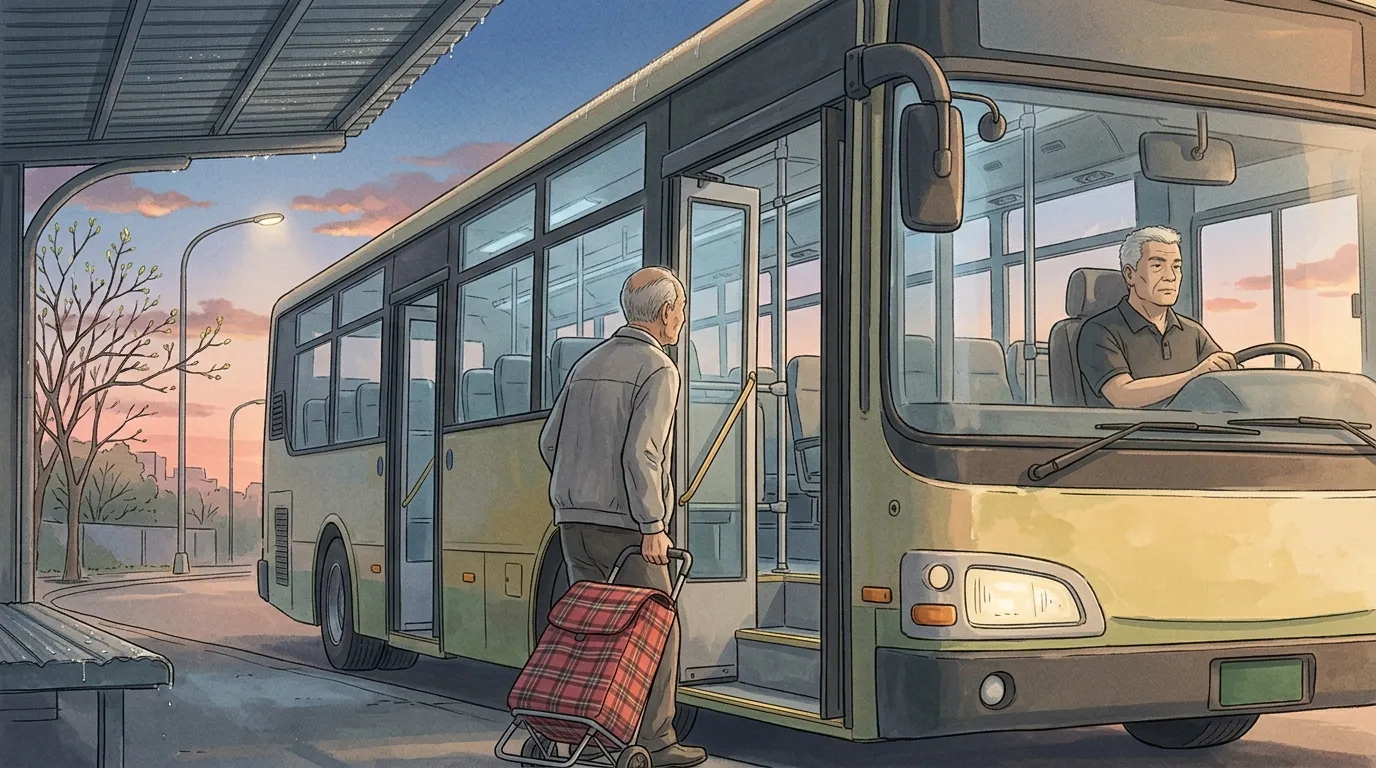
First stop.
One person standing under the shelter.
An old man. Looked to be in his seventies. Thin gray jacket, white shirt underneath. Left hand on a wheeled shopping trolley — red plaid fabric, small wheels, standing steady on the platform tiles.
The doors opened. Hiss.
The old man stepped up onto the platform. Left hand pulling the trolley; the trolley’s wheels caught the lip of the step, hesitated, and he lifted it through. Slow, but without hesitation.
Right hand reached into his pocket for a card. He held it to the reader.
Beep —
He didn’t look at Chen Zaifa. Pulled the trolley and walked in. The trolley’s wheels rolled across the bus floor, making a faint sound.
He walked to the third row on the right. Sat down. The trolley rested beside his leg.
Chen Zaifa looked in the rearview mirror.
The old man sat there, face toward the window. The morning light lay across his white hair, tinting it a pale blue-pink. The red plaid trolley stood at his feet.
Chen Zaifa looked away.
Closed the doors. Hiss.
Pulled out.