Chapter 4
Chápǔ'ěr
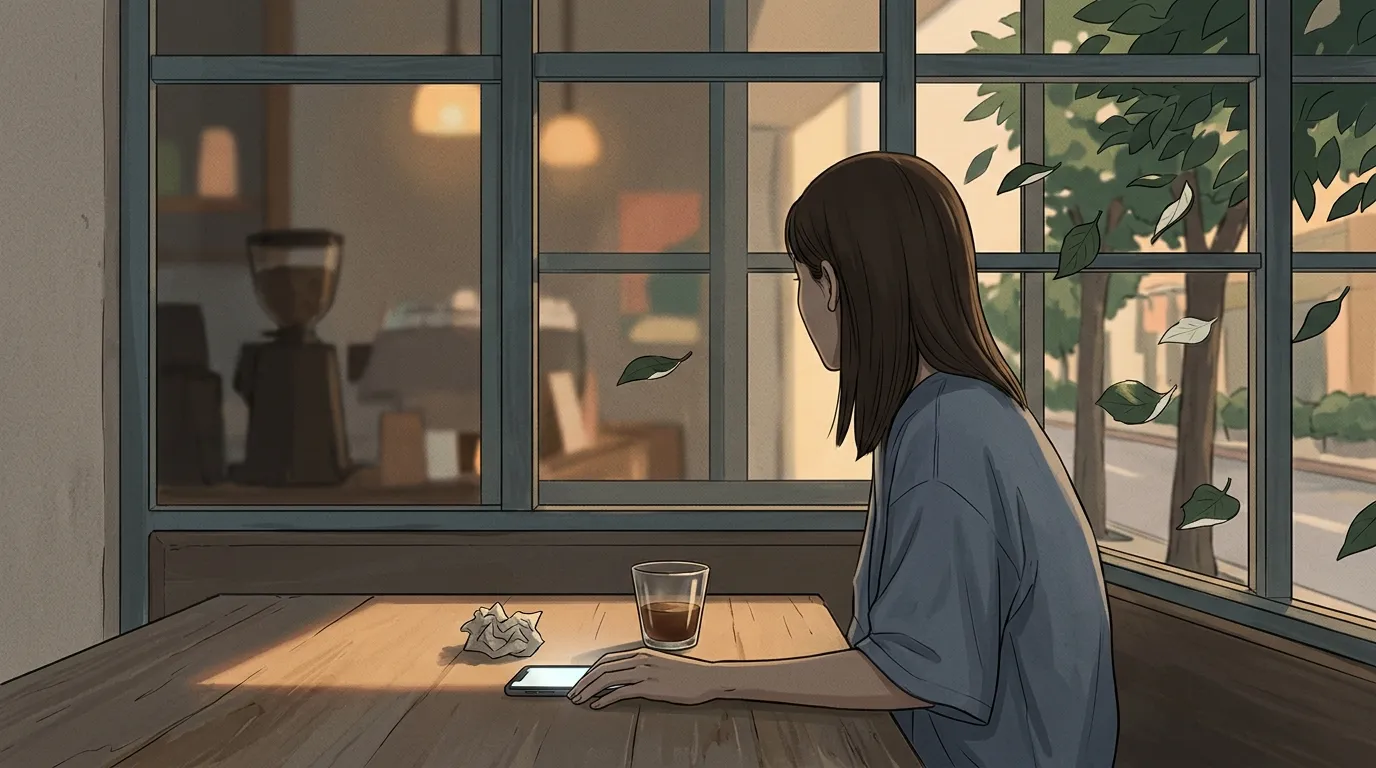
Chapter 4: Chápǔ’ěr
Chápǔ’ěr’s first post in the main group came on her second day.
She wrote: “Hi everyone, I’m Chápǔ’ěr! Really happy to meet you all. A little about me — I studied design, sort of — former dropout, haha, currently working at a café, picking up small freelance jobs on the side. I’ve been running into some stuff at work lately, like, manager issues, it’s kind of complicated. Anyway, hi!” Followed by a waving sticker, a confetti sticker, and then a “haha” emoji.
A few people said “welcome welcome!” A few 🌱s got pressed. Mǐnkuí-jiě said: “Oh Chápǔ’ěr is so sweet! Feel free to talk about anything, we’re a really warm space here.”
I was scrolling a different window at the time and didn’t respond right away.
Then I went back and read her intro again. The part that stopped me was: manager issues, it’s kind of complicated. Anyway, hi! — that anyway, hi. The way she said it was like throwing something serious out into the room and then catching it herself, covering it over before it could land.
I know that move. I’ve made it a lot.
I typed a quick reply in the group: “Welcome Chápǔ’ěr! Feel free to come to us with anything.” And not long after, a private message popped up. Fúqú.
“Zhànlán, would you be willing to be a companion for Chápǔ’ěr? She’s been targeted by her manager at work, a lot of pressure, she needs someone stable. I think you’re in the right place for it right now.”
I said yes.
Fúqú said: “Thank you. Chápǔ’ěr is interesting — she thinks fast, lots of ideas, but she has a habit of using laughter to cover the heavier things. When you talk to her, no rush — just let her talk.”
I said I understood.
Fúqú said: “Your headspace has really been good lately.”
No question mark.
Near the end of that month, I sent my first private message to Chápǔ’ěr.
I said: “Hey, it’s Lánlán! Fúqú mentioned you’ve been going through some stuff — if you ever need to talk, I’m here.”
Almost forty minutes of silence. I thought maybe she wasn’t going to respond today. Then she sent a wall of text.
“Oh hi Lánlán-jiě!! I’ve literally been wanting to talk to someone forever but didn’t know who to message haha, like you know that feeling? Every time I start to, I think I’m bothering someone, but honestly I’m kind of losing it, like my manager — can I talk about it? Are you free right now? I’m in the bathroom, haha, because my manager has been making things weird every time he sees me in the office so I’ve been hiding in here to text you. Sorry this is so weird lol.”
I read that and felt something — I thought of a specific afternoon two years ago when I’d also opened Fúqú’s messages from a bathroom stall because I couldn’t do it at my desk, too scared a coworker would see.
I wrote back: “I’m free now, go ahead, bathroom is totally fine, I’ll wait.”
Chápǔ’ěr’s manager was named Shī Dézhèng, thirty-nine, overseeing an eight-person design department.
She worked part-time at a chain café, but because she had a design background, her manager had borrowed her to handle layout work for some promotional materials. What started as a one-off became routine. Her pay stayed at part-time rates. No additional compensation. Two months ago she’d worked up the nerve to ask about it, and he’d said “you’re not full-time yet, let’s talk once we convert your contract” — and for two months since then, there’d been no word on conversion, but the extra workload hadn’t shrunk either.
“I’m not saying I can’t help out, it’s just — like — I just feel like it’s being taken for granted.” Chápǔ’ěr said. “And the way he looks at me, I can’t explain it, but the way he looks at me says, like, what do you know, you’re just a dropout, who are you to be here, not in actual words but just — the look — and then—” She paused. “And then I know I’m being oversensitive. Right. Haha.”
That haha landed like a cigarette butt dropped in water. A short hiss, then gone.
I said: “That look you’re describing isn’t being oversensitive. What you felt is what you felt.”
Chápǔ’ěr went quiet for a few seconds, then said: “Huh, that sounds like… my mom.”
I said: “Does it?”
She said: “Yeah like, my mom sometimes also checks whether I’m being oversensitive before she says anything. It’s like — being told it’s not actually your fault. That feeling. Thanks, haha. Sorry I cried a little just now. I’m fine now!”
Then she sent a wiping-tears emoji.
We met in person for the first time in early May.
She said she wanted a quiet café. I said I knew one, on Dà’ān Road, not a chain, the grinder wasn’t too loud, walking in felt like walking into someone’s lived-in living room.
Chápǔ’ěr got there before me. When I walked in, she was already at the window seat — twenty-four years old, a gold clip in her hair, a plaid overshirt over a T-shirt, phone in hand, scrolling without really looking, the way you scroll when you’re waiting for someone.
She looked up when she saw me, and her whole face lit up. “Lánlán-jiě!”
I sat down. On the table was a latte that was almost gone, and a napkin she’d been folding and unfolding into a ball.
She said: “You don’t look like what I pictured.”
I said: “What did you picture?”
She said: “Like, I don’t know, more — teacher-ish? Haha, your smile is kind of funny, you know.”
“Funny how.”
“Not like ugly-funny! Like, your smile makes people feel relaxed. You know what I mean!” She laughed at herself a little, then seemed to remember something and dialed it back slightly: “Lánlán-jiě, did you — did you also go through something before you joined the group?”
“A breakup,” I said. “And some things that came with it.”
She said: “Are you a lot better now?”
“A lot better.”
“That’s good,” she said. “I sometimes wonder — groups like this, does everyone end up okay in the end, or do some people — I don’t know, I can’t really say it, haha.”
I said: “Everyone here is moving toward something better.”
That was a very correct thing to say.
We sat in that café for almost two hours.
Chápǔ’ěr talked a lot — about her manager, about how her position at the company was like a gray zone, neither full staff nor used like a temp, about how her roommate had switched jobs the month before and now left early and came back late every day, about how it felt to be alone in that studio apartment, about how a professor in design school had once used one of her projects as a counter-example in front of the whole class, about how dropping out was never just one reason, about how she didn’t tell her mom much of any of this because her mom’s usual response was “you just think too much.”
When she said “you just think too much,” I saw her fold the napkin again.
I said: “Has your manager said anything recently about making your contract permanent?”
She said: “Yeah, he said last week he was working on getting it approved, but it depends on what people above him decide. And on how I perform.” She paused. “And he said, if I had any concerns, I could bring them up now, but I should think carefully about my position first.”
“What does that mean,” I said. “‘Think about your position’ before bringing up concerns?”
“It means I’m part-time, I have no standing to raise anything,” she said, picking up speed a little. “But like, I wasn’t going to raise anything unreasonable anyway, I just wanted to ask about the pay, and then he said that, and then I just — didn’t. Ha.”
She laughed. The kind of laugh where you can’t remember, right after, what you were laughing at.
I said: “Have you thought about just sitting down with him directly?”
She said: “Yeah. I’ve actually been thinking about it a lot. I feel like if I could lay out what I have to offer and what I need, he might be — he might be more reasonable than I think — I don’t know, but if I said it clearly, it would feel better than how things are now, just hanging.”
I listened. The coffee cup stayed in my hand.
“Not yet,” I said. “You’re not in the right headspace for it.”
Chápǔ’ěr paused and looked at me.
I kept going: “Your feelings about him are still running hot right now. If you go in like this, your emotions will get steered around by him and he’ll have more to use against you. Wait until you’re steadier. It’ll go a lot better.”
She said: “Oh, yeah. I hadn’t thought of it that way.” She nodded. “That sounds right.”
It sounded right when I said it. I believed I was right.
But for one second, I heard my own voice overlap with another voice from another point in time, in a way that felt slightly off.
That second came and went. I didn’t follow it.
When I got home that afternoon, I cracked the window — May air, a little damp. The studio was just as small as always, three steps from bed to desk, but that day I sat at the desk and it felt okay.
My phone lit up. Mǐnkuí-jiě in the Helpers Circle: “Lánlán, you met with Chápǔ’ěr today right? How’d it go?”
I said: “Pretty well, she’s easy to talk to, a little unstable right now, but I think with time it’ll be fine.”
Mǐnkuí-jiě said: “Great! You have your own way with things, just keep being there for her. Fúqú says you’re a natural match.”
I said thanks.
Then I opened the main group, toggling between the Helpers Circle and the main group for a while. Today in the main group, a member called Xiǎo Zhōu had posted about going to the dentist — about getting a nerve block, described in extreme detail — said the sensation was “like your whole face turns into a slab of something but there’s still something moving inside the slab.” Someone replied “oh god that sounds horrifying.” Xiǎo Zhōu said: “Not horrifying, it’s fascinating! I finally understand what they mean by dissociation haha.”
She said dissociation so cheerfully that I figured she must’ve been in an okay mood.
I sent a “haha” emoji back, then put my phone down.
After that meeting, Chápǔ’ěr started texting me more often.
There was a code phrase — that was a tradition in the Companions system. Every pairing had one: a signal the person being accompanied could use to say I need to talk right now. Not “I’m about to break down,” not “I need you” — just a sentence that sounded ordinary from the outside. But you two would know what it meant.
Chápǔ’ěr spent about ten minutes choosing hers — typing something in our chat window, deleting it, typing something else, deleting that — and finally sent: “I want boba.”
I said: “That’s good. Simple. Nobody will clock it.”
She said: “Right! Because I literally always want boba anyway, so it blends right in, haha! Like even if someone saw my screen they’d have no idea if it’s a code or if I’m just hungry!”
She was already laughing before she finished writing it.
The first time Chápǔ’ěr sent “I want boba” was a Wednesday that same week, around nine at night.
I got it and replied right away: “I’m here. Go ahead.”
She said her manager had called out a layout she’d made, in front of the whole office, said it was “off,” but couldn’t say how it was off, and finally landed on “it feels amateurish.” She said: “I know what he said isn’t totally wrong, but like — you know? Like in front of everyone — like—” She sent three dots. A little while later: “Actually never mind I’m probably just too sensitive. Haha.”
I said: “You’re not too sensitive. When someone calls your work out like that, of course it stings. What you felt is real.”
She said: “You always say that, and then I feel like — okay maybe it actually isn’t my fault. Thank you.”
Then she said: “I was kind of just thinking — should I maybe go bring up the thing with my manager now? Like, the conversation.”
“Wait,” I said. “Your feelings are still fresh today. Give it a few days.”
She said: “Oh right, you’re right, I always forget.”
That conversation ran about forty minutes.
The second “I want boba” was the following Monday.
The third was that Thursday.
The fourth was the Wednesday after that.
The fifth came three days after the fourth.
By the fourth, I noticed Chápǔ’ěr was saying she felt “okay” more often. She said “actually things have been a bit better lately,” she said “I had dinner with my roommate today, it was nice,” she said “my manager didn’t bother me much today” — all real things, all said sincerely, I had no reason to doubt any of it.
But then the fifth “I want boba” came in at eleven-thirty at night.
Her messages that night were different. No “haha,” no emojis, sentences cut short.
My manager said that thing again today. Depends on your performance. I don’t know why but the tone of it made me think of being called on in school. I’m crying.
That last line was just that. No “sorry to bother you,” no laugh to cushion it. Just three words.
I kept her company until almost one in the morning.
After I put my phone down, I stared at the ceiling. The AC ran its steady sound, the kind of sound that never has anything wrong with it.
She said she was getting better. But the time she needed from me kept getting longer.
I put my hand on my chest. Something had settled there — light, but with weight. Not because of her. Something that was mine.
That feeling was my problem. Not hers.
Around that same time, a member named Hǎilàng disappeared from the group.
Not a sudden disappearance — the kind where you slowly notice her less and less until one day you realize it’s been a long time since you’ve seen her post. I remembered Hǎilàng — she’d mentioned a few times that she was caring for an elderly family member, said there were a lot of feelings in that caregiving that had nowhere to go, and I’d replied to her a few times. She wrote the way she seemed to live: calm, not scattered, nothing dramatized, but every single thing she said had a weight to it.
One day I asked Mǐnkuí-jiě in the Helpers Circle: “Haven’t seen Hǎilàng post in a while, is she okay?”
Mǐnkuí-jiě said: “Her situation — there was some kind of misunderstanding between us, and she stopped coming.”
“What kind of misunderstanding?”
“Like, her perspective on some things was a bit different from where we’re coming from. So she ended up — not coming anymore.” She paused. “Sometimes it just goes that way. Not everyone fits this group’s approach. I know that sounds harsh, but some people do leave at a certain point — and that’s not necessarily a bad thing, maybe she found somewhere that works better for her.” She sent a smiley face. “How are you doing? How’s Chápǔ’ěr?”
I said fine.
I didn’t ask any more about Hǎilàng.
But I held on to the word “misunderstanding.”
During that stretch, Fúqú shared something in the Helpers Circle — a “Companion Observation Log” template she’d put together.
It was a simple chart. Fields for: member’s current status this week, key events, emotional keywords, how I responded, and observations to track going forward.
Fúqú said: “I’ve always felt that if you run on instinct alone, you develop blind spots. Writing down what you observe lets you see patterns you can’t otherwise see. This isn’t mandatory, but I found it useful for myself — feel free to try it.”
Mǐnkuí-jiě immediately said: “I’ve been using this for two years, every single week!” And said it made such a difference. Liào Tíngxù said thanks to Fúqú for compiling it.
I screenshotted the template. That night I filled out an entry for Chápǔ’ěr — a page and a half — and then stared at the last field for a long time. Observations to track going forward. I typed: “Continue being present, track whether her confidence in making her own decisions is growing.” Then closed the document.
The act of filling it out made me feel like I was doing something structured.
That feeling — and the floaty feeling I’d had sitting in my chair after winning Helper of the Month three months ago — weren’t the same in the details, but there was a thread running through both of them that was.
There was a member named Qiū Píngpíng. She was one of the oldest members in the group.
The first time I noticed her was on a night not long after I’d joined. She’d posted a single “mm” in a group conversation, nothing more, but when I read it, it didn’t feel light. She didn’t say anything else after that.
After Chápǔ’ěr joined, she posted in the main group one day saying work had been hard, then added: “But I have Lánlán-jiě! Having someone to talk to helps so much.” With a heart. The heart got a lot of responses — a lot of people said “that’s wonderful,” said “Lánlán you’re great,” said this was what Good People was all about.
Píngpíng hit the heart. But said nothing.
I asked Fúqú: “Is Píngpíng okay lately? She posts so rarely.”
Fúqú said: “She’s adjusting, needs some space. Everyone has their own rhythm. Have you talked to her?”
I said no.
Fúqú said: “She’s a good person. If you get a chance, have a chat with her — she’s been here a long time, her perspective on a lot of things is different from ours.”
That night I sent Píngpíng a private message.
I said: “Hey Píngpíng, I’m Lánlán, we haven’t really talked before, but I see you in the group — how are you doing lately?”
She took about half an hour to reply.
“Okay. Are you the one accompanying Chápǔ’ěr?”
“Yeah, that’s me.”
“Mm,” she said. “How do you see her current state?”
I said: “She’s making progress, but not consistently — sometimes good, sometimes she still needs a lot of support.”
“Mm,” Píngpíng said. “Have you ever asked yourself — if she starts doing better, how does that feel for you?”
I looked at that question. I was a little surprised by it, but I thought I understood what she was getting at.
“You mean, if she doesn’t need me anymore, would I feel the loss of that sense of accomplishment?” I said. “I’ve thought about that. But if she actually gets better, that’s the best possible outcome. That’s something I should be happy about.”
Píngpíng was quiet for a long time. I’d already started to reach for another window when she said:
“Mm.”
Then: “It’s good that you’re thinking about it.”
She didn’t say anything more. I said “thanks for talking with me,” she said “sure,” and I closed the window.
That pause before the “mm,” and then the “it’s good that you’re thinking about it” — I only registered, once I was back in the main group, that there was a kind of gap between those two things. I couldn’t tell what kind of gap it was.
I didn’t ask. I assumed she was done.
Early June, Chápǔ’ěr sent the sixth “I want boba.”
It was a Friday. I was about to leave work, had spent the afternoon freezing under the office AC, pulled my jacket out of the drawer and put it on, and then my phone lit up.
I replied “I’m here,” leaned back in my chair, put my earbuds in, and waited to read.
She said her manager had told her to redo something that had already been finalized, said a client had complained, but when she checked with the client, the client said they’d never received that version at all. “So I don’t know if it’s because I didn’t send it or because he didn’t forward it, but he put it on me right away, like — you know? The way he said it—” She went on for a while, words coming fast.
I kept her company for an hour.
Toward the end, Chápǔ’ěr said: “Actually I’m thinking — should I just go talk to him now, just lay it out, if he keeps doing this I’ll—I just want to say it clearly.”
“Say what clearly?”
“Like, the pay thing. And what my job is actually supposed to be. All at once.”
I thought for a second and said: “Your feelings are still running today. Going in now won’t work well. Let this week pass first.”
Chápǔ’ěr said: “Okay, you’re right, I’ll wait a bit longer.”
She said “thank you,” said “I’m so glad you’re here,” said “I don’t know what I’d do on my own otherwise,” said “you must be so busy and you still reply every time, thank you.”
I said no worries, said I had time, said she shouldn’t worry about it.
I put my phone down and looked at the office ceiling. The AC blew circles above my head.
She said I’m so glad you’re here. I knew that was real. And I knew — for me, hearing that sentence, that feeling of something being caught — that was real too.
Both things were real.
But I couldn’t explain why both had to be true at the same time.
That weekend, at home, sorting through odds and ends on my phone, I found my chat window with Chápǔ’ěr and scrolled back a long way.
I counted the “I want boba”s. Six times, in a month and a half.
Then I opened another window alongside it — the messages between me and Fúqú from when we’d first gotten to know each other, two years ago.
I hadn’t opened that window in a long time. I only scrolled up a short distance, and I found a sentence Fúqú had sent me at some point. Then I flipped my phone face-down on the blanket.
That sentence, and some of the things I’d said to Chápǔ’ěr — the sentence structures weren’t the same, but something at the core, the logic of it, the timing, that structure of I’ll judge for you whether you’re ready — was the same.
My screen went dark from being face-down.
I didn’t flip it back over.
That night I didn’t think too hard about it, because thinking hard about it wouldn’t help, because I was already helping her the right way, because she said thank you, because I believed I was doing the right thing.
The Sunday after that, I sat in the café on Dà’ān Road.
I was waiting for Chápǔ’ěr — we’d agreed to meet this week, and she’d said she wanted to treat me to coffee, as a thank-you. I got there first, ordered a pour-over, set my phone on the table, and watched the trees outside through the window.
Summer had come. The leaves were deep green — the kind of green that flips pale in the wind before turning dark again. I watched them do that for a while. It didn’t feel bad.
My phone lit up. Chápǔ’ěr: “I’m on the MRT, ten more minutes!” Followed by a running sticker.
I sent back okay.
Then, about seven minutes later, my phone lit up again.
“Lánlán-jiě, thank you for this past month and more. I really feel like — like you’re the most important person in my life right now.”
No emoji.
I read that sentence. Outside, the leaves turned once more.
I knew what I should say — I should say “don’t put it like that, you have so many people,” say “I’m just your companion,” say “the most important person is always yourself.” All of those would be right.
But while I was thinking about what I should say, my phone was warm in my hand in a way I couldn’t name.
Not quite joy, but close to it.
Not quite unease — but underneath the joy, something like a small stone, oddly shaped.
I couldn’t name it.
The grinder ran from somewhere behind the counter. The wooden table had a ring of warm yellow where the light hit it. Chápǔ’ěr said ten more minutes.
I still hadn’t replied to her message.