Chapter 5
The Perfect Temperature
Chapter 5: The Perfect Temperature
I know now what “the perfect temperature” means.
It’s that state where you don’t feel hot, don’t feel cold — where you stop being aware of your own body. That not-noticing. That slow dissolve where the boundary between you and everything around you starts to blur.
One year in, I was living in that temperature.
After Chápǔ’ěr joined, I didn’t have room to think about much else for the next six months.
She took up a lot of my emotional bandwidth — and I didn’t experience that as a bad thing, not then. It was just: knowing there’s someone waiting for you, someone who might need you at any moment, someone who keeps you in a state of low-level readiness. Background process. You don’t feel tired. But you can’t fully relax, either.
Those six months, we met at least once a week. More calls than that. Her manager Shī Dézhèng got reassigned to a different department at the end of May — no longer directly over her — and that helped Chápǔ’ěr a lot. Helped so much that for a while, she was only sending “I want boba” every other week. I started thinking she might be close to graduating. Then at the end of June her roommate moved out, and she was living alone, and “I want boba” came back — more often than when the manager was still there.
The days when I saw “I want boba” show up again, something in me stirred. Light, hard to name — like a wire being reconnected. I didn’t look at that feeling, because it wasn’t right. I just saw that Chápǔ’ěr needed me again, that she was at her most vulnerable, and that I should be there.
I couldn’t say it was abnormal.
That’s roughly how I was thinking about it then.
By the one-year mark — which is where we are now, at this chapter — I had three companions at once.
Chápǔ’ěr was the first. The other two were assigned to me by Fúqú later on: one named Chénguāng, thirty-one, going through a divorce; one named Yuèyá, twenty-five, who said her relationship with her family had been strained for years and she didn’t know how to fix it. My companionship with Chénguāng and Yuèyá never went as deep as it did with Chápǔ’ěr. They were easier to talk to, both of them had more of their own direction. Sometimes I felt like I wasn’t really helping them that much — they just needed someone to listen. But Kindness Miles were Kindness Miles.
On the points leaderboard at that point, I was second. Mǐnkuí was first.
She’d been holding that position for as long as I could remember. Her score was roughly one-point-eight times mine. I’d never overtaken her. I’d never tried particularly hard to, I told myself.
The thing that first made me stop was Chápǔ’ěr and Shī Dézhèng.
By that point Shī Dézhèng had been in his new department for almost four months, but the company was small enough that switching teams didn’t mean never seeing someone. On a Wednesday in early July, Chápǔ’ěr sent me a torrent during her lunch break — that rapid-fire, sentence-fragment, filler-word-tumbling-over-itself way she wrote when something was happening. The gist was: Shī Dézhèng had run into her in the break room that morning, said “I hear you’ve been doing well lately,” and the tone had been impossible to read — that kind of tone where you can’t tell if it’s genuine or sour — and then he’d put his hand on her shoulder and given her a pat.
She said she’d been trembling the whole morning.
I was at my desk writing her back, thinking about those words — trembling the whole morning — thinking that must have been a brutal few hours.
In the middle of typing my reply, my phone lit up with a message in the main group.
Fúqú.
“It feels like a lot of people are under more pressure today. Remember to say something — feelings get heavier when they stay inside. I’m here.”
No question mark.
I looked at that message for a few seconds.
I didn’t think anything. I went back to replying to Chápǔ’ěr. I really didn’t think anything, not at that moment. It was just — something, light, grazing something somewhere.
What that grazing was, I only understood later.
Fúqú’s timing had always moved me. She was always saying the right thing at the right moment, like she had some fine-tuned sense of the group’s temperature. It was like that when I first joined, and it was like that after I became a companion — every time I was in the middle of a private conversation with a member, Fúqú would drop something into the main group that felt like it was saying the exact same thing, and I’d get this feeling of yes, exactly — like being echoed.
But that Wednesday in July, I started tracing backward without meaning to.
Before that Wednesday, Fúqú showing up at exactly the right moment was happening at least once a week. She didn’t post every day — maybe once or twice a week — but the timing of those posts was too precise. I’d be in a chat with Chápǔ’ěr, who was telling me her whole day had fallen apart, and then the main group would get: “How’s everyone doing right now? Pressure needs to come out.” A member would just have told me in private she’d had a huge fight with her mother, and then the main group would get: “Family relationships can make us feel so isolated sometimes. You’re not carrying this alone.”
That frequency — it was high enough that I started running a kind of inventory in my head.
I hadn’t opened anything, hadn’t compared any records. Just a feeling I couldn’t quite name — the odds of this don’t quite add up.
I told myself it was coincidence. Seventy, eighty people in the group — of course someone was under pressure at any given moment, and Fúqú could say almost anything and it would “happen” to match someone’s situation.
I put the feeling down. Or told myself I had.
The Gratitude Gathering was at the end of August.
Fúqú brought it up in the Helpers Circle. She said it was something she did every year around this time — getting everyone together, no particular agenda, just letting people who’d found each other here actually meet, and take a moment to thank each other.
The venue was a rented event space in Dà’ān — eight minutes on foot from the Dà’ān MRT stop. I knew the area, because I’d interviewed for a job on that street once. The space was small, maybe thirty people comfortable, wood long-tables, a few rows of folding chairs, a dried-flower arrangement by the door. Fúqú said: “It’s casual — no need to dress up. Just come as you are.”
Around twenty-some people showed. All the more active members, plus a few I’d only ever seen as names in the group and never privately messaged. Chápǔ’ěr came too. She’d put on a light plaid short-sleeve top, her hair was done, and the moment she walked in she found me and said “Lánlán-jiě!” and came to sit beside me.
The first half of the evening was pretty ordinary — someone brought snacks, everyone shared them around, caught up, Chápǔ’ěr said a few words to Chénguāng sitting next to her and I tuned in for a bit, it seemed like they were hitting it off. Someone was looking for the nearest parking exit. Someone was debating when the MRT had last updated its design.
Then Fúqú said: “Let’s take a moment to share gratitude. Nothing long — just one moment that gave you strength.”
And it began.
A member named Jǐnróng went first. She said that at the end of last year, a potential work transfer had almost forced her to leave Taipei. During that time, someone in the group asked her every morning “how’s today going”, and that had made her feel like she wasn’t handling it alone. She said “that morning check-in was how I knew I hadn’t disappeared.” Her voice caught a little at the end.
Then a man I didn’t know the name of said that during his divorce last year, someone from the group had still been answering his calls in the middle of the night. He said thinking about that call now still made him feel warm.
Then Jiāyí spoke about something from last year. Her voice was steady at first, but by the end it had started to shake. She said: “I know this has all made me better. I really do. The fact that I can say that now — it’s because of all of you.”
I sat on my folding chair and watched them, and something rose slowly from my chest, and my eyes went hot.
I was surprised I was crying. It was like something had loosened somewhere, and my eyes loosened with it. I didn’t wipe the tears away, because Chápǔ’ěr was crying too, and a few people nearby were crying too, and the emotion in that room was real — thick in the way that only happens when a lot of people feel something at the same time.
That feeling was real. Real in the moment, not the kind of real you convince yourself of afterward.
And then, inside that realness — something else was also there, something I couldn’t put into words.
It wasn’t fighting the feeling. It was just there, alongside. Like taking a sip of tea, and on that one sip, there’s something — you can’t quite say what.
I never found a name for it afterward. I just sat in that room and let my tears dry and listened to the next person say their thanks.
Fúqú said she was grateful for everyone — grateful for every “soul willing to give.”
When she said it, I noticed the phrasing. Souls willing to give. She didn’t say “brave people” or “people willing to speak up.” She said souls. The word made everyone in that room simultaneously become something precious.
I didn’t overthink it in the moment. I just held onto the phrase.
Later I thought about what that phrase had actually done. It divided everyone in the world into two kinds: people who were in that room, and people who weren’t. The ones in the room were souls who give. The ones who weren’t — were just people who hadn’t said anything.
But that was a later thought. In the moment, I was just moved.
After the gathering, people filtered out slowly through the event space’s entrance.
Chápǔ’ěr said she was heading to the MRT, asked if I was going that way, and I said I’d walk a bit first to think — she went on ahead. I stood by the door for a moment, adjusted the strap of my bag, and looked up to find Qiū Píngpíng standing beside me.
I hadn’t noticed her come over. She’d been there the whole evening but hadn’t shared a single word of gratitude — she’d just sat, drank something, nodded occasionally.
She said: “You cried today.”
Not a question.
“Yeah,” I said. “It was moving.”
She looked at me. Her expression was calm — not the kind of calm that comes from having no feelings, but the kind where all the feeling is underneath.
“Have you ever thought,” she said, “about who benefits most from all this.”
My first reaction was to think she meant the group’s public image — the kind of question like, does this kind of gathering create dependency in members, does it help the group function better. I assumed she was asking about management.
“You mean,” I said, “like whether the gathering is useful for holding the community together?”
Píngpíng didn’t say yes or no. She just looked at me. Her expression didn’t move.
Then she said: “Do you know why Hǎilàng left.”
Not a question.
I said: “Mǐnkuí mentioned there was some kind of misunderstanding between her and the group, and then she stopped coming.”
Píngpíng said: “Mm.” Paused. “Go ask her.”
Then she said good night, turned, and walked away.
I stood there at the entrance of that event space, watching her go toward the MRT, the night wind pushing her hair back once, and then she was gone around the corner of the sidewalk.
I stood in place for a while.
The shape of the question turned in my head — who benefits most. I tried fitting it into every framework I could think of, and each one half-worked and half-didn’t. The gratitude atmosphere drawing the community closer — that benefits Fúqú, benefits Mǐnkuí, benefits the companions, benefits the people being accompanied.
Every explanation fit. So which one was hers, I couldn’t say.
Something else happened that evening.
Near the end of the gathering, a member named Wénqí stood up to share. She talked about the night before her surgery last year — she’d had an operation — and how someone from the Helpers Circle had kept her company talking through the whole night, so she wasn’t as scared. Then she said: “I want to thank Lánlán-jiě. That night she asked me what my favorite season was. I said spring. And we talked about spring for a long time. I kept thinking about that conversation on the operating table, right up until the anesthesia put me to sleep.”
I was in the middle of wiping my eyes and I stopped.
Spring things.
I had that memory. But at the time I hadn’t thought much of it — I was just keeping her company, talking her through things she loved to shift her attention, the most basic accompanying technique. I wasn’t even sure how clearly I remembered that night. But she remembered it more clearly than I did.
That image stayed in my head for a long time.
I thought later — this memory, for Wénqí, was real and precious. The things we’d talked about that night were the memory of being accompanied during her most vulnerable moment. What happened was real. That warmth was real.
But when she said it, that gratitude was placed in this specific room, after Fúqú had just said souls willing to give — and the gratitude made the entire room more… confirmed in what it was.
I couldn’t say what the problem was with that. I also couldn’t say there wasn’t one.
On the way home that night, something kept returning to me no matter how many times I set it aside.
Fúqú’s way of asking.
I’d thought of it on the MRT home — I was sitting in a window seat, the night view passing outside as the line headed south, lights moving through the glass.
Every time the group discussed whether to do something, Fúqú’s question was almost always —
“Do you feel your current state is right for this.”
Period. Not a question mark.
I’d always assumed it was just her way of speaking — the way Qú-jiě talked, measured and complete, like she was confirming rather than asking. But on the MRT that night, something made me stop on the phrasing.
“Do you feel your current state is right for this.”
What was it actually asking?
It wasn’t asking: Do you think this is a good idea?
It was asking: Do you feel your current state is suited for it?
Whether the thing itself was good or not — that wasn’t in the question. What was in the question was your state. The assumption built into it was: maybe this thing could be done, but your current state — is it right for it? So if the answer was I’m not in a great place right now, the natural conclusion was then don’t do it yet — not is this thing worth doing on its own merits.
The thought flashed through my mind like a light briefly turned on.
I couldn’t keep thinking about it, because the train arrived at my stop and I had to get out.
I walked out of the station and home. The shape of the thought was still there in my head, but I couldn’t tell what shape it was. I couldn’t tell what it made me feel, either.
I didn’t sleep that night.
I lay in bed and something kept turning, slowly — not urgent, not violent, just turning. Not painful enough to call suffering, but enough to keep me awake.
In all that turning, what I kept coming back to was what Píngpíng had said: “Do you know why Hǎilàng left.”
Hǎilàng.
That name in my memory was a single line — someone who cared for an elderly family member, someone whose voice always ran quiet, someone Mǐnkuí had said left over some kind of misunderstanding.
“Go ask her.”
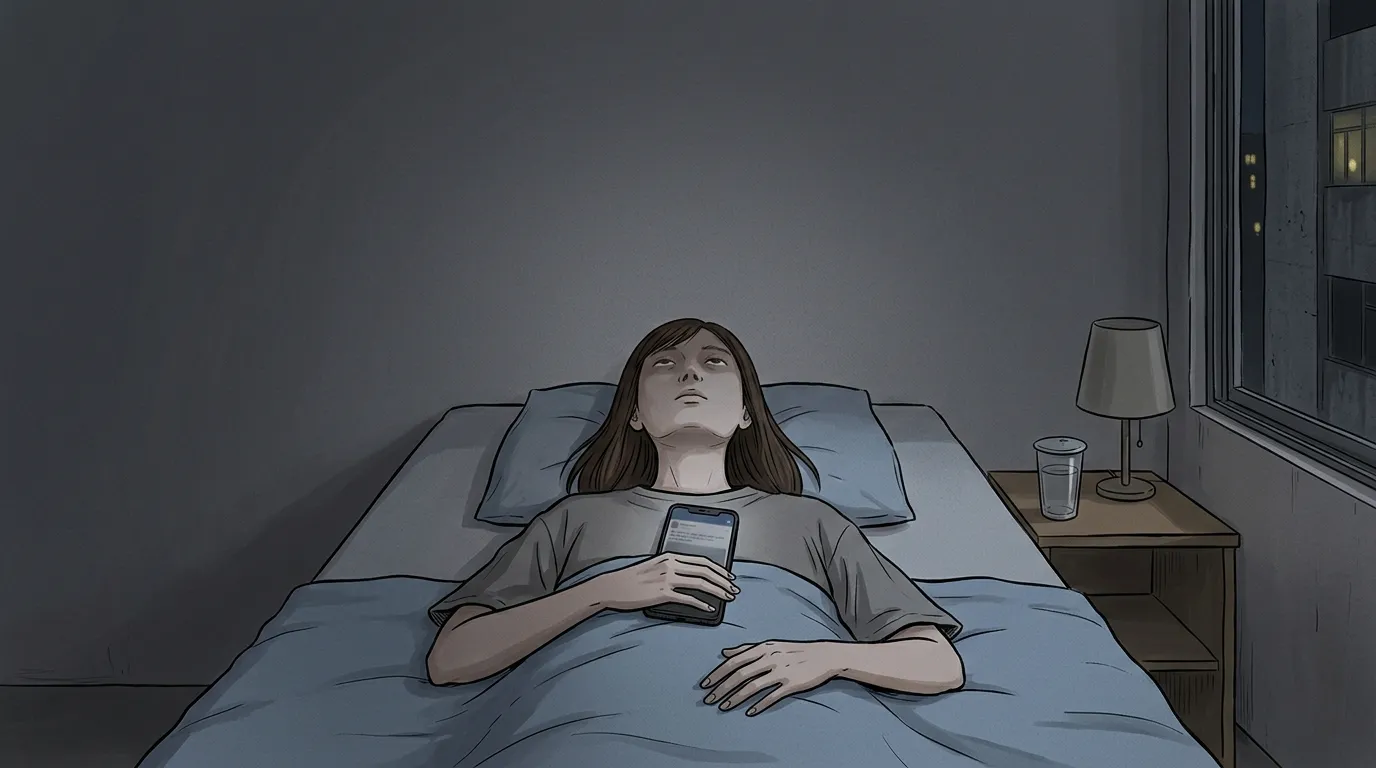
I pulled my phone out from under the covers, opened social media, searched Hǎilàng, Good People — nothing came up. Then I thought of her avatar: a photo of waves breaking against rocks. I tried some keywords in the search bar, switched through a few platforms, and finally found an account with that same photo as its profile picture. The account was set to private.
The last public post was from this past November.
The post was short. One line: “There’s nothing wrong with me. I just need to leave a place that makes me feel like something is.”
No comments. Either they’d been hidden when the account went private, or she’d already been private when she posted it and no one had seen it to comment.
I looked at that line. I turned down the screen brightness one notch — I didn’t know why. I just did.
“There’s nothing wrong with me. I just need to leave a place that makes me feel like something is.”
I stared at it. Didn’t move.
What “that place” was, I didn’t know. Maybe home. Maybe work. But she’d said there’s nothing wrong with me. She hadn’t said I’m better now. That difference in word choice carried weight — the problem wasn’t in her.
After that she never posted anything else. Account private.
I rested the phone on my chest. The ceiling was a gray flat surface in the dark.
I decided I was going to find Hǎilàng.
I didn’t know where that decision came from, or what I’d say if I found her, or whether she’d even want to talk. I wasn’t even sure the account was definitely hers — maybe it was someone with a similar name and a similar profile picture and nothing more.
But I’d decided. That was it. No particular reason. Just decided.
The screen on my chest dimmed slowly. I didn’t turn it back on.