Chapter 6
What Hǎilàng Said
Chapter 6: What Hǎilàng Said
It took me a long time before I was actually sitting across from Hóng Lán.
Between the decision and the meeting, two or three months passed. Those two or three months, I didn’t stop functioning inside the group — Chápǔ’ěr was still there, Chénguāng and Yuèyá were still there, the points were still accumulating, I kept companioning, kept typing those replies, kept using the method Fúqú had taught me: What are you feeling right now? Then I’d wait for them to finish, let them feel caught.
At the same time, I was looking for Hǎilàng.
I didn’t tell anyone I was looking. It wasn’t something I could say in the main group, and it wasn’t something I could ask Fúqú. I tried a few possible accounts, searched across different platforms, ran old photos against new ones. The whole process carried a guilt I couldn’t quite name — the feeling of doing something I shouldn’t, but I couldn’t figure out who had decided it was something I shouldn’t do.
I found her in the end through someone named Zhèng Yǎorán.
Yǎorán was a former member, had left about six months before Hǎilàng, and I’d barely overlapped with her — a few exchanges in the group, nothing more. When she left, what I remembered being said was that she needed to “take some time to settle.” Then she was gone. I found her account on one platform, sent a message explaining I was Lánlán, that I was looking for Hǎilàng, that there were things I wanted to talk about.
She went quiet for several days. No reply. I assumed she wasn’t going to.
Then she replied: I’ll give you her contact. But you have to decide for yourself whether to reach out.
That was it — no further explanation. The shape of that sentence made me pause. You have to decide for yourself. She put the decision in my hands, rather than saying “she’d welcome a message” or “she might not reply.” Just: you have to decide for yourself.
I reached out to Hóng Lán.
She replied quickly — faster than I’d expected — and said she was willing to meet. Then, in the same message, she added: The things I’ll tell you, you probably won’t believe.
I read that line at my desk at work, sitting in my chair, and felt something slide slightly downward in my chest. It was hard to describe — like receiving something you didn’t yet know how to hold.
I arrived first.
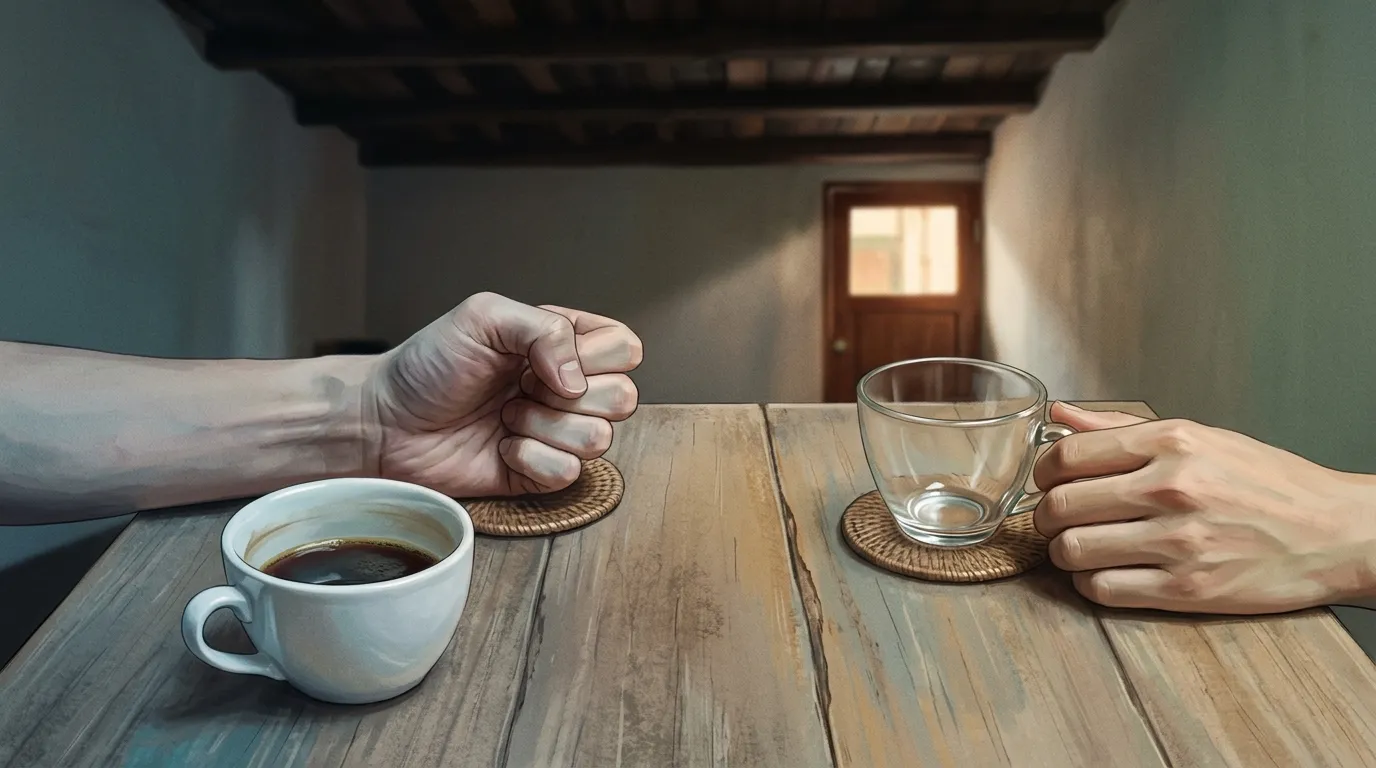
The café was on a small lane near Shīdà, housed in a renovated old building. The wooden door needed to be pushed. Inside, the ceiling was low, the beams exposed, a few of them dark-grained with age. Small tables. Jazz came from a speaker in the corner — not loud, not intrusive, just present — mixing with the sound of the ice machine into a steady background hum.
I ordered an Americano, chose the table against the wall, and sat down to wait.
I didn’t know what to do with myself during that wait.
My phone screen was on. I picked it up, then didn’t know what to look at. That feeling was unfamiliar. For the past two years, there had always been something to do on my phone — Chápǔ’ěr’s messages, the main group’s activity, Yuèyá saying today is hard, Chénguāng saying she had family court tomorrow and needed encouragement. My phone had always been a space where someone was waiting.
That day, that space suddenly had no one waiting. Strictly speaking, they were there — the messages were all there — but I didn’t want to open any of them.
I flipped the phone face-down and watched a thin curl of steam rise from the Americano, then disappear. I kept waiting.
Someone at the next table was typing on a laptop, the keyboard sound distinct and even. That sound told me the world outside was still running normally: someone writing, someone working. The normalcy of it made me feel strangely distant from it.
Then Hóng Lán pushed open the wooden door and came in.
She was more direct than I remembered. My impression was “takes care of elderly family, speaks calmly” — that wasn’t entirely wrong, but in person, the first thing I noticed was how clear her eyes were. She scanned the room once from the doorway, found me immediately, walked over, set down her bag, sat, said sorry to keep you waiting, and not one motion was wasted.
She was around twenty-nine. Pale grey top, hair pulled back, wire-framed glasses. The glasses made her look like someone reading a data table — someone who had trained herself to read situations, the way a clinician reads a room. She asked the owner if they had pour-over, and ordered the most basic one.
“How did you find me?” she asked first.
I said Yǎorán’s name. Said Yǎorán had given me her contact.
She listened, gave a small nod, expression neutral. “How is she doing?”
“I’m not sure,” I said. “She replied once, then went quiet.”
“Mm.” Hóng Lán said. A pause, and then without continuing that thread: “Are you still in the group, or have you already left?”
“Still in.”
She glanced at me — just confirming a premise, no judgment in it. “So why did you come looking for me?”
I thought for a moment. “I want to know why you left.”
She set down her hot water cup, folded her hands on the table, and said: “Alright. The things I’ll tell you, you probably won’t believe. Are you ready?”
She said it evenly, as if stating a fact. As if she’d said it many times before, and by now those words were just a label she attached: what I’m about to say, you may not be in a position to receive yet.
I said I was ready.
She said she’d been in the group for about eight months.
Through those eight months, she’d always felt slightly out of place. Everyone was kind to her — it was just that her instinct was to say “I noticed a phenomenon” where others said “I felt.” She said that wasn’t a matter of right or wrong; she’d simply noticed there was a gap between her language and the language of that place. “I’ve had some training in the social welfare field, so I tend toward observational vocabulary. Maybe I was overthinking it — but I kept feeling that the language system was doing something.”
When she said “maybe I was overthinking it,” her voice held no particular inflection. It was a reservation bracket, set there and left.
“Doing what, exactly?” I asked.
“I’ll come back to that,” she said. “Let me tell you what happened to me first.”
She said that around month four or five, she began to feel better. The “better” was specific: she started reaching out to an old friend from university, someone who had drifted away two years earlier over a misunderstanding that was never quite explained. She started seriously considering changing jobs, because her current work environment left her feeling suffocated.
She said she thought that was the signal that she was ready to “graduate.”
“Then what?” I was listening. The Americano sat untouched on the table.
“Then, in the period when I was getting ready to tell Fúqú I thought I was ready to graduate—” She paused. “Three things happened in succession.”
The first: the misunderstanding with her university friend. She’d reconnected, and the friend had responded well at first — but about a month in, the friend went cold. When Hóng Lán asked why, the friend said she’d heard something about Hóng Lán, that her emotional state had been unstable lately, that she wasn’t safe to get close to. She couldn’t trace where the information had come from. She asked around. Found no source.
The second: the job change. She’d found a position she really wanted, made it through the interview, but the company told her they’d received a “well-meaning note” suggesting that Hóng Lán’s emotional state had been unstable recently, and recommending they delay the hire. She later asked her former supervisor, who confirmed he had received a phone call — the caller had introduced themselves as “a friend who cares about her.”
The third: her family. Her relationship with her mother had been slowly improving — but during that same period, her mother suddenly became more distant, said Hóng Lán had joined “a strange place,” said her condition was worrying. Hóng Lán said she tried to ask her mother where she’d heard this. Her mother said someone had sent her an article — that some groups used mutual support as cover, but members became more dependent the longer they stayed, and couldn’t leave.
“These three things,” Hóng Lán said, “all happened within a month. My first reaction was the same as yours — coincidence. Then I told myself maybe I was overthinking it.”
She turned her cup slightly where it sat, a small movement, the movement of someone in the middle of a thought.
“But I noticed a pattern,” she said. “Every time I was close to getting better, something went wrong.”
The sentence landed between us. The jazz was still playing. The keyboard at the next table was still going. But I felt both of those sounds recede for a moment — pushed to the outer edge of the scene.
“I still can’t say with a hundred percent certainty,” she continued. The “I still can’t say with a hundred percent certainty” came after “every time I was close to getting better, something went wrong” — and it wasn’t retracting that sentence. It was saying: even so, I had sufficient reason to leave.
“Did you tell Fúqú any of this?” I asked.
“Some of it.” Hóng Lán said. “She said she was very worried about me. She said she’d observed this phenomenon, that it was my reaction before entering a very important breakthrough — that external pressure tends to concentrate right before a genuine recovery. She said this meant I was close to getting better.”
Something in my chest tightened.
“So I left,” Hóng Lán said, the same even tone. “My judgment was: a place that required me to stay while doubting it was not helping me.”
I looked at her. She did speak with a trained observational register — the kind that says I have seen a pattern, and this pattern has a name in a system. She used “phenomenon” instead of “feeling.” She used “noticed” instead of “believed.”
My first reaction, as she finished, was a low-grade defensiveness. A voice in my head: You don’t understand the culture there. There was real warmth — you’re not acknowledging that. Those three things could genuinely be coincidences.
I didn’t say any of that out loud.
I don’t know why I didn’t. Maybe because something had already loosened before the words could form.
Then Hóng Lán said something, and my mind jumped directly to Chápǔ’ěr.
“In the group,” she said, “was there someone you were companioning?”
“Yes.”
“Has that person ever gotten better — and then needed you again?”
I didn’t answer immediately.
In that pause, Chápǔ’ěr’s face flashed through.
After her boss’s department reshuffle, the code phrase I want boba had grown sparse. I’d thought she was close to graduating. Then her roommate moved out, and the signal came back — more frequent than before. I’d told myself: she’s at her most fragile now. She needs me.
I remembered the time she said she wanted to formally talk to her boss about her title and salary. I’d said: not yet — you’re not in the right headspace for it.
Those were Fúqú’s words. I knew, as I said them, that they were Fúqú’s words.
I remembered her saying she wanted to try making peace with the boss who’d been bullying her — that was last week. I remembered the feeling I’d had when she said it: a sinking. A quiet no. The no came before anything else, before any analysis, settled in my body while she was still talking. I didn’t say it out loud. But what I said afterward — are you sure you’re ready for that, could a reconciliation like this end up hurting you more — I had told myself, as I was saying it, that I was protecting her.
The jazz receded from my awareness.
The keyboard sound receded.
I sat at that small table, my Americano long cold — I didn’t know how long it had been cold. Hóng Lán sat across from me, not speaking. She didn’t need to speak. She was waiting for me to finish the calculation myself.
That silence was long. Long enough that I eventually became aware of my hand on the table — and realized, at some point I couldn’t identify, it had closed into a fist.
Hóng Lán watched me. No satisfaction on her face. No pity. Just a stillness that said: I see where you are right now.
Neither of us spoke.
I knew she knew what I was thinking. She didn’t say it out loud, because it didn’t need to be said. It was already inside my head.
In the end, I moved first — picked up the cold Americano and took a sip, because I needed something physical to close out that silence.
“Your conclusion,” I said, my voice slightly flat, “is that those things weren’t coincidences.”
“My conclusion,” she said, “is that I couldn’t determine whether they were coincidences — but I knew that place made me feel more endangered, not more safe, when I was close to getting better. So I left. Both of those things can be true at the same time.”
The pour-over she’d ordered had been empty for a while. She didn’t order another.
Fúqú had told Hóng Lán, when Hóng Lán was almost well: this means you’re about to break through. Sitting at that small table, I thought about that sentence for the first time from a different angle. Maybe on the surface it was an explanation. But underneath it, there was another function — it gave Hóng Lán a reason to stay.
I couldn’t articulate what the difference was. I just knew the shape was different.
When we walked out of the café it was still afternoon, the sky still light.
Hóng Lán paused briefly at the door, adjusted her bag strap, then said: “You decide how to handle this.”
She didn’t say you should leave. She didn’t say do you believe what I told you. Just: you decide, a small nod, and she walked off down the lane.
I stood outside that wooden door and watched her go, the jazz still faintly audible from inside.
I rode my scooter home.
It wasn’t far, but at a red light, I looked down at my hands.
They were resting on the handlebars. They looked the same as always. But I could feel something — feel that those hands had done things. Cold air moved through from behind my neck. Pedestrians crossed on the zebra stripe. A cyclist waited next to me, phone in a handlebar mount, navigation playing.
The light was still red.
I stared at my hands until it turned green, then looked away and kept riding.
Back in my studio apartment, I didn’t sit down right away.
I stood in the room for a moment, set my bag by the desk, took off my jacket, then sat on the edge of the bed with both feet on the floor, and just sat there, doing nothing.
My phone was in my bag. I didn’t reach for it.
I tried to talk myself down.
Maybe coincidence. Those three things — the misunderstanding with the old friend, the job falling through, the family’s shift in attitude — all of them had natural explanations. Hóng Lán had social work training; maybe that training had made her particularly alert to certain patterns, alert enough to read ordinary bad luck as design. Maybe she’d just had a rough stretch. Maybe those “well-meaning notes” were sent by people who genuinely cared, with no agenda behind them.
I ran through all of it in my head.
It held together.
But there was one thing I couldn’t argue past.
Last week, Chápǔ’ěr had said she wanted to try making peace with her boss. I remembered the feeling: that sinking. That no. The no came before any rational thought — it came from somewhere in the body.
And then I’d said things that kept her sitting in that uncertainty instead of moving forward.
Now, sitting on the edge of the bed, I couldn’t say with certainty what that no had been. Was it protecting her? Or was it something else — something that didn’t have a name yet, but that had arrived faster than the thought of protecting her.
I wanted to say it was protecting her. That version was cleaner.
But I couldn’t make it hold.
The light outside was late-afternoon light, angled, orange shading toward grey, falling across the face of the building across the street — the kind of light that looks like it’s about to go dark but hasn’t yet. I sat inside it and didn’t move.
Then I reached into my bag, took out my phone, and opened the conversation with Píngpíng.
I sent a message: Do you know about what Hǎilàng said?
I put the phone on my lap and waited.
She didn’t reply right away.
I sat there watching the conversation window, watching my question sit there, a small blue checkmark confirming she’d seen it — but no typing indicator appeared.
I waited a long time.
Long enough that I began to sense she was deciding something on her end.
Then she replied:
I know. I’ve seen more. But I can’t leave, because they really did help me, and that help was real.
I looked at that message and didn’t move.
Those few words — I read them many times. I understood them. It was just that the thing they contained needed time to settle.
She said: that help was real.
That help was real, so she couldn’t leave. Both sentences held. They were two faces of the same trap.
I didn’t reply.
That evening I didn’t log into the group.
I just didn’t. My body didn’t want to move, and there was no clear decision. The phone sat on my lap. I muted the LINE main group’s notifications — didn’t leave, just silenced it. The notification dot stopped jumping. But if I tapped in, the messages would all be there, and those people would all still be talking.
I’d just cut off the blinking for now.
Then a message came through, and I saw it was from the group — because the mute had only killed the icon badge; the push notification still came through. I flipped the phone face-down, but I’d already seen the preview:
Where’s Lánlán? Quiet today?
Mǐnkuí.
The way she asked it was half announcement, half roll call — framed like concern, but with the undertone of: this position is being watched. I remembered how that kind of message used to land — a warmth at being held in someone’s thoughts.
Now the shape of it was different.
I left the phone face-down on my lap.
Later I lay on the bed and didn’t cry.
The sky hadn’t fully darkened yet. The building across the street was starting to light up, window by window — the kind of sight that makes you think: someone is eating dinner in there, someone is changing clothes, someone is living a parallel life doing the ordinary things that get done every day.
I thought about that first night in the group, when I still knew nothing. Fúqú had written in the main chat: Lánlán is here — welcome. No need to rush to say anything. Just be here for now.
I remembered how that sentence had let my shoulders drop.
Now I knew that sentence had another way of being read.
But I still couldn’t say clearly what that other reading was. I just lay there, looking at the ceiling. The ceiling was there — a grey-white surface, at a distance that was neither close nor far, the exact right distance to hold something that couldn’t yet be put into words.
I closed my eyes, then opened them again.
The lights outside were still on. The windows of the building across the street, one by one, those strangers in there spending their night.