Chapter 7
Every Timely Hand
Chapter 7: Every Timely Hand
I decided to stay in the community.
That sounds strange, but I had genuinely thought it through. That evening I lay in bed and turned it over for a long time, and finally reached a conclusion: leaving meant I couldn’t see anything clearly, while staying gave me a chance to confirm whether what I was thinking was actually true. That was the reason I gave myself, and I knew there was a gap in it—maybe I just wasn’t able to leave yet. I knew that. I didn’t want to look at the gap.
The next morning, I opened LINE, found the Helpers Circle group, typed “good morning” under someone else’s “good morning,” and hit send.
Fúqú replied quickly with a sticker of a tight hug.
I set my phone on the nightstand, and that was how it began.
That week I paid closer attention than before.
I didn’t take notes. I didn’t screenshot anything. I didn’t show the slightest sign of anything unusual to anyone. I just kept my eyes open and let them see the things they’d always been able to see but that I’d chosen not to look at.
I sat in the Helpers Circle, watching messages move past one by one.
On the third day, Chápǔ’ěr sent: “I want bubble tea.”
I replied, asked her what was going on. She said today her supervisor’s colleague had been talking loudly nearby, and it made her think of how Shī Dézhèng used to talk in the break room—that same feeling. She said she knew it wasn’t the same thing, but her body had tensed up anyway. I told her I understood, said that kind of tension was sometimes more significant than it looked, and asked her to tell me more about what kind of tension it was.
She said a lot. As she talked, she realized it wasn’t actually that serious, just something that had been stirred up, and then she wrote: “Haha okay thank you so much I feel so much better now!”
I put my phone down. Sat at my office desk. Outside the window, a construction sound—low-frequency, continuous.
I noticed something. In the Helpers Circle, Liào Tíngxù had a companion named Shītíng whom she didn’t seem to pay much attention to. But every time Shītíng told me something, Liào Tíngxù seemed to know about it almost immediately. I’d say “Shītíng mentioned she’s been really struggling with insomnia lately,” and Liào Tíngxù would respond almost at once: “I just saw her posts—yeah, she really does seem to be having trouble sleeping.”
That speed made me pause.
I thought for a moment, then asked Liào Tíngxù: “Are you following her on other accounts?”
Liào Tíngxù said: “She sometimes posts things on Instagram. Qú-jiě said we should keep an eye out.”
I filed that away and didn’t say more.
It was a hypothesis. I tried to find evidence.
I started tracking who was accompanying whom, and who was feeding updates back to Fúqú on whose behalf. The more I watched, the clearer a shape emerged.
Yáng Hànshēng was accompanying Mǐnkuí; Mǐnkuí was accompanying people near the top of the points rankings. Liào Tíngxù was accompanying several newer members and would regularly post in the Helpers Circle: “Chénguāng mentioned today that her mother called—might be worth keeping an eye on her state,” and “Yuèyá seems to be making progress—she said she talked to her brother on the phone yesterday.” Those updates were passed in by whoever had been talking with Yuèyá and Chénguāng. Yuèyá and Chénguāng hadn’t posted them to the Helpers Circle themselves.
In other words: Yuèyá and Chénguāng didn’t know their status was being reported.
As that shape slowly clarified in my mind, I felt something I couldn’t quite name—cold.
I spent a long time trying to make sure I wasn’t misreading it. A community with this kind of scale could reasonably have this kind of design—letting experienced members know the status of people who needed attention, so they could “intervene in time.” Plenty of organized volunteer groups have similar structures. That wasn’t the problem in itself.
The frightening thing was just this one thing: the people being reported on didn’t know they were being reported on.
I thought about each of Chápǔ’ěr’s “I want bubble tea” messages, and then I thought about how every time she sent that signal, Fúqú would appear in the group shortly after: “Everyone worked hard today—remember you don’t have to carry it alone.” That timeliness—I used to think it was Fúqú’s intuition.
Then I thought: who had passed Chápǔ’ěr’s state to Fúqú?
Me.
I hadn’t known I was doing it, because the way I’d done it was—posting in the Helpers Circle, “Chápǔ’ěr’s been a bit unstable today, everyone keep an eye out.” I thought I was sharing information so the group could support her.
But that was a report.
I remembered my third week in the community, the first day I spoke up in the group—the day Fúqú messaged me privately. I’d asked her, “How do you manage to be there all the time?” She’d replied: “I’m always here.” I remembered thinking that line was moving, that it felt like a presence beyond what an ordinary person could sustain. A kind of promise.
She was always here.
Because someone told her when she needed to appear.
I sat with that understanding for a while. Didn’t move.
And again—maybe none of this was a problem.
I kept telling myself, repeating it in my head: plenty of mutual aid systems work this way, they need coordination, they need information to flow, that’s reasonable.
But my body sat there knowing something was different. I couldn’t explain which part was different. It just was.
Later I went looking for an old document.
The Helpers Circle had a shared folder that Fúqú had created early on, containing some “Companion Guides” for new helpers. When I’d joined, Mǐnkuí had walked me through it. At the time I’d only skimmed the pages on “handling emotional crises” and “how to set limits”—the rest I hadn’t read closely.
That evening I pulled out the document and read it from the beginning.
In the final section of the appendix, under “Companion Observation Log Format,” there was a paragraph I hadn’t noticed before:
“If your companion shows signs of a breakthrough—beginning to reconnect socially, progress on work opportunities, improvement in family relationships—please update the Helpers Circle in real time so we can evaluate together whether the accompanying approach needs adjustment.”
Breakthrough.
That word made me stop for a long time.
Three things had happened to Hóng Lán in succession just when she was about to break through.
I was reading if your companion shows signs of a breakthrough, and I felt the density of the air in the room shift.
But I’d said it—there were other possible explanations for all of this.
I couldn’t confirm any direct link between that document and the three things that had happened to Hóng Lán. Maybe “evaluate whether the accompanying approach needs adjustment” was just a good-faith coordination mechanism—genuinely just a way to keep everyone informed, to make the accompanying more flexible.
I held all of it and kept moving through the week.
The points leaderboard was posted that Monday.
I looked at the spreadsheet and found my name in the second column—my score had jumped a few points, because I’d handled several harder cases the previous week.
Then I looked further down, at the names near the bottom.
Those people with lower point totals—I thought for a moment, then cross-referenced—yes, this month they had been noticeably more active in the group, reaching out, responding faster than usual, initiating check-ins more often than they normally did.
Five months in, at a Monthly Assembly, I’d noticed the lower-ranked people were especially aggressive about reeling people in. At the time I’d found it charming—a strange quirk of human nature. Almost everyone on the Zoom screen that month had cried. I was the only one who hadn’t. I’d told myself I was just drier than most, felt a vague sense of being on the margins, then let it pass.
Now I thought that marginality might have had its own meaning. Maybe my body had known something before my mind caught up—the emotional direction of that scene didn’t match the direction my body recognized, so my tears hadn’t been drawn out. I couldn’t read that feeling then. I still couldn’t read it entirely now. But I was beginning to suspect that not crying had meant something.
Looking at the pattern now, a calculation assembled itself slowly in my head.
Falling behind on points meant needing to find more people to help. Finding more people to help meant needing more people who needed help. Needing more people who needed help meant keeping those people in a state of needing help. Those people staying in a state of needing help meant helping them generated more points.
When the calculation finished assembling, I felt something in my chest begin to turn, slowly, a full rotation, and then keep turning.
I remembered that Monthly Assembly. I remembered Mǐnkuí saying she “didn’t care about points,” then pulling that A4 sheet from her bag. I remembered her saying points were “a record of what we give each other, not a competition.”
I remembered thinking that was sweet. That kind of absurd sincerity, the kind that made me want to smile.
That smile was still in there somewhere. I just couldn’t get to it anymore.
That evening, Mǐnkuí posted an announcement in the group:
“Reminder everyone—the Annual Gratitude Assembly date is confirmed! The 15th of next month, Da’an District Activity Center, same place as always. Hope everyone can make it! We meet here every year, and this year is no exception 💪🌱”
Below it, a stream of hearts, “So excited!”, “I’ll be there!”
Chápǔ’ěr wrote: “I’m coming!! Will there be everyone’s favorite bubble tea haha 😂”
I looked at Chápǔ’ěr’s message and paused on the crying-laughing emoji for a second.
She’d said bubble tea.
The Annual Gratitude Assembly.
A few months ago when I saw that name, I’d thought of the gathering last August—those faces going up to speak their gratitude, Jǐnróng saying “that good-morning message every day made me know I hadn’t disappeared,” the tears I’d cried, the fact that the feeling was real.
Now I sat reading that announcement on my phone screen and felt something rotate inside my stomach—the same rotation as before. Not quite pain. Just a wrongness I couldn’t name.
I thought about Jiāyí.
The first time Jiāyí attended a Monthly Assembly, she’d been nominated for Most Meaningful Case, and she’d assumed it meant “she was so difficult that everyone helped her.” Fúqú gently clarified that it actually meant “the process of helping her had helped everyone grow.” Jiāyí had cried. I’d watched that scene from the edge, felt something I couldn’t name for a second, then let it pass.
Under the new framework: Most Meaningful Case meant this person’s difficulty had generated the most points for her helpers. Her emotion was built on a fundamental misunderstanding of how she had been defined.
In that moment, Jiāyí’s tears were real. In that moment, the feeling of being thanked was real for her.
That realness existed at the same time as something else.
I didn’t know how to hold both things in my mind at once. But they were both there.
Fúqú had liked the announcement.
I looked at that heart, and thought back to my first day in the community, when she’d written in the group: “Lánlán is here—welcome, no need to rush into anything, just be here for now.” Those words had let my shoulders drop.
Then I thought: how did she know I’d arrived?
I’d joined quietly that day, no introduction, just lurking. But she’d called me by name.
I knew the answer now. The recruitment team had been tracking those platforms—systematically searching for people, finding my post on PTT, sending that private message that had been written many times before, just tailored slightly for each person. They’d known who I was before I ever set foot in the group. They didn’t need to wait for me to introduce myself.
That message had been sent to a carefully selected target. By the time I entered the group, they already knew who I was.
I’d said from the beginning—I knew that message was sent to a specifically chosen target. But that “knowing” had always been abstract. I knew it had happened, but I hadn’t been able to feel the weight of it. That weight had only begun settling down over this past week.
It settled like this: I went and found the account that had first messaged me.
The account was called Liánfú. I found it, opened our conversation, and read those first few words—saying she’d seen my post, saying there was a place I might want to check out.
Then I searched what she’d said elsewhere, across different platform threads, and found a few instances where different people had written, at similar points in time, in nearly identical phrasing: I saw what you shared, there’s a place that might be right for you, followed by a link. The replies came from different accounts. But the language was nearly the same—the kind of phrasing that sounds personal but is actually a template.
I couldn’t be certain. My reasoning might be wrong. But that inference sat in my mind, and it sat there heavily.
That afternoon, my phone lit up.
A message from Chápǔ’ěr. No signal—just a plain message:
“Hey, I’ve been thinking lately—I feel like… I don’t need to reach out to you every day anymore? I think I’m doing better. That’s a good thing, right? (laughs)”
I looked at that message. The phone nearly slid off my desk. I caught it with my palm just in time.
Then I sat without moving, feeling something plunge inside me, fast, like it was passing through my sternum, going down, coming to rest somewhere very deep.
It wasn’t happiness.
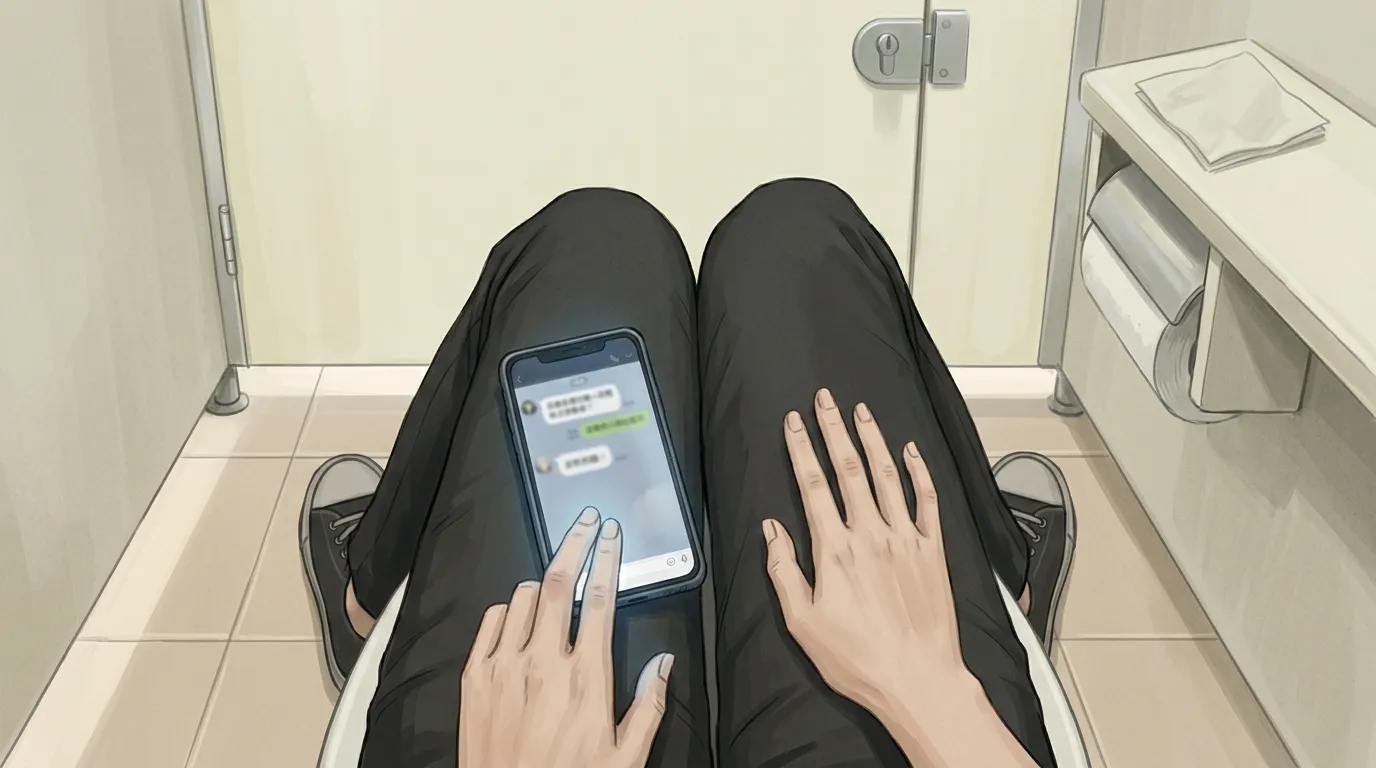
I sat in a bathroom stall for a long time, phone on my knees, telling myself this is good, she’s made progress, telling myself this was the outcome a helper was supposed to hope for, telling myself this feeling was just habitual emptiness.
Those things all made sense. But my body was still cold.
I wrote back: “That’s great. What’s been going on for you lately?”
She said a few things—Shī Dézhèng’s coworkers had started treating her better, she’d signed herself up for a weekend design class, last week she’d gone over to her roommate’s new place for a drink and they’d talked for a long time and it had felt good.
I read each word. Each one was evidence that she was getting better.
Then I remembered a few moments. When she said she wanted to reconcile, I’d said you’re not in the right headspace for that right now. When she said she wanted to have a formal talk with her supervisor, I’d said not yet. When her frequency of reaching out had climbed, I’d felt something inside me—like a line being reconnected—and I hadn’t looked at that feeling, had smothered it with she needs me.
I remembered a month ago, when she’d mentioned a new friend she’d met online—said the person was interesting, she was thinking of meeting up over the weekend, asked if I wanted to come along. I’d said: you should make sure this person is someone you can actually trust—be careful with strangers you don’t know. She’d said you’re right, maybe next time, and that new friend’s name never came up again.
I had believed, at the time, that I was protecting her.
The things I’d said—incidentally—I sat in that bathroom stall and tried to ask myself honestly: how incidentally.
That question didn’t have a clean answer. Some of those things—when I said them, I truly believed I was protecting her, the motivation was real. But some of them—that not yet—when I said it, had I first felt the sinking sensation, that she’s getting better, I’m going to lose her, and then found the “protection” justification afterward?
I wasn’t sure which came first.
I sat there, turned the phone face-down on my knees. Through the gap in the window came voices from the hallway—people deciding where to go for lunch.
I needed her to need me.
That was it.
The first time I put it in those words, said it to myself, it landed in my mind just like that. Rough, incomplete, uncomfortable to say out loud—but it was there. Just those words, imprecise but said: I needed her to need me. Not that I wanted her to be okay. I needed her to need me.
I needed her to need me, so I had done certain things that kept her needing me.
Those words placed what Fúqú had been doing to me for three years side by side with what I’d been doing to Chápǔ’ěr for the past year. The distance between those two things was much shorter than I’d thought.
I turned my phone over, wrote back to Chápǔ’ěr: “You’ve grown so much lately. That design class sounds like a real fit for you.”
She replied: “Thank you Lánlán-jiě!! 💕 You’re the first person here who really got me.”
I looked at that message without moving, let those words stay in my eyes for a moment.
Then I put my phone in my pocket and walked back to my desk.
Píngpíng happened to be running errands near my office that day. She messaged asking if I wanted to grab something to drink—just the two of us.
I said yes.
We sat down in a small café by the window. She ordered tea, I ordered a hot Americano. The place was tiny—two tables pushed against the wall, the street outside, the ring of a bicycle bell, someone walking by. An ordinary afternoon.
After she arrived, we talked about a few things, all perfectly normal—her students, an exhibition she’d been helping them prepare for, a copywriting project I’d had to redo at work. The copy was for a laundry detergent brand—tagline “Gently protecting your family”—and the client had said the word “gently” reminded him of his ex-girlfriend, so he needed it changed. Three rounds of revisions. Píngpíng set down her cup, said “Oh,” then didn’t laugh, but her shoulder moved very slightly.
The conversation was ordinary enough that I relaxed a little.
Then she asked: “How’s Chápǔ’ěr been?”
I said: “She’s better. She said she might not need to reach out to me every day anymore.”
Píngpíng set down her teacup. There was a pause before she spoke: “What was the feeling for you when she said that?”
I looked at her. This was the question she’d asked me a long time ago—if she gets better, what will you feel? I’d answered her getting better is the best outcome. Now she was asking what was the feeling for you when she said that.
“A sinking.” Just that, nothing added.
Píngpíng looked at me, said nothing.
In that silence, I knew she was waiting for me to go on. She didn’t need to push me with any words—she was just there, waiting.
“I think,” I said, “in the things I was doing to help Chápǔ’ěr—some of them genuinely helped. And some—” I stopped. “Some of the things I said kept her in a place of needing me more than they moved her forward.”
Píngpíng listened. No nod, no headshake. Just stayed.
“I don’t know which ones were which,” I said. “Both things were happening at the same moment I was speaking. I can’t separate the proportions.”
She said: “Mm.”
Just that one sound, then stopped, leaving it with me.
Outside the window a child was running, an adult chasing behind: wait, wait. The sound came through the glass, a little far off.
“Back then,” I said, “when you asked me what I’d feel if she got better—did you already know?”
She looked at me, thought for a moment. “I saw a possibility. I couldn’t be certain, but I saw the possibility.”
“Why didn’t you just say so?”
A pause. Longer than the others.
“Because,” she said, “the consequences of saying it directly weren’t mine alone to bear.”
The conversation stopped there for a moment. Then she said she needed to use the bathroom and I said okay. She stood and walked away. Outside, the child had stopped running. The adult had caught up. They stood there talking.
I thought of something Píngpíng had said a long time ago: the fact that you’re thinking about it is enough. At the time I’d taken it as a compliment.
What she’d meant by enough might have been only this: thinking about it was all she could do. Within the limits of what she could bear, that was the most she had.
Near the end of that week, I sorted through some old photos on my phone.
I wasn’t looking for anything in particular—my storage was nearly full and I needed to delete some things. I swiped back through the album, past old photos. There was one of me and Gě Wàngzhōu at some beach—it had been windy that day, my hair was wild in the picture, and he was laughing.
I paused, then kept swiping, looking for things to delete. Somehow, I ended up in our LINE conversation.
I opened it, scrolled up, and found a few lines he’d written in the period before we broke up—he’d said you seem really different lately, said the people in that group talk in a strange way, do you think you’ve been affected? I’d said you don’t understand those people. I’d thought it was him not understanding me.
Reading those lines now, I felt another interpretation surface from between the words: maybe when he said you’ve changed he was right.
Then I remembered something else. About eight months after I joined the community, he mentioned that an old classmate had messaged him—said some of those mutual aid communities aren’t healthy, I heard you’re in one, just letting you know, with a screenshot attached. He showed me the screenshot and asked, do you know who said this? I said I didn’t, said maybe someone had a prejudice against that kind of community.
He said: okay, you can judge for yourself.
Now I pulled up that exchange again and looked at the screenshot’s phrasing—some people are saying, just a friendly heads-up, you can judge for yourself—that tone, that structure, resembled what Hóng Lán’s mother had received in that article.
The profile picture on the account in that screenshot was a slightly blurred photo of someone in side profile. The background was an interior space.
I enlarged the profile picture.
The interior background—
I recognized that bookshelf.
It was the bookshelf from a photo Fúqú had once shared of her study, one I’d seen in the Helpers Circle. She’d said she was organizing her books and snapped a picture. The bookshelf was distinctive—there was an irregular triangular wooden divider, one side longer than the other, giving the whole shelf a deliberate slant. I remembered pausing when I saw that photo, even leaving a heart under it, thinking about where you’d go to have something like that custom-made. That triangle—I remembered it.
In that screenshot, the background of the profile picture had that same triangular wooden divider.
The profile picture had been cropped from the corner of another photograph, cropped so you couldn’t make out who it was. But the shape of the bookshelf hadn’t been cropped out.
I sat there, phone in my hand, feeling something from somewhere very far away—a sound that couldn’t travel any closer, that stopped at that distance and stayed there.
Why.
I thought about those months when we were falling apart—him saying sometimes the way you talk makes me feel like you’re managing me, saying I can’t get in. Some of that was probably true. I had carried Fúqú’s way of speaking into our relationship.
But that I don’t know what you’re thinking—had part of it grown slowly from that screenshot. And then that distance had put me in front of my computer at two in the morning posting on PTT. And then that message had arrived.
That reasoning could be wrong. But it sat in my mind with a weight I couldn’t ignore.
I set my phone on the desk.
Fúqú had reached out to Gě Wàngzhōu privately. I didn’t know what had passed between them. I couldn’t confirm any direct chain of cause and effect. I only knew an account had sent him a message, and that account’s profile picture had a bookshelf I recognized in its background.
And then I thought about those last months when the relationship collapsed—him saying I feel like your people changed you, made you stop trusting me. That stop trusting—where had that come from.
The question hung in the room.
I needed to ask her.
That decision was quiet. The light outside had gone pale—the gray-white wall gradually losing what light it had, shifting toward another color, the kind of gray that comes just before dark, the gray that has lost its warmth. I needed to ask her—whether that account was hers, what she’d said to Gě Wàngzhōu, why she had done it.
Fúqú’s LINE conversation was closed on my screen. The question was with me, waiting for me to open my mouth.