Chapter 8
Because I Love You
Chapter 8: Because I Love You
I asked her to meet.
This was a few days after that evening—I couldn’t go right away. I spent roughly three days rearranging in my head what I wanted to say, then tearing it apart, then rearranging again, until I realized that no version I constructed satisfied me. Then I thought: maybe that version never existed to begin with. So I sent her one line: “Can we meet.”
She said of course. She asked when worked for me. I said Saturday afternoon. She said fine, you pick the place.
I thought about it and chose a café in Zhongshan District that neither of us had been to together. She didn’t know it. That was why I chose it. I needed somewhere that wasn’t her territory, somewhere with the background noise of strangers talking, so that at least in the silences I wouldn’t completely lose my footing.
It was a little absurd, all that calculation. I know that now. It didn’t help anyway.
She got there before me.
I pushed open the glass door and saw her sitting at a two-person table by the window, a glass of water in front of her she hadn’t touched. She looked up and gave a small smile—not warm, just light, like: I know you came here for a reason. I’m waiting.
I sat down without ordering anything, without asking how she’d been. I asked directly.
“Have you been in contact with Gě Wàngzhōu.”
She didn’t answer right away. There were two seconds of silence—I understood later that those two seconds were her deciding how to answer, not whether to. Which angle to enter from, which frame to use. Just two seconds, and then she said:
“I have. Because I was very worried about you at the time.”
The way those words landed—I have—I can’t explain it, but they stopped me cold. I’d expected her to deny it. I’d expected her to at least ask why I was asking, to buy herself a little time. Instead she said I have and followed it immediately with because I was worried about you, the admission and the explanation arriving as a single gesture.
I said: “You used the ‘Liánfú’ account.”
Something shifted in her eyes—something very small, gone in a second. She said:
“I have a backup account I don’t use much. Sometimes I use it on other platforms to check if there’s anyone who needs to be noticed.”
That was all. She didn’t say what the account was called, didn’t confirm or deny it was Liánfú, didn’t deny having multiple accounts. The effect of that phrase—backup account—was to leave my question suspended mid-air with nowhere to land.
“And what did you say to him.”
Her fingers moved slightly, then settled flat on the table. Perfectly calm. She said: “I didn’t do anything to damage your relationship. I just wanted to understand how things were on his side, to make sure you weren’t being negatively influenced by him.”
Every word of that sentence was technically coherent. I didn’t do anything to damage your relationship—she may have genuinely believed that. Understand how things were on his side—it sounded like surveillance, but the word understand made it sound like care. Make sure you weren’t being negatively influenced—negative influence was her standard phrase, and she said it the way a doctor delivers a diagnosis, as though she had the authority to determine what counted as influence and what made it negative.
I said: “You didn’t ask my consent.”
She was quiet for a moment. Then she said:
“Lánlán, it didn’t occur to me that I needed your consent. Your state was very unstable at the time, and I was doing what I always do—putting your protection first. I understand now why that feels wrong to you. I’ll remember that.”
I’ll remember that.
Those words left me speechless. Because they sealed off every possible response—they performed the appearance of someone accepting correction, turned my you didn’t ask my consent into a matter already handled, a problem she’d said okay, noted to. That I’ll remember that made it impossible to continue with but you shouldn’t have done this, because she’d already said she knew.
I felt the force I’d pushed with get caught by her, then returned to me at a softer angle.
That awareness, in that moment, left me with a sinking feeling. Her goodwill was real—I could feel that she believed what she was saying. Every word she said, she genuinely thought was right: contacting Gě Wàngzhōu was to protect me, remembering consent was something she’d learned, saying I do what I always do was because she truly had a way she did things, and she thought that way was good.
That realization landed and the sinking went deeper, in the exact opposite direction from what I’d expected.
Because the thing I couldn’t win against—she believed in it herself. That was so much harder to deal with than a lie.
I said: “I need to think.” I stood up and picked up my bag.
She said: “I’ll be here.”
Just those words, said lightly, like someone telling another person there’s no rush. But the way that I’ll be here settled on my shoulders—I felt that weight the whole walk out of the café and all the way home.
Like an invisible rope, following me.
I didn’t think much on the way home. I stood at a bus stop waiting, and nearby a child was crying, and the adult next to them was saying don’t cry, don’t cry, and the child cried louder, and then the bus came and I got on and sat by the window, and outside was Taipei in the afternoon—completely ordinary, people walking, cars moving, all the colors normal.
That evening I didn’t go on the group chat. Since joining I’d almost never let a whole evening pass without logging on for no particular reason. I sat on the sofa, phone on the coffee table, TV on but I wasn’t watching. A travel program was describing some city in Japan. The host said, the broth here has a warmth that makes you feel caught. I let that sound enter and pass through.
Then the next morning, Fúqú posted a message in the main group.
“Lately I feel like everyone’s carrying a little extra weight—each of you is bearing so much. I want to remind you: you’re not alone. Sometimes we push ourselves too hard, and we start to doubt things. That’s part of growing.”
Then a hugging sticker.
I took a screenshot and saved it in a folder in my photos. The message wasn’t addressed to me alone—there were over seventy people in that group. She might have been speaking to anyone, or everyone, or no one in particular, just making a general observation.
But I knew it was for me. That start to doubt things, that that’s part of growing—I knew where that language was aimed.
She really was a good teacher. The thought appeared in my mind with a flavor that was neither quite bitter nor quite sour.
That afternoon, Mǐnkuí sent me a private message in the Helpers Circle group.
“Lánlán, I care about you. You’ve been quiet in the group lately, and everyone’s been thinking of you.”
I read Mǐnkuí’s message several times. She said I care about you, not I’m worried about you—that subtle difference mattered in her language system. Care was active presence; worry was reactive emotion. She always chose the former. She really did care about me. She had no idea her message was part of this context. She’d just noticed I’d been quiet recently, registered something she read as a signal that Lánlán needed to be checked in on, and came.
A mobilized good person.
The concept became concrete for the first time as I read that message. Mǐnkuí wasn’t a co-conspirator—she was harder to deal with than a co-conspirator, because she was sincere. Her care was real. She didn’t know what she was doing. How do you tell someone who genuinely cares about you you shouldn’t have done this, when she doesn’t know what she’s doing.
Then Liào Tíngxù sent: “If you need company, I’m here anytime.”
Liào Tíngxù’s message had the tone of a work confirmation, like someone checking an item off a task list: Lánlán—messaged—status pending. She’d been sent. I was almost certain of that. But I couldn’t be certain whether sent meant a direct instruction from Fúqú or just the natural output of the system—seeing that someone had posted that message in the main group and knowing that Lánlán needed to be contacted.
The distance between those two possibilities might not be as far as I’d thought.
Then Jǐnróng.
“Lánlán-jiě, are you okay lately? I saw that everyone’s been worried about you—if it’s okay, could we talk? There are some things I want to say to you.”
Reading Jǐnróng’s message, something in my chest loosened slightly. The loosening startled me, and then I understood why: I was reading something genuine. It wasn’t like Liào Tíngxù’s task-confirmation check-in. Jǐnróng actually wanted to say something. She thought my current state was a reaction before entering an important breakthrough, thought she could see me struggling, and wanted to come and catch me.
The things she said weren’t false.
That feeling made my thinking waver in that instant.
Maybe I really was too sensitive.
The thought arrived while the phone was still in my hand and Jǐnróng’s message still on the screen, and I looked at those words and thought: maybe Hóng Lán’s three things were just her subjective interpretation. Maybe Fúqú contacting Gě Wàngzhōu really was just concern for me. Maybe I misidentified that bookshelf. Maybe the points system was just an incentive structure without the complexity I’d assigned to it. Maybe when Píngpíng said I’ve seen more she meant a different kind of more. Maybe all of this together was just the way a strict mutual-aid community operated. Maybe my emotional state lately had skewed my judgment.
The maybes started turning in my mind, one pulling in another, pulling in another. They spun, faster and faster, until past a certain speed they went smooth and slippery—impossible to grip, like a ball in a circular tube. You think you’re controlling it. It’s actually running on its own.
Then I realized I’d started to doubt whether what I remembered from the past few days was how I actually remembered it.
When Fúqú spoke in the café—had she really said those things? That putting your protection first—had I misremembered her exact words, or had she said exactly that? That I’ll remember that—did it sound like genuine acknowledgment or a technique for ending a conversation? What I felt in that moment: was that my emotions coloring my perception, or was that actually what was happening?
I sat on the living room sofa. It was dark outside, the lights weren’t on, I’d pulled my legs up and the phone rested on my knees. The screen’s glow was the only light. Outside, occasional traffic, a voice drifting over from a neighbor’s—couldn’t make out words, just sound, proof that outside there were other people, other lives, completely unrelated to the living room where I was sitting.
I knew what they were doing to me. I also knew that I had been genuinely emotional, that I had said some things that weren’t entirely accurate, that I had accepted Hóng Lán’s account a little faster than I should have.
Both things were true at the same time. Knowing I was being pulled back somewhere by a language system, while also knowing that part of me was the way they said I was. That part of me is the way they say I am made I know what they’re doing to me very hard to hold onto—because if part of me is the way they say I am, then what they’re saying isn’t entirely wrong, then their motivations aren’t entirely what I think they are, then—
I let that chain of thought run a few more loops and then stopped it. Deliberately stopped it.
I opened the conversation with Píngpíng. The last thing she’d said was the consequences of saying it directly aren’t mine alone to bear, and then the conversation had stayed there—I’d never replied.
I hesitated a long time, then typed: “I went and asked her.”
And waited.
The thread showed delivered. No other movement. She hadn’t read it.
I waited an hour. Still nothing.
I put the phone on my chest and stared at the ceiling.
The unread message wasn’t an answer, but it was a weight. The person I knew should be here wasn’t here. She just wasn’t there. That wasn’t Píngpíng doing something to me—it was just that.
Sometime around midnight I was no longer sure whether I’d slept. For a stretch I was awake; for another stretch my consciousness started to go light, then to drift, and then I was somewhere where the light and time were wrong.
It was the first evening I’d joined the group.
In the dream the group window was open. The goodnight relay had just started—someone sent goodnight, then another person, then another. The goodnight passed from person to person like a roll call, like confirming that everyone was still here, still present.
Then Fúqú said my name in the group: “Lánlán is here—welcome, no need to rush, just be here for now.”
In the dream I wanted to ask how did you know I’d come in—the question was there in my throat, very clear, but I didn’t ask it.
I watched the goodnight relay continue, one after another, and then it was my turn, and the blank space waited for me.
The me in the dream typed goodnight. Hit send.
And watched that goodnight sink downward, down into the relay, blending with everyone else’s goodnight, until you couldn’t tell which one was whose anymore.
I woke on the living room sofa, phone still on my chest, not yet dawn outside. Somewhere far away a garbage truck.
Two days later, I decided to go see her again.
I spent a long time thinking about why. The only thing I was certain of was this: I needed to confirm whether I could still stand on my own ground and speak from it. Those two days of muddied reality had left me very uncertain. I needed to bring that uncertainty into her presence and use her reaction to find out whether my judgment had completely come apart.
This time she chose the location—her studio, in Xindian, a private apartment she owned, where she normally saw clients.
I thought afterward that I should have recognized sooner what that choice meant: she’d moved our next meeting onto her ground. And I’d agreed.
I stood at her door and pressed the intercom, waiting.
Her studio was small but carefully arranged—a few books on a low table, a green plant in the corner, white curtains, soft light coming through. She sat in the chair she usually used for sessions, positioned with a wall behind her, which made her whole posture look stable, supported. She didn’t gesture for me to sit. I stood there and didn’t sit either.
I said: “I want you to know—I’m not going to accompany Chápǔ’ěr anymore. I’m going to tell her the truth.”
I’d expected her to say something. I’d prepared for many versions of what she might say. I’d prepared my responses, arranged my counterarguments in order.
She was silent for a long time. I stood there and felt every second of that silence as real—she wasn’t deciding how to respond, she was actually thinking about what I’d said.
Then she said: “I know you’re in a lot of pain right now. I’m not going to stop you from doing what you think is right.”
Every counterargument I’d arranged in my head lost its footing. Everything I’d prepared was for her trying to stop me. She wasn’t stopping me. She said I’m not going to stop you.
That not-stopping was more destabilizing than any stopping could have been.
Then she asked:
“I only want to ask you one thing. In these two years you’ve been here—were you actually helped.”
The sentence ended without a question mark. It landed as a statement: I am asking you something you already know the answer to.
I couldn’t speak.
“Think about it. Set aside the frame you’re using right now—I’m talking about back then. Three months after the breakup, posting on PTT at two in the morning, and no one caught you. That was when you came into this group, and you felt your shoulders come down. Was that real.”
The feeling of shoulders coming down fell out of memory the moment she said those words—completely real, completely specific. That feeling, that night, that someone finally understands what I’m saying.
I couldn’t say it wasn’t real. Because it was.
She continued: “You slept the deepest sleep of those three months here. Was that real.”
That too came back—the night after three months of not sleeping well, finally going under, every part of the body letting go.
The was that real at the end of each sentence, no question mark, landing as a statement—she already knew my answers, and was only asking me to look at them.
I felt the floor beneath me begin to give.
Slowly. The way you suddenly realize something that was always true: the floor was never solid, and your weight has been here all along, and you’ve only just discovered that weight has somewhere further to go.
She said: “You were nominated Helper of the Month here. The day you won, you felt useful. You felt like you had a place in this world. Was that real.”
The weight of that award fell from memory—the Zoom window that afternoon, the voice reading out my name, the feeling of something expanding in my chest, the sense that I have not disappeared from this world—
My fingers went cold. A retreat moving outward from somewhere inside.
She said last: “I’m not saying the things that were wrong don’t exist. I’m only asking—what do you do with the things that were real.”
That what do you do with them hung in the studio.
“Before you decide what to do, think about those too.”
I stood there and couldn’t speak.
Not convinced—defeated by my own memories.
I knew her words were a tool. I knew the function of what do you do with the things that were real was to keep me staying, to make those real memories into a reason I couldn’t leave. I knew the question itself was a maneuver.
But what that tool pointed at was real. The shoulders coming down was real. The deepest sleep was real. Having a place in this world was real. The feeling of being helped was real, and it hadn’t become false because of what I now knew—it was just real, it was there, it was still there.
Both truths were present, and they held each other up: helped, so dependent; dependent, so continuing to be helped; continuing to be helped, so continuing to be real. The real had grown from inside that loop. You couldn’t separate it out and say this part is genuine, that part is manipulation, because they were two faces of the same thing.
This was not a problem that could be solved with a right/wrong framework.
I picked up my bag. She didn’t rise to see me out.
I said “I understand,” and walked out. The sound of the door closing behind me, in Xindian in the afternoon, was completely ordinary.
I walked along the streets of Xindian—a row of convenience stores, a person on a scooter passing me, traffic lights, sunlight, all ordinary.
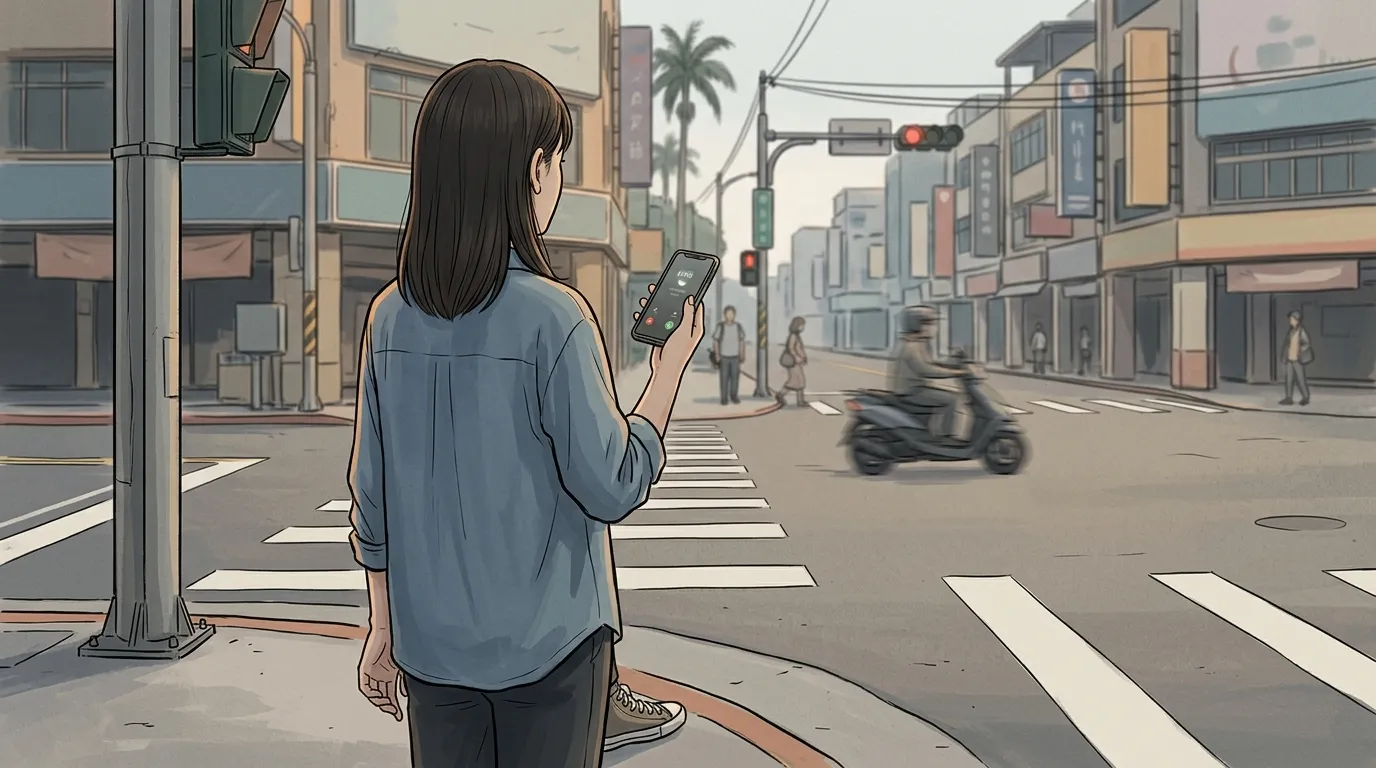
I walked a while, then stopped at a red light to wait.
My phone vibrated.
Chápǔ’ěr. Calling. The screen showed her name.
I answered.
She said: “Lánlán-jiě, I’m really not okay today. Can you be with me?”
Her voice was real. That vulnerability was real. She really wasn’t okay today. She really wanted to find me. That reaching-out was because she believed I would be there.
I stood holding the phone at the red light. The light hadn’t changed.
I said: “I’m here.”
And then I heard my own voice.
That I’m here—after I said it, for the first time I stayed inside the words instead of moving past them, feeling what they were made of.
Was it goodwill. Was it habit. Was it that I also wanted to keep being needed—or was it all three things at once, mixed together, with no way to separate which came first, which was the real motive, which was the reason I found later to explain it.
The light turned green.
I hung up and started walking toward where Chápǔ’ěr had told me she was.
One step, then another.