Chapter 9
Good People
Chapter 9: Good People
Chápǔ’ěr was waiting for me at the FamilyMart by the Jiangzicui Station exit on the Bannan Line.
She said FamilyMart, so I walked to FamilyMart. She was already there, sitting against the wall, an untouched cup of hot oolong tea on the table in front of her. When she saw me come in, she looked up briefly, then her eyes dropped back down.
“Did you wait long.” I set down my bag and sat across from her.
“No, I just got here.” A pause. “Actually, I’ve been here a while.”
“Drink your tea.”
“Mm.” She didn’t move.
I went and bought a hot milk tea, came back. She still hadn’t touched hers.
“Tell me what’s going on.”
Chápǔ’ěr kept her head down, her fingertips tapping lightly on the lid of her cup. “It’s just—the design assignment, the teacher told me to redo it. Said the concept was unclear, said I hadn’t thought through the relationship between the space and its function. And then I redid it, but I didn’t know how to fix it, I didn’t know what I hadn’t thought through, you know? I did another version, and it still wasn’t right. And then I just—” She stopped. “And then I thought I probably can’t keep doing this.”
“How long have you been saying that.”
“Saying what.”
“That you probably can’t keep doing this.”
Chápǔ’ěr thought about it. “A long time.” Then she gave a pained smile, the kind that knows it looks pained. “Just every time I get sent back. Every time.”
I placed my phone face-down on the table.
We sat there for about an hour and a half after that. I listened to her talk about what the teacher said, she showed me the design on her phone, I asked her who the space was for, she said an elderly person, I asked if the person had back problems or leg problems, she said the teacher hadn’t specified, I said then decide for yourself, she said is that okay, I said whose assignment is it anyway.
She thought about it. “Okay, bad back then.”
“So for this hallway—you said it needs to be this long—someone with a bad back walking that distance, is there anywhere they can lean for a moment in the middle?”
Chápǔ’ěr started sketching in her phone’s notes app. That was it—she started thinking on her own.
I listened to myself speak.
Every word, I heard with complete clarity. Who was saying “put a low stool in that corner”? Was that me? Was that me having an opinion about design, or was I saying the kind of thing you say when you’re being there for someone? “Decide for yourself”—was that my suggestion, or was I copying a certain way of asking questions? When had I started talking in that register?
I knew where that register came from.
I didn’t stop talking. I kept asking her questions, kept looking at the floor plan she was drawing, kept saying “you could try this.” That part of me was running—smooth, uninterrupted. Another part stood further back, in a very quiet way, listening to every word I said, asking: is this you, or is this the you that you learned.
I kept asking myself without stopping, because the moment I stopped, Chápǔ’ěr would notice. She’d think she’d said something wrong, that her problems were too much trouble, that she’d worn someone out again. I’d been trained to this point—I could hold the sharpest questions in my head while my expression and my hands stayed completely still. I didn’t know when that ability had grown in me, or what to call it.
Fúqú had said something once—she said “a truly good companion makes the other person unaware of the craft.” I’d heard that line many times. I’d always thought it was a description of gentleness. Today it occurred to me that it could also mean: making the other person unaware that you are, at this moment, watching something other than her. The invisibility of technique is there so as not to disturb.
I watched Chápǔ’ěr concentrate on tracing lines on her phone screen. Her nails were a little bitten. I folded that observation away too, with all the other things I shouldn’t have been thinking while I was with her.
Before she left, Chápǔ’ěr put away her phone, drank the oolong tea that had long gone cold, and then she looked at me and said: “You know, Lánlán-jiě, every time I talk to you, I feel like—after I’m done, I feel like I don’t need to run away as much.”
She looked down, a little embarrassed. “Don’t laugh at me.”
“I’m not laughing.”
“I mean it. Like, really.”
I said: “I know.”
The moment those words left my mouth, something dropped fast beneath my sternum. Like something had lost its footing, but hadn’t quite hit the ground. Just that one moment, and then it passed.
Chápǔ’ěr waved goodbye, pushed open the door, and walked out. I watched her figure disappear at the corner of the street.
I sat without moving, looking at the half-finished cup of oolong tea she’d left on the table.
On the way back I took the bus. I’d meant to take the MRT, but when I saw the schedule there was a wait, so I stood at the curb for five minutes and boarded one heading toward Taipei Main Station. I sat by the window on the right side. Outside was Banqiao at night—the streetlights and the shop signs bled together, sliding past the glass one frame at a time.
I was thinking about something I couldn’t stop thinking about.
If I disappeared from that group tonight, and Chápǔ’ěr sent a message tomorrow morning and I didn’t answer—who would she turn to. She’d mentioned college classmates, but that relationship sounded thin, someone she hadn’t been close with to begin with. She’d mentioned a high school friend, but that friend was down south now. She’d mentioned that after her roommate moved out, she sometimes woke up in the middle of the night and didn’t know what to do, so she’d just look at her phone.
If I wasn’t there, and she reached for her phone, whose name would she see.
Then the next question arrived: was it possible that because I was there, she’d stopped trying to find anyone else? Had I, as a convenient outlet, plugged up whatever opening she might have made for herself? By staying close to her, had I made it so she didn’t need to work at building other connections—was that it? Or had she always been this way, and I’d just happened to appear?
I couldn’t tell.
The only thing I could tell was this: if I exposed them now, Chápǔ’ěr might lose her only support in the chaos that followed. If I didn’t expose them, she would keep being part of this system, keep needing me, and part of that need had been cultivated. Either choice could hurt her. I couldn’t find a third option.
I leaned against the window and watched the lights outside pass by, one frame at a time.
It felt less like confusion and more like a cold, small clarity. Like being locked inside a glass room—you can see all the light outside, you know where the door is, but you can’t push through. The light surrounds you. You know exactly where you are. You just can’t get out.
The bus reached Taipei Main Station. I transferred to the MRT and got off at Da’an Station.
I walked home, fit my key in the lock, pushed the door open, stepped into the entryway. Didn’t turn on the lights.
I stood in the dark. My mind wasn’t running through anything—I just stood there, letting my eyes adjust.
I thought about messaging Píngpíng. Then didn’t.
I stood like that for a while.
What came to me was: I need to see her in person. Not a message. I have to go see her.
Two days later, I messaged Píngpíng: “Can I come find you.”
She replied about twenty minutes later: “I’m at Cháng’ān Park. Come when you can.”
I hadn’t been to that park before. It was near where she lived. I looked it up, took the MRT, walked a few minutes. A little past five in the evening. There were some older people doing exercises near the plaza, a mother pushing a stroller. Píngpíng was sitting on a bench near the fountain, her jacket zipped up to the collar, holding something cupped in her palm. I didn’t see what it was until I got close—a square eraser, its corners worn round.
She saw me coming, didn’t stand up, just gave a small nod.
I sat down beside her.
The silence was long. The sound of the fountain was underneath everything; a breeze came through now and then; from the plaza drifted a faint blur of broadcast music.
Píngpíng didn’t break the silence. I didn’t either.
We just sat. I didn’t know what she was thinking, but the silence wasn’t anxious. It was the kind that says: we both know what happened before we got here.
Eventually I said: “Can I ask you something.”
Píngpíng watched the fountain. “Go ahead.”
“Do you regret staying.”
Her fingers stopped turning the eraser. She didn’t turn to look at me. She let out a slow breath, and then she said: “What I regret is the first silence.”
I didn’t say anything.
“Every silence after that grew out of that first one.”
I asked: “And if you could do it over.”
Píngpíng was quiet for longer this time. She put the eraser in her pocket, placed both hands on her knees, fingertips pointing down. The broadcast from the plaza switched to a new song—loud for a moment, then fading back to quiet.
“I don’t know,” she said. “What I do know is that if I came forward, the people who don’t have anywhere else to go would lose the only thing holding them up. I can’t carry that.”
“So you just keep going like this.”
Píngpíng turned and looked at me—not a reproach, not an explanation, just a look. Then she looked back at the fountain.
She said: “Every morning I wake up and choose the silence again.”
A pause.
“Yesterday’s choice doesn’t count for today. Tomorrow I’ll have to choose again. Every time is new.”
When those words settled, I understood she was talking about herself. And not only about herself.
I leaned back against the bench. The wood was a little hard. I looked at my own hands on my knees for a moment, then looked out toward the park. The sky was getting dark. Light came down between the buildings and hit the fountain at an angle, turning it a kind of gold that wasn’t quite beautiful.
I thought of everything I’d said to Píngpíng over these two years. Not once had I told her what I’d found. Not once had she told me she already knew. Between us it had always been—you throw a small stone, I throw one back, both of us fully aware there’s a well beneath us, neither of us saying it first. Today was the first time we’d both stood at the edge, knowing the other was there too.
We were quiet again for a while.
The water in the fountain caught the last of the light. A child ran past, circled the fountain once, kept going.
Píngpíng said: “Whatever you decide, I’m not in a position to say anything either way.”
“Why not.”
She looked ahead. The corner of her mouth moved—something quiet settling into place. “Because my own choice—I still can’t say if it was right or wrong.”
I stood, picked up my bag. “I’m going.”
“Okay.”
I took a few steps, then heard her call behind me: “Lánlán.”
I turned around.
She was still on the bench, not standing, looking at me. The way she looked was like she was confirming something.
She said: “The first time, after the Monthly Assembly ended—you were in the hallway, everyone was crying, and you weren’t. I watched you for a long time from the side. I thought to myself—this one’s probably just like me.”
She looked away after that, back toward the fountain. Didn’t say anything else.
I stood there.
I didn’t say anything, because I didn’t know what the right thing to say was. I turned and walked away.
Out of the park, onto the sidewalk, I stopped at a red light and waited.
And then the tears just came.
I didn’t make any sound. My body didn’t move. I just stood there, waiting for the light to change, tears running down my face, and I didn’t wipe them. I knew what I was crying about—the kind of crying that doesn’t have a name, that layer underneath grief, the one that means you’ve been seen by someone, that means she and I are stuck in the same place, that means this not being alone—this very thing—can’t save either of us.
The light changed. I crossed the street, walked a few steps, dried my face.
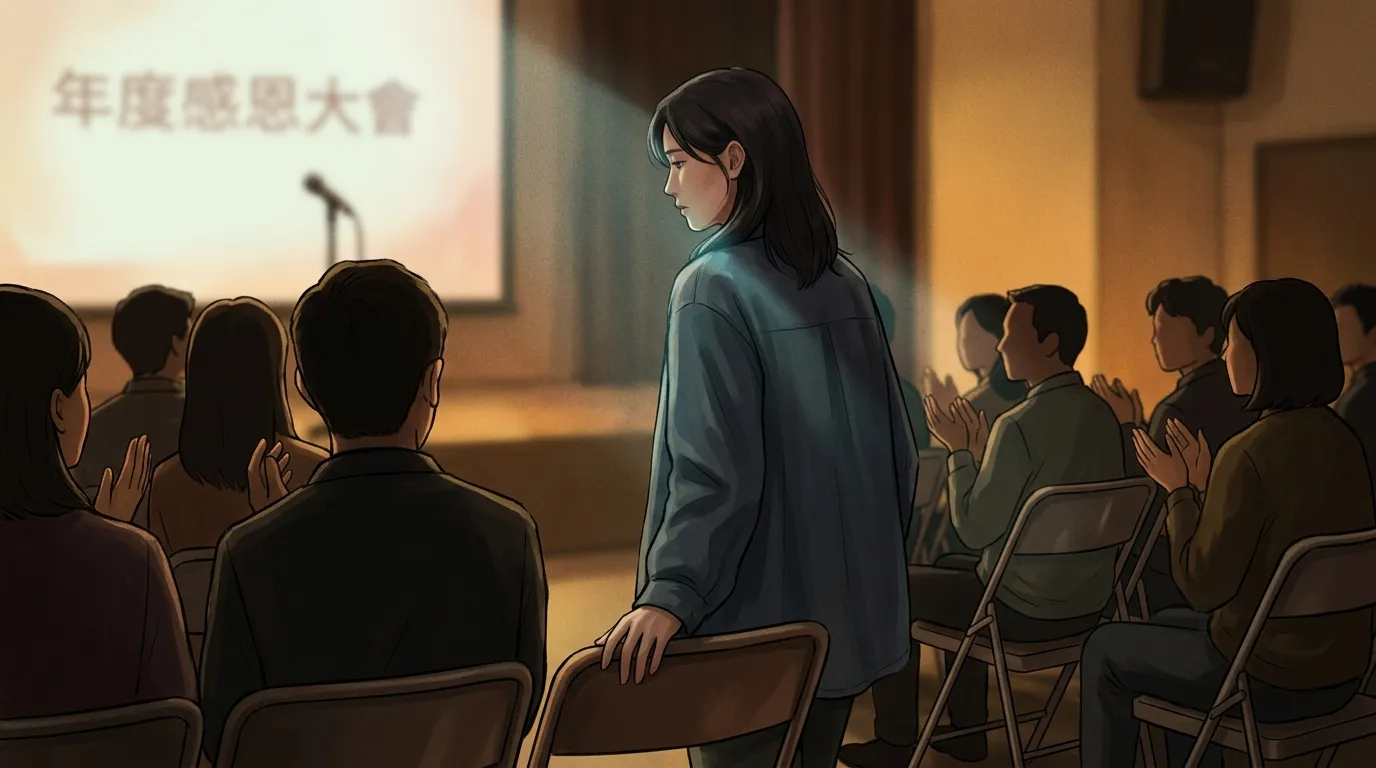
The Annual Gratitude Assembly was held at the Da’an District Community Center. About a third of the seats were filled when I arrived.
I picked a spot in the middle-back section, on the aisle side. Not the very last row—the last row feels like fleeing, too obvious—but I didn’t want to be near the front either, where you’d have to turn your head to go unnoticed. Middle-back was right. Present, but not quite.
I hadn’t changed my clothes. Just what I was already wearing—a dark blue jacket, black pants.
People kept coming in. Faces I knew, faces I didn’t. I sat in my chair, put my phone in my bag, and left it there.
When Fúqú took the stage, I felt a ripple of movement in the rows ahead—someone adjusting their seat, a murmur. I could see her from where I sat. She was in a pale-colored top today, her hair neatly done, standing at the microphone, her voice carrying through the whole room. I could hear the sound without hearing what she was saying. It was like water running—present somewhere behind me, a background I registered without entering.
The emcee read out this year’s nominations for top helper.
I listened.
My name wasn’t there.
I had known this. I knew it with complete clarity, knew I was in the act of confirming it—but what that confirmation meant, I couldn’t say. Was it disappointment? Was it relief? Both, a little. Neither, exactly.
The first person to come up and give thanks was a member I didn’t know well—a guy who’d been in the group nearly two years, someone I’d seen a few times. He said after he was laid off last year he had made it through four months because every Wednesday someone called him, not to say anything profound, just to ask what he’d eaten that day, had he slept okay, had he gone outside for a walk. He said he eventually found a new job, and his mother cried and said thank God, and he cried too on the phone, but it was a different kind of crying from when he’d first lost his job—that cry told him he’d actually come through.
When he finished, the room applauded.
My hands joined in.
The second person to speak was Wénqí.
I didn’t place her at first. It was only when she reached the microphone that I recognized her. She looked a little better than the last time I’d seen her—her face had more color, her voice was steadier. She said thank you to whoever had been with her through the nights that were hard to survive. She said she’d started going to the park every morning now, sometimes with coffee, sometimes without, just walking. She said she couldn’t name the day her recovery had started, but she knew she wasn’t afraid of mornings anymore.
She bowed her head and said: thank you, Good People.
The next speaker was a young woman I didn’t recognize. She was young, with a slight accent—probably from the south. She said when she left home and moved to Taipei for work, she didn’t know a single person, and after her shifts she’d go back to her rental and stare at the ceiling and count the tiles. She’d counted until she herself found it strange, but there was nothing else to do. She said on her first night in the group, someone she’d never met sent her a message: “You worked hard today. Rest now.” She looked at those words for a long time. She said she didn’t know how to explain what they meant to her. She said she still lives alone, but she doesn’t count tiles anymore. She meets up with two or three people from the group for meals every week. She said thank you, Good People.
As she stepped off the stage, I saw a woman in the front row stand and give her a brief hug. It was short, easy, like something they’d done many times before.
I sat there, listening.
And then the tears came again. No warning—one person was talking about not being alone in Taipei, and my eyes went hot.
I knew what I was crying about.
I was crying because these thank-yous were real. The man who’d been laid off had truly made it through. Wénqí was truly not afraid of mornings. That woman was truly not alone. These things were true. I couldn’t use the system is broken to erase them. The feeling of being held—it was there, it was not fake, even if the thing doing the holding was something I couldn’t name, even if I had doubts about what was underneath—but the warmth those people felt, the kindness they received, it had existed. It had really existed.
I couldn’t deny that it was real.
And I didn’t know if someone like me was even qualified to.
I knew all of this. I sat there, knowing. But knowing didn’t give me anywhere to put it.
So I sat, and let the tears come on their own, and kept still, and let the thank-yous pass by me one by one.
The emcee said, if anyone wants to say something, you’re welcome to come up.
I had no intention of going on stage.
The third person finished speaking and stepped down. The stage was empty for a stretch. The emcee stood to the side smiling, waiting. No one stood. The silence went long—not long enough to be uncomfortable, but long enough that you could feel the weight of what hadn’t been said.
And then my legs stood up on their own.
I say “my legs stood up on their own” because in that moment I genuinely did not know if I’d decided to stand. The standing seemed to have happened before I was aware of it. By the time I came back to myself, I was in the aisle, moving toward the stage, legs working, feet moving.
I walked to the microphone.
The lights were bright. I couldn’t make out faces in the audience, only shapes and light.
I said: “Thank you, Good People.”
Just that.
I let the words sit in the air for a moment.
Then I said: “I mean that sincerely.”
“This is the most honest thing I’ve ever said.”
“It’s also the most complicated.”
I stepped off the stage. My legs were a little unsteady on the way down. I held the back of a chair as I passed, made it to my seat, sat down.
The room applauded. I didn’t try to interpret what the applause meant.
After the assembly ended I walked out of the community center.
Outside was Da’an at night. People on the sidewalk. A coffee shop across the street still open, its light orange.
I stood by the entrance, zipped up my jacket, and stayed there.
My phone stayed silent.
I waited for a moment.
No message from Chápǔ’ěr. No message from Píngpíng. No message from Fúqú. The group was quiet—nothing came through, no one waiting for an answer from me.
The silence felt unfamiliar. Not comfortable or uncomfortable, just unfamiliar. It took me a moment to realize: this was the first time in two years that I’d stood somewhere outside this group with no one waiting on me at all.
I stayed in that silence for a while, and then I started walking.
Whether I eventually left.
Whether I exposed them.
What happened to Chápǔ’ěr.
I know you want to know. I want to know too. But I can’t tell you—not because I won’t, but because I’m still inside that question, still thinking, still haven’t found my way out.
I’ve never forgotten something Fúqú said. She said it a long time ago, not long after I first joined. I asked her something, and instead of answering, she said: “Are you sure your current state is the right one for making this decision.”
I’ve used that sentence many times since. With Chápǔ’ěr, with others, with myself. It’s an effective question. I used it for a long time.
Later I realized: it had borrowed away my capacity for decisive action.
What I mean is—every time I was about to do what felt like the right thing, I’d first ask myself: is my current state the right one for this. And then I couldn’t be certain. Was I in a good enough state? Was I clear-headed? Was I acting from emotion or from reason? And then I couldn’t move.
That sentence taught me to doubt myself.
I don’t know if Fúqú knows this. I don’t know what she meant when she first said it.
Maybe she was only asking exactly what the words say—your current state, this decision, do they fit.
But in me it became something else.
So I’m still thinking.
What a good state looks like. When you can trust your own judgment. When the “right thing” is actually right, and not just what you believe is right.
I don’t have an answer.
I’m still thinking.