Chapter 1
South Gate Noodles
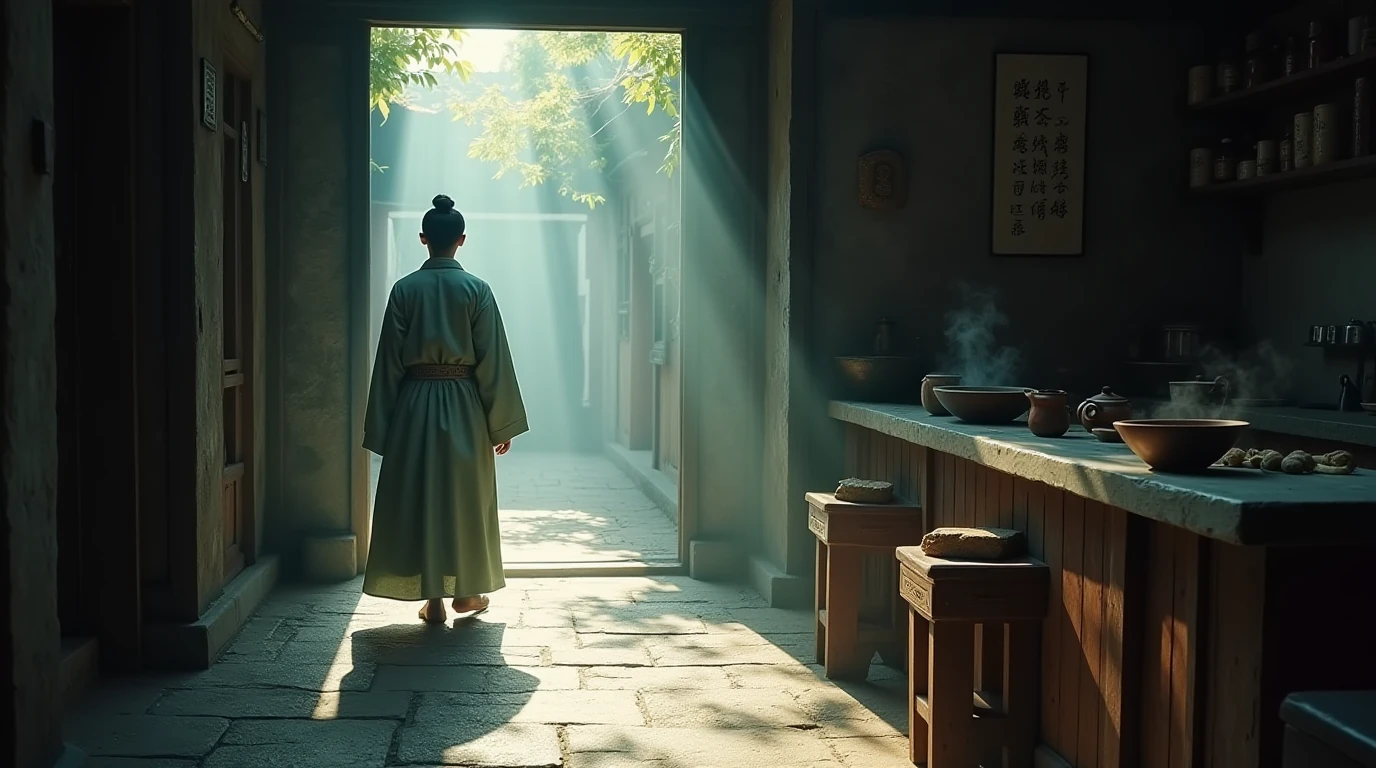
Before the Mao hour’s sunlight had crested the eaves, the only movement in South Alley was a scraggly dog, asleep against the alley wall.
The alley was barely six chi across. At its mouth, a crooked jujube tree thrust half its branches sideways, facing a single half-worn wooden door. The paint had peeled from the door in great strips, exposing the pale wood beneath. Above the lintel there was no sign—just a square wooden plaque painted with two black characters: Mian.
The door hadn’t opened yet, but the kitchen was already alive.
Zhou Tieshan pushed his sleeves past his elbows, revealing forearms roped with veins. He pressed his palm flat against the ball of dough and bore down. The dough rolled, collapsed, rolled again under his hand—refusing to yield, like a stubborn white cloud. He worked fast. Three breaths per fold, five to reach the right pull. Where an ordinary noodle shop master needed half an hour at the dough, Zhou brought it to the Three Brights in half an incense stick’s time—hands bright, dough bright, board bright.
The stove fire was already going. The bone broth from last night’s simmer sat warming on the range, bubbling with tiny quiet pops, its fragrance drifting lazily out into the alley.
Zhou Tieshan was the proprietor of this noodle shop—and, in truth, its owner outright. His dough-kneading skill he’d picked up ten years ago on an escort run, learned standing watch in an inn’s back kitchen. Back then, seven of them had been guarding a shipment of medicine across Wild Ford Slope, freezing and starving, bellies so empty they ached. The innkeeper had produced half a sack of flour and asked who could knead. Zhou back then wasn’t a shopkeeper—he was a guard, and his hands knew strength. But the dough he worked came out more resilient than anyone’s.
That was ten years ago.
Now he was just over forty, with two deep creases at his temples and a diagonal scar across his palm—a slash running from the base of his thumb to the wrist bone, like an old wound that never quite healed. He never spoke of it. No one asked. To anyone who walked through the door of this noodle shop on South Alley, the owner simply made good noodles, ran a steady stove, and could cut beautiful longevity noodles on feast days. Nothing else to know.
Halfway through the dough, footsteps sounded at the back door—heavy and steady. Old Fourth.
The old man set down a basket of meat, covered with a damp cloth. He placed the basket on the low stool beside the cutting board, lifted the cloth, revealing half a carcass and a length of marrow bone, still pink with fresh meat. Old Fourth was around forty, thick-set, his neck thicker than most men’s—that came from years of splitting bones. He carried knives on his person at all times, the handles worn bright and smooth from use; at his hip hung that same inseparable cleaver he always wore.
“Marrow bone. Killed this morning.”
Old Fourth’s speech was spare—one sentence per exchange.
Zhou Tieshan nodded without looking up, hands still working the dough.
Old Fourth went to the back kitchen to start the fire. Before the flames were up, he’d already taken up the marrow bone. The sound of bone-splitting came through in steady, measured rhythms—each blow landing true, cleanly separating joint from flesh. Every stroke showed the work.
The front door made its second sound—the push of Sun Daozi.
“Well, Zheng the Butcher’s in early today.” Sun Daozi stifled a yawn and pushed his sleeves up. “Marrow bone? Are we putting on the frills tonight?”
Old Fourth said nothing, just kept chopping. Sun Daozi didn’t mind. He went about wiping tables and cleaning stools, quick and efficient. He had been an information broker by trade; his mouth was his capital, and ten years in a noodle shop hadn’t dulled it one bit. Wiping a table, he let spill what he’d heard at the teahouse the night before: “Old Zhang’s ox from the north city—trip-wired, they say. Leg broke clean off. Took them all afternoon to butcher. South market’s going to jump a full ten percent—”
“A ten percent jump and you’re still the one paying.”
Sun Daozi clicked his tongue and slung the rag over his shoulder. “I just like keeping track of things. What’s it to you?”
That was the noodle shop’s daily overture. Zhou Tieshan listened from the kitchen, felt the dough shift under his palm, and let the corner of his mouth lift—not quite a smile, but close enough. He never stopped their sparring, never took sides. The rule was this: inside this shop, words were free, but hands couldn’t stop. The routine was fixed; the people were alive within it.
The front door sounded a third time—Shen An.
Old Sixth came in the way a leaf comes over a wall—light, barely a whisper of sound when he landed. He was just under forty, tall and thin, with pale features like a clerk who’d spent his whole life in a medicine shop’s back room with no sunlight. But Zhou Tieshan knew exactly what Old Sixth carried in his sleeves—three silver needles, two throwing knives, a packet of lime. In ten years, none of it had ever left his sleeves. But Old Sixth carried it every day, and replaced it every day, like a ritual he couldn’t have explained if he’d tried.
Old Sixth brought out bowls and chopsticks and set them in the front hall—one by one. Chopstick ends facing out, bowl rims facing out, all precisely arranged. The same meticulous precision as his unexpressive face.
At the beginning of the Chen hour, the front boards came off the door and hung from the crooked jujube tree’s branch. Morning light slanted into the shop, falling across the eight-immortal table.
The table was elm, bought collectively by seven men, solid, its surface marked with dents and scrapes of varying depths. The deepest scar sat at the corner, as if something blunt had struck it hard. Seven benches stood around the table—six placed properly, one empty.
On that empty bench, Old Seventh had set a coarse ceramic bowl. Inside, the tea leaves Old Second had given him the night before, long cold, the leaves settled at the bottom like a small dark clot of mud.
“Is Old Seventh late again?” Sun Daozi asked.
Shen An shook his head, pointed outside, then at his own ear, and made the gesture for “counting accounts.”
Old Seventh managed the money and went each morning to the money shop at the alley’s mouth to reconcile accounts. This was set routine, decided ten years ago, immovable as stone. Zhou Tieshan lowered the dough into the pot, steam rising up and blurring his vision—and blurring, too, the empty corner of the kitchen.
That corner should have held a knife.
Old Fourth’s knife hung on the back kitchen wall—a cleaver, narrow and thick, its edge gleaming. But at Old Fourth’s hip hung another half-knife—its sheath a makeshift piece of ox horn, dark and dull, wrapped around whatever lay inside. No one knew what it was.
Only Zhou Tieshan knew.
It was his brother’s half-blade.
“Are the noodles ready? We’re going to have a crowd at breakfast.” Sun Daozi called from the front.
“No rush.” Zhou Tieshan lifted the noodles into a bowl, ladled on the bone broth, scattered a handful of scallions, and carried it out.
The first bowl was Spring Sunshine Noodles—plain and clean, scallions bright green, broth clear as light. This was the bowl that showed the depth of Zhou Tieshan’s dough work: noodles separate and distinct, smooth and resilient, the broth a true bone broth simmered a full night, its flavor drawn into the marrow itself.
The breakfast crowd came in ones and twos. The neighbors of South Alley came for value; this noodle shop on South Alley succeeded on generous portions and honest flavor, the owner a man of few words—anyone who walked in was a customer, and once they left, he didn’t watch them go. Sun Daozi handled the front, Old Fourth prepared ingredients in back, Zhou Tieshan commanded the stove, Shen An wiped bowls in a corner. By late morning, five baskets of noodles were gone, the bone broth had been watered twice, Sun Daozi had collected for thirty-seven bowls, and every copper had gone into Old Seventh’s coarse wooden box behind the counter.
Old Seventh came back near midday.
His return was even quieter than Old Sixth’s—he slipped in through the side door practically soundlessly, took his seat behind the counter, and opened the account book. He was under thirty, fair-skinned, with refined features like the young master of some escort company. He always had an abacus in his hands: large beads for income, small beads for expenses. The click of beads told him whether the day’s business had risen or fallen.
“North city market is climbing.” Old Seventh turned pages without looking up. “Those three hundred taels—”
He stopped.
Zhou Tieshan was passing through carrying a bowl of noodles. He heard that half-sentence, and his hands hesitated—just for a moment. He didn’t turn around. He delivered the noodles to the customer’s table. On the way back, he passed the counter again, and his gaze lingered on Old Seventh’s profile for an instant.
Old Seventh turned the account book faster, as if that topic had never been spoken.
Zhou Tieshan noted it away inside himself.
Once the lunch rush cleared, the shop emptied. Sun Daozi lay face-down on the counter, asleep. Old Fourth had gone to the back courtyard to smoke pipe tobacco. Old Sixth was outside washing scallions. Shen An sat in a corner, staring at nothing—or rather, at something no one else could see. Old Fifth came back from a delivery run, went straight to the back kitchen to tend the fire. In the escort company he’d handled logistics; in this noodle shop, it was the same work.
Old Seventh was behind the counter, going over accounts. Zhou Tieshan was wiping down the stove.
This was the daily life of the noodle shop on South Alley. Seven men, seven years—no, ten years. Ten years of days strung together like this: morning market, midday, evening, preparing ingredients, collecting money, closing up. Anyone who came in was a customer; anyone who left was back on the street. No one talked about before; no one asked where you’d come from.
Except that empty bench was always there.
On this particular day, the routine was broken at the Wei hour.
By the Wei hour, the light had gone lazy, slanting sideways. Sunlight filtered through the jujube tree’s leaves and scattered across the shop floor in broken patterns. This was not a noodle-eating hour; the shop was empty save for Sun Daozi, still face-down at the counter, a small pool of drool beside him.
Someone stood in the doorway.
The cloth in Zhou Tieshan’s hand went still for a breath.
A young man.
Fair-skinned, refined-featured, wearing a blue-cloth robe—not quite new, not quite worn. No sword at his hip, and none of the restless energy that martial society men carry—no weapons, no hidden implements, his pace unhurried, his bearing like a young master from an escort company with nothing to do, or a young scholar out for a stroll, or a young shopkeeper from some street front.
Zhou Tieshan looked at him once. Looked again.
Something wasn’t right.
The young man’s posture was wrong for a young master or a scholar. His shoulders sat too level, his back held too straight—a bearing that spoke of rigorous training. That way of standing, Zhou Tieshan had seen before—at the escort company, in the world of martial society, on young people who’d begun their training before they could call themselves disciples.
He set down the cloth and nodded toward the young man. “Sit wherever you like. Bowl of noodles?”
The young man walked in and sat in the corner by the wall.
That corner table faced the eight-immortal table straight on—and faced the empty bench straight on. He had chosen this seat deliberately. His gaze fell, almost naturally, on the empty bench. Stopped for a breath. Moved on.
“Spring Sunshine Noodles,” he said. “Plain.”
Zhou Tieshan acknowledged him and put the noodles on. The fire burned high. Steam rose and blurred his vision. Through the haze he watched the young man—the young man sat perfectly upright, hands folded on the table, eyes level, his expression calm and unhurried. The way he looked at the empty bench was not curiosity—it was confirmation. Like someone checking a set of numbers before arriving at a judgment.
The noodles came. Broth clear, scallions bright green, noodles separate and distinct.
The young man picked up his chopsticks and ate. Not fast. But there was a clean, precise economy to every movement—even his chewing rhythm seemed calculated.
He ate the whole bowl. Drank the broth dry.
Then he drew a small silver ingot from his sleeve, set it on the table, and from his chest produced a folded note, which he laid over the ingot. He stood, gave Zhou Tieshan a nod, and walked out.
The silver sat on the table; the note sat beneath it. Zhou Tieshan went over, dropped the silver into the counter box, and drew the note free.
The note was ordinary xuan paper, cut somewhat carelessly. A single line of text in the neat, formal Guange script—
Ask about Third Brother.
Zhou Tieshan’s hand did not tremble.
He folded the note. Folded it slowly—one fold, two folds, then folded again into a small square, and tucked it into the hidden pocket inside his left sleeve. That pocket had held Third Brother’s written token ten years ago. In the years since, it had held whatever could not be set down, whatever would not fit anywhere else.
When he raised his head, the light at the doorway had shifted. The sun had passed its midday angle.
The young man was gone.
Zhou Tieshan stood behind the counter for a breath.
He wondered who the young man was. He looked like Third Brother—that refined handsomeness, the way his features sat. But this young man was fairer than Third Brother, quieter, and he lacked the hot temper Third Brother had carried in his youth.
He looked like Third Brother.
Zhou Tieshan pressed the thought down. He picked up the cloth from the stove and went on wiping the stretch of counter he’d left unfinished. The cloth dragged across the surface; the marks of ash and grease vanished, came back, vanished again. For ten years this was how he’d gotten through his days—wiping the stove, wiping the cutting board, wiping the things that should not leave marks.
But some marks cannot be wiped away.
The note in his sleeve pressed against the old scar at his wrist like a small, fine splinter. He finished the stove, draped the cloth over his shoulder, and walked into the shop. Sun Daozi had just woken, rubbed his eyes, and asked: “That fellow just now—he gone? Did he pay for the Spring Sunshine?”
“Paid.”
“Doesn’t look like a man of the world,” Sun Daozi said, yawning. “Too clean.”
Zhou Tieshan offered nothing.
He crossed to the eight-immortal table, lifted the coarse ceramic bowl of cold, dried tea leaves, and upended it. The leaves, long dried, came loose in a thin crust and scattered. He set the bowl back in its place.
The empty bench stood square and true, exactly as it had every single day for ten years.
The shadows lengthened once more.
===