Chapter 2
The Rules of the Yangchun Noodle
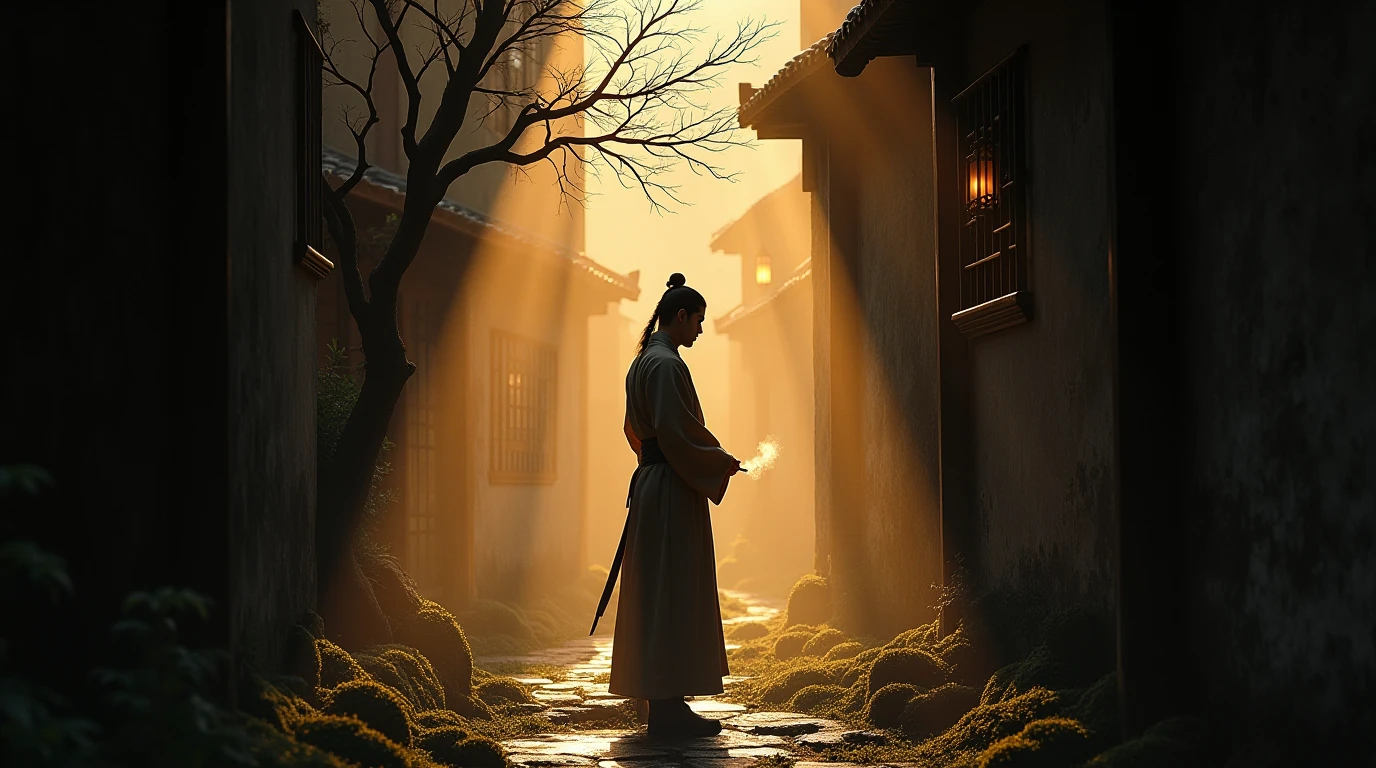
Sun Daozi had a mouth that didn’t know friend from foe.
Everyone in South Alley knew it. Wang the Tofu Lady complained he was vicious with his tongue—he told her she’d misseasoned her bean curd brine. Li the Scrap Metal Man griped that he was too sharp with his comeback—Sun Daozi told him his scale weights were filled with quicksilver. Ten years of this, and the regulars in South Alley had learned the drill: enter the noodle shop, avoid the seat nearest the stove, wait until Zhou Tieshan’s Spring Sunshine Noodles hit the table, then settle back at the eight-immortal table and eat at leisure.
Sun Daozi didn’t care. He’d accumulated more enemies than he could keep track of.
This day, the Wei hour. The sun had swung west, the midday rush cleared, and a half-pot of rich broth sat warming on the stove. Sun Daozi had tucked himself behind the counter, nursing a cup of long-cold tea, using a small knife with a walnut-wood handle to hollow out a six-fen walnut. The shell was hard; he worked the blade tip along the seams, carving inward by millimeters, letting the shell fragments dust the counter in a fine layer.
The door creaked.
Sun Daozi didn’t look up. Anyone walking in after the midday rush was either a scavenger, someone needing the privy, or—
“Spring Sunshine Noodles. Nothing added.”
The voice was clean, unhurried, no trailing off.
Sun Daozi raised his eyes.
Same young fellow as yesterday. Fair complexion, clear brows and eyes, wearing a half-worn indigo robe, no weapon at his belt, carrying the same cloth bundle as the day before. His posture was upright—not the usual slouch into a bench, chopsticks drumming the bowl rim to rush the kitchen, but held slightly erect, as if ready at any moment to rise.
Sun Daozi sheathed the knife, eyebrows lifting.
“Wasn’t yesterday your first visit?”
“I ate here yesterday.” The young man answered slowly, each word measured and placed. “Today I’ll eat another bowl.”
” Nothing added?”
“Nothing added.”
Sun Daozi tossed the half-hollowed walnut into a saucer, leaned back against the counter, and chewed the walnut meat he’d carved out. Across the half-length of the shop, he ran his eyes over the young man from head to toe.
Standing with roots—the stance wasn’t one of those flowery, show-off forms you learn in a school. It was the real thing, forged in actual steel-and-blade work. Steps were steady; his center of gravity never wobbled when he walked, and when he’d crossed the worn door threshold, he’d cleared it cleanly, not so much as a toe catching.
Sun Daozi drew the walnut-wood knife across his thumbnail, two light strokes.
At that age, with that bearing, dressed like that—he could pass for the young heir of an escort company. But a young heir wouldn’t come to the south district for a bowl of Spring Sunshine Noodles, and he wouldn’t leave a note on day one and come back on day two.
“Just passing through?” Sun Daozi asked, voice drawn out.
The young man set his cloth bundle on the table corner, seated and steady. “Passing through. Eating a bowl of noodles.”
“From where?”
The young man smiled—a faint one, the corner of his mouth lifting slightly, but his eyes stayed cold.
“Did your master never teach you that you don’t ask where a traveler came from?”
Sun Daozi snorted, leaned back, and flipped the walnut-wood knife between his fingers.
“Alright then, little brother.” He wasn’t annoyed. He nodded toward the stove. “Spring Sunshine, nothing added. Broth’s warm on the stove, won’t be a moment.”
The young man acknowledged with a sound, said nothing further.
Sun Daozi turned toward the stove. Passing the eight-immortal table, his pace slowed half a beat. The empty stool bore no bowl—Old Seventh’s coarse ceramic bowl was soaking behind the counter, and this morning’s tea dregs still hadn’t been emptied out. He glanced sidelong at the young man. The fellow was staring at the empty stool, his gaze fixed on the seat as though counting the grain of the wood.
At the stove, Zhou Tieshan was ladling broth into a large copper spoon, his wrist turning over—the same motion as any other day. Sun Daozi drifted closer and dropped his voice beside the old man.
“That young fellow is back.”
Zhou Tieshan’s ladling hand paused for a heartbeat, then continued. He poured the broth into the noodle bowl.
“I saw.”
“Unusual.” Sun Daozi leaned against the stove’s edge, the small knife turning a slow circle in his fingers. “Left a note yesterday, came back today, orders nothing but plain noodles, sits like a scholar, but his eyes are tracking everything.”
Zhou Tieshan scattered the scallions into the bowl with more force than usual; they landed on the broth’s surface and set off a few bright sparks of oil.
“He’s a customer.”
“Customers don’t sit like that.” Sun Daozi pressed closer, voice lower. “Old Brother, don’t play dumb with me. You’ve clocked this young fellow’s style—what’s your read?”
Zhou Tieshan lifted the noodle bowl; the steam rose and blurred his brow.
“Whether I have or haven’t—what does it change?”
“Is he here for vengeance or here to spy?” Sun Daozi stepped after him. “If it’s vengeance, I need to brace for it. If it’s spying, I need to know which kind of business he’s circling.”
Zhou Tieshan kept walking, carrying the bowl toward the eight-immortal table.
“Eat the noodles first. We’ll talk after.”
Sun Daozi followed behind, the walnut meat in his mouth crunching with each chew, and let the subject drop.
The noodles arrived. The young man took the bowl, chopsticks steady, lifted a strand of noodles and conveyed it to his mouth, chewed twice, swallowed slowly. His movements were neither fast nor slow—it could have been a man genuinely intent on his bowl of noodles, or a man merely going through the motions.
Sun Daozi sat behind the counter, blade-tip digging back into the walnut’s shell, but his eyes never left the young man.
He’d read the world of martial society for over a decade. He’d seen every type come through: men borrowing silver, men settling scores, men claiming kinship, men digging up old ledgers—each had their own way of sitting, their own way of watching. The look in this young man’s eyes wasn’t foreign to him. It was the gaze of someone who knew this place held an answer he needed, only it was buried deep and showed nothing on the surface.
Zhou Tieshan returned to the stove and began working the midday dough. The kneading was the same as always—steady, rhythmic, strong—but Sun Daozi, standing closer than usual, caught that the force was heavier than typical. Usually, kneading dough was exertion. This was pressure being worked out through muscle.
He said nothing more.
The young man finished his noodles, set the bowl down gently, and laid his chopsticks neatly across the rim. Rising, he drew a small silver ingot from his sleeve, set it on the table, and turned to leave.
Sun Daozi’s eye caught the ingot—that had to be at least two mace. A bowl of Spring Sunshine Noodles cost ten cash at most; the man had paid twenty times the price.
“Too much,” he called after the retreating figure.
The young man didn’t look back.
“Keep the change.”
The doorboard knocked, and he was gone from the alley’s mouth.
Sun Daozi brought his gaze back and rolled the small ingot between his fingers. Full silver, clean cast—no market-grade dross mixed in. This ingot had come from either an escort company’s accounts or a wealthy household’s disbursements to servants.
He flicked it onto the counter. It rang bright and sharp against the wood.
“This young fellow wasn’t here for the noodles.”
Zhou Tieshan’s hands stilled on the dough.
The kitchen filled with the sound of broth murmuring in the pot, and from outside, the sparrows on the crooked jujube tree chirped twice. Late afternoon light filtered through the seams of the worn door planks and striped the floor in slender beams.
Sun Daozi leaned against the counter and waited for the old man to speak.
Zhou Tieshan kneaded on. Not a word.
Sun Daozi counted one breath, then two, then three. On the third, he slipped the walnut-wood knife back into his belt and headed for the back alley.
“I’ll step out back, get some air.”
He didn’t need to look to know the old man was watching.
The back alley was narrow—just wide enough for two people abreast. Moss grew along the base of the walls, slick underfoot. Sun Daozi braced himself against the brick and fished out a pinch of pipe tobacco, rolled a crude cone, lit it with his firesteel, and drew deep.
The smoke unfurled, bitter and tinged with the earthy bite of Yunze south district’s homegrown leaf.
His thoughts drifted.
Ten years ago, Third Brother had the same habit. Back in those days, sharing a bowl with the brothers, he’d say nothing about what he wanted, and only reveal he wanted plain broth noodles once the bowl arrived. He’d finish, leave a silver ingot, and walk out—overpayment left on the table, because that was the code of the world: settle accounts face to face.
But this young man wasn’t Third Brother.
Third Brother had broad features, a volcanic temper, and a voice that carried like a street brawl—you could hear him from ten li away. This young man’s face was refined, his speech measured and quiet, each word placed with care, unhurried.
But something was the same.
The way he sat in the corner. The angle of the chopsticks lifting noodles. The habit of setting the chopsticks across the bowl’s rim when he was done—Sun Daozi had watched it back then, and carried the memory for ten years. He couldn’t forget.
He raised the crude cone to his lips and drew again.
The smoke had burned down to the end; it singed his fingers. He stubbed the ember against the wall base and ground out the ember’s glow.
Third Brother’s nephew.
He turned those words over in his mind, again and again.
If this was Third Brother’s nephew, then the note, then the question about “Third Brother’s affairs”—it all fit. But if this was Third Brother’s nephew, why wait ten years? Why show up at this hour, at this particular moment?
Ten years ago, Third Brother died on Wild Ford Slope. His remains lay in the south district’s charity morgue for three days before Old Brother paid for the coffin out of his own pocket. If there’d been family to claim him then, they could have come, should have come—taken him home or given him a proper burial. Why wait a decade?
Unless—
He lifted his head and gazed at the thin strip of sky above the back alley.
Unless some debts from that night were still open. Unless some scores were still unsettled. Unless there were questions that couldn’t be asked until now.
Sun Daozi tucked the tobacco back into his coat and rubbed his palm against the wall. His hand was damp.
He’d been an information broker by trade. Making his living off word and whisper. That night ten years ago, his job had been to scout ahead and report back: clear. And yet when the ambush erupted from the reed beds, he’d heard not a whisper of wind.
His failure.
He’d felt that weight ever since.
But he’d also seen Old Fourth retreat first. Seen Old Sixth’s sleeve-cannon, its case still full—one dart not thrown. In the chaos he’d only had time to look back once: Old Fourth’s back retreating, Old Sixth following behind, and when he’d turned again, Third Brother was down in the blood.
Was that what the young man had come to ask about?
Sun Daozi took out the firesteel again—not to light another smoke, just to feel it in his palm, turning it over and over.
Something surfaced.
Last night, after closing, Old Seventh had been tallying accounts at the counter. He’d gotten halfway through the sum, then stopped abruptly. “Those three hundred taels—” He’d said it like that, clipped, and then nothing. At the time, Old Brother had been wiping the stove, Zheng the Butcher had been in the back kitchen splitting bones, Old Fifth had been sweeping, and Sun Daozi himself had been behind the counter carving a walnut.
Old Seventh had opened his mouth—and then just stopped.
Those three hundred taels.
Third Brother had borrowed a sum once: three hundred taels. Old Seventh had been the go-between. But Third Brother had died on Wild Ford Slope, and the silver had been on him when it happened—lost somewhere in the skirmish. Afterward, Old Brother had gone to the morgue to identify the body. The silver was gone by then.
The matter had been quietly dropped. Silver lost, accounts muddied, never spoken of again.
But what had Old Seventh meant last night, saying “those three hundred taels—”?
Sun Daozi pocketed the firesteel, folded both hands into his sleeves, and took a few steps toward the alley’s mouth. Halfway there, he stopped and glanced back toward the back kitchen.
Zheng the Butcher’s cleaver rang against the cutting block—the rhythm was faster than usual. Old Brother was still at the stove, the cloth in his hand scrubbing the same patch of iron it had been scrubbing for what felt like forever.
Sun Daozi considered, then didn’t go back.
He continued toward the alley’s mouth, slowing as he passed Old Sixth’s cramped little room. Old Sixth normally spent this hour out back, slicing scallions— he’d slice until dark and not come out until the stars were fully up. Tonight it was silent. The window paper was sealed tight; not a sound from within.
He had taken two more steps when a dull thud came from behind him.
Like someone driving a fist into the wall.
Sun Daozi stopped.
He stood in the middle of the back alley, tobacco smoke still curling at his nostrils, moss slick under his feet. He didn’t move, just stood there.
The thud came once and stopped.
It could have been Old Sixth rolling over in his sleep and bumping the bed frame. Could have been Old Seventh’s abacus falling. Could have been—
Sun Daozi shook his head.
He turned and walked back toward the front shop. Passing Old Sixth’s door, he didn’t slow his steps and didn’t glance that direction.
Some things, you don’t ask.
That was the code of South Alley. The code of the shop.
When he returned to the front, the stove had been cleaned and put to bed. Old Brother sat behind it, silently grinding the blade of his dao. Zheng the Butcher peered out from the back kitchen; spotting Sun Daozi, he muttered: “Second Brother, you’re back.”
“Back.” Sun Daozi settled behind the counter and drew the walnut-wood knife out again.
No one mentioned the young man.
No one mentioned the thud.
When darkness fell, the shop closed on schedule. Seven benches flipped up onto the tables, the stove fire died, and the door planks were dropped one by one into their brackets. Old Seventh left last, palming the young man’s small silver ingot and muttering, “Two mace for a bowl of noodles—generous soul,” while turning the bright pellet under the oil lamp for a long, hard look.
Sun Daozi sat in the corner and smoked an entire pipe.
The tobacco burned down to ash. He stubbed the pipe out, rose, and walked toward the door. Passing the eight-immortal table, his pace slowed again—the empty stool sat squarely at the table’s edge, its seat filmed with a thin layer of dust. The lamplight caught it, and the dust looked like a pale mist.
He felt like saying something. Then decided there was nothing to say.
Old Brother’s words at the stove kept echoing in his ears: Eat the noodles first. We’ll talk after.
The noodles were eaten. The talk never came.
Sun Daozi folded his arms into his sleeves and walked into the back alley. Narrow by day, it was narrower still in the dark. His feet stumbled on the uneven blue-stone paving, hands trailing the walls for guidance.
Old Sixth’s window was black.
He stood at the alley’s mouth a while. The tobacco smell still clung to his nose; he exhaled twice, driving the earthy bite out of his sinuses.
Would the young man come again tomorrow?
If he did, what would he say?
What was he actually asking with that—“ask about Third Brother’s affairs”?
Sun Daozi raised his eyes and looked at the stars. Yunze south district’s night wind was biting cold; it stiffened the back of his neck. He drew his arms tighter into his sleeves and walked out past the alley’s mouth.
At the mouth of South Alley, the crooked jujube tree cast a long shadow across the ground. Moonlight outlined its branches in silver, and the pattern they made on the earth looked like a face you couldn’t quite read.
He stood there a moment, then turned and walked back to the shop.