Chapter 3
Half a Blade
At the third quarter of the Chen hour, Zheng the Butcher set his meat cleaver down on the chopping block, wiped his hands with a rag, and stood up to leave.
Old Zhou was kneading dough behind the stove. He heard Zheng go but didn’t look up. Old Zhou never looked up while kneading dough. Ten years of habit.
“Old Fourth, the meat market gets crowded in the evenings. Don’t dawdle.”
“I know.”
Zheng gave his answer and pushed through the door curtain. The curtain was sewn from old cloth, washed pale, its edges fraying. Every time Zheng pushed it aside, his fingertips brushed against the rough threads.
The street was already busy. South Alley with its blue stone paving came alive most during the morning market—vegetable vendors carrying their poles, the tofu lady hawking from her wooden tray, a few idle men leaning against the wall catching the sun. Zheng walked unhurried, his broad shoulders leaving exactly half the lane. Not too wide, not too narrow. Just right.
Turning onto Coffin Street and heading west brought him to the South Alley meat market. The market occupied a cross street, three shops lined up side by side, the smell of blood detectable from half a block away. Zheng had walked this route for twenty years. He could do it blindfolded.
Today there was indeed a line at the meat stall. Three merchants, one woman, plus two unfamiliar faces. Zheng took his place at the end, unperturbed, leaning his back against the wall to wait.
The woman ahead glanced back at him. She knew him, nodded. Zheng nodded back without speaking. He had always been a man of few words. These years, even fewer.
After a while, one of the two unfamiliar faces ahead turned around. A young man in his early twenties, thin-faced with high cheekbones, the corner of his mouth carrying a sneer’s permanent resident. The young man sized Zheng up, his gaze lingering for a moment on the ox-horn sheath at Zheng’s waist.
“Whatcha lookin’ at?” The young man spoke softly, but loud enough to be heard.
Zheng ignored him.
“Whatcha lookin’ at, huh?” The young man stepped closer. “When’d South Alley meat market start gettin’ visits from lowlife trash? All that flab on your face—think you’re scaring somebody?”
His companion snickered.
Zheng slowly turned his head.
He didn’t do anything dramatic. Just turned his head, lifted his chin a fraction. His eyes were already narrow to begin with. Lift them like this and they became nothing but a crack of shadow. But something lived in that crack of darkness—something nameless—just that thin slit of a gaze, and the young man’s words jammed somewhere in his throat.
The young man stopped laughing.
Zheng didn’t look at him again. He turned back, waited as before. As if that glance had never happened. As if the young man wasn’t even there.
The young man stood there for a moment, his face growing uncomfortable. He wanted to say something, but his companion pulled him back. The young man huffed, turned away, and said nothing more.
Zheng felt nothing stir inside him. He’d seen this plenty of times. Ten years ago, young men like this infested the world of martial society—eyes fixed on the crown of their own heads, convinced of their own vast abilities. And then what? How many of their names still echoed in those circles?
He ran the young man’s face through his mind once. Didn’t memorize it. Didn’t deserve the effort.
When Zheng’s turn came, Sun the shopkeeper was working on a section of bone. Sun was past fifty, his hands still deft. When trimming bone, he didn’t use a knife—just a hook to catch the sinew, fingers to pry it loose. Three quick motions and meat separated from bone.
“Old Fourth’s here.” Sun looked up. “How much today?”
“Half a rack of pork ribs, two sections of knuckle bone.”
“Knuckle bones—tender or mature?”
“Mature. For broth.”
“Got it.”
Sun worked quick and clean. Weighed the order, tied it with straw rope, and held it out. Zheng took it, gave it a feel, nodded.
“One hundred twenty cash.”
Zheng dug into his coat and pulled out a string of coins, counted out twenty coppers onto the counter. Sun pocketed the payment, grabbed a lotus leaf to wrap the knuckle bones. Zheng shouldered the ribs and bones behind him, turned, and left.
As he walked out of the meat market, his steps paused at a certain alley mouth.
It was an old alley, narrow, walls peeling on both sides, blue stone slabs cracked and broken. The alley stretched into darkness, impenetrable. Zheng gazed into that blackness for a breath’s length. Then he looked away and kept walking.
He didn’t go in.
The alley was called Rear Coffin Street. Ten years ago they had retreated there, done a headcount, and found one man missing.
Zheng carried the ribs and bones back to the noodle shop, unhurried. The weight sat right on his shoulder—he was used to it. His shoulder didn’t ache.
At the shop entrance, he delivered the meat to the kitchen. Old Sixth was there slicing scallions. Cut fine, each strand distinct, his hands light and quick. The knife on the cutting board made barely a sound.
“Back?” Old Sixth didn’t look up.
“Back.”
Zheng set the ribs and bones on the worktable, began sorting. Ribs chopped into sections, knuckle bones cracked at the marrow end, everything categorized and stored. Twenty years of this work gave him certainty in his hands. He could do it blindfolded.
He didn’t talk while he worked. Old Sixth didn’t either. The two of them shared the silence, each occupied with his own task. In the kitchen, only the sounds of blade on board, firewood crackling, water bubbling in the pot.
Zheng was accustomed to this silence. Ten years—this was how a noodle shop should be. However bitter the life, you needed somewhere to rest your feet. This place was their rest.
Midday customers came and went. Zheng worked in the kitchen, didn’t venture out. The front handled the lunch crowd; the kitchen just needed to keep supplies ready. He set the knuckle bones in the pot. The water wasn’t hot yet. He stoked the fire.
While waiting for the water to boil, he leaned against the stove, drew the ox-horn sheath from his waist.
The sheath was polished ox horn, gleaming with oil. That sheen came from ten years of touch. The mouth of the sheath had worn uneven, a slight roughness you could feel when you ran your thumb over it. He did that now, thumb brushing across that uneven spot.
The blade inside, he didn’t draw.
He just touched it.
That blade had been with him ten years, but he rarely took it out to look. The times he did could be counted on one hand. Every time he drew it, it was in the dead of night, alone, hidden from the others.
He didn’t know why he had to hide it. Maybe because of what the blade was.
The blade was broken in half.
The blade had belonged to Third Brother.
Zheng had seen Third Brother’s blade. It was a fine weapon—three chi and two cun, proper steel, narrow and long, singing when it swung. Third Brother had one habit with the blade: he liked to hold it lower than most swordsmen, three cun lower than normal. Called it “low strike, high finish.” Truth was, it just meant faster draws.
That night at Wild Ford Slope, when Third Brother fell, he thrust the blade into Zheng’s hands. Zheng remembered the motion even now—Third Brother pressing the hilt against Zheng’s forearm, the blade extended horizontally, mouth forming one word:
“Blade.”
Just that one word.
Zheng hadn’t understood at the time. He was pulling free from a three-way scuffle, his arm cut open, blood soaking half his sleeve. When Third Brother thrust the blade at him, he caught it by instinct.
Then he heard Third Brother say one more thing: “Keep it safe.”
Very quiet. Not like Third Brother at all. Third Brother’s voice was loud, his breath steady—you could hear him from thirty feet away. But that night the sound was as faint as a mosquito’s whine. Zheng only caught it because he was so close.
Then Third Brother collapsed.
Zheng didn’t remember how he retreated. His mind was blank, just one thought circling: retreat. Fall back. Get somewhere out of sight.
He retreated fast. Faster than he would have expected.
He always said he pulled back first to cover Old Sixth’s withdrawal. He’d told Old Zhou that, told Old Seventh the same, sometimes even told himself. But he knew in his heart it wasn’t true.
That night he retreated first because he was afraid.
He saw Third Brother fall. That big a man—one swing could split a whole ox’s flank—the premier blademaster of the central plains, just fell. Blood poured from Third Brother’s belly, soaking the dead grass red.
Zheng was afraid.
He was afraid he would end up the same way. He was afraid the blade would come for him next. He was afraid of dying.
So he ran.
He wasn’t covering anyone. He was simply terrified.
He had never told anyone this truth. Not one word.
The water in the pot boiled. Zheng pulled his thoughts back, dropped the bones in. The knuckle bones needed two hours to extract their flavor. He banked the fire low, covered the pot, turned to leave.
The lunch rush in the front hadn’t ended. Zheng lifted the door curtain for a look.
Most of the customers had cleared. The corner table sat empty. Acheng hadn’t come.
He paused, let the curtain fall.
It had been two days since that young man showed up. First day he came once. Second day he came again, sat at the same seat, ordered the same bowl of noodles, left silver when he finished, not a word more.
Zheng had seen young men like this before. Deep wells, no tells, eyes that looked simple while their minds turned more corners than anyone else’s. This kind of young man wasn’t here for the noodles. He was here for something else.
What he was after, Zheng didn’t want to know.
Ten years of history—why dig so deep? What would it change if you knew? Third Brother had been dead ten years. His bones were long rotted. Could he crawl out of his grave to settle the score?
Zheng let the curtain fall, went back to the kitchen.
The afternoon was light work. Zheng prepared all the supplies needed, set the meat cleaver on the chopping block, leaned against the stove, and waited for dark.
When dark came, the eight-immortal table filled with people.
Seven around one table eating dinner—this was the rule. However busy the day, they ate together from one bowl. However bitter the life, you needed somewhere to rest your feet. Ten years, and no one had ever broken this rule.
Old Zhou sat at the head. Before him a bowl of Spring Sunshine Noodles, his chopsticks resting on the rim. Old Zhou had a habit with noodles—he liked to lift them up first, blow them cool, eat them one bite at a time. Never rushed.
Old Second’s bowl was already empty, scraping the bottom with his chopsticks. A little soup remained. Old Second scraped with care, scraping one mouthful, then another, leaving not a single drop of oil.
Old Fifth had finished, pushed his bowl aside, picking his teeth. Old Seventh still had half a bowl, eating slowly, threading one strand at a time into his mouth.
Old Sixth sat in the corner, bowl in his hands, chopsticks lifting noodles without seeming to eat. His eyes flicked occasionally toward the door, then back.
Zheng sat on the kitchen side of the table, a bowl half-finished before him. The noodles were just alright—Old Zhou’s hand was heavy, too much salt. He said nothing, ate as it was.
Halfway through the meal, Old Fifth rose with his bowl and walked toward the kitchen.
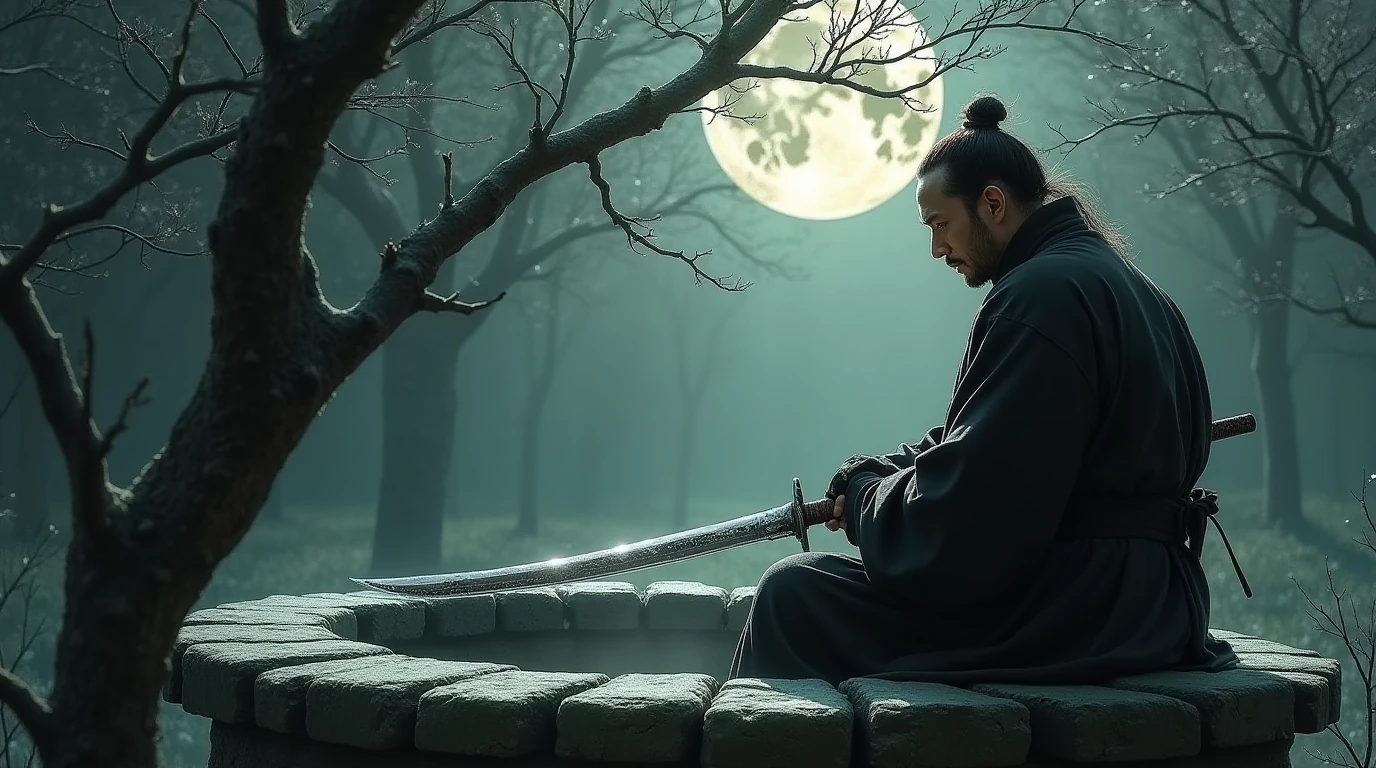
The kitchen had a small door leading to the back courtyard. In the courtyard stood a well. Zheng sharpened his blades there. On the well’s edge sat a whetstone, worn down an inch over ten years of use.
Old Fifth walked up to Zheng, held his bowl out.
“More broth.”
Zheng looked at him.
Old Fifth’s expression was nothing unusual—just his usual face, bowl extended, waiting. But Zheng had known Old Fifth ten years. He knew what Old Fifth looked like when something was on his mind.
This was that look.
Zheng took the bowl, stood, walked toward the kitchen.
The pot in the kitchen was still warm. Zheng ladled a scoop of broth, turned back. Old Fifth hadn’t moved—he stood right at the kitchen door, waiting.
Zheng handed the bowl back. Old Fifth took it but didn’t leave. He stood there watching Zheng sharpen.
The whetstone sat on the well’s edge. Zheng brought his cleaver over, poured water on the stone, began sharpening. The blade’s friction against stone had a particular quality in the night air—shhk-shhk-shhk—steady, unhurried.
Old Fifth stood beside him, took a sip of broth.
“Someone’s been asking about Third Brother.”
Zheng’s hands didn’t stop.
“Who?”
“That young man.”
Zheng’s blade paused.
Just a pause. Momentary, barely noticeable. But deep down he knew it was there.
He didn’t look up, kept sharpening. Shhk-shhk-shhk.
“Third Brother’s been dead ten years. What’s to ask?”
Old Fifth glanced at him.
“You know who he’s asking around to?”
“No.”
“Yesterday he asked me.”
Zheng’s hands paused again. Longer this time.
Old Fifth held his bowl, didn’t look at Zheng, eyes fixed on the far corner of the courtyard. A old pagoda tree grew there, branches bare, long since shed its leaves.
“He asked me how I retreated that night.”
Zheng said nothing.
The blade made a harsh scrape against the stone—shhk. He was pressing too hard, blade edge grinding against stone.
“I didn’t tell him.”
Old Fifth took another sip. The broth had gone cold.
“Things like that, you can’t explain.”
Zheng lifted the blade, examined the edge in the moonlight. The blade was still white, not sharp yet. He set it back on the whetstone, continued.
Shhk-shhk-shhk.
“What’s his relation to Third Brother?”
“Nephew.” Old Fifth said it plainly. “Blood nephew.”
Zheng’s hands slowed.
“What does he want?”
“To collect the body.”
Old Fifth finished the broth in his bowl, set the empty bowl on the well’s edge.
“Wants to take Third Brother home.”
Zheng paused.
“Take him home?”
“Bury him back home.”
The courtyard was quiet. Night wind stirred, carrying a chill. The pagoda tree’s branches swayed, rustling faintly.
Zheng said nothing. He lifted the blade, examined it in the moonlight. The edge was finished now, silver-bright, gleaming under the moon. He sheathed the blade. It went in with a soft click.
“What home? Third Brother’s family plot?”
“Didn’t say exactly. Probably his hometown.”
Zheng wiped the water from the whetstone, set his cleaver back on the chopping block.
“Where was Third Brother’s hometown?”
“No one knows.”
Old Fifth looked at Zheng. That look was strange—hard to read. Like he was waiting for Zheng to say something, or watching to see if he would.
Zheng didn’t bite.
He picked up the rag lying nearby, wiped the whetstone clean, returned it to its place.
“You ask that young man what he was doing that night?”
Old Fifth hesitated.
“I asked.”
“What’d you tell him?”
“I said, following orders. Old Zhou gave the retreat command. I retreated.”
Zheng nodded, said nothing.
“He’s been asking others too. Asked Old Second, asked Old Seventh. Don’t know if he’s asked Old Sixth.”
Old Fifth turned the empty bowl in his hands.
“I told him it doesn’t add up. If he asks you, don’t say much.”
“Why?”
Old Fifth looked at Zheng, moonlight carving the wrinkles on his face one by one.
“Because it doesn’t add up.”
Zheng looked back, said nothing.
Old Fifth took his bowl, walked toward the kitchen.
At the kitchen door, he stopped. He didn’t turn around.
“Old Fourth.”
“Mm?”
“That night, you pulled back first.”
Zheng’s hands froze on the whetstone.
He didn’t look up. Moonlight fell on the well’s edge, stone surface pale with light. He stared at that pale surface, counted the moments.
“I know.”
His voice was quiet.
Old Fifth didn’t say anything more. He walked into the kitchen.
Zheng sat on the well’s edge, didn’t move.
Night wind stirred, cool against his skin. He drew the ox-horn sheath from his waist, held it in his palm, felt its weight. Heavy, substantial. He drew the blade from its sheath.
Moonlight fell on the blade.
The blade was broken in half.
The break ran through the middle, jagged, as if it had been cracked apart by some tremendous force. At the break’s edge was a nick—ten years old, long since rusted—but Zheng knew exactly where it was.
He ran his thumb across the nick.
The blade was cold. Chilled through. It had been cold for ten years. Sometimes Zheng wondered: if blades had body temperature, would this one feel like a living thing?
No. It was dead. Like Third Brother.
He raised the blade, held it to the moonlight. Light reflected off the blade, white and bright, making his eyes ache.
“Blade.”
He mouthed the word silently.
That was what Third Brother had said when he thrust the blade into Zheng’s hands that night. Just that one word—“blade”—light as a mosquito’s whine.
Even now, Zheng didn’t understand what Third Brother meant.
Was he telling Zheng to keep the blade safe? Or to do something with it?
Third Brother’s words never finished. He died too fast, ran out of time. Zheng had asked himself a thousand times: what if he hadn’t retreated? What if he’d stayed one breath longer at Third Brother’s side—would Third Brother have finished the sentence?
No. Third Brother’s wounds were too grave. Even if Zheng had stood there frozen, Third Brother couldn’t have completed that sentence.
But he still wondered.
He sheathed the blade, returned the sheath to his waist.
When he stood, he glanced in the direction of that alley.
The alley lay west of the courtyard, beyond a wall, invisible. But Zheng knew it was there. Ten years, and he had never once gone there. Not once.
He went inside to wash the bowls.
When he came out, the front hall lights were out. Zheng walked toward his room, and as he passed Old Sixth’s door, he heard something inside.
Like something striking the wall.
Very soft, a muffled sound.
Zheng stopped.
He stood there listening for a while. Old Sixth’s room had gone silent, still as any other night. But he had definitely heard that sound.
He didn’t knock.
He turned and went to his own room.
Lying on the bed, Zheng stared at the ceiling beam. The beam was old, wood blackened, cracks packed with dust. He looked for a long time, eyes tired, before he finally closed them.
Midway through the night, he woke.
The room was pitch black, nothing visible. He reached toward his waist, found the ox-horn sheath, pulled his hand back.
The blade was in the sheath, untouched.
He turned over and slept again.
The next morning, Zheng rose and lit the kitchen fire as usual.
The fire caught just as dawn light grayed the sky. He added two sticks to the stove, watched the flames leap, turned to draw water from the well for washing.
Old Sixth was at the well.
He crouched on the well’s edge, a throwing knife in his hand. The blade glinted in the light, Old Sixth’s fingers pinching the handle, turning it, over and over.
Zheng drew his water, said nothing.
He crouched to wash his face. The well water was cold, shocking a shiver through him.
Old Sixth said nothing either. The two of them shared the silence—one washing his face, one turning his blade.
Zheng finished washing, stood, dried off.
He glanced at Old Sixth. The throwing knife still turned in his hand, blade catching light. Old Sixth’s eyes were fixed on the edge, his expression somewhat absent.
Zheng wanted to say something. Didn’t.
He turned and went back to the kitchen.
The fire was burning well now, water in the pot beginning to steam. He picked up his cleaver, poured water on the whetstone, began sharpening.
Shhk-shhk-shhk.
The blade’s friction against stone echoed through the morning kitchen. He sharpened slowly, carefully, each stroke bringing the edge to a gleam.
When he finished, he held the blade up to check.
The edge was silver-bright, like new.
He sheathed the blade, turned to work at the cutting board.
Slicing meat, splitting bones, simmering broth. Twenty years of this work—he could do it blindfolded. The blade rose and fell on the chopping block, thunk-thunk-thunk, the sound carrying from the kitchen, through the door curtain, into the front hall.
In the front hall, Old Zhou was already kneading dough.
The dough turned in Old Zhou’s hands, pressed flat, rounded, rolled out. Old Zhou kneaded slowly—one batch could take half an hour. But the noodles he produced had spring to them, held together in the pot, lifted without clumping.
Zheng listened to that sound from the kitchen, and something in his chest settled.
He had heard this sound for ten years. Every morning like this—dough turning in Old Zhou’s hands, blade rising and falling on the board, water bubbling in the pot.
Ten years. Every day the same.
Sometimes he wondered: if that night had never happened, what would have become of them? Would they still be scattered, each doing his own thing—escorting runs, brokering information, butchering pigs?
Yes. Certainly. The seven of them had never been the same kind of people. They came together by chance. If not for that escort run, if not for the bandits at Wild Ford Slope, they would have parted ways long ago.
But after that night, they couldn’t part.
Third Brother was dead. Died at Wild Ford Slope, belly opened, blood pooling on the ground. The six of them carried Third Brother’s body back, kept him at the South Alley charitable morgue for three days until they had scraped together enough silver for a coffin.
Zheng knew about the three hundred taels. Old Seventh had mentioned it once—that Third Brother had borrowed three hundred taels trying to buy his way out of something, but before the matter was settled, the man himself was dead.
Three hundred taels. Not a small sum.
Zheng hadn’t asked where the silver went. Old Seventh said it was gone, and that was that—he believed him. Old Seventh was the handler; if he said the silver was gone, then it was gone. No need to dig.
But now that young man had come. Asking about Third Brother, asking about that night. Keep digging, and sooner or later he’d dig up the silver.
Zheng didn’t want to get involved.
He was just a butcher. Killing pigs and butchering goats—that was his trade. Silver matters were beyond him, and he didn’t want to learn. Those three hundred taels were Old Seventh’s handling. Old Seventh knew the details. If Old Seventh couldn’t explain it clearly, that was Old Seventh’s problem.
Zheng had his own affairs to tend.
He lifted the knuckle bones from the pot, drained them, set them on the cutting board. Picking up his blade, he began trimming. Every bit of meat stripped clean from the bones—not a scrap left behind. This was his craft.
The blade scraped bone, a dry rasping sound.
He trimmed with care, each stroke stripping meat from the bone. When finished, he cracked the joints with the blade back, scooped out the marrow for broth.
By the time he finished, the sun had risen.
Customers began filtering into the front hall. The morning rush was light—just a few, ordering bowls, eating, leaving. Zheng worked in the kitchen, stayed inside, but he heard someone call out front:
“One Spring Sunshine Noodle—”
That was Old Second’s voice. Serving tables was Old Second’s job, along with greeting customers.
“Two of you, right this way—”
Two customers had arrived. Zheng dropped the noodles in the pot, and while they cooked, he glanced out.
The corner table sat empty. No one there.
He ladled the noodles into bowls, added broth, carried them out front.
Old Second took the bowls and turned to serve the customers. Zheng stood at the kitchen door, looked at that empty seat.
The stool sat proper and upright, identical to the other six. Just no one sitting in it.
Ten years. That stool had sat empty every single day.
Zheng looked away, went back to the kitchen.
The stove fire burned steady. He turned it low, covered the pot, and went to the back courtyard to sharpen.
He had already sharpened this morning. But he went anyway.
Something made him want to do it again.
He drew the blade, poured water on the whetstone, began sharpening. The blade’s friction against stone echoed through the courtyard—shhk-shhk-shhk.
After a while, he stopped, held the blade up.
Moonlight fell on the blade.
The nick on the blade was still there. Ten years old, long since rusted—but that mark would always be there. Zheng looked at it once, then once more.
He didn’t know where that nick had come from.
That night had been chaos. Too many people, too many blades. He couldn’t tell whose stroke had made it. By the time he caught Third Brother’s blade, the body was already broken. All he had was this half.
Where was the other half?
He didn’t know.
He only knew Old Sixth might have the other piece. Old Sixth had never said so, and Zheng had never asked. The two of them had each held their half of the blade, and that was how ten years passed.
Ten years.
He sheathed the blade.
Would that young man come back tomorrow?
He didn’t know.
He stood, walked back toward the kitchen.
On the way, he glanced again toward that alley.
The alley was dark, still invisible.
He didn’t go in.