Chapter 4
A Traveler Asks the Way
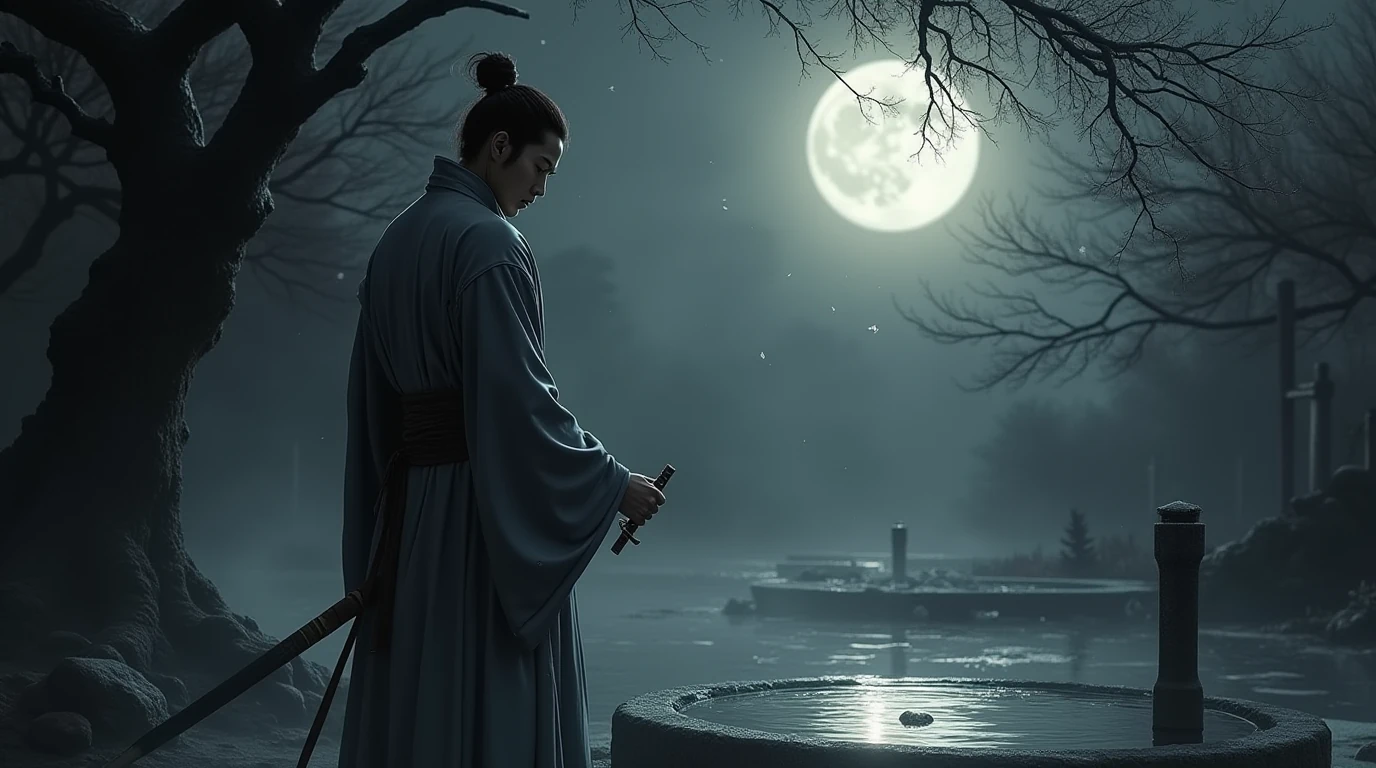
Old Fifth woke before the sky had even begun to think about light.
When he opened his eyes, the paper window let in nothing but darkness—not even the gray pre-dawn glow that usually preceded the morning. The room was black as ink. Only the blade propped against the wall caught what little moonlight remained from the night before, its edge throwing back a thin, cold gleam. Old Fifth didn’t move. He lay there for a long while, watching that shard of light on the blade, then finally rose.
Fang the Escort didn’t smoke. Didn’t drink. Didn’t waste words on nonsense. Early on, when he was still running escort runs under his master’s instruction, he’d been taught two rules: The blade never leaves the body. The body never breaks protocol. Fifteen years with the Yongning Escort Company, and he hadn’t broken either rule once—not in all that time. When the company finally disbanded, he came to this noodle shop. But the habits held. He still woke before dawn. Still washed his face at the well, still honed his blade, still stepped into the kitchen to glance at the day’s menu.
He did every job in the shop. Mornings he walked to the meat market in the southern district to inspect the cuts. Back at the shop, he’d slice scallions. Afternoons he ran the delivery orders. After dinner, when it came time to close, he gathered the bowls and wiped down the tables. He did all of it steadier than anyone—steadier than anyone had to. A man running escort runs, you learned, your hands had to be steady. Your mind had to be steadier still.
A steady mind was how you survived.
He hauled water from the well. The surface caught his reflection—an aging face, past forty now, brows faint, eyes fainter still, like a pane of glass scrubbed half-clean. This face didn’t look like a killer’s face. But in his years with the Yongning Escort Company, he’d put his blade through three bandits who’d tried to take the goods he guarded. One of them he’d sliced clean across the ear—half the ear, gone in a single stroke.
That was ten years ago now.
Old Fifth dried his face, took up the waist-blade, and walked to the front hall. Tonight was his turn for deliveries. The Wang family at the lane’s end had ordered two bowls of Spring Sunshine Noodles, to be brought personally. He tucked the blade at his hip, the scabbard pressed beneath his outer robe—hidden, but not so deep he couldn’t draw it fast.
He lifted the noodles and stepped outside. The lane was still cool, the air carrying that pre-dawn chill. The crooked jujube tree at the entrance slowly emerged as the morning light strengthened, its leaves heavy with last night’s moisture, hanging limp. He walked at his own pace—not fast, not slow—his feet finding the cracks between the blue-stone slabs, one step after another, each step planted firm.
He delivered the noodles. Collected the payment. On the way back, he passed the eight-immortal table.
No one was sitting at it. Old First was inside kneading dough. Old Second was wiping down tables. Old Fourth was in the back kitchen, splitting bones—the rhythm of blade on cutting block steady and sure. Old Sixth slipped past him carrying a basket of already-cut scallions toward the kitchen, his footfalls light as a shadow.
Old Seventh was behind the counter, going over the accounts. The abacus beads clicked and clattered like a small, busy rain.
Old Fifth lowered himself onto the bench in the corner. Said nothing.
He was used to that, too. Saying nothing.
The young man came in before the Wei hour.
Old Fifth was in the front hall, wiping a table, when he looked up and saw the young fellow walk through the door. He was wearing that same half-worn robe of blue cloth, features clean and handsome, steps steady. Old Fifth noticed how the young man’s gaze swept the shop, then came to rest on the empty bench in the corner.
That bench sat there every day. Had sat there for ten years. The spot had never moved.
“One bowl of Spring Sunshine Noodles.” The young man took his usual seat—the table against the wall. “Extra scallions. Extra meat.”
Old Fifth acknowledged him with a grunt, slung the cloth over his shoulder, and headed into the kitchen. The young man had been coming in every day lately, more or less at the same time—first thing in the Wei hour, same table, same bowl of noodles. This young fellow’s habits were more regular than many old hands of the world. Old Fifth noted it away in his mind.
When the noodles arrived, the young man picked up his chopsticks slowly. He looked up, and finding Old Fifth still standing by the table with the tray, he asked:
“Uncle Five, when you used to run escort runs, where all did you go?”
The tray was still in Old Fifth’s hands. He paused—just a half-beat—then set it down on the table. The tray met wood with a soft, quiet sound.
“All over. North and south of the river.”
“All over,” the young man repeated, lowering his gaze to his noodles. His voice was flat. “And ten years ago? Can Uncle Five remember where he was that winter solstice?”
Old Fifth’s chopsticks hung suspended in the air.
He watched the young man’s hand move steadily, pinch a strand of noodles, bring it to his mouth. The chewing was slow, deliberate—like he was waiting for an answer. Those young eyes lifted, found Old Fifth’s, and held them. Clear. Bright. No emotion in them at all.
Old Fifth set his chopsticks down on the rim of the bowl. His voice, when it came, was flat as ever.
“Can’t recall.”
He turned and walked away, over to the counter behind which he began wiping a surface that was already spotless.
The young man didn’t press. He simply bent his head and finished his noodles. When he was done, he left a piece of silver on the table, rose, and walked toward the door. As he passed Old Fifth, his steps hesitated—just for a moment.
“Uncle Five’s blade work is very steady,” he said. “Doesn’t look like escort work. Looks more like—”
He didn’t finish the sentence. He just gave a small nod and stepped out into the daylight.
Old Fifth stood behind the counter and watched the blue-cloth figure disappear into the brightness beyond the door.
His left hand drifted, almost without thinking, to the scabbard at his hip.
Night fell. The shop closed.
Old Fifth didn’t go back to his own quarters. Instead he sat down by the well in the back courtyard. Moonlight fell across the well platform, stretching his shadow long. The evening breeze carried a faint dampness, and the old locust tree in the corner rustled its leaves against the night.
He drew the blade from its scabbard.
Three chi two cun. The steel was true. The body narrow and long—this was an official-issue blade from the Yongning Escort Company. Ten years ago he’d carried this blade on escort runs. Ten years later he carried the same blade in this shabby noodle shop. The blade hadn’t changed. Neither had he.
—No. That wasn’t right.
He’d changed.
Old Fifth closed his grip around the handle, stood up.
He drew a breath, and began to move through the forms.
The blade path was Night Battle All Directions.
He hadn’t practiced this technique once since that night ten years ago, the night at Wild Ford Slope. The night Third Brother fell. The night the blood flowed like water. He’d drilled this form for fifteen years, but he’d never used it in actual combat—because his master had always said, this form was a way of fighting that leaves no room for retreat. Meant for desperate last stands, not for escort runs.
But that night—in the retreat—he had used it.
Old First had shouted Withdraw! He’d followed the order. Turned and walked. Three steps. Then behind him, the sound of blades. He looked back and saw only Third Brother’s back, shielding Old First. Blade-light in firelight. Blood-light in firelight.
He’d followed orders. He’d done his duty. He’d turned and kept walking.
By the time Third Brother fell, he was already ten paces away.
Old Fifth’s blade arced through the air.
Night wind slipped through the gap in the corner wall, cooling the sweat on his brow. His movements were slow—deliberate, each position held and checked, like he was relearning a motion long forgotten. The Night Battle All Directions form moved in eight directions. Every strike was an advance. Every strike left no room for retreat.
His master had called it Burning the Boats. For when things went wrong.
He’d never used it when things went wrong. In fifteen years of escort runs, his most common techniques had been Serpent Form and Flank Strike—both ways of fighting that left you an out. He wasn’t the type to back himself into a corner.
But tonight he was running this form.
One stroke east. One stroke west.
One stroke south. One stroke north.
Four strikes done, then northeast, northwest, southeast, southwest. His wrist was beginning to ache. Sweat dripped down from his brow, catching the moonlight, glinting as it fell. His tempo slowed. The sweat began to creep into his eyes.
He stopped. Drew a breath.
Then he sheathed the blade.
The leather grip of the scabbard had worn smooth and slick over the years. As he tucked it back to his hip, his fingertips brushed against something inside the scabbard.
He froze.
Old Fifth drew the scabbard out again, turned it upside down, and angled it toward the moonlight to look into the opening.
There was a slip of paper pressed against the inside of the leather lining.
He pulled it out. The paper was folded small—no bigger than the first joint of his thumb. He unfolded it. Two characters, written in a steady hand:
Third Brother.
Old Fifth’s face went pale in the moonlight.
His fingers tightened, crinkling the paper. Then, slowly, he smoothed it flat again. Ordinary xuan paper, folded roughly—torn, more likely, with a fingernail rather than cut. The characters were written in Guange script, the strokes bold and practiced, carrying a force he knew well.
Third Brother’s hand.
He knew Third Brother’s hand. Ten years ago, at Wild Ford Slope, Third Brother had written a note by the campfire—a message for Old First, reporting on the situation. Third Brother’s calligraphy had never been good, but it had always been forceful, the strokes like knife cuts.
This Third Brother—the same hand as that note by the fire.
Old Fifth stood in the moonlight, the paper crumpled in his palm, and did not move for a long time.
The back courtyard was silent. Only the locust leaves whispered in the corner. From somewhere over by the wall came the sound of meat being cut—Old Fourth, still awake, or awake again. Old Fourth had been sleeping lightly lately. Any sound woke him. Old Fifth knew this.
He folded the paper, tucked it back into the scabbard.
The leather lining inside the scabbard was rough. The paper fit snug against it—held fast enough not to fall out, hidden well enough not to be found. How long had this paper been there? When had it been placed? Who had put it there?
He didn’t know.
He only knew that this was Third Brother’s hand from his younger years—and Third Brother had been dead for ten years.
He re-hangered the scabbard at his hip and walked back toward his quarters.
Two steps. He stopped. Turned and looked back at the well platform.
Moonlight fell across the well, the water surface flat as a mirror.
He stood there for a long moment. Then he turned, went inside, and closed the door.
The night was still.
In the room next door, where Old Fourth slept, a light flickered once in the window—then went dark.