Chapter 5
Three Hundred Taels
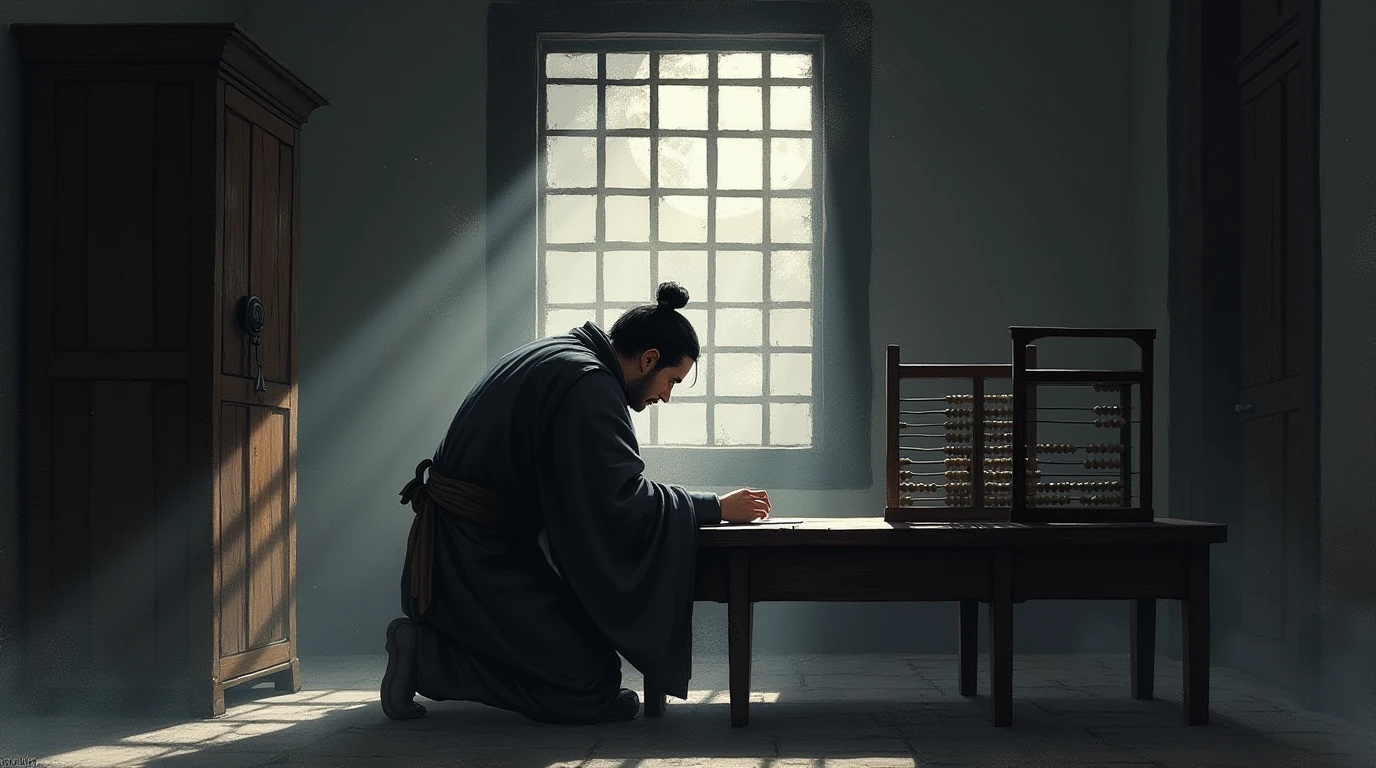
The midday rush wound down. The sun had already passed its zenith over the eaves. Old Seventh ran his fingers across the abacus beads, each one clicking against the brass rod with a crisp, steady sound. This was his most familiar hour of the day—the only moment he allowed himself to drift, to let his mind wander. The rest of the time, his focus was absolute, every thought bent on the abacus before him, silver moving in and out, accounts clear and precise.
Three hundred taels.
The beads stopped. Old Seventh’s fingers hovered in the air, not coming down.
The words had come through the money shop’s keeper. The man had caught Old Seventh at the alley mouth, heading to settle accounts. Said it was a message from the young fellow—carried by a passerby. The young fellow, of course, was Acheng. Fifth day now. No sight of him, but a message had come through.
Three hundred taels’ worth of debt.
Old Seventh turned the five words over in his mind. Three hundred. Taels. Debt. He had combined those three words more times than he could count—in dreams, in the late hours when he sat alone over the account books, every time he passed that hidden compartment. But each time he severed the sentence halfway through, like snuffing out a lamp.
Today someone else had finished the sentence for him.
How long had the beads been still? He couldn’t say. Three beats, maybe more. The money shop man called out “Accountant” twice before he came back to himself. He moved the one hundred twenty-three taels and four mace of income into the reckoning, his hands mechanical but precise.
The money shop keeper was shrewd. He knew better than to ask questions—just delivered the message, bowed, and took his leave. Old Seventh nodded, closed the account book, and rose. His knee struck the table edge as he stood, a dull throb of pain.
He sat a while longer in the counting room. Afternoon light filtered through the window lattice, casting a diagonal slash across the floor. The room held little of value—just an abacus, the account ledgers, a few copper coins strung together for quick tallies, and an old cabinet against the wall. The cabinet was locked with three mechanisms Old Seventh had installed himself; no ordinary key would open it.
Inside: three hundred taels of silver. Not a single coin touched.
Old Seventh had kept the books at the money shop for six years before coming to the noodle shop. Six years of watching silver flow in and out. Some borrowers who couldn’t repay. Some who paid with their lives. Some—like Third Brother—whose borrowers died, and the silver lingered on.
The money had been his to give.
Ten years ago that winter, Third Brother sat on the threshold of a ruined temple at Wild Ford Slope, rubbing his hands together as he spoke. He said he had a debt abroad—three hundred taels, just enough to fund a run of medicinal goods. He said if this run panned out, the matter would be settled. He said the run was safe—he’d made inquiries. The scattered brigands at Wild Ford Slope were all bluster. If they showed, a bit of silver would send them packing.
Old Seventh asked what the silver was for.
Third Brother smiled. Said it was “to settle a matter.”
Three words. Ten years now. In the world of martial society, to settle a matter meant using silver or favors to make a dispute go away—ensure it would never be pursued. What Third Brother had come to settle, Old Seventh didn’t ask. He simply drew the stack of silver notes from his sleeve, counted them three times—three hundred taels, not a coin more or less—and pressed them into Third Brother’s palm.
He remembered the hand that took the silver. Calloused fingers, thick knuckles, an old scar across the thumb from his early years in the world. Third Brother’s hand. He knew it.
What came after he remembered only in fragments. Or perhaps he remembered too much, and too hazily. That night’s memory was like cloth left too long in water—pulled up, it had lost its shape, leaving only a few deep stains behind. He had seen Old Fourth fall back. He had seen Old Sixth’s needle box still full. He had seen Third Brother go down.
Third Brother had been wearing his robe when he fell.
The gray cloth, blue lining, faded from washing—it wasn’t worth anything. Third Brother had borrowed it saying the nights were cold, he’d need warmth on the road. Old Seventh hadn’t thought twice. The silver was already given; a robe could go too.
He only learned later that Third Brother, wearing his robe, had died in the reeds at Wild Ford Slope. Gutted. bled out. The robe was redder than the reeds.
And the three hundred taels?
Old Seventh didn’t know.
He only knew that after that night, the three hundred taels came back to him. Silver notes tucked into the lining of a bundle, placed there by unknown hands at an unknown hour. He counted three times—three hundred, not a coin more or less.
The notes went into the cabinet’s depths. Ten years. Three new locks. The notes hadn’t moved.
He didn’t know whose money it was. The debt was owed to a dead man—how does one settle such an account?
He didn’t know whether to speak of it at all.
The first day Acheng came to the noodle shop, Old Seventh recognized him. The brow, the eyes, the way he sat, the way he spoke—it was all too familiar. Too like the man who had sat on the threshold at Wild Ford Slope ten years ago, rubbing his hands together, asking to borrow silver.
Third Brother’s nephew. Third Brother’s heir.
The thing Acheng had come to ask—he could guess at it. It would be about that night, about Third Brother’s death, about—
The three hundred taels’ debt.
Old Seventh sat in the counting room, watching the light line creep across the floor. The sun had shifted; the midday rush was ending. Soon the brothers would file back in, and come evening they’d gather around the eight-immortal table for noodles. Third Brother’s seat was empty. His bowl was empty. Had been for ten years, day after day.
He should ask Old First.
Old First had a note. Third Brother had written it himself when he borrowed the silver—on a piece of Xuan paper cut crooked, three lines of text. The first line read: Lin Sanhe makes this note. The second: Borrows silver, three hundred taels. The third: To be repaid upon completion of the matter.
The note had been in Old Seventh’s possession. Written and then Third Brother said, keep it with you—you hold the silver, keep it with you and it’s safe. So Old Seventh tucked the note into his account ledger, alongside the three hundred taels’ worth of notes.
Later the note went missing. He searched a long time. Never found it. He thought perhaps it was lost that night, or perhaps Third Brother had taken it back. He said nothing. The silver was gone—what good would a note do?
Then one day Old First said the note was burned.
That was three months after the rout. Old First called him to the back courtyard, said it was time to settle old matters. He said the silver Third Brother borrowed was Void now—the man was dead, the debt was dead. He said he’d smoothed things over with the creditors; no one would come asking. He said he’d burned the note, so it wouldn’t cause trouble later.
Old Seventh had said nothing. He watched Old First’s face—the exhaustion there, and something else, a kind of resolve he couldn’t name. He wanted to say the note wasn’t in Old First’s keeping—but the words caught in his throat.
Perhaps the note truly was burned. Perhaps not. Perhaps what Old First burned was another piece of paper, while keeping the real note. These questions had turned in his mind for ten years, and no answer came.
Today he would ask.
Old Seventh left the counting room as the sun dropped to the level of the crooked jujube tree at the alley’s mouth. He passed through the kitchen, out the back door, around the woodpile stacked by the wall, and came to a stop before the door of Old First’s small room.
The door hung half-open. No light within.
He stood a long time at the threshold. Hand raised, lowered. Lowered, raised. The door’s paint had mostly worn away, exposing the grain beneath—rough, dry, carrying the smell of old damp and kitchen smoke.
He knocked.
Three raps, neither light nor heavy. The universal knock of their world—to call on someone, you knocked this way.
No sound from within.
He knocked again. Harder this time, his knuckles striking wood with a dull thud.
“Enter.”
Old First’s voice came through the gap—low, hoarse, as if he’d just woken.
Old Seventh pushed the door open. The room was dark; only a thin thread of daylight slipped through the window lattice, illuminating an old wooden table in the corner, a lamp on it, a chair beside the lamp. Old First sat in the chair, back to the door, face buried in his palms.
He had been waiting. Old Seventh knew he had been waiting all along.
“Old First.”
“Close the door.”
Old Seventh pulled the door shut. The room grew darker still—just that thread of daylight and the lamp’s flame. Old First hadn’t lit the lamp, hadn’t turned around. His face stayed buried in his palms, as if asleep, or lost in thought.
“I have something to ask you.”
“Ask.”
Old First didn’t move. His voice came muffled through his palms, indistinct.
“That three hundred taels of silver—”
“I know.”
“Acheng has come asking about it.”
“I know.”
Old First finally moved. He lifted his face from his hands, turned around. The room was too dark to read his expression—only his eyes caught some light and gleamed, like the lamp’s reflection, or something else.
“The note,” Old Seventh asked. “Third Brother’s note. Is it still with you?”
“Burned.”
“When was it burned?”
“Three months after the rout.”
Old Seventh was silent a beat. He remembered that time. The day Old First called him to the back courtyard.
“When it was burned,” he asked, “what had become of Third Brother’s note?”
Old First didn’t answer.
The room was very still. Only the lamp flame trembled, making tiny crackling sounds. Wind moved outside the lattice, and the thin line of daylight swayed like a lotus on water.
“Old First.”
“Yes?”
“Where is Third Brother’s note?”
Old First was silent again. Longer this time. Old Seventh counted his own heartbeats—one, two, three. No answer came, but he knew the answer was written on Old First’s face. He had seen that expression before. Ten years ago at Wild Ford Slope, just before Third Brother fell—that was the face he had worn.
“Go back.”
“Old First—”
“Go.”
Old First stood, his back to Old Seventh, and walked toward the window. His shoulders were broad, his spine straight—they had been straight ten years ago, and they were straight now. But that spine carried something new now—a bow, a weight that hadn’t been there before.
“Third Brother’s note was never burned.”
Old First’s voice came from the window, very quiet, as if speaking to himself.
Old Seventh’s feet stopped.
“I know where it is.”
Old First’s shoulders shifted—half a turn, then stopped.
“I’ve known where it is for ten years.”
Old Seventh stood by the door, watching Old First’s back. The light from the window had already dimmed; the sun had set. Only the lamp flame remained. He thought of ten years ago, that winter night, when Third Brother sat on the temple threshold and handed him the note, saying keep it with you—you hold the silver, keep it with you and it’s safe.
The note had been with Old First all along.
Old First said it was burned—but what he’d burned was another piece of paper. The note he’d kept for ten years, hidden in a secret pocket at his sleeve, alongside the message Acheng had left.
Why?
Old Seventh didn’t ask. He knew why. Old First wasn’t hiding it from him—Old First was hiding it from himself. Pretending the matter was settled, pretending the silver was gone and the note was burned and Third Brother’s debt was clear.
But the debt wasn’t clear. The silver sat locked in the cabinet; the note stayed in Old First’s sleeve; not a single coin of Third Brother’s debt had been touched.
“The three hundred taels,” Old Seventh said, “were never spent.”
He didn’t say when he’d discovered this, or how the silver came back, or that he’d kept the secret for ten years. He only said this one thing, his voice quiet, as if to himself.
Old First’s back stiffened.
“Never spent?”
“Never spent.”
“Not a single coin touched?”
“Not a single coin touched.”
Old Seventh watched Old First’s back. He couldn’t see Old First’s face—only saw those shoulders slowly sag, as if a weight had been lifted. A ten-year burden, lifted in the space of a sentence.
“I’ve done accounts my whole life,” Old Seventh said. “This one I cannot balance.”
He turned and pulled open the door and stepped out into the darkness.
Behind him came Old First’s voice, very quiet—addressed to him or to himself, hard to say:
“Third Brother’s note was never burned.”
Old Seventh’s feet stopped.
But he didn’t turn back.
The night had grown late. Every light in the noodle shop had gone dark except one—a solitary lamp burning in the back courtyard corner. That was Old Fifth’s room. As Old Seventh passed, he saw the lamp shadow flicker once against the window paper, then go dark.
He returned to his own quarters without lighting a lamp. Moonlight filtered through the lattice, casting a diagonal across the floor—not like the afternoon’s light. This one was thinner, fainter, like a thread that wouldn’t break.
He took out the abacus and worked the beads one by one. The brass rods gave their crisp, steady clicks.
Three hundred.
He stopped at three hundred.
Tomorrow Acheng would come again. And the day after, and the day after that. He would keep asking about the three hundred taels, about the note, about what happened that night.
Old Seventh didn’t know what to tell him.
He set the abacus on the table, lay down, and closed his eyes. Moonlight filtered through his eyelids, faint and diffuse, like a veil.
He thought of ten years ago, that winter night, when Third Brother sat on the temple threshold and handed him the note, saying keep it with you—you hold the silver, keep it with you and it’s safe.
He thought of ten years ago, that morning, when Old First called him to the back courtyard, saying the note was burned, to prevent future complications.
He thought of tonight, at dusk, when Old First’s voice came from the window, saying the note was never burned—I know where it is.
He kept his eyes closed.
Tomorrow there were still many accounts to settle.