Chapter 6
Rainy Night
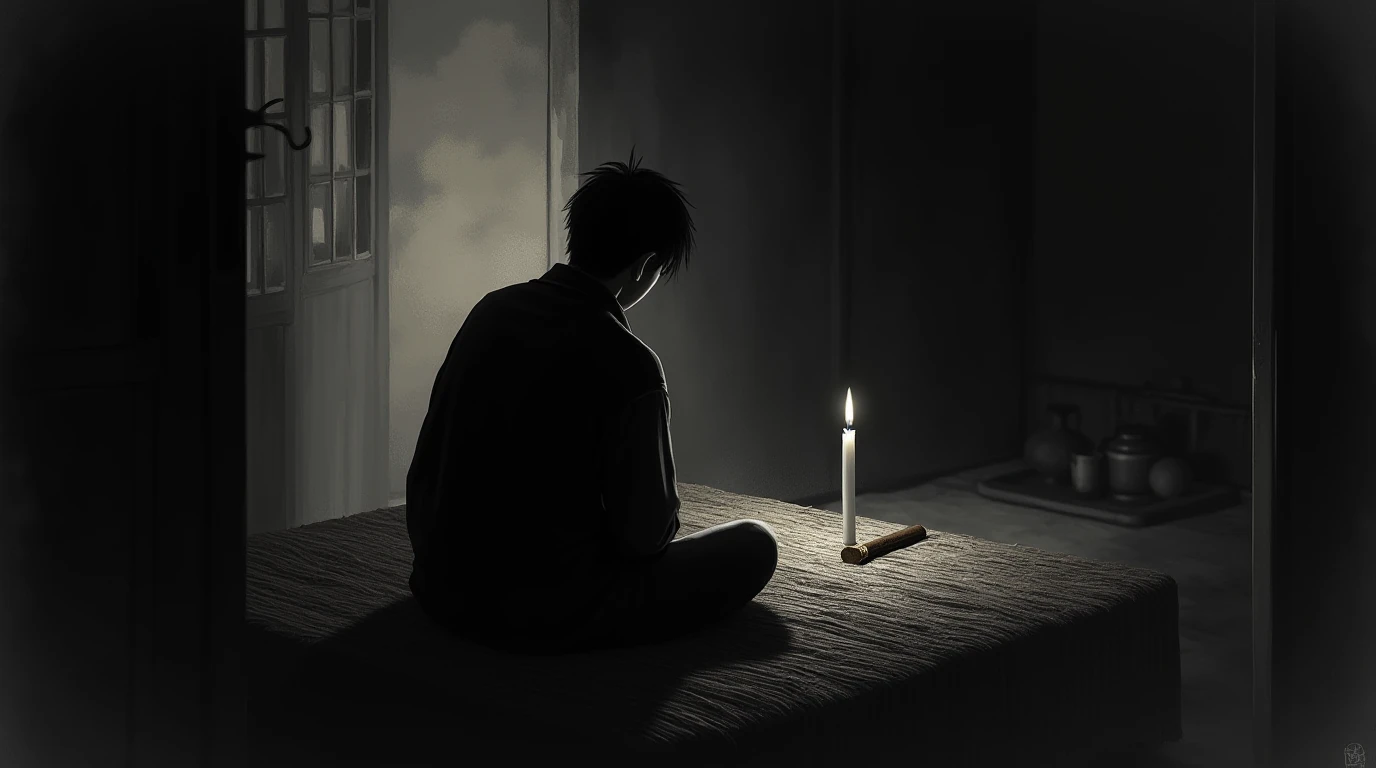
The rain started during the Shen hour.
At first it was only a thin veil, like someone up in heaven shaking out a silk screen, scattering a whole basin of ash across the south district. The proprietor pulled in the noodle sign. Old Second stacked the last bench. Old Seventh’s abacus fell silent. And in the blue-stone alley, there was only the sound of rain striking the leaves of the jujube tree.
Old Sixth was in the kitchen wiping bowls.
His movements were slow. A single bowl, he could wipe three times over. First pass, water. Second pass, cloth. Third pass, cloth again. Bowl bottom up, bowl rim down, the inner surface catching the sky’s light outside. When the rain was loud, nothing else could be heard. When the rain was soft, he could hear the drip of his wiping water striking the stove ledge.
He liked that sound.
Ten years now. Every rainy night he took the late shift. Not because the rules demanded it—because he had asked the proprietor for it. On rainy nights customers were few, bowls were few, and he could manage alone. Old First hadn’t agreed at first. But when Old Sixth insisted, he let it go.
What Old First didn’t know was that on rainy nights, Old Sixth could actually sleep.
On normal nights he slept lightly. Any movement woke him. A rat crossing the rafters, rain tapping the door boards, someone coughing in the next alley—he heard it all. Once awake, he’d lie there with eyes open until dawn, until sunlight crept through the window, and only then close his eyes again.
Rainy nights were different. Rainy nights were long, the rain’s rhythm was steady, and every surface it struck sounded the same. He could pretend it was something else. Pretend it was reeds. Pretend it was the water running under the Zeshui Bridge. Pretend that all the sounds of the night had been washed thin and pale.
He was on his third wipe of the bowl when the door moved.
Not a knock—a shoulder wedging the door gap open. Old Sixth’s hands didn’t stop. His eyes didn’t lift. Only his ears pricked.
Footsteps, light, cloth-soled, making no sound on the blue stone. The footsteps stopped near the corner. A chair creaked.
Old Sixth set the bowl in the rack, turned, and went to the stove for noodles.
On rainy nights there weren’t many noodle-eaters, but there were some. Some couldn’t get home because the rain was too heavy. Some came because their homes were cold and they wanted something hot. Old Sixth didn’t ask and didn’t look. He just served.
The stove fire hadn’t gone out—banked low, ready for noodles at any moment. Old Sixth scooped a handful of noodles into the boiling water, stirred twice with his chopsticks, waited for them to float, ladled them into the bowl, splashed a ladle of scallion oil over the top, scattered a pinch of scallion greens.
The scallions had been chopped by Old Fourth during the day, sitting in an earthen pot, covered with a damp cloth. Chopping scallions was normally Old Sixth’s job. But he hadn’t chopped any today—Old Fourth had done it for him.
Old Fourth hadn’t been sleeping well these past few nights. His spirits during the day were off. Old Sixth could see it, but said nothing. Old First had asked him to take the late shift, so he took it, and quietly did Old Fourth’s work too. Not out of pity for Old Fourth—the scallions would just sit there anyway.
When he carried the noodles out, the rain had thickened.
It struck the door boards, struck the jujube leaves, struck the blue-stone pavement of the alley. In the corner sat a figure in a blue cloth robe, water stains on the shoulders. Hair plastered to the forehead, wet through.
It was Acheng.
Old Sixth set the noodles on the table—not dropped, but lowered gently. Between bowl and table surface there was only the distance of a wood grain, the sound small enough to be almost inaudible.
Acheng glanced up at him.
That look was quick, like the flash of a blade. Old Sixth neither avoided it nor met it. He simply pushed the scallion bowl toward Acheng. The scallions were piled high, heaping, drizzled with sesame oil, gleaming in the candlelight.
Acheng picked up his chopsticks. Didn’t move.
He was looking at Old Sixth.
Old Sixth didn’t move either. He stood by the table, hands hanging loose. Outside, the rain fell hard. Inside, only a single candle, the flame no bigger than a bean, swaying in the draft from the doorway.
Acheng ate a bite of noodles.
Old Sixth turned and went back to the kitchen.
He had known Acheng would come tonight. He’d known since afternoon—the sky darkening, swallows flying low, flies clustering on the stove and refusing to leave. These were all signs of rain. Old Sixth had lived in the south district for ten years. He knew how to read them.
He also knew Acheng would ask questions.
The past few days Acheng had asked Old Fifth, asked Old Second, asked Old Seventh. Each person answered differently—some at length, some brief, some circling, some direct. Old Sixth had said nothing. He’d only listened. Stood in the kitchen wiping bowls, or stood in the back courtyard sharpening knives, or stood in the corner watching the fire.
He didn’t speak.
Ten years. The total number of words he’d spoken in the noodle shop was less than anyone else’s. Not that he didn’t want to— he didn’t know what to say. Everything said would be wrong. Every question asked would ring false. Some things buried in the heart, buried long enough, become part of the bone. Pull too hard and you can’t get it out. Bury it soft and it never stays covered.
He stood in the kitchen, listening to the sounds outside.
Rain. The clink of bowl and chopsticks. The sound of chewing. Then footsteps, light, stopping beside him.
Old Sixth didn’t turn.
“Old Sixth.”
Acheng’s voice wasn’t loud, half-swallowed by the rain. Only a few words cut through. Old Sixth’s hands stopped on the stove ledge. He didn’t move.
“Where were you that night?”
The rain was loud, loud enough to drown everything. Old Sixth turned, reached for the cloth on the stove, collected the empty bowl in front of Acheng, and placed it in the wash basin. The water was warm—right temperature for washing bowls.
Acheng asked again: “How many of your hidden weapons did you use that night?”
Old Sixth pushed the scallion bowl toward Acheng.
Piled high, drizzled with sesame oil, gleaming in the candlelight. Acheng looked at the bowl of scallions. Didn’t move. Didn’t ask again.
Old Sixth turned and walked away.
By the time he reached the back courtyard, the rain had turned to a downpour.
It struck the eaves, struck the edge of the well, struck the straw mat where Old Sixth kept his blade hidden. He didn’t go inside. He stood by the well and let the rain soak him. Water ran down his neck, into his collar, over his chest.
Cold.
He liked that cold. The feeling of rain striking his body—like someone using silver needles to pierce his skin, one prick after another, not deep but dense. He stood in the rain, let those needles do their work, until he was soaked through.
That night had been the same.
The rain was heavy, heavy as if someone up in heaven had tipped over a whole jar of water. That night they had been lying in ambush in the reeds, waiting for the medicine convoy to pass. They waited half a watch. Instead of the cart, the arrows came.
The arrows were probing—sparse, inaccurate, landing in front of the reed beds. Old Second said it was a small band of bandits from Wild Ford Slope, nothing to worry about. Old Fifth passed the word: hold steady.
Then the arrows stopped.
When the arrows stopped, the rain stopped too. Old Sixth still remembered that moment—how the world beyond the reeds suddenly went quiet, not even the insects were singing. He had been crouched at the rear, a hidden-weapons case in his hand. Three silver needles, two throwing knives, one packet of lime.
The case had been full.
Every time before a mission he checked it over. Needles honed bright, knives sharpened, lime freshly packed. The case was his own making—wood, coated with tung oil, impervious to water. Ten years now, this case had traveled with him from Wild Ford Slope to the blue-stone alley. Not a single day apart.
That night he had held the case and waited for the signal.
The signal never came.
After the arrows stopped, everything went to chaos. Twelve men burst out of the reed beds, every one armed, every one masked, heading straight for Old First. Old Fourth rushed forward and cut one down with a single stroke. Old Fifth drew his blade and followed. Old Second was shouting something. Old Seventh had somehow vanished.
Old Sixth didn’t move.
He held his case, standing at the edge of the reed beds, watching. Old Fourth’s blade came down, blood spattering across the reed leaves. Old Fifth’s blade thrust forward, a man fell, crushing a whole clump of reeds. Old First blocked three strikes, retreated three steps, his back already against the ditch.
Then Third Brother charged.
Third Brother came out from Old First’s left, a single stroke splitting a man’s shoulder to the bone. That stroke was heavy—heavy enough that the man didn’t even scream before he went down. Third Brother’s blade didn’t stop. On to the second, the third, each stroke drawing blood, each stroke lethal.
Old Sixth watched. The case in his hand stayed closed.
At that moment he had wanted to move. He knew he should move—should snap open the case, should loose the silver needles, should throw the knives, should scatter the lime. But his feet might as well have been rooted in the ground. He couldn’t take a single step.
He watched Third Brother cut down a fourth man. Watched him cut down a fifth. Watched him turn to rescue Old First— and then he saw Third Brother’s blade snap.
The blade broke in the middle, the break jagged, as if it had struck something hard. Third Brother was left holding only half a handle. The blade itself had gone somewhere. The enemy’s blade was already before him, bloody, gleaming cold, aimed at Old First’s chest.
Third Brother threw himself in front of Old First.
The blade went in.
Old Sixth still remembered that blade—narrow and long, good steel, no blood on it yet—blood came later. Third Brother’s body deflected the blade. The point entered Third Brother’s left flank, emerged from his right, trailing a string of blood beads.
Third Brother didn’t fall.
He used the half-handle to cut down the man before him, then shouted: “Retreat! Move!”
Old Fourth ran first. Old Sixth saw him spin and go, fast, plunging into the reeds. Then Old First, dragging Old Fifth backward. Old Second had somehow gotten to the outer perimeter and was already scrambling toward the alley.
Old Seventh was nowhere.
Old Sixth didn’t run.
He stood at the edge of the reed beds, watching Third Brother. Third Brother was still upright, braced against the blade that had run through him, both hands gripping the half-handle. His robe was soaked through with blood, the color had darkened by half.
Old Sixth recognized that robe. It was Old Seventh’s.
He wanted to move.
At that moment he should have moved—should have rushed in, should have dragged Third Brother back, should have thrown every hidden weapon loose, should have killed them all.
But he couldn’t.
His limbs were fine. Arms could lift, legs could run, the case was right in his hand. But his bones felt like they’d been softened by the rain. He couldn’t take a single step.
Third Brother fell.
Not from the blade—the blade hadn’t knocked him down. His own legs gave out. He sank to his knees, then toppled sideways into the reed beds, robe spread out, like a puddle of blood and cloth.
Old Sixth tried to charge back.
He wanted to charge back and haul Third Brother up. Wanted to loose every hidden weapon. Wanted to kill them all. But he had only taken one step when someone grabbed him.
It was Old Fifth.
Old Fifth’s grip was fierce, fingers digging into his wrist, nails biting into the flesh. Old Fifth was shouting something—Old Sixth couldn’t hear, could only see Old Fifth’s mouth working, opening and closing, as if issuing some order.
Then Old Fifth dragged him away.
Old Fifth dragged him through the depths of the reeds, across a ditch, through a clump of willows, to the back alley of Coffin Street. It was only when they gathered there that Old Sixth realized his hidden-weapons case was still full.
Three silver needles. Not one missing.
Two throwing knives. Not one thrown.
One packet of lime. The paper hadn’t even been opened.
He just stood there. Standing in the corner of the back alley of Coffin Street, gripping that case of hidden weapons, motionless. Others were talking. Someone was crying. Someone was calling Third Brother’s name. He heard none of it.
He heard only one sound.
The sound came from inside his own chest—dull, heavy, like something stopped it up. That sound was asking: Why? Why didn’t you strike? Why didn’t you save him?
He didn’t know.
He only remembered the chaos. Everything too loud to hear clearly.
The rain had stopped.
Old Sixth stood in the back courtyard. The rain had stopped, but his clothes were still wet. The whetstone by the well had been darkened by the rain, a groove worn into its surface over ten years’ use now pooling with water.
He thrust his hand into that pool.
The water was cold—cold enough to make him shiver. He pulled his hand out, wiped it on his hem, and walked back to his room.
The room was small. A bed, a table, a chair. The bed was a gift from Old Fourth years ago. The table was one Old Seventh had rejected. The chair he had made himself—jujube wood, sturdy but plain.
He walked to the bed and lifted the straw mat.
Under the mat was the half-blade.
The blade had broken in two, the break jagged, the edge marked with a trace of rust. Ten years now, this blade had been with him ten years, hidden under the straw mat, not taken out once. He only remembered that night, taking the blade from Third Brother’s hand—whether Third Brother had handed it to him or he had picked it up himself, he couldn’t recall.
The broken halves would never match.
He knew Old Fourth had the other half. Hidden in that makeshift ox-horn sheath, honed bright. He had never asked. Old Fourth had never mentioned it. The two of them had an unspoken understanding—as if neither of them knew about it at all.
He took the blade out, held it up to the candlelight.
No blood on the blade. But there was rust. He rubbed at it with his thumb. It wouldn’t come off. Ten years now, that rust had grown into the steel, grown into his bone, and wouldn’t scrape away.
He was setting the blade back under the mat when he stopped.
The angle was wrong.
That night he had laid the blade flat, the body of the blade parallel to the wall. Now the blade lay at an angle—off by about half an inch—as if someone had picked it up and set it back down.
Old Sixth didn’t move.
His hand rested on the straw mat, over the blade, feeling the ridge of rust along its surface. His heart was beating fast, fast enough to leap out of his chest. But he didn’t move. Didn’t make a sound.
Someone had been in his room.
The thought rose from the back of his skull, slowly, slowly, climbing before his eyes, freezing him solid. Ten years. Only he had ever entered this room. Old First sometimes knocked to ask if there was hot water. Old Second might come in during the late shift to drink a bowl of cold water. But they always knocked. Always called out first.
Tonight no one had knocked.
Old Sixth took the blade out and held it.
The handle was jujube wood, held for ten years, wrapped in leather until the grain gleamed. He gripped the handle and sat on the edge of the bed, not lying down.
The night had grown deep.
The rain had stopped, but the clouds hadn’t scattered. The moon hid behind them, refusing to show itself. The room was dark as ink. Only the candle on the stand held a single spark, casting his shadow on the wall, motionless.
He sat like that. Holding the half-blade. All night.
When dawn came, Old Second knocked at the door, asking if the bowls were washed. Old Sixth set the blade back under the mat, stood up, and opened the door.
Old Second stood in the doorway, a bowl of Spring Sunshine Noodles in his hands.
“Old First sent this. Said you worked the late shift, you deserve it.” Old Second handed over the bowl. “Acheng left. Did he ask anything?”
Old Sixth took the bowl. Didn’t answer.
Old Second looked at him, frowned, but didn’t press. He turned to leave, took two steps, then stopped. “Old Fourth didn’t sleep well either. Spent all night in the back kitchen sharpening knives.”
Old Sixth set the bowl on the table. The noodles still rose in a curl of steam.
“Someone was in my room last night.” he said.
Old Second spun back. His eyes sparked.
“Did you see them?”
Old Sixth shook his head.
“The blade was moved.” he said. “The angle was wrong.”
Old Second’s frown deepened. He walked back inside, stood in the doorway, scanning Old Sixth’s room. Bed, table, chair, straw mat—nothing out of place.
“Old Fourth?” he asked.
Old Sixth shook his head.
“Why would it be Old Fourth?”
“He has the other half of the blade.” Old Second’s voice dropped low. “If he wanted to put them together—”
“The other half of the blade is his.” Old Sixth said. “It was his ten years ago.”
Old Second stared at him. Said nothing.
Old Sixth lifted the bowl and ate a bite of noodles. Old First had cooked them. Plenty of scallions, salt balanced just right. Old First’s kneaded noodles—ten years, and in all of Yunze City, only he could work dough like that.
“Last night the rain was heavy.” he said. “Someone might have slipped in to get out of it. Happened to brush the mat, that’s all.”
Old Second studied him for a moment. Then laughed.
“Fine. You say what you say.” He tucked both hands into his sleeves. “I’ll go find Old Fourth. Ask where he was last night.”
Old Sixth didn’t stop him.
He finished the bowl, set it on the table, then walked to the bed and took out the half-blade. The handle sat solid in his palm, steady as something grown there.
He set the blade under the mat. Body of the blade parallel to the wall, precise to the hair.
Then he covered it with the straw mat, tidied the room, sat at the table, and waited for Old First to call him.
Old Fourth hadn’t slept well either. Spent all night in the back kitchen sharpening knives.
Old Sixth knew why.
He also knew whether Old Fourth had been in his room last night or not.
But he didn’t say.
Some things buried in the heart, buried long enough, become part of the bone. He had no intention of pulling this bone out for anyone to see.
Old Second’s footsteps came from the back courtyard—light, quick, like he was searching for something. Old Sixth didn’t rise. He sat at the table and drank a mouthful of the cold noodle broth.
The broth had gone lukewarm. Slightly congealed. But not bad.
He ladled another bowl of water, thinned out the congealed broth, and drank it sip by sip, waiting.
Outside, the daylight grew brighter. The sun behind the clouds was climbing.