Chapter 7
Third Brother's Tale
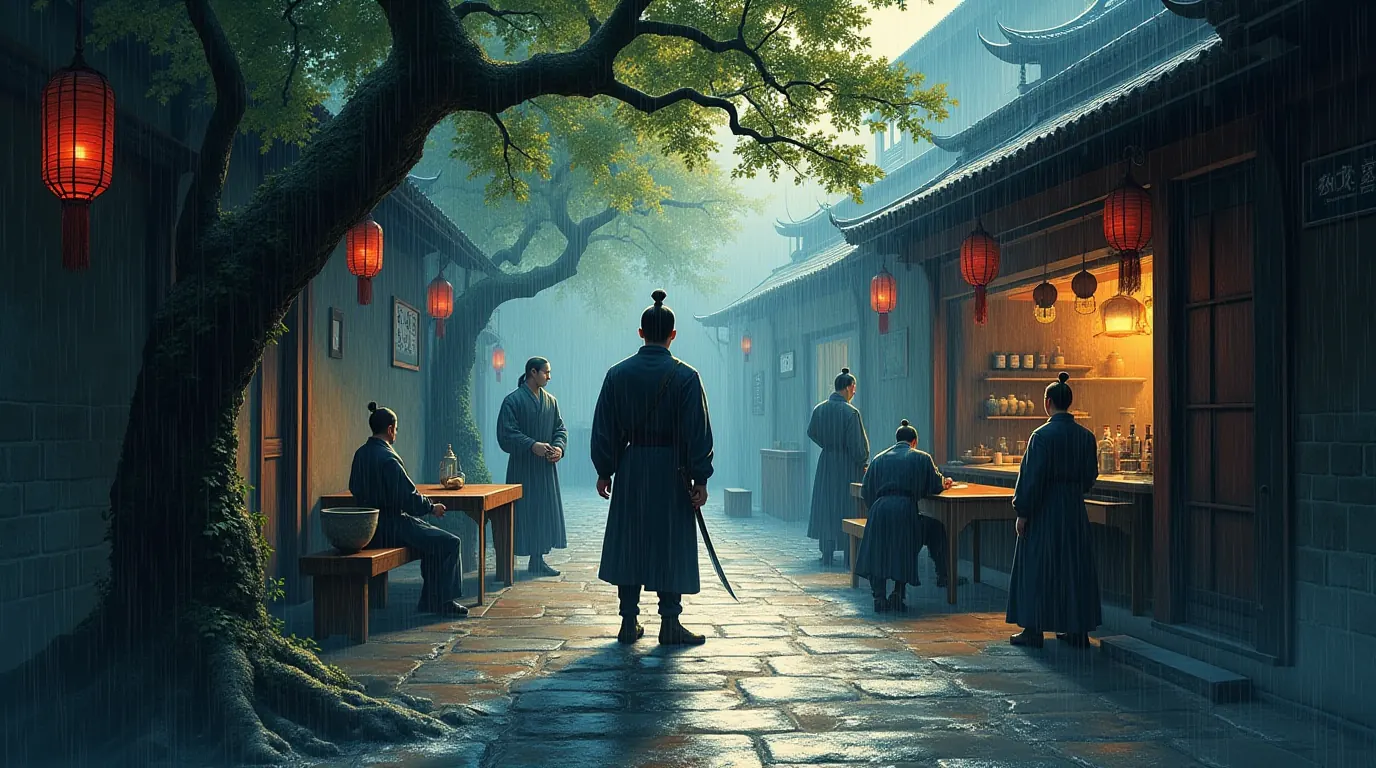
The rain had stopped.
The bluestone pavement of South Alley was still damp, the air carrying that clean bite of earth washed clean by rain. The front panels of the noodle shop had been taken down early; Old Second was wiping the eight-immortal table with a cloth, his hand moving heavier than usual—three times the force. In the corner, Acheng sat in his usual spot, a bowl of Spring Sunshine Noodles before him, the scallions piled so high they threatened to spill over.
He ate slowly. A bite of noodles, a sip of broth. His chopsticks moved through the bowl as if he were counting the strands at the bottom.
Old Seventh sat behind the counter, the abacus beads motionless for half a stick of incense. He watched Acheng. Acheng watched the bowl. Between them, the silence stretched taut as a bowstring.
Old Seventh spoke first. “Rain was heavy last night. Didn’t get a chance to talk properly.”
Acheng looked up, set down his chopsticks. There was something in his eyes that Old Seventh had never seen in another person—not anger, not grief. Something deep and fathomless, like water at the bottom of a well.
“Uncle Sun.” Acheng called not Old Seventh but Old Second, who had just emerged from the kitchen. “Bring out Old Master.”
Old Second’s hand froze mid-wipe, the cloth suspended in air. He glanced at Old Seventh, who gave a small nod.
“Old Da’s kneading dough.” Old Second said. “Right now he’s—”
“Bring him out.” Acheng repeated. Softer this time, but the weight was heavier.
Old Second didn’t ask again. He turned and disappeared into the kitchen. A moment later, Old Da emerged from behind the curtain, flour still on his hands, which he wiped on his apron before sitting down across from Acheng.
Old Seventh set down the abacus and came over, standing at Old Da’s side.
Acheng pushed the bowl aside and drew a sheaf of silver notes from his sleeve, laying them on the table. The denominations made Old Seventh’s eyelids twitch—three hundred taels. Not a single copper more, not a single copper less.
“This is Third Uncle’s.” Acheng said. “He said while he was alive that this debt should be repaid.”
Old Seventh’s throat tightened. Three hundred taels of silver, locked in his chest for ten years, untouched. Acheng had produced them now, light as a breath, as if settling an old account. But it wasn’t his debt to pay. It was Acheng’s to settle.
“The money can wait.” Old Da spoke, his voice heavy as a stone at the bottom of a well. “First tell us—what do you actually want?”
Acheng looked at Old Da, then at Old Seventh. Finally, his gaze fell on the empty stool in the corner. It held nothing but the coarse ceramic bowl Old Da placed there each morning, the bottom crusted with yesterday’s tea leaves.
“Third Uncle’s bones.” Acheng said. “I want to take him home.”
Old Seventh’s mind went numb. Bones. The public charnel house. Ten years—where was that body, the one that had lain at the charnel house for three days?
“The night Third Uncle died,” Acheng continued, “you were the ones who collected his body. I traveled a thousand li from my hometown just to bring Third Uncle back. He’s been drifting outside for ten years. It’s time for him to go home.”
Old Da said nothing. Old Seventh saw his hand move inside his sleeve, as if feeling for something.
Acheng’s voice was calm, calm as a bowl of still water, but every sentence he spoke landed like a stone on the table.
“Before I came, Third Uncle gave me three things to ask.” Acheng said. “First, about the three hundred taels. Second, about the brothers from that night—are they all right? Third—”
He paused. His gaze moved from Old Seventh to Old Da.
“—ask whether the money for collecting his body has been paid.”
Old Seventh’s face went white.
That money—the charnel house fee—Old Da had paid it. Not him. But what did Old Da’s payment have to do with Third Brother’s bones? What did any of it have to do with him? The debt Third Brother owed him, the silver notes still locked in his chest, untouched, had nothing to do with the charnel house money.
But Acheng’s second sentence made his heart sink: Third Uncle’s bones were collected by Old Da. Acheng was asking Old Da, but he wasn’t only asking Old Da.
Old Da finally drew his hand from his sleeve.
In it was a piece of paper, unevenly cut, yellowed xuan, the edges slightly frayed. Old Da set it on the table and pushed it toward Acheng.
“Is this note in your handwriting?”
Acheng glanced at it and shook his head.
“Not mine.” He said. “Before I came, Third Uncle handed this note to me. He said—if someone ever comes with the same note, you will believe me.”
The world went dark before Old Seventh’s eyes.
The note. The note in Old Da’s sleeve. He’d thought Old Da had burned it years ago. Old Da had said he’d burned it, back in Chapter Five, and Old Seventh had believed him—but now the note was here, in Acheng’s hand, in Old Da’s hand, in this broken-down noodle shop, like a club swung against the back of his skull.
“Third Uncle said,” Acheng picked up the note and looked at it, “‘Ask about Third Brother.’ While he was alive, he wanted to ask you these things. But he never got the chance.”
Old Seventh stared at Old Da’s hands. Old Da’s fingers were thick-knuckled, a slanting scar across his tiger’s mouth from the Wild Ford Slope battle ten years ago. Now those hands lay empty on the table, as if something had been surrendered.
“About the note,” Old Seventh opened his mouth, “I—”
“Lao Qi.” Old Da cut him off, his voice not loud, but iron-wrapped. “Stay out of the money.”
Old Seventh’s mouth snapped shut.
Acheng tucked the silver notes back into his sleeve, then lifted the bowl of cold Spring Sunshine Noodles again. He didn’t eat—just stared at the scallions floating in the chilled broth, floating in ten years of time.
“Third Uncle, when he was alive,” Acheng said suddenly, “loved Spring Sunshine Noodles best.”
Old Seventh froze.
“He said, ‘Someday if you go to Yunze City, have a bowl of Spring Sunshine Noodles at that shop.’” Acheng said. “Third Uncle had friends there.”
Old Seventh stared at Acheng, and suddenly understood why he’d ordered only Spring Sunshine Noodles. Not because it was cheap. Not because it was simple. Because Third Brother had said so. Third Uncle had friends there—and those friends were the seven of them.
Spring Sunshine Noodles, extra scallions, no meat. The simplest bowl of noodles, a brother’s longing made tangible.
Old Seventh’s eyes stung.
“What kind of person was Third Uncle?” Acheng asked suddenly.
Old Da said nothing. Old Second stood nearby, also silent. Old Seventh didn’t know what to say. He thought and thought, and everything he came up with felt wrong.
Acheng saw their hesitation.
“I’m not asking what you’d tell strangers.” He said. “I’m asking—Third Uncle, in your eyes, what kind of person was he?”
Old Da finally spoke.
“Honor among brothers.” He said. “Never owing money.”
The words hit Old Seventh like a punch.
Never owing money. Third Brother had borrowed three hundred taels, the IOU was still in Old Da’s sleeve, not a single copper repaid. But Old Da said never owing money—had he lost his mind, or was he talking about something else?
Acheng nodded, his gaze shifting to Old Second.
“Old Second?”
Old Second sat down beside Acheng and turned a small knife with a walnut-wood handle once around his palm. The blade flashed in the morning light, then disappeared back into his sleeve.
“Tough mouth.” Old Second said. “But soft heart. When it mattered, he’d carry the load for you.”
Acheng nodded again, gaze moving to Old Fourth.
Old Fourth stood at the kitchen door, the meat-cleaving knife in his hand, the handle worn slick with use. When he heard the question, the vein in his neck jumped, as if he were pressing something down.
“Hot temper.” Old Fourth said. “Never blew up at his brothers.”
Acheng’s brow creased, then smoothed. He turned to Old Fifth.
Old Fifth sat beside the eight-immortal table, spine straight as a rail, just as when he’d run escort all those years. His hand rested at his waist, the knife sheath hanging there, a thumb-sized sliver of paper hidden inside the sheath’s lining.
“Steady hand.” Old Fifth said. “No risks.”
Acheng asked Old Sixth.
Old Sixth stood by the window, backlit, his expression unreadable. His sleeve twitched—that was where his silver needles, throwing knives, and lime lived, ten years full, not one deployed, still full today.
“Didn’t talk much.” Old Sixth’s voice was soft. “But what he said, he did.”
Acheng looked at Old Seventh last.
Old Seventh’s throat tightened. He thought and thought, and his memories of Third Brother felt different from the others’.
“Good with numbers.” Old Seventh said. “Always said honor and business should be kept separate.”
Acheng listened, then said nothing.
He stood, walked around the eight-immortal table, and came to stand beside Old Seventh. Old Seventh stepped back instinctively, but Acheng didn’t stop—just stood there, looking into Old Seventh’s eyes.
“That night, what did Third Brother ask you to do that you didn’t do?”
Old Seventh’s mind exploded.
The money. Three hundred taels. He’d counted it three times, the silver notes had come back to him after the chaos, he’d locked them away, untouched for ten years. But that wasn’t what Third Brother had asked him to do that night.
Third Brother had borrowed the silver, said it was “to settle things.” The money was delivered, and the man died on the way. He’d waited ten years for word on what that money was for, but the silver came back, and the man never did.
Acheng turned to Old Da.
“That night, what did Third Brother ask you to do that you didn’t do?”
Old Da’s hand clenched inside his sleeve. The note. The silver. The charnel house fee. Bones. That night ten years ago, he’d found Third Brother’s body at the charnel house, paid the corpse-keeping fee, had the man put in a coffin. But that wasn’t what Third Brother had asked him to do that night.
What Third Brother had said before the chaos, Old Da hadn’t heard a word of it. He’d given the retreat order, but Third Brother wasn’t nearby, the order never reached him. He was field commander—he should have made sure everyone heard, but he hadn’t.
Acheng turned to Old Second.
“That night, what did Third Brother ask you to do that you didn’t do?”
Old Second’s mouth opened, then closed. Intelligence. The intelligence was wrong. He’d reported nothing unusual ahead, but twelve men had been lying in ambush in the reeds, and he hadn’t seen a single one. He was an information broker—that was how he made his living—but that night his intelligence was bad, and it cost a brother.
Acheng turned to Old Fourth.
“That night, what did Third Brother ask you to do that you didn’t do?”
Old Fourth spun the knife once around his palm, nearly nicking his own fingers. His lips trembled, wanting to say “I pulled out first,” but the words died in his throat. That night Third Brother had pressed a blade into his hands and said “Take it.” He took it—but after taking it, he didn’t go back.
Acheng turned to Old Fifth.
“That night, what did Third Brother ask you to do that you didn’t do?”
Old Fifth’s spine locked rigid. Orders. Obey orders. He’d obeyed, executed, pulled Old Sixth out of the chaos. But that night Third Brother had said “You go first, I’ll hold the rear”—Third Brother had told him to go, and he went, but he wasn’t sure that counted as “didn’t do.”
Acheng turned to Old Sixth.
“That night, what did Third Brother ask you to do that you didn’t do?”
Old Sixth’s sleeve twitched, as if something were about to fall. His fingers gripped the fabric, knuckles white. That night his dart case had been full, not one thrown. He’d watched Third Brother take blades meant for others and fall in the chaos, wanted to charge back in, but Old Fifth had grabbed him. Old Fifth had grabbed him—not Third Brother had told him to do otherwise.
Six men, six different answers.
Acheng stood beside the eight-immortal table and looked at each of their faces in turn. His gaze was like a ruler, measuring not length but depth.
“Then do you know,” Acheng said, “what Third Brother asked all of you to do that night?”
No one spoke.
Old Da shook his head. Old Second shook his head. Old Fourth shook his head. Old Fifth shook his head. Old Sixth shook his head. Old Seventh shook his head.
Acheng drew the sheaf of silver notes from his sleeve and set them on the table. Three hundred taels. Not a single copper more, not a single copper less.
“That night, before they set out, Third Uncle had spoken to each of you.” Acheng said. “He said, all seven of you, not one missing. He said, when this escort run was done, he’d treat all of you to Spring Sunshine Noodles.”
Old Seventh’s throat tightened.
Spring Sunshine Noodles. Third Uncle said he’d treat the seven to Spring Sunshine Noodles when he got back. But he died that night, the silver delivered but the man dead first, and those words could never be spoken.
“He asked Old Da to make sure everyone was present.” Acheng continued. “He asked Old Second to verify enemy numbers. He asked Old Fourth to lead point. He asked Old Fifth to pass orders without distortion. He asked Old Sixth to cover the rear. He asked me—”
Acheng paused, corrected himself: “He asked Lao Qi to have the silver ready.”
Old Seventh’s mind exploded.
Silver. Three hundred taels. “To settle things.” Third Brother borrowed the silver to settle things, to end his feud with Dan Shiba. He’d borrowed the silver, written the IOU, and died. The silver came back to Old Seventh’s hands, but were the things settled?
“But some of you didn’t follow through.” Acheng’s voice was calm, calm as still water, but every sentence fell like a stone on their hearts. “Old Da didn’t confirm. Old Second’s intelligence was wrong. Old Fourth pulled out first. Old Fifth pulled Old Sixth away. Old Sixth didn’t throw a single dart. Lao Qi didn’t deliver the silver.”
Six men, six failures.
“But none of that is the most important thing.” Acheng said. “The most important thing is, each of you has a different version of Third Brother in your heart. The Third Brother you remember isn’t one person.”
Old Seventh wanted to argue, but the words died in his throat.
Old Da’s Third Brother was deeply honorable. Old Second’s was tough-mouthed but soft-hearted. Old Fourth’s was hot-tempered. Old Fifth’s was steady, no risks. Old Sixth’s was a man of his word. Old Seventh’s was good with figures, kept honor and business separate.
Six men, six Third Brothers.
“But Third Uncle was only one person.” Acheng said. “When he borrowed the silver, he said ‘to settle things,’ but he died before the things were settled. He gave each of you tasks, and some were done, some weren’t. But whether done or not, he died.”
Old Seventh’s eyes stung.
“That night, what Third Brother said—some heard it, some didn’t.” Acheng said. “The words that weren’t heard might matter more than the ones that were.”
He lifted the bowl of cold Spring Sunshine Noodles and drank a sip of broth.
“I want to take Third Uncle’s bones back with me.” He said. “But I don’t know where his body is.”
Old Seventh’s vision went black.
Bones. Charnel house. Ten years ago Old Da had found Third Brother’s body at the charnel house, paid the corpse fee, had him put in a coffin. But ten years have passed—where is that coffin now?
“South Alley Public Charnel House.” Old Da said. “I paid.”
Acheng nodded, then shook his head.
“Third Uncle’s bones aren’t there.” He said. “I checked.”
Old Seventh’s mind exploded.
Third Uncle’s bones weren’t at the charnel house. Old Da clearly said the charnel house, but they weren’t there. Had Old Da forgotten, or—
“Third Uncle’s bones were buried ten years ago.” Acheng said. “In the back alley of Coffin Street.”
Old Seventh’s eyes finally wet.
The back alley of Coffin Street. The hiding spot during retreat. That night the seven had gathered there, counted heads, and were missing one—Third Brother. They’d waited and waited until dawn, until the charnel house sent word that a body had been found and they should come identify it. Old Da went. When he came back, there was blood on his left sleeve, said it was Third Brother’s.
That night, the seven buried Third Brother together in the back alley of Coffin Street.
But now Acheng says Third Uncle’s bones aren’t at the charnel house. Third Uncle’s bones are in the back alley of Coffin Street. Buried by the seven of them together.
Ten years. They’ve eaten Spring Sunshine Noodles at this shop for ten years. Seven people, one eight-immortal table, one empty stool. One bowl of Spring Sunshine Noodles.
But Third Brother’s bones were buried in the back alley of Coffin Street, right where they walked every day.
Old Seventh’s tears finally fell.
He looked at Old Da, whose note still lay on the table. He looked at Old Second, whose walnut-wood knife still turned in his palm. He looked at Old Fourth, whose meat cleaver still gripped his hand. He looked at Old Fifth, whose sheath still hid that sliver of paper. He looked at Old Sixth, whose sleeve still held those darts, not one thrown.
Six men, six secrets.
And Acheng was gone.
Acheng said the bones were his, the silver was theirs. But the three hundred taels that Third Brother had borrowed were now back in Old Seventh’s hands. The note Third Brother had written was now in Old Da’s hands. The half-blade was now split between Old Fourth and Old Sixth.
Everything Third Brother ever owned was still here.
Except Third Brother himself.
Old Seventh stood up suddenly.
“Old Da.” He said. “The note.”
Old Da looked up.
“The silver is with me too.” Old Seventh said. “In the chest. Three hundred taels, not one touched.”
Old Da said nothing.
Old Seventh spoke again: “I’ve kept things from all of you for ten years.”
Old Da drew the note back into his sleeve.
“I’ve kept things from all of you for ten years too.”
Old Second’s knife stopped turning.
Old Fourth’s cleaver stopped turning.
Old Fifth’s spine went rigid.
Old Sixth’s sleeve twitched.
Six men, six “kept things hidden for ten years.”
What Acheng had said suddenly rang in Old Seventh’s mind: “That night, what Third Brother asked you to do that you didn’t do—what he said, some heard it, some didn’t. The words that weren’t heard might matter more than the ones that were.”
Third Brother had given each of them instructions that night, before it all happened.
But each of them had failed to do something.
That’s why the battle was lost.
Not lost to the enemy. Lost to themselves.
Old Seventh lifted the bowl of cold Spring Sunshine Noodles and ate it all, bite by bite. The noodles had gone hard with cold, the broth bitter with chill, but he ate it all.
Third Uncle said he’d treat the seven to Spring Sunshine Noodles when the escort run was done.
But that bowl, he couldn’t treat them to himself.
Old Seventh set down the empty bowl and looked at the empty stool across the table. It held nothing but the spot where the bowl went each morning, that spot empty for ten years.
“The money,” Old Seventh said, “I’ve figured it out.”
Old Da glanced at him.
Old Seventh didn’t add anything. He stood, walked behind the counter, and took the sheaf of silver notes from the innermost hidden compartment. Three hundred taels. Not a single copper more, not a single copper less.
He set the silver notes on the table and pushed them toward Old Da.
“The silver is Third Uncle’s.” He said. “Now it should be returned to his nephew.”
Old Da didn’t take them.
Old Seventh pushed the notes again, this time all the way to the spot where Acheng had sat. Acheng was gone, but the spot was still empty, the scallions at the bowl’s bottom already settled.
“Third Uncle’s bones are in the back alley of Coffin Street.” Old Seventh said. “I went to the charnel house, they said there’s no record of anyone by that name. But Acheng said the back alley of Coffin Street.”
Old Da’s eyelid twitched.
“That place,” Old Seventh said, “I remember.”
Old Da said nothing.
Old Seventh looked into Old Da’s eyes and spoke each word carefully: “That night, we seven buried Third Brother together. In the back alley of Coffin Street.”
Old Da’s hand clenched inside his sleeve.
“Third Brother died wearing my robe.” Old Seventh continued. “I always thought the robe was buried with him. But Acheng said the robe wasn’t there.”
Old Seventh’s eyes stung again.
“Third Brother’s robe—did you take it?”
Old Da didn’t answer. He simply drew the note from his sleeve and set it on the table. The edges were worn, but the characters were still clear: “Ask about Third Brother.”
Old Seventh stared at the note, and suddenly understood.
The note wasn’t written by Acheng, wasn’t written by Old Da. It was Third Brother’s. The note Acheng brought was something Third Brother had written while alive, written for the seven of them to see.
“Ask about Third Brother.”
What Third Brother wanted to ask them, things he never got to ask ten years ago, now asked through Acheng’s mouth.
Old Seventh pushed the sheaf of silver notes toward Old Da.
“The silver is Third Uncle’s. The note is Third Uncle’s too.” He said. “Third Uncle’s things should be returned to his nephew.”
Old Da finally drew his hand from his sleeve and gathered both the silver notes and the note into his sleeve.
“I’ll go to the back alley of Coffin Street.” Old Da said.
Old Seventh shook his head.
“We’ll all go.” He said. “Third Brother was buried by all seven of us. Now all seven of us should go together to ask him out.”
Old Da looked at him.
Old Seventh added: “Third Uncle said honor and business should be kept separate. But I’ve kept them separate for ten years, silver is silver, brothers are brothers, and it never felt right.”
He looked down at the grain of the table.
“But Third Uncle said when he borrowed the silver, it was ‘to settle things.’ The silver came back, the man didn’t, the things were never settled, so the silver became our debt.”
Old Da reached out and patted Old Seventh’s shoulder.
Old Seventh’s eyes wet again.
“Third Uncle’s debt should be settled.” He said.
Old Da nodded.
Old Seventh stood, tucked the silver notes back into the hidden compartment behind the counter. Not on the table—in that spot that hadn’t been touched in ten years.
“The silver stays there.” He said. “Until Third Uncle’s business is settled, then we’ll reckon.”
Old Da nodded again.
Old Seventh walked to the door and stood under the crooked jujube tree. The leaves trembled in the wind, post-rain sunlight filtering through, every droplet on the blades glistening sharp.
He turned and looked back into the shop. Old Da sat by the eight-immortal table, the note in his hands. Old Second stood at the kitchen door, the walnut-wood knife in his grip. Old Fourth stood at the back kitchen door, the meat cleaver in his hand. Old Fifth sat in the corner, hand on his sheath. Old Sixth stood by the window, backlit.
Six men, six secrets.
But now some of the secrets had been spoken, at least some of them.
What Acheng said rang in Old Seventh’s mind again: “That night, what Third Brother asked you to do that you didn’t do?”
Six men, six failures.
But Acheng also said: “Whether you did it or not, he died.”
Third Brother, dead ten years.
But his silver notes remained, his note remained, his half-blade remained, his longing for Spring Sunshine Noodles remained.
The debt he left his seven brothers, still unsettled.
Old Seventh stood at the door a moment longer, then turned and walked back inside.
“Old Da.” He said.
Old Da looked up.
“First thing tomorrow morning, we go to the back alley of Coffin Street.” Old Seventh said. “Ask Third Brother out.”
Old Da nodded.
Old Seventh turned to Old Second: “Old Second, go to the charnel house tonight, ask if they ever received a body ten years ago.”
Old Second acknowledged, the walnut-wood knife turning once in his palm.
Old Seventh turned to Old Fourth: “Old Fourth, go to the back kitchen and bring Third Brother’s half-blade.”
Old Fourth froze, his grip on the knife tightening.
“For what?”
Old Seventh said: “To put it together with the half Acheng has.”
Old Fourth’s mouth opened, then closed. He shot a glance at Old Sixth, who stood by the window, backlit, sleeve twitching.
Old Seventh turned to Old Fifth: “Old Fifth, go to the money shop and withdraw three hundred taels, bring it first thing tomorrow morning.”
Old Fifth’s spine straightened, he nodded.
Old Seventh turned to Old Sixth: “Old Sixth, take night watch tonight, we all go together to the back alley of Coffin Street tomorrow.”
Old Sixth said nothing, just nodded.
Old Seventh looked at them, and a strange feeling rose in his chest.
Ten years. Seven men guarding this broken-down shop, eating Spring Sunshine Noodles for ten years, hiding secrets for ten years. But now the secrets were being spoken, the debts were being sorted.
Third Uncle’s debt should be cleared.
Old Seventh gathered the empty cold bowl, set it on the empty stool in the corner. Bowl bottom up, rim down, like a period, like a beginning.