Chapter 8
That Night
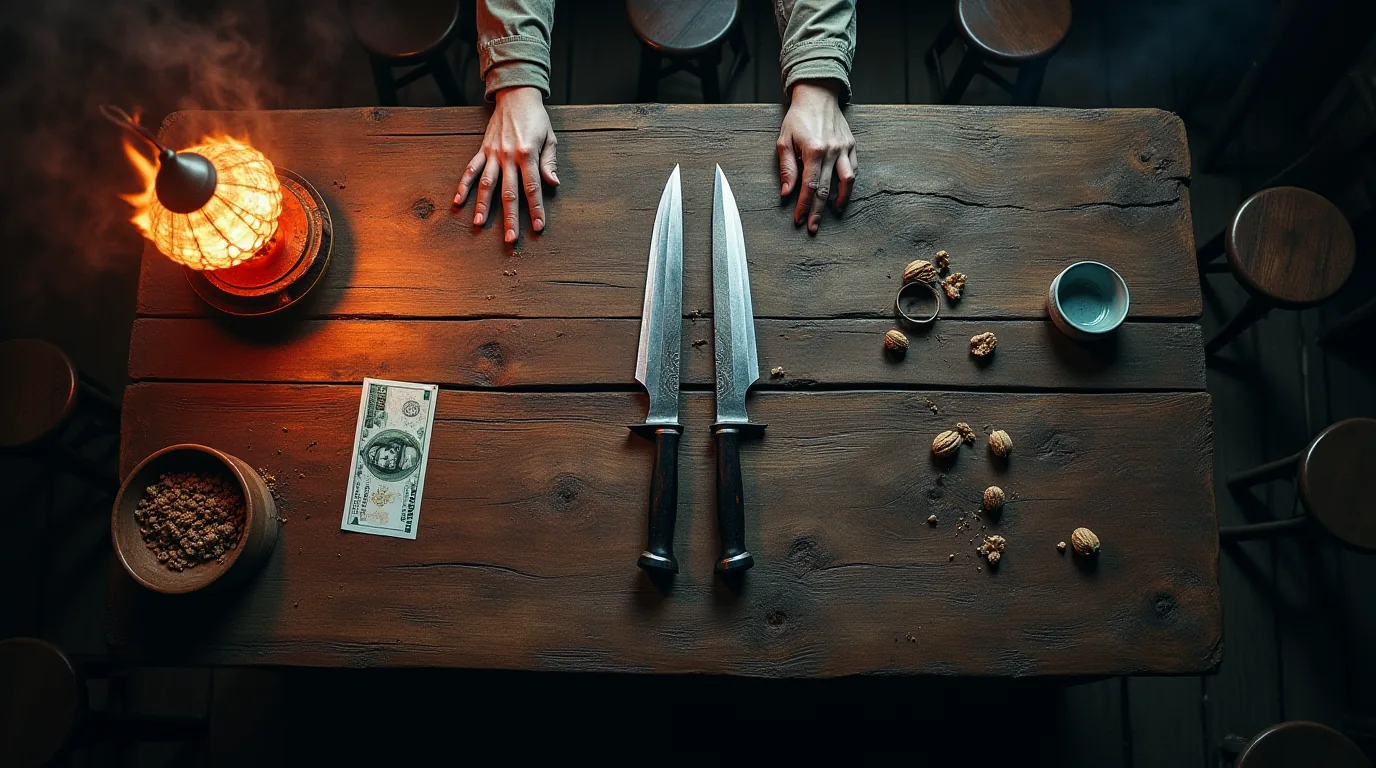
The lamp wick had burned down halfway.
Seven men sat around the eight-immortal table. The elm surface had been polished smooth by ten years of palms, and the dent near the corner—the one left by a blunt instrument—sat directly beneath the eldest brother’s palm. He didn’t look down at it. He knew it was there.
The empty stool sat upright at the head of the table. Beside it, seven narrow benches. Six occupied. One empty. Old Seventh had set his coarse ceramic bowl on the empty stool. The tea leaves at the bottom had dried into a dark crust overnight.
Acheng sat at the far end of the table, his gaze resting on that empty stool, unblinking.
“Let’s begin, then.” The eldest brother’s voice was heavy—heavier than when he commanded the stove, but without the usual fire. “Ask what you need to ask, Young Master Acheng. The six of us are here.”
Acheng nodded. From his chest he drew out a folded sheet of xuan paper—not a note, but a silver note. Three hundred taels. In the lamplight it caught a faint greenish gleam. He set it on the table, dead center between the six occupied benches.
“First question.” Acheng said. “Who left first that night?”
Silence.
The eldest brother glanced at Old Second. Old Second was cracking walnuts, the shells crumbling to dust on the table. His hand never stopped.
“No one left first.” The eldest brother said. “We were scattered.”
“No.” Old Second looked up. “Old Fourth retreated first.”
Old Fourth’s chopsticks rested on the rim of his bowl, untouched. His neck had thickened—not with anger, but with restraint.
“Bullshit.” Old Fourth said. “I was covering Old Sixth’s retreat.”
Old Sixth said nothing. He sat in the corner farthest from the lamp, his features pale and indistinct, like ink bleeding into water.
“Old Sixth.” Acheng said.
Old Sixth’s sleeve stirred.
”…Yes.” Old Sixth’s voice finally came, hoarse. “Old Fourth pulled back first. I was behind him.”
“Covering you?” Acheng asked.
Old Sixth didn’t answer. Old Fifth took over.
“The order I received came from Old Third.” Old Fifth said, spine straight. “He told us to fall back.”
“Old Third told you to fall back?” Old Second’s walnut fragments stopped mid-air. “When did he say that?”
“Before the melee.” Old Fifth said. “He said, ‘Old Fifth, you go first. I’ll hold the rear.’”
“So you left?” Old Fourth asked.
“I left.” Old Fifth said. “When Old Third gives an order, I follow it.”
Old Seventh suddenly cut in: “The money was Old Third’s decision, all by himself.”
All seven men went still for a moment.
“What money?” the eldest brother asked.
Old Seventh didn’t look at the eldest brother. He looked at the silver note on the table, his fingers tracing a light line across its surface, as if confirming the note was real.
“Three hundred taels.” Old Seventh said. “Old Third borrowed it. For settling things.”
“Settling what?” Old Second asked.
“I don’t know.” Old Seventh said. “He only said it was for settling something. Didn’t say what. I handed him the silver, and then he left.”
Acheng pushed the silver note forward an inch.
“Then let’s go through it one by one.” He said. “What did Old Third ask each of you to do that night. Whether you did it or not.”
The eldest brother spoke first: “He asked me to confirm everyone had arrived. I thought everyone was there.”
“Thought?” Old Second dragged the tip of his walnut knife across the shell, leaving a white line.
“Old Third wasn’t nearby before the melee.” the eldest brother said. “My order was ‘Cover Old Third’s retreat,’ but I never confirmed he heard it. I was the first one scattered.”
“You’re saying the order was given, but the man never got it?” Old Fourth asked.
“The man only found out later that it never reached him.” the eldest brother said.
Acheng wrote something down on his paper.
“Old Second.”
“I was on intelligence that night.” Old Second drove the walnut knife into the shell. “The front reported no abnormalities. I believed it.”
“Believed it?” Old Fifth asked. “You, the intelligence man, didn’t check it yourself?”
“I checked.” Old Second said. “Three times. All three times said the coast was clear.”
“Then it’s on you.” Old Fourth said. “Bad intelligence, men died. You ready to carry that?”
“I carry it.” Old Second’s eyes blazed back. “But bad intelligence isn’t mine alone to blame. Dan Shiba used Wild Ford Slope’s name to set the trap. You think I’m some immortal god who can divine the future?”
“Dan Shiba?” Acheng looked up. “Dan Shiba set the trap?”
Old Second’s mouth froze mid-gesture.
“I said too much.” the eldest brother said.
“Dan Shiba is someone Old Third wronged.” Old Seventh picked up where Old Second left off. “Ten years ago Old Third chopped off his pinky. That’s something we all know.”
Acheng wrote another note.
“So that night was a revenge hit?”
“It was.” Old Seventh said. “The target wasn’t the shipment. It was one of us.”
“Which one?”
Old Seventh said nothing. Old Second said nothing. Old Fourth said nothing.
“The eldest brother.” Old Sixth spoke suddenly.
All seven men turned to look at the eldest brother.
“The target was the eldest brother.” Old Sixth said. “Old Third figured it out. He shouted ‘Something’s wrong!’ and threw himself in front.”
The eldest brother’s hand pressed flat against the table, knuckles whitening.
“What did Old Third shout before he went down? Did any of you hear it?” Acheng asked.
“Retreat.” Old Fifth said. “He shouted retreat.”
“No.” the eldest brother shook his head. “That’s not what he shouted.”
“What was it, then?” Old Fourth asked.
The eldest brother looked at Old Fourth.
“Knife.” the eldest brother said. “He shouted ‘knife, knife.’”
Old Fourth’s chopsticks clattered into his bowl.
“What knife?” Old Second’s walnut knife remained embedded in the shell, untouched. “Whose knife?”
“His knife.” the eldest brother said. “He was shouting during the melee. That knife broke.”
Old Fourth’s hand slowly reached toward his hip, settling on the ox-horn knife sheath. The mouth of the sheath was worn uneven—ten years of wear.
“That night. How did the knife break?” Acheng asked.
Old Fourth didn’t move. Old Seventh answered for him.
“It broke in the melee.” Old Seventh said. “Old Third’s knife. It was originally his, and it snapped in two during the fight.”
“And then?”
“Old Fourth took half of it.” Old Seventh said. “The other half… vanished.”
Old Fourth’s hand lifted from the sheath, coming to rest on the table. That hand was rough, knuckles thick, calluses harder than Old Seventh’s abacus beads.
“That half-blade is my own knife.” Old Fourth said. “It broke in the melee. Not Old Third’s.”
All seven men went still.
“What did you say?” Old Second finally pulled his walnut knife free from the shell and drove it into the table.
“I said that half-blade is my own.” Old Fourth repeated. “My own knife, from ten years ago. The one I carried that night. I had my knife and Old Third’s knife side by side in front of me, and when the enemy’s blade came down on both—mine broke first.”
“And Old Third’s knife?”
Old Fourth didn’t answer. Old Sixth spoke for him.
“Old Third’s knife broke too.” Old Sixth said. “Both blades broke together.”
“So that half-blade in your hand—which one is it?” Old Seventh asked Old Sixth.
Old Sixth’s sleeve stirred again.
“I don’t know.” Old Sixth said. “Maybe it was Old Third’s. Maybe I picked it up. Maybe he pressed it into my hand. I don’t remember.”
“Don’t remember?” Old Fourth looked up. “You’ve had it for ten years and you don’t know whose it is?”
“Too much chaos.” Old Sixth said. “Couldn’t hear anything clearly.”
Old Fourth’s mouth opened, then closed. He remembered that night—the reed beds, arrows flying sparse, twelve men bursting from the shadows, blades flashing, he and Old Third standing shoulder to shoulder at the front, the enemy’s strike coming down, his blade first, then Old Third’s. When he turned back, Old Third was already on the ground, a gash across his belly.
He’d run.
He thought Old Third was dead. He thought he was dead himself. He thought he was about to die.
He’d run. Not covering Old Sixth. Not anything like that. Just fear.
“That night—who was the first to see Old Third fall?” Acheng asked.
Old Second’s mouth opened, then closed. Old Fourth’s hand pressed flat on the table, unmoving.
“I was.” Old Second said.
“Where were you?”
“Perimeter.” Old Second said. “I was in the rear, didn’t push forward. When I saw Old Third go down, Old Fourth was closest to him.”
“Then what?”
“Old Fourth ran.” Old Second said. “I went to cover.”
Old Fourth’s mouth opened again.
“Bullshit. I went for the knife.”
“What knife?” Old Seventh asked.
“Old Third’s knife.” Old Fourth said. “Before he went down, he pressed the blade into my hand and said ‘Knife. Hold onto it.’ I thought he meant just that—don’t let it fall into enemy hands.”
“And then?”
“Then mine broke first.” Old Fourth said. “I grabbed Old Third’s knife, used his blade to block twice. His broke too. I took the half and ran.”
“The other half?”
“I don’t know.” Old Fourth said. “When I ran, Old Sixth was right behind me. I thought he picked it up.”
Old Sixth said nothing. His hand slowly reached into his collar, and withdrew something.
Half a blade.
Three chi and two cun. Good steel, narrow and long. Broken at the middle, edge ragged, a rust-scarred gouge along the break.
He set it on the table, right beside the three-hundred-tael silver note.
Old Fourth stared at the half-blade, his eyes widening slowly.
“This is—”
“This is your knife.” Old Sixth said, his voice as hoarse as a cracked drum. “Picked up in the melee ten years ago. After you ran, I saw it by the wall.”
“You’ve had it for ten years?”
“Ten years.” Old Sixth said. “You’ve had yours for ten years. I never asked.”
Old Fourth’s mouth opened, then closed.
“Why didn’t you ask me?”
“Why didn’t you ask me?” Old Sixth shot back.
Old Fourth didn’t answer. Old Sixth didn’t answer.
The two men looked at each other. In each other’s eyes, they saw the same thing.
Ten years of silence.
“That night—how many throwing knives did you use?” Acheng asked Old Sixth suddenly.
Old Sixth’s hand pressed flat on the table, unmoving.
“Zero.” Old Sixth said.
All seven men went still.
“Zero?” the eldest brother asked. “Your throwing knife case was full that night. You didn’t release a single one?”
“No.” Old Sixth said. “Too much chaos. Couldn’t hear anything clearly.”
“Couldn’t hear clearly?” Old Second dragged the walnut knife across the table surface, leaving another white mark. “You’re a throwing knife specialist. Even if you can’t hear, you throw!”
“I threw.” Old Sixth said.
“You threw?” Old Fifth asked. “One knife?”
“One knife.” Old Sixth said. “I was aiming for the enemy’s wrist, trying to save Old Third. But I missed. The blade flew out and stuck into the wall.”
“And after?”
“Never got a chance to retrieve it.” Old Sixth said. “Too much chaos. Old Fifth dragged me away.”
Old Fifth’s hand pressed flat on the table, unmoving.
“That night—I was the one who dragged you.” Old Fifth said. “I was following Old Third’s order to retreat, but I saw you standing there frozen, so I hauled you off.”
“Good call.” Old Sixth said. “I was standing there. My legs had gone numb.”
All seven men went still.
Too much chaos. Couldn’t hear anything clearly.
That was Old Sixth’s version. And Old Fourth’s version. And Old Seventh’s version. The eldest brother said he’d been scattered, the order never reached anyone. Old Second said bad intelligence, nothing he could do. Old Fifth said he followed orders, and following orders isn’t wrong.
Seven versions. Not one of them complete.
“And the money?” Acheng pushed the silver note forward another inch. “Three hundred taels. What do you know?”
Old Seventh’s hand slowly reached beneath the counter, pulling open a hidden compartment. From it he withdrew a stack of silver notes, setting them on the table, right beside the other half-blade.
Three hundred taels. Every last scrap accounted for.
“The money’s been here the whole time.” Old Seventh said. “After the melee, it came back to me. I counted it three times, confirmed it was all there, and locked it away. Ten years. Not a single tael touched.”
“Why didn’t you say anything?” the eldest brother asked.
“I don’t know.” Old Seventh said. “Maybe I was afraid. Maybe I felt that once the money came out, things would really have to unravel.”
“Unravel what?”
“Old scores.” Old Seventh said. “Once the money comes out, someone’s got to settle accounts. Settling accounts means talking about what happened that year. Talking about it means asking about Dan Shiba, about the trap, about who ran first, about why no one went back to save Old Third.”
“So you kept it hidden for ten years?” Old Second’s walnut knife remained embedded in the table, untouched.
“Ten years.” Old Seventh said. “And one more thing I kept hidden.”
“What?”
“The written pledge.” Old Seventh said. “The eldest brother told me the pledge was burned, and I believed him. But when the eldest brother told me that, I never asked what the pledge looked like, whether it burned completely, whether a copy was kept.”
The eldest brother said nothing. His hand on the table, knuckles had gone white again.
“The eldest brother hid the pledge for ten years.” Old Seventh said. “I hid the money for ten years. You hid yours, I hid mine. Hidden until now.”
Acheng wrote another note.
“The three hundred taels—what were they borrowed to settle?” he asked.
Old Seventh shook his head.
“I don’t know. Old Third only said it was for settling something. Didn’t say what.”
“I know.” Old Sixth said suddenly.
All seven men turned to Old Sixth.
“That night, when Old Third borrowed the money, I was right there.” Old Sixth said. “When he borrowed it from Old Seventh, he said one thing.”
“What?”
“He said—” Old Sixth paused, as if recalling a voice from ten years past. “He said, ‘This money isn’t what I owe the world. It’s what the world owes me.’”
Old Seventh’s fingers traced across the silver note.
“The world owes him.” Old Seventh repeated. “He borrowed money to collect a debt from the world?”
“Yes.” Old Sixth said. “He was going to find Dan Shiba. Dan Shiba wanted to kill one of us. Old Third wanted to settle it privately.”
“Settle privately?” Old Second’s walnut knife jabbed into the table. “Dan Shiba lost a finger. How much money would it take to settle that?”
“Three hundred taels.” Old Seventh said.
“Three hundred taels to settle a finger?” Old Fourth asked.
“It wasn’t about the finger.” Old Sixth said. “It was about a life. Dan Shiba didn’t want money. He wanted one of us dead.”
“Which one?” the eldest brother asked.
“You.” Old Sixth said.
The room went still. The lamp wick flickered, flame dancing, shadows swaying on the walls.
“Dan Shiba wanted to kill me?” the eldest brother asked. “He had no grudge against me.”
“Not you.” Old Sixth said. “Old Third was the one who cut him. But Dan Shiba thought you gave the order.”
“So Old Third was going to use the money to ‘settle things’—by taking the blame himself?” Old Seventh asked.
“Yes.” Old Sixth said. “The money was to buy a life from Dan Shiba. Not his own life. Yours.”
“Buy my life?” the eldest brother asked.
“Dan Shiba wanted your life.” Old Sixth said. “Old Third discovered this, so he went to Dan Shiba to settle it privately. He thought he could shoulder the blame himself, get Dan Shiba to take the money and stop pursuing you.”
“But he couldn’t carry it.” Old Seventh picked up.
“He couldn’t carry it.” Old Sixth repeated. “So he died.”
The eldest brother said nothing. His hand on the table, fingers slowly unclenching, as if ten years of tension had finally exhausted itself.
“And the black pot?” Acheng asked. “Who’s supposed to carry this black pot?”
Seven men looked at each other. The eldest brother, Old Second, Old Fourth, Old Fifth, Old Sixth, Old Seventh, Acheng.
No one spoke.
Then Old Seventh broke the silence.
“That black pot, Old Third carried it himself.”
“What do you mean?” Old Fourth asked.
“The black pot is ‘getting the seven of us surrounded.’” Old Seventh said. “But the one who set the trap was someone Old Third had wronged—not any of us. Old Third knew this, but he kept it hidden, kept it hidden until he went to carry it alone. He thought he could handle it alone. He couldn’t. So he died.”
“So the pot is his?” Old Second’s walnut knife remained embedded in the table, untouched.
“It’s his.” Old Seventh said. “But he died, and the pot remains. The pot’s on him, he’s in the ground, and the pot went with him. Buried for ten years.”
“What now?” Old Fifth asked.
Acheng didn’t answer. From his chest he drew out something else and set it on the table.
A slip of xuan paper, the size of a thumb joint. Guange script. Two characters written on it.
Third Brother.
“What’s this?” Old Fourth asked.
“A name slip. Hidden inside the knife sheath.” Acheng said. “Hidden inside Old Fifth’s knife sheath.”
Old Fifth’s hand moved to the knife at his hip, unmoving.
“This is Old Third’s handwriting.” Acheng said. “Before the operation, he slipped it in quietly.”
Old Fifth slowly drew the knife from his hip, set it on the table. Inside the sheath, sure enough, a narrow groove—and in the groove, a thin slip of xuan paper.
Acheng drew the slip from the groove, unfolded it. Same content as the one on the table.
Third Brother.
“He couldn’t write.” Old Fifth said. “He asked me to write it for him.”
“You wrote it for him?” the eldest brother asked.
“I wrote it for him.” Old Fifth said. “He said he wanted to hide a name slip inside his knife sheath. I asked him what name to write. He said his name. I asked him why. He said—”
Old Fifth stopped.
“What did he say?”
“He said, ‘If anything happens later, you take this and come find me.’”
The room went still. The lamp wick flickered again, flame swaying, casting shadows of varying depth across seven faces.
“So he knew something was coming.” Old Seventh said. “He prepared ahead of time.”
“He knew Dan Shiba wanted revenge, but thought he could handle it.” Old Sixth picked up. “He borrowed the money, wanted to settle it privately. The money never got delivered—the man died first.”
“The money never got delivered?” Old Fourth asked. “The money was on him?”
“On him.” Old Seventh said. “The robe he was wearing—the silver notes were tucked inside. After the melee, the money came back to me.”
“Why back to you?” the eldest brother asked.
“Because the robe was mine.” Old Seventh said. “Before Old Third left, he borrowed my robe to wear. He said it was cold, something thick would be better for the work. I lent him the robe. He wore it onto the battlefield.”
“And the robe after?”
“I don’t know.” Old Seventh said. “I thought the robe went into the ground with Old Third. But the eldest brother never took it.”
The eldest brother’s hand pressed flat on the table, unmoving.
“Why didn’t you take it?” Old Seventh asked the eldest brother.
The eldest brother didn’t answer. Old Second’s mouth opened, then closed.
“Too much chaos, no time.” Old Fifth spoke for him. “That night, when we retreated, nobody had time to grab anything.”
“But we had time to bury him.” the eldest brother suddenly spoke. “We had time to carry Old Third to the back alley of Coffin Street, time to dig a pit, time to bury him, time to set up a marker. Why didn’t we have time to grab one robe?”
All seven men went still.
Too much chaos. Couldn’t hear anything clearly.
That was everyone’s excuse. And everyone’s wound.
“Before Old Third fell—what did he actually shout? Did any of you really only hear ‘knife’?” Acheng asked suddenly.
The eldest brother looked at Old Fourth. Old Fourth looked at Old Second. Old Second looked at Old Fifth. Old Fifth looked at Old Sixth. Old Sixth looked at Old Seventh. Old Seventh looked at the eldest brother.
Seven men looked the circuit. No one spoke.
Then the eldest brother stood.
“Let’s go.” he said.
“Where?” Old Seventh asked.
“The back alley of Coffin Street.” the eldest brother said. “To bring Old Third out.”
Old Fourth reached into his chest and drew out that half-blade, setting it on the table.
“The other half—who has it?”
Old Sixth’s hand slowly reached into his collar, and withdrew the other half-blade.
The two halves lay side by side on the table, broken edges meeting. The flame flickered, lamplight falling on both broken edges—the rust-scarred gouge, sharp and clear.
The gouge matched.
It wasn’t physics. It was ten years.
Ten years of silence, ten years each man holding half a blade, ten years no one asked the other a single question.
“Let’s go.” the eldest brother said again.
Old Seventh gathered the three-hundred-tael silver notes, setting them beside the two halves.
“The money’s coming.” he said. “What we owe Old Third, we repay.”
Old Fifth rose, resettling his knife at his hip.
Old Second’s walnut knife returned to his belt as he stood.
Old Fourth picked up the half-blade from the table, sheathing it in the ox-horn case, and rose.
Old Sixth tucked the other half-blade back into his chest, and rose.
Seven men. One by one, they stood.
The empty stool still sat upright at the head of the table. The coarse ceramic bowl still rested on the empty stool. The dried tea leaves still crusted the bottom.
Acheng rose last, pushing the silver note forward one more inch, dead center between the two halves.
“The money’s yours.” he said. “But we settle this first.”
He turned toward the door, stopped, and looked back at the seven men.
“When Third Uncle was alive, he said something about what you’d answer when someone asked about that night.” he said. “Now I understand what he meant.”
He pushed open the door. Night wind poured in, setting the lamp wick swaying.
“Let’s go.” he said. “We finish this before dawn.”
Seven men filed through the door, Old Fourth at the front, Old Sixth at the rear, the eldest brother and Old Seventh in the middle, Old Second bringing up the rear, still cracking walnuts in his mouth.
The empty stool and the coarse ceramic bowl stayed where they were, waiting for their return.
The back alley of Coffin Street was three turns east along the South Alley. In the night wind, seven men’s footsteps rang out in turn, as they had ten years before.
Only this time, no one was retreating.